
Home Is Where the Gold Is
Home Is Where the Gold Is
Home Is Where the Gold Is
For some athletes, nationality can be tricky….or an opportunity.
For some athletes, nationality can be tricky….or an opportunity.
By Ben Rothenberg
August 7, 2024
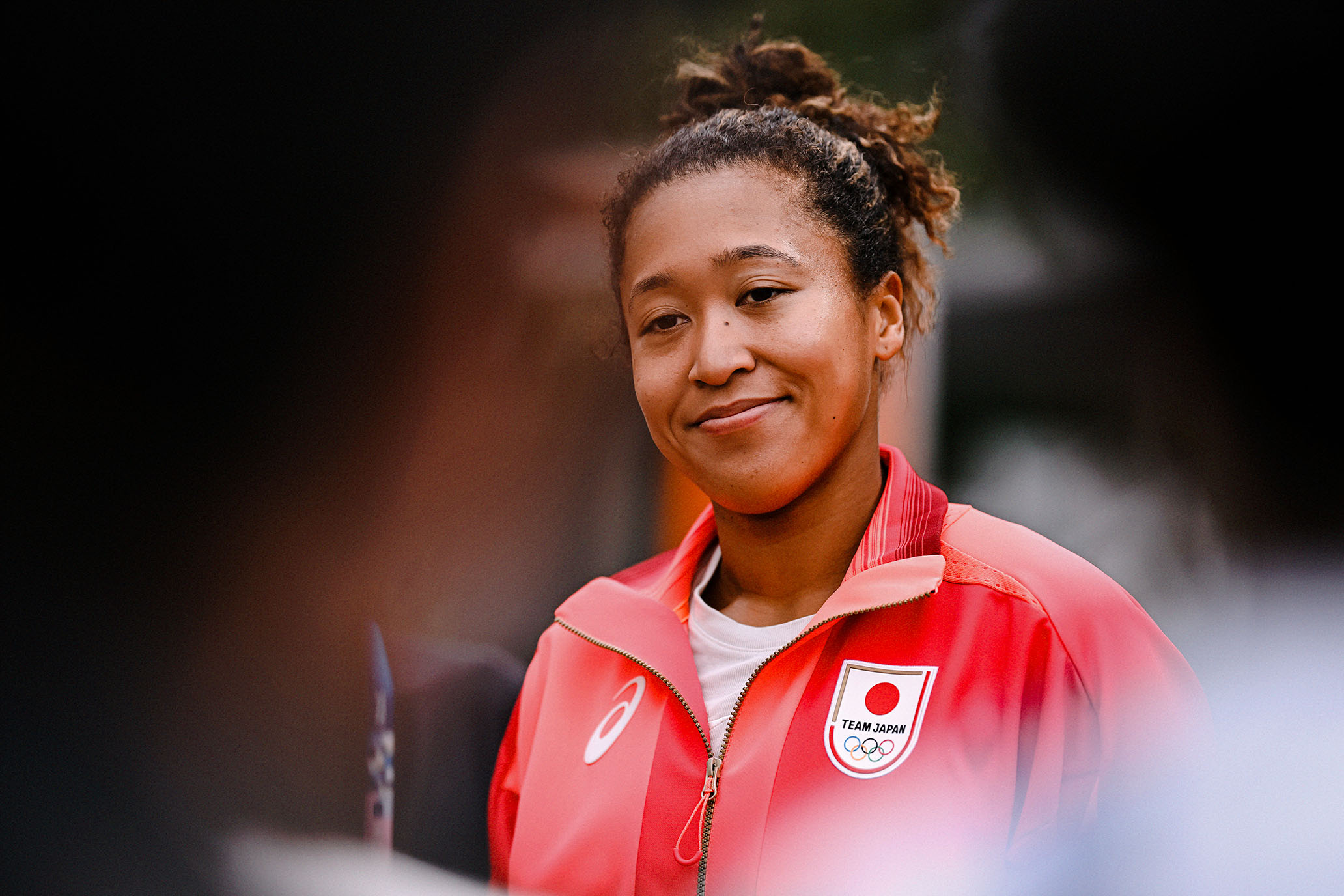
Naomi Osaka represented Japan at the Olympics. // Getty
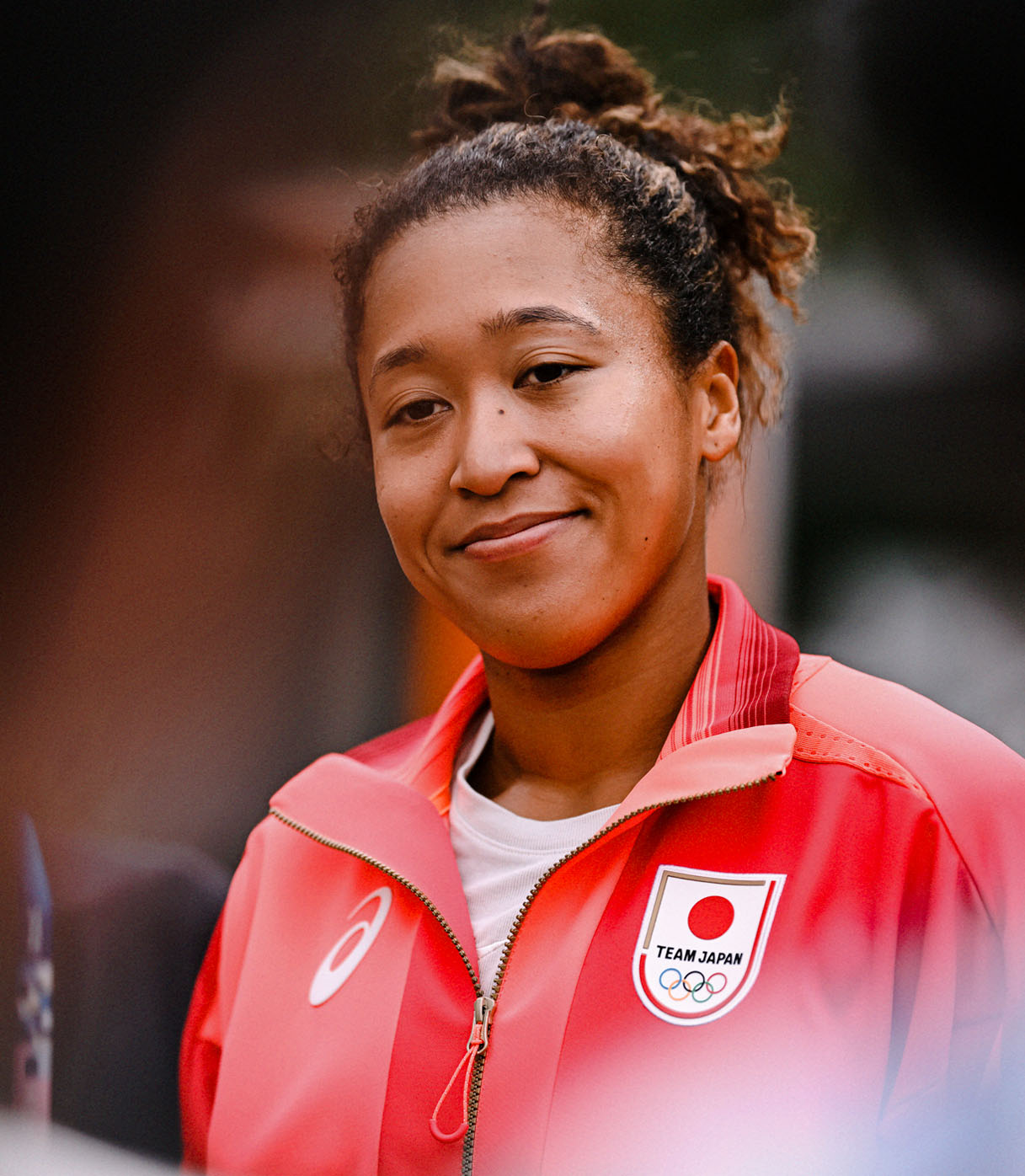
Naomi Osaka represented Japan at the Olympics. // Getty
As they sat next to each other on a bench in Paris Monday night, a guy from Mississippi offered a guy from Louisiana some distinctly Southern medical advice for how he might patch up the cuts on his ragged right hand.
“I’m not putting no damn duct tape on it,” the guy from Louisiana replied.
A few minutes later, “The Star-Spangled Banner” played and both men stood with their right hands over their hearts. Sam Kendricks, the guy from Mississippi who had competed for Ole Miss, had his hand covering the S and A of the “USA” written across his shirt; Armand “Mondo” Duplantis, the guy from Louisiana who had been a star for LSU, had his hand covering the E and N at the end of “SWEDEN.”
The story of the world’s best pole-vaulter will ring familiar for American tennis fans: An enormous homegrown talent opted to represent greener shores overseas.
Duplantis, born and raised in Lafayette, Louisiana, where he grew up with a pole-vault pit in his backyard, has improbably become the biggest Scandinavian star of the 2024 Olympics, and arguably the biggest representing all of Europe.
_________
As it was for immigrants of various vocations, the United States was a popular destination for overseas tennis champions throughout the 20th century, with many of the best switching to representing America during their careers. In the amateur era, the champion Molla Bjurstedt Mallory switched from representing her native Norway to representing the United States midway through winning her eight US Open titles, spanning 1915 to 1926, after marrying American stockbroker Franklin Mallory.
More dramatically, an 18-year-old Martina Navratilova had defected to the United States early in her career after a loss in the semifinals of the 1975 US Open, requesting political asylum so she could escape the Communist regime in her native Czechoslovakia, which was exerting strict control on her tennis travel. Navratilova won all 18 of her major singles titles as an American. Other high profile transfers to the United States came later in careers: Both Czechoslovakia’s Ivan Lendl and Yugoslavia’s Monica Seles acquired U.S. citizenship and switched to representing the United States as their respective countries disbanded in the 1990s.
But after the Cold War thawed out, the growing number of players who moved Stateside to chase their tennis dreams at Florida academies were no longer commensurately changing their allegiances along with their addresses. Most famously, Siberia-born Maria Sharapova moved to Florida at age 7 with her father, Yuri, and has lived in the United States ever since. She fit in with the locals right away, speaking English with no trace of a foreign accent and acquiring major American sponsorship deals. But though many Americans suggested Sharapova would fit right in, she remained representing Russia for her entire career. “I felt like Maria shoulda-coulda have played for the United States,” Mary Joe Fernández, the longtime U.S. Fed Cup captain, told me. “But, you know, we get some, we don’t get some.”
Sharapova rarely played for the Russian Fed Cup team, and played few tournaments in Russia, but her successes at the Grand Slam events meant she remained one of Mother Russia’s favorite daughters. At the 2012 Summer Olympics in London, Sharapova was chosen to carry the Russian flag in the opening ceremony. At the 2014 Winter Olympics in her former hometown of Sochi, Sharapova was picked to carry the torch into the stadium during the opening ceremony.
Sharapova said in a 2015 interview on CNBC that the idea of switching to represent the United States wasn’t something she or her family had ever seriously considered. “I would have if I wanted to,” Sharapova said, “but it’s never been, actually, a question in my family or in my team whether I wanted to change citizenships.” Sharapova, whose sponsor portfolio never relied on any major Russian deals, said she felt tied to Russia because of its “rich culture” as well as the childhood years she spent there that she still considered formative. “I know that for so many years I was shaped into the individual I was from those experiences,” she said. “And not necessarily simply the country, but the people, the mentality and the toughness and that never giving‐up attitude.”
Though she never wavered from her official Russian identity, her apparent Americanization was scrutinized and lamented back in Russia. In 2018, Sharapova posted a picture of her mother and herself standing with their arms around each other in front of an artwork at The Broad, a Los Angeles art museum: one of Jasper Johns’s paintings of the American flag. The image caused strong divided reactions from Sharapova’s Russian followers, who debated in the comments if the image was unpatriotic or disloyal. “Masha is no longer ours,” one Russian commenter rued. “She will never return.”
After Sharapova, the USTA’s reputation for laissez faire came into sharp relief in 2013, when for the first time in the 40year history of the ATP rankings there were zero American men ranked inside the top 20. There were, however, several players inside the top 20 who lived in the United States, including the dual citizen German-American Tommy Haas and U.S. permanent resident Kevin Anderson, who represented South Africa.
Haas, who had lived in the United States since he was 13, said he wouldn’t mind being counted as an American to help shore up the ranks, “In many ways I feel like I am, so maybe you guys should too,” he said.
But Patrick McEnroe, then the general manager of player development for the U.S. Tennis Association, told me that persuading foreign-born players to join forces with his federation was not something he would do in his role. “I would love for Tommy Haas to be an American, but that’s his call,” McEnroe said. “I know that he thought about that a couple of years ago. But at least from my perspective with the USTA, I can tell you that we don’t pursue any players that have that dual citizenship. I would never go to Tommy Haas and say, ‘Hey, I really want you to play for the U.S.’ In my role with the USTA, I wouldn’t do that.”
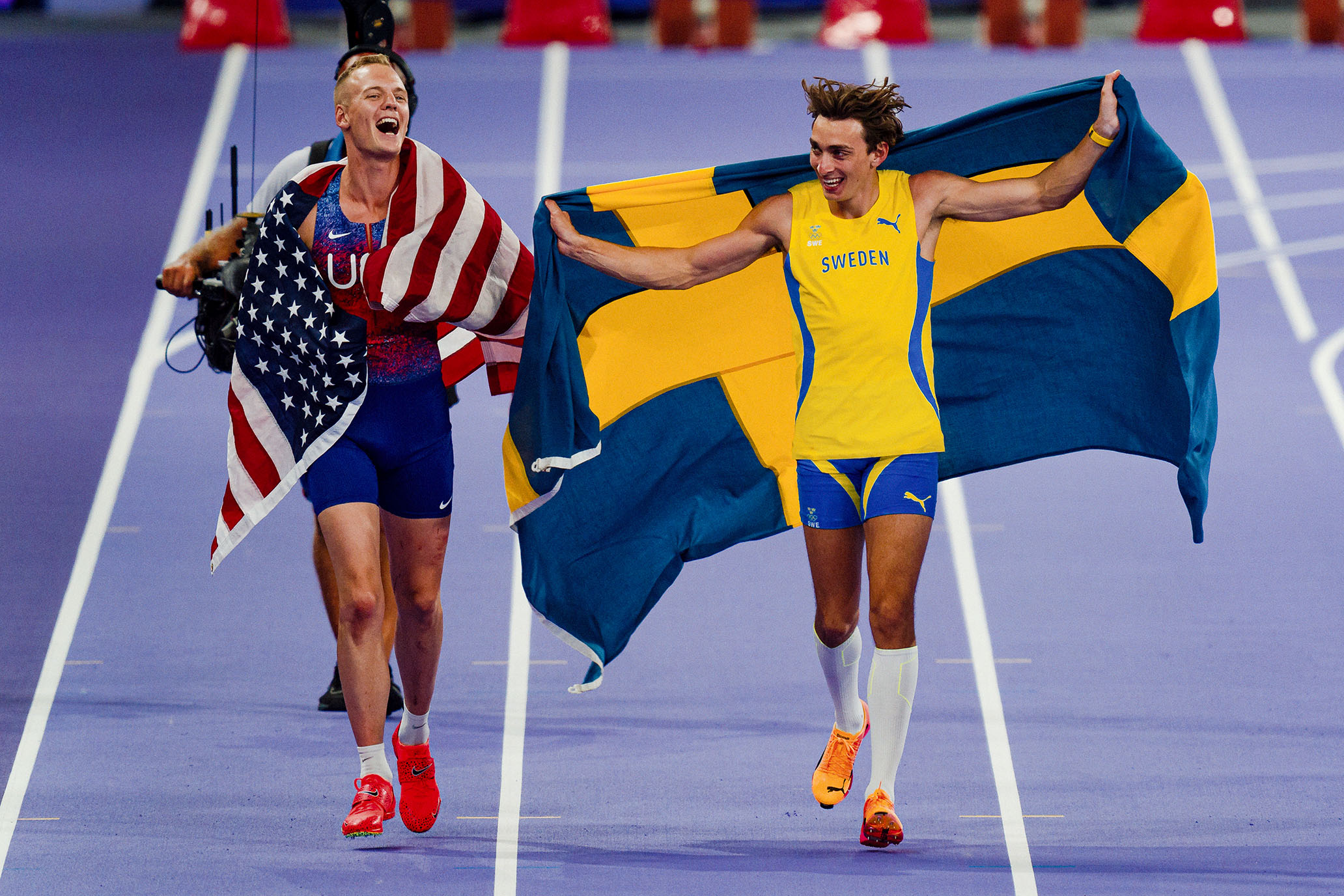
Sam Kendricks and Armand Duplantis are from Mississippi and Louisiana respectively. // Getty
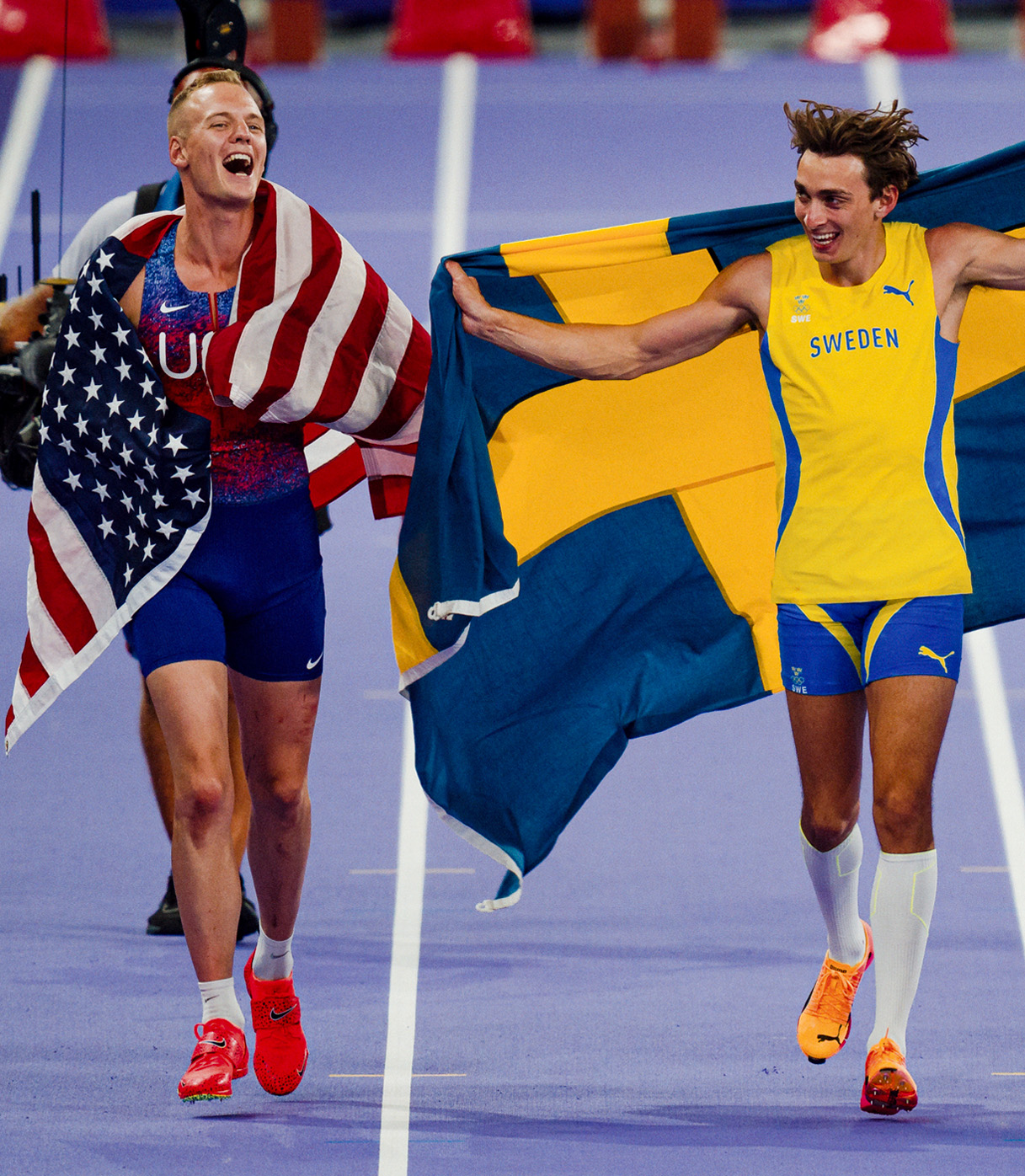
Sam Kendricks and Armand Duplantis are from Mississippi and Louisiana respectively. // Getty
As the trend continued, it wasn’t just that foreign players weren’t choosing to switch to America anymore in the 21st century; many Americans were choosing to replant themselves on other soil, betting they could blossom more fully in less crowded crops.
Monica Puig would not have qualified for the 2016 Rio de Janeiro Olympics had she chosen to continue representing her longtime home of the United States, as she had at the start of her junior career; Puig, a Floridian for years, was ranked 49th when the cutoff was made for the 2016 Olympics, well below the quartet of top Americans who were taking the country’s four allotted spots. But because Puig had chosen early in her career to represent her birthplace of Puerto Rico, the U.S. island territory that has had its own separate Olympic committee since 1948, she was able to secure a spot in the exclusive draw under the Puerto Rican flag. Puig made the most of the opportunity: Playing the best tennis of her life, she stunned the field to win Puerto Rico’s first gold medal in any event in Olympic history. (Puerto Rican Gigi Fernández had won two Olympic gold medals in women’s doubles in the 1990s, but representing the United States.) The United States won 46 gold medals in Rio de Janeiro; an additional 47th won by Puig for the Stars and Stripes might’ve gained little notice. But playing for Puerto Rico, Puig was immortalized on the island as a sporting hero.
Even Americans born in the United States have been increasingly lured away in recent years. Ernesto Escobedo, a native Los Angeleno with a booming forehand, reached a peak ranking of 67th in 2017, then the ninth-best among American men. By January 2023, Escobedo’s ranking had slipped to 310th, behind 27 other American men. But on his way to battling through the Australian Open qualifying draw, Escobedo suddenly became his nation’s top player—because midway through the tournament his flag had officially switched to Mexico, a country with no other men ranked inside the ATP top 500 in singles.
“It’s always been in me that I wanted to play for Mexico, you know? Like, always, my whole life,” Escobedo said in a January 2023 interview with Mike Cation on the Behind the Racquet podcast. “Even if I was born in the States, in L.A., I was raised as a Mexican. I was raised with a culture, a Mexican culture, with my family, and I’ve always enjoyed going back to my [family’s] hometown in Zacatecas.” In many ways it was an obvious choice. Escobedo had told The New York Times he had been embarrassed to have the American flag beside his name after the racist, anti-Mexican rhetoric of Donald Trump had been a cornerstone of his winning presidential campaign.
________
The trend of Americans opting to play for ancestral homelands has been most pronounced among Asian-Americans, with U.S.-born players like Jason Jung (Taiwan), Ena Shibahara (Japan), and Treat Huey (Philippines) all becoming some of their country’s biggest stars this century.
The most prominent case of an Asian-American tennis star opting to play for another country, of course, is Naomi Osaka, who was born in Japan but moved to the U.S. as a toddler when she was 3.
No one would have doubted the Americanness of the Osaka sisters: They were natural-born as American citizens through their father Leonard Francois’ American citizenship and had lived in the United States since their early childhoods. But once Mari and Naomi started entering professional events, for which players were required to list a single nationality on tournament entry forms, they consistently affiliated themselves with Japan. When Naomi had made her professional debut in Jamaica just before her 14th birthday, as a dual citizen who had lived for more than a decade in the United States, it was “Naomi Osaka (JPN)” listed on the draw sheet. That pivotal decision, which was reconsidered and pondered but ultimately never changed, had profound effects on Naomi’s career.
“We were talking about that a lot,” Daniel Balog, Naomi’s first agent, told me of the dilemma of which country Naomi should represent. “We were thinking: In case it really takes off, which market is better? And we were thinking of the United States, I’ll tell you. There was definitely a lot of talk about it.”
The commercial success of Kei Nishikori, Balog told me, was a major consideration. “You saw that he was an absolute superstar in Japan,” said Balog. “Obviously the Japanese market is massive if you are very good, and they’re willing to really get behind you…. And it was less competitive on the Japanese side because she was the lone star. With the United States, there’s so many good players, right? You’d compete against Serena, Madison Keys—so many. So I think it was a good move; I think it was great.”
Katrina Adams, who served as president and chairman of the USTA for two terms from 2015 to 2019, similarly to McEnroe, told me the USTA gave players space to make their own choices. “That’s the thing about America: You can be who you want to be,” Adams told me. “I can name 20 players that grew up and trained in America while becoming top 5 in the world representing other nations. But you are who you are. And so, yeah, [Naomi] lived in New York as a kid, but she’s Japanese. And that’s who she represents, and that’s her choice.”
Harold Solomon, an American who coached Osaka in Florida before her choice was cemented, had lobbied the USTA to recruit her but told me the overtures the USTA made to Naomi and her family were ultimately too little too late. “I think if the United States possibly had stepped up at the time and said, ‘Look, we’re willing to make this investment, we’re willing to do this or send a coach with her and help pay for her expenses,’ I mean, there’s as good a chance as not that they would have done the U.S. thing,” he said.
Years after Naomi Osaka and her parents made their choice, she won two US Opens and two Australian Opens under her belt, and questions about how America missed out on this generational champion swirled. Osaka has gone on to win more major singles titles than any other player born in the 1990s, and more than any other Asian. While she has remained based in the United States, only occasionally visiting Japan, she has been embraced by the country. In Tokyo in 2021, Osaka was picked to be the first tennis player to light the cauldron at an Olympic opening ceremony.
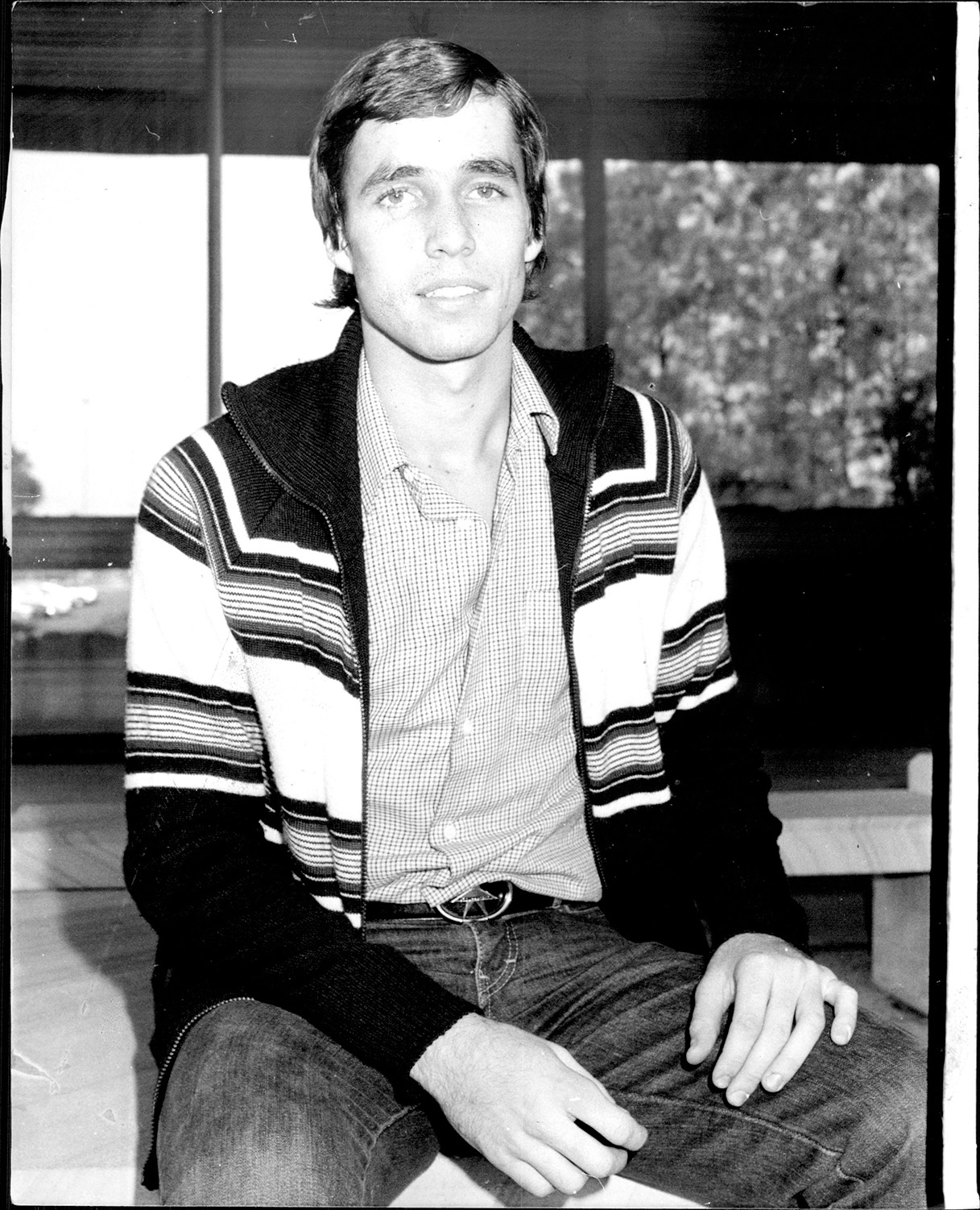
Ivan Lendl in 1980, when he still represented Czechoslovakia. // Getty
Ivan Lendl in 1980, when he still represented Czechoslovakia. // Getty
Osaka lost in the first round of these current Olympics, ceding the spotlight to stars like Duplantis to have their own biographies more widely learned. Duplantis’ mother, Helena, was born in Sweden, and Duplantis decided to represent the country in his early international career, despite having never lived in the country and not speaking the language. But after he switched, and after his breakout success made him one of Sweden’s most famous sportsmen, he studied Swedish intensively. When Duplantis won the 2020 Jerringpriset, the annual award given to Sweden’s top sportsman, the country was further won over by Duplantis giving his acceptance speech in Swedish. “When the Swedish people have finally given him their immense love, he gives it back to them and speaks the people’s language—BEAUTIFULLY!” said Swedish radio journalist Bengt Skött.
The reaction back in Duplantis’ home state of Louisiana has been considerably more mixed, making the obscure sport of pole vault into a local flashpoint for callers to debate on local sports talk radio. Scott Prather, a host on ESPN Lafayette Radio, told me that he pulls for Duplantis as a hometown hero but frequently hears from natives who don’t. “I don’t know that there’s anyone that actively roots for him to fail, per se,” Prather told me. “But I’ve heard some—even some that work in sports—that say, ‘Look, if he’s going up against an American in the Olympics, I’ll root for the American.’ And my response is, ‘But he also is, like, from right here, your hometown, you know?’ I’ll debate with them: ‘So he could go up against somebody that you know nothing about, in a sport you don’t watch, who is from the Midwest or the West Coast, and you’re rooting for the other one?’ And they’re like, ‘As long as it says “USA” on the chest!’”
“I don’t argue with them,” Prather added. “To each their own, but it’s a weird juxtaposition: There’s a part of you that you feel like you’re rooting local in terms of your roots in your country, but you’re not really rooting local in terms of what has been brought up in your backyard. I guess they view it as patriotism? I don’t have a problem with that. I don’t try to really change anyone’s mind, I just try to give them all the information.
“I don’t know how it is in Sweden for him. I hear it’s a little different,” Prather said. “But to be the best ever at something, and in your hometown not have the full support?”
Any bitterness over Duplantis’ defection among American sports fans should probably come off as greedy: Even without Duplantis, the United States has won 21 gold medals through Monday at the Paris Olympics, the most of any nation, with many more likely to pour in; Sweden has won only three.
________
But few of the American golds came with anything like Duplantis’ sparkle. A few minutes after he declined the duct tape suggestion on Monday night in Paris, Duplantis easily broke the Olympic record in pole vault, and then broke a world record of his own for the eighth time, clearing an unprecedented height of 6.25 meters—that’s 20 feet and six inches in Louisiana.
Kendricks, the guy from Mississippi, had topped out at 5.95 meters—nearly a foot less in Mississippi. Having claimed the silver for the United States, Kendricks spent the last half hour of the competition leading the cheers for Duplantis. A Greek guy from Athens—Greece, not Georgia—rounded out the podium with bronze.
Amid the excitement and celebration at Duplantis’ gravity-defying feats, there was bafflement on both sides of the Atlantic. Many European fans couldn’t understand why a Swedish superstar had been so reverent to the American anthem, which was playing as 100-meter-dash gold medalist Noah Lyles stood atop the podium on the other side of the Stade de France. Many Americans couldn’t understand why a guy from Louisiana was decked out in Swedish blue and yellow, setting records for another country.
Thousands of Swedes flocked to Paris to watch Duplantis, dotting the stands of the Stade de France with yellow. Many wrote messages for him across their Swedish flags: “Kung Mondo” (King Mondo) read one horizontal stripe; others used the yellow cross to make mini crosswords of “Mondo/Flying Swede” or “Gold/Mondo.”
Once Duplantis had come back down to earth with another world record on Monday night, he ran a victory lap with the enormous Swedish flag his father had handed him floating behind his shoulders. The DJ inside the Stade de France played a track they might have labeled as the Swedish national anthem: “Dancing Queen” by ABBA.
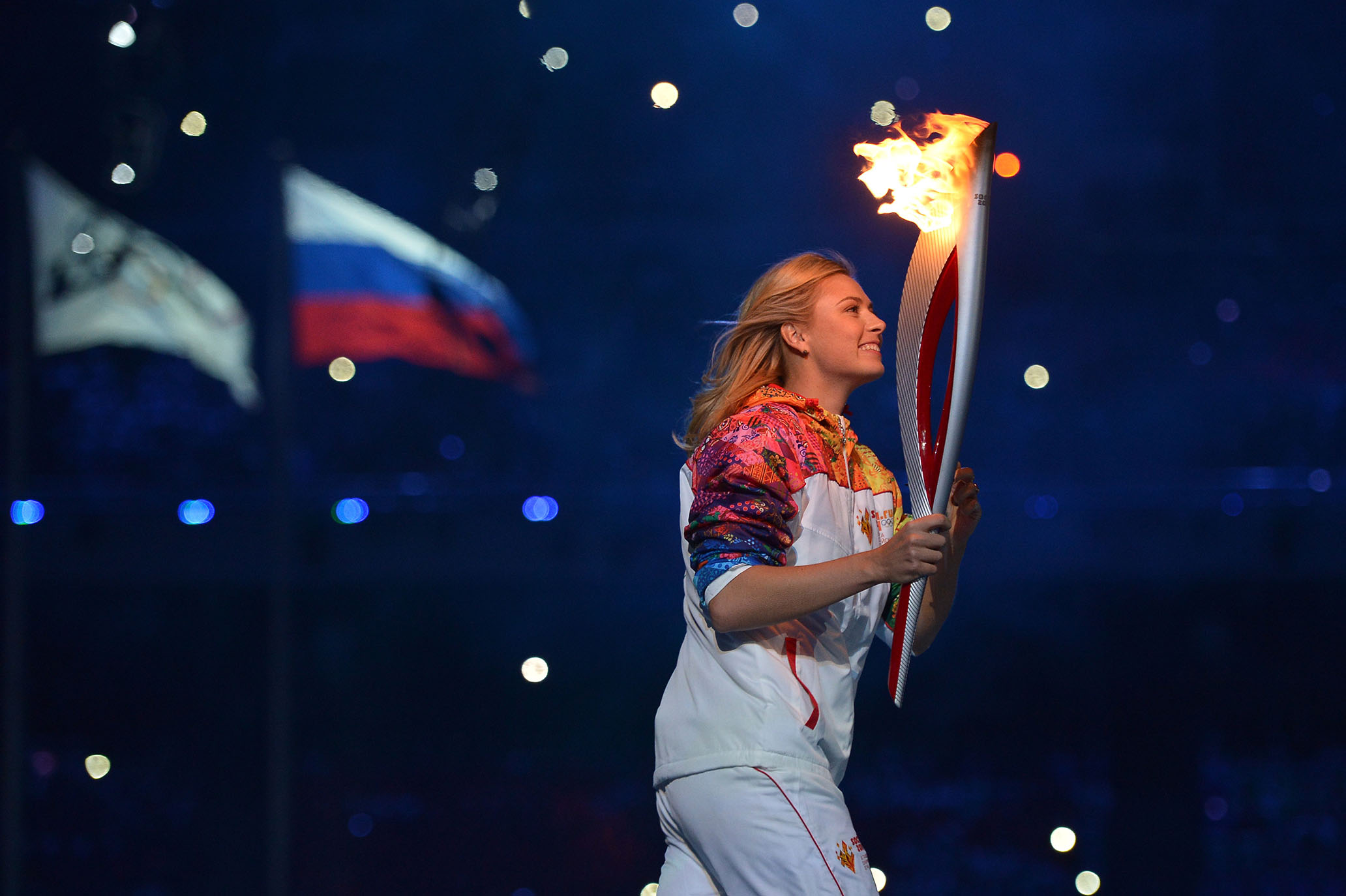
Maria Sharapova was the torch-bearer at the 2014 Winter Olympics in Sochi, her hometown. // Getty
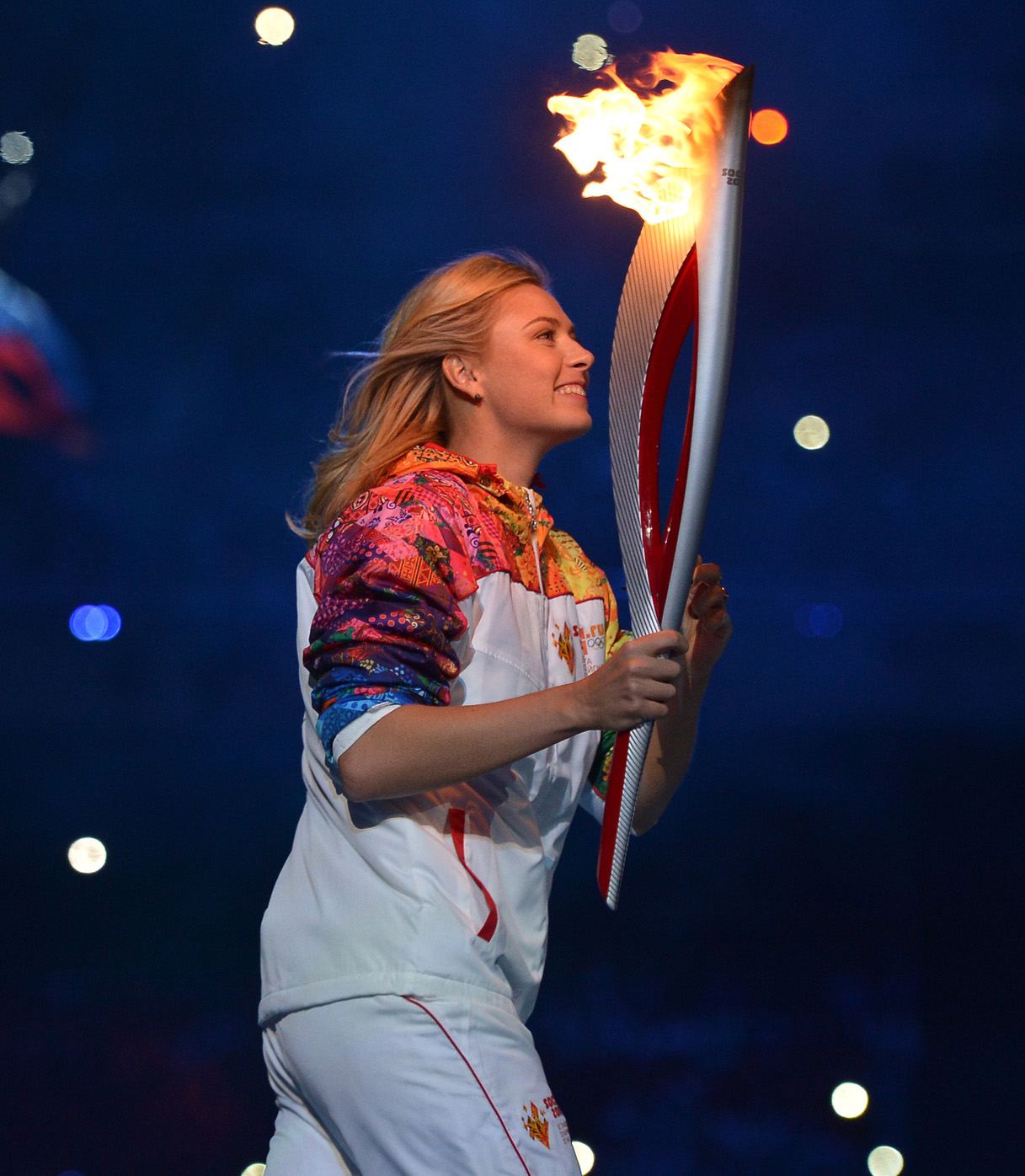
Maria Sharapova was the torch-bearer at the 2014 Winter Olympics in Sochi, her hometown. // Getty
Editor’s note: This piece was adapted from Naomi Osaka: Her Journey to Finding Her Voice and Her Power, by Ben Rothenberg

SIGN UP — YOU'RE ONLY AS GOOD AS YOUR SECOND SERVE.
The Beef Bracket
The Beef Bracket
The Beef Bracket
Testy exchanges at the Paris Olympics.
Testy exchanges at the Paris Olympics.
By Giri Nathan
August 2, 2024
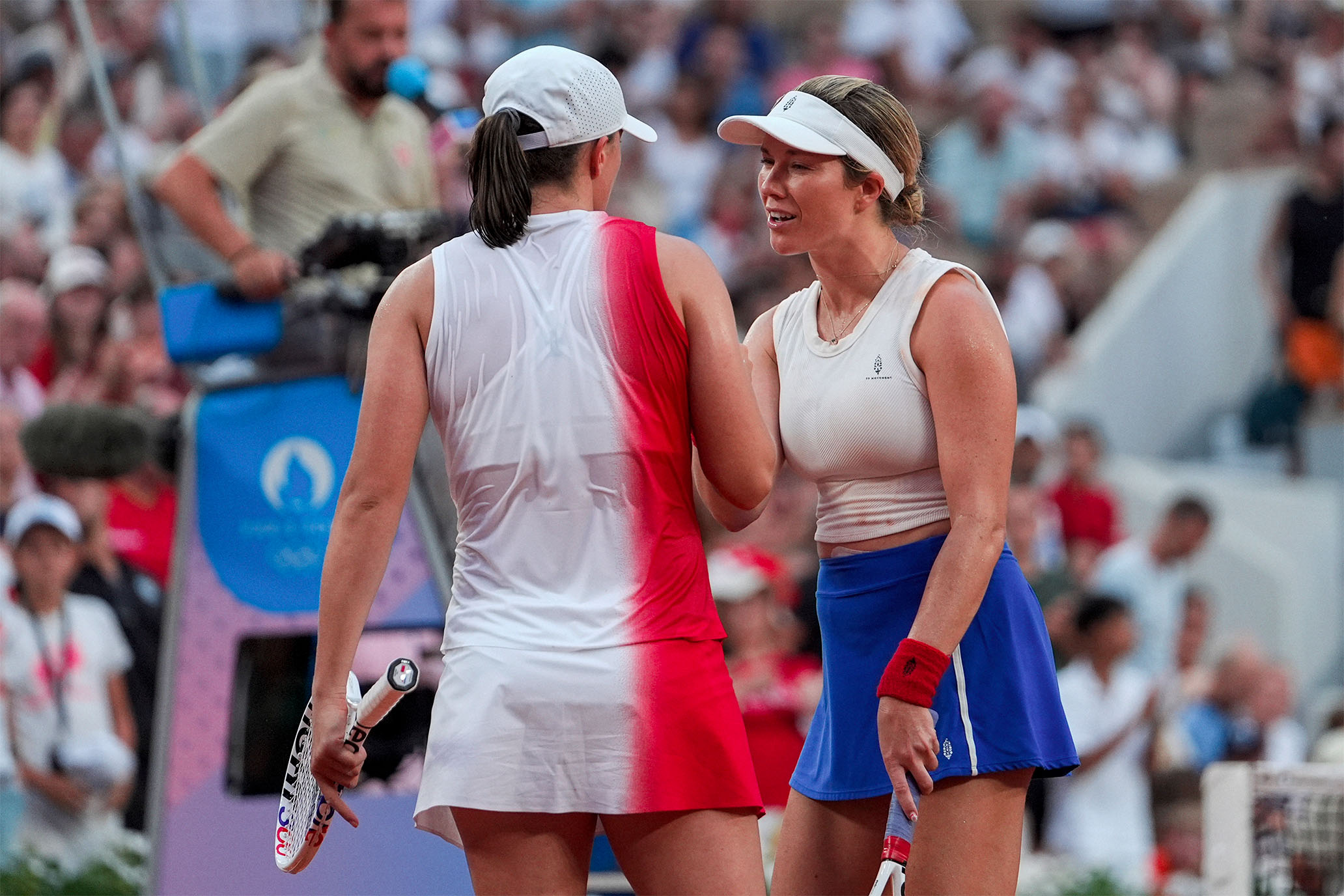
Iga Swiatek gets a lecture from Danielle Collins at the Olympics. // AP
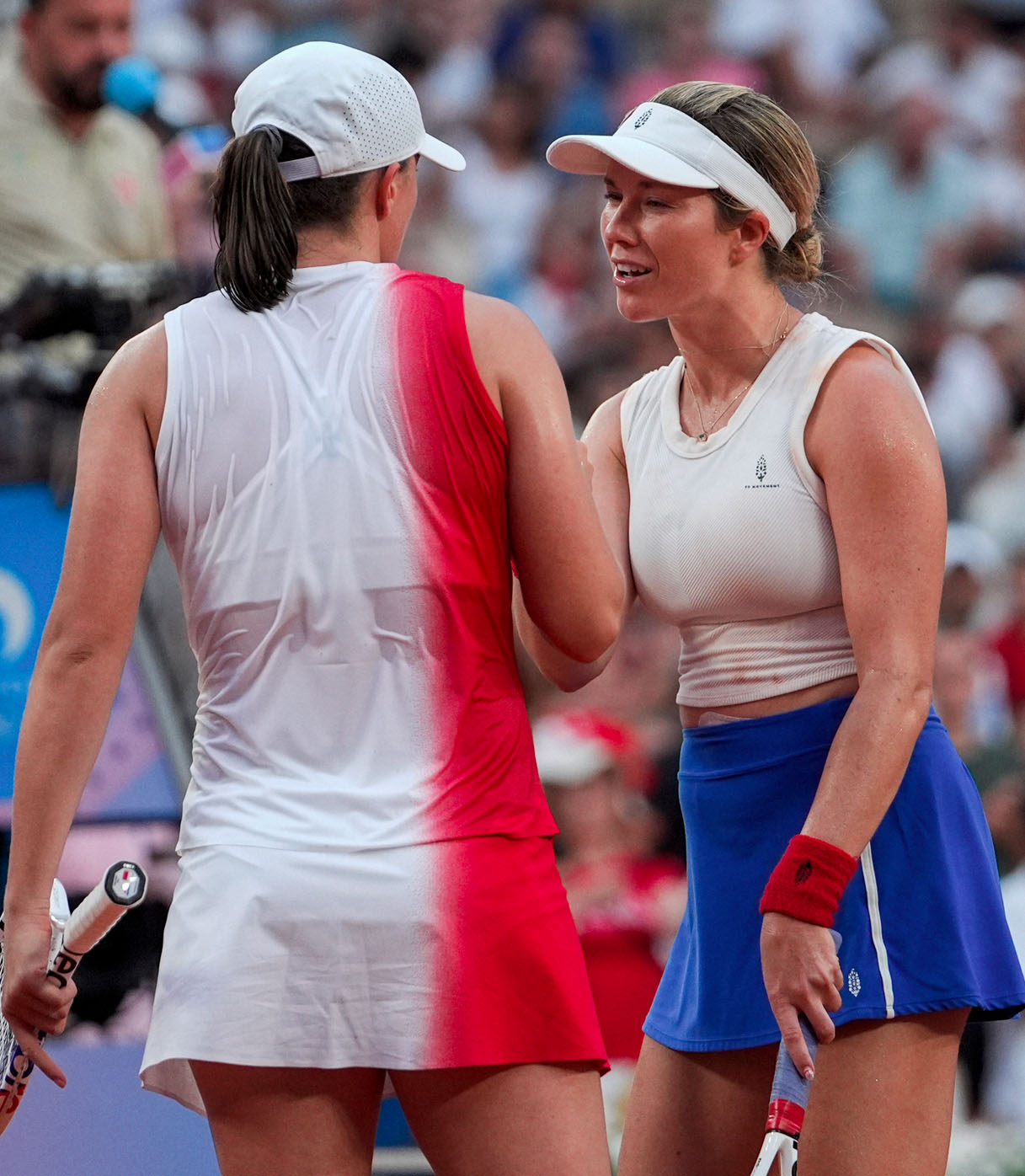
Iga Swiatek gets a lecture from Danielle Collins at the Olympics. // AP
As far as tennis is concerned, this Olympics has been a beef Olympics. So much beef on the singles court, most of it inscrutable, all of it involving the U.S. contingent in some way.
The only one that I fully understood: Coco Gauff’s beef with the umpire in her quarterfinal versus Donna Vekic. Gauff pleaded for a hindrance call after a corrected line call, didn’t get it, and the ensuing argument dragged on for nearly five minutes and brought her to tears. She lost the match two games later. It’s the third time this year we’ve seen this particular Gauff vs. umpire beef, following similar incidents at Roland-Garros in June and in Dubai in February. I don’t think this beef was warranted—the umpire appeared to make the correct call, which was quite difficult in real time—but I at least get the core of Gauff’s complaint, and I get why video review would smooth over these situations. It was a messy and draining scene. For a 20-year-old who spends almost the entirety of her time in the public eye so preternaturally composed, it’s a strange emerging pattern.
Forget the umpires, though—the player-to-player beef in the women’s draw has been far more compelling, if far less parseable. This is the stuff of pure WTA Mad Libs: “audacious smack talk between Qinwen Zheng and Emma Navarro at the Paris Olympics.” To my untrained eye, nothing particularly scandalous occurred during the actual third-round match between these two. All that can be said is that it was competitive. Zheng went down match point at 3–5 in the second set before winning 6–7(7), 7–6(4), 6–1. Afterward, Zheng celebrated in unremarkable fashion and approached the net for a handshake. Navarro met her with a smile (only later revealed itself as sarcastic), held on to Zheng’s hand, and began a long tirade, shaking her head. I’m sad the camera angle was so poor, because the online lip-readers would have reveled in this. Fortunately the players each summarized that conversation for the press. “I just told her I didn’t respect her as a competitor,” Navarro told AFP. “I think she goes about things in a pretty cutthroat way. It makes for a locker room that doesn’t have a lot of camaraderie, so it’s tough to face an opponent like that, who I really don’t respect.” That’s about as vicious remark as I’ve heard on the tour in a decade, and it’s coming from two players I don’t remotely associate with the art of beef.
Zheng also offered her own account, per the AFP. “She told me she doesn’t know how I have a lot of fans,” she said. “It looks like she’s not happy with my behavior towards her. If she’s not happy about my behavior, she can come and tell me. I would like to correct it to become a better player and a better person.” Setting aside the rest of the absurdity, it is funny for Navarro to wonder how a top 10 tennis player belonging to the most populous ethnic group on earth could possibly have a lot of fans. I also laughed at this ice-cold line from Zheng: “I’m glad that she told me that. I will not consider it an attack because she lost the match.”
Every additional line I read about this exchange hurled me further into the depths of noncomprehension. How bad could Zheng’s contribution to locker room “camaraderie” possibly be? Shoving people into lockers and giving them noogies? And is Iga Swiatek her partner in crime? Because this wasn’t the only opaque reference to “locker room” conduct in this week’s beef. On paper, a quarterfinal pitting Iga Swiatek against Danielle Collins is a more sensible environment for beef. Swiatek has a history of gamesmanship—stalling the server, flailing her limbs wildly before the opponent plays a passing shot, the usual bathroom-break high jinks—that have slowly crept into the popular tennis discourse. Danielle Collins has a history of…being Danielle Collins. She yells a lot. Louder than anyone to have ever played pro tennis, probably? It’s a combustive pairing. They also have some history. Swiatek rose from her grave with a double break in the third set to deny Collins what would’ve been a huge win in the second round of this year’s Australian Open. Swiatek then destroyed her in their next matchup at Indian Wells.
Unlike Navarro–Zheng, this match had some outwardly contentious moments. Early in the first set, Collins beaned Swiatek in the stomach at close range, leaving her doubled over. At the end of the second set, Swiatek took a leisurely nine-minute bathroom break, saying after the match that she’d asked an official about the time limit and was told there wasn’t one. Early in the third set, Collins was bouncing the ball, ready to serve, when Swiatek held her racquet up as if to wait for some fans to stop moving around. “There’s, like, no one behind me,” Collins said, audible on the court mics. “Play at the server’s pace.” That particular delay method is a Swiatek staple, and certain oppositional fan bases out there were thrilled to see a player acknowledge it aloud. Collins retired at 2–6, 6–1, 1–4, citing an abdomen injury, and the ensuing handshake was a disaster. Collins said something that left Swiatek visibly agitated and confused. She sort of elaborated in the press, though I’m going to need a native speaker of Collinsese to explain to me what any of this means:
“I told Iga she didn’t have to be insincere about my injury. There’s a lot that happens on camera, and there are a lot of people with a ton of charisma and come out and are one way on camera and another way in the locker room. And I just haven’t had the best experience, and I don’t really feel like anybody needs to be insincere. They can be the way that they are. I can accept that, and I don’t need the fakeness.” I need the realness too! You guys have got to be way less elliptical if you’re going to get this spicy. Swiatek, for her part, said she had no idea what she was talking about either.
As fate would have it, this was the beef half of the bracket, and the two beefed-with players would meet in the semifinal with a guaranteed medal at stake. Zheng, who had just retired Angelique Kerber with a firecracker quarterfinal win, took on Swiatek on Thursday. History was not in Zheng’s favor, on multiple levels. Swiatek came into the match with a 25-match winning streak on these courts, extending back to the 2022 French Open. At that tournament, a teenage Zheng, yet to break out on tour, took one tiebreak set off of Swiatek before getting wiped out. In the years since, Zheng has since become an elite player and Australian Open finalist, but she still hadn’t figured out that essential puzzle: 0–6 against Swiatek. That changed on Thursday. Zheng ran away with the first set and leaped out of a double-break deficit in the second to claim her first win in the topspinniest matchup on the WTA. A devastated Swiatek wept and said she “blew it,” before presumably going back to terrorizing her peers with alleged insincerity.” She won the bronze medal match on Friday, but didn’t celebrate it. Congrats to Queen-wen, who is the first Chinese woman ever to make the Olympic singles final. Win or lose, she must kindly explain what the hell is going on in that locker room.
The Hopper
—Andy Murray has finally retired.
—And so has Angelique Kerber.
—Carlitos has withdrawn from Montreal.
—CLAY Tennis remembers the time Novak abandoned his partner.
—Rafa and Novak play one for the road, via Giri.
—The Washington, D.C. ATP tournament is in full swing.
—Some schedule changes to the WTA’s China Swing.
SIGN UP — YOU'RE ONLY AS GOOD AS YOUR SECOND SERVE.
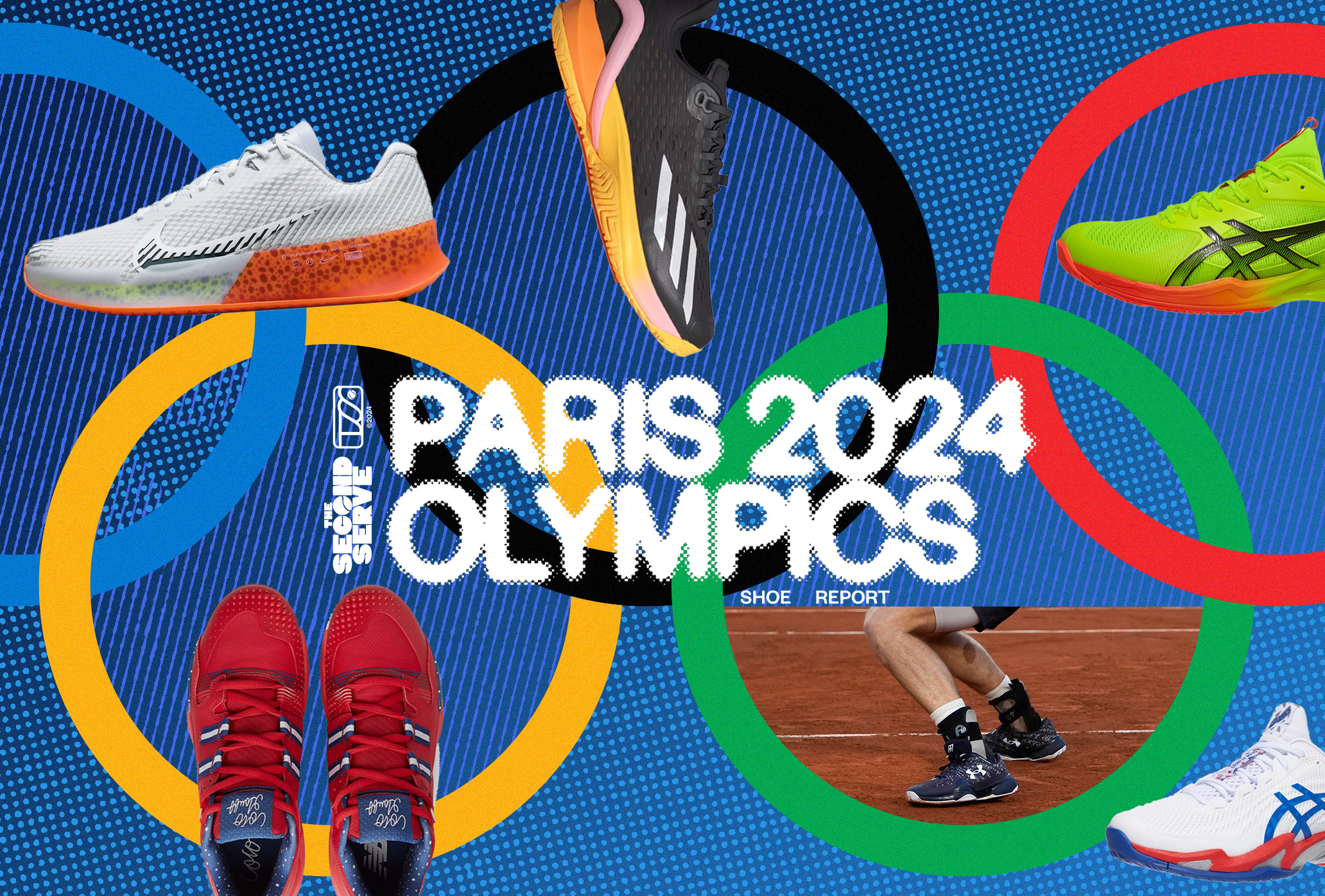
The Paris 2024 Olympics Shoe Report
The Paris 2024
Olympic Shoe Report
The Paris 2024
Olympic Shoe Report
Players embrace national pride—and colors—in Paris.
Players embrace national pride—and colors—in Paris.
By Tim Newcomb
July 30, 2024
Brands seem to have two different approaches to the Olympics. The biggest—think: Nike, Asics, and Adidas—take an all-encompassing approach, introducing Olympics-themed colorways that will span across all sports. That means most athletes wearing these brands don’t have colorways that match their country, but colorways that help market the brand. Other brands, such as New Balance, Yonex, and Wilson, take a more player-by-player approach that often gives athletes colorways to fit their country’s flag. Here’s a taste of the models treading on the red clay of Roland-Garros.
COCO GAUFF
New Balance Coco CG1 “Star-Studded”
New Balance announced this fully U.S.A.-themed colorway even before Wimbledon started, reminding us at the time that we had plenty to look forward to when we returned to Paris. The latest iteration of Coco Gauff’s signature shoe—and another model available to fans at retail—is drenched in red with white stars atop blue in various places both on the midsole and collar. Paired with her U.S.A. kit, largely in blue, Gauff’s footwear certainly pops with plenty of American flair.
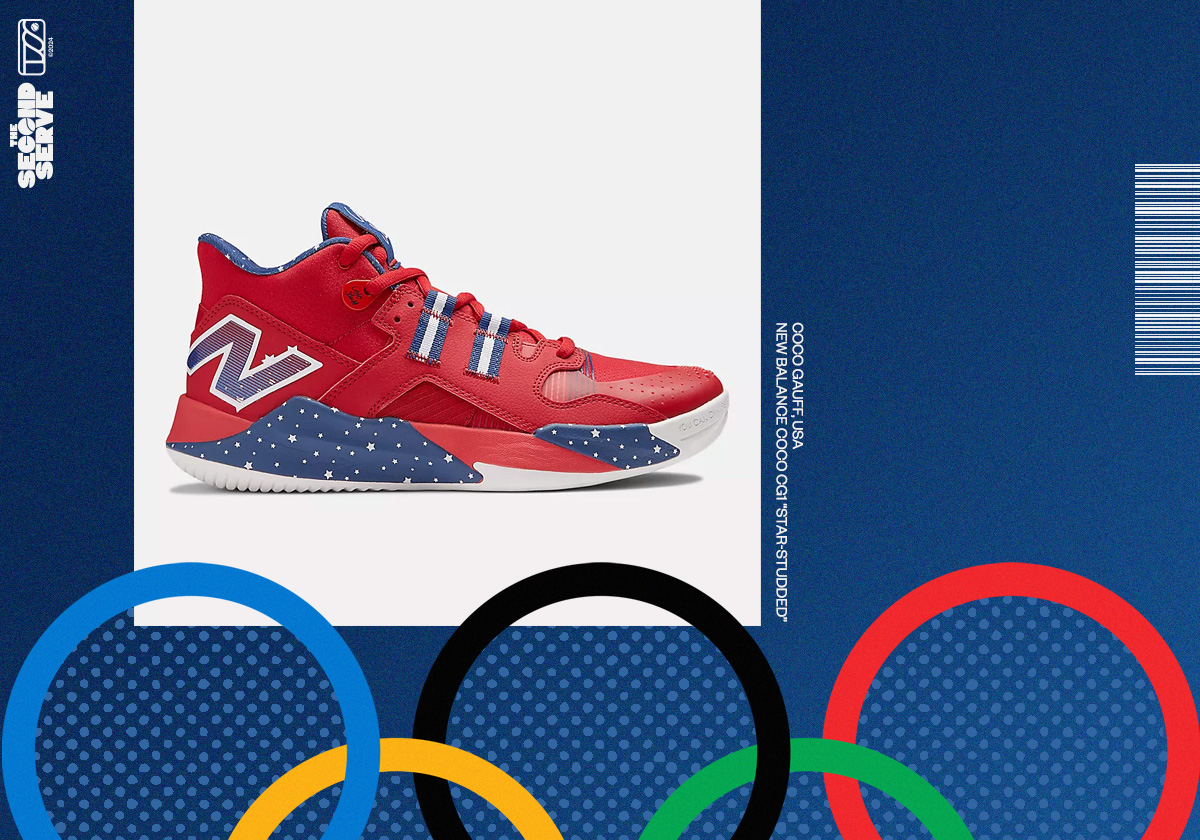
Images courtesy of New Balance
Images courtesy of New Balance
NOVAK DJOKOVIC
Asics Court FF3 Novak “Paris”
While most Asics athletes enjoy the brightness of neon yellow and orange as part of the brand’s Olympics colorway, Novak Djokovic has a decidedly more Serbian-themed design for his player-edition shoes, a style that is also available at retail. A white base, his Court FF3 design features accents of red, blue, and gray, sometimes in confetti style across the midsole and tongue. After having worn an all-red version during Roland-Garros, Djokovic’s white-based look gives him a fresh approach to the Paris clay.
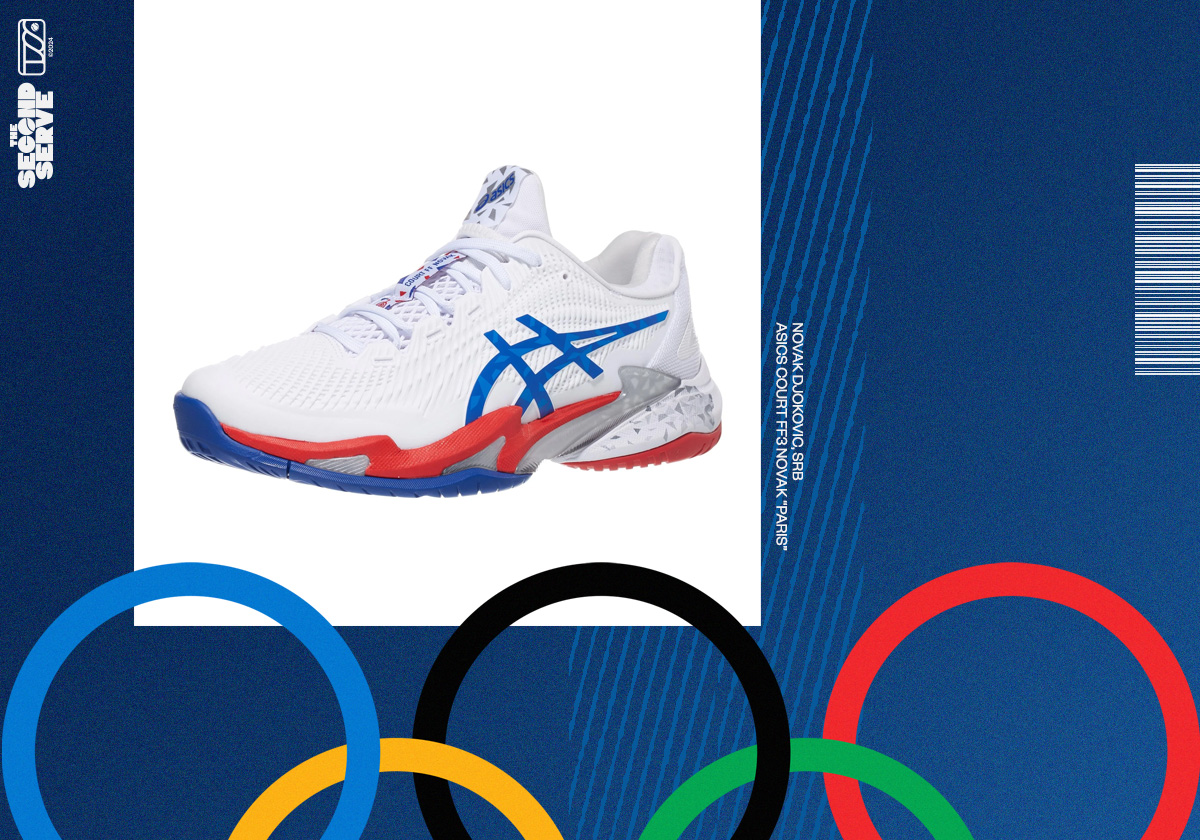
Image courtesy of Asics
Image courtesy of Asics
TOMMY PAUL
New Balance Fresh Foam X CT-Rally
New Balance has embraced the Stars and Stripes aplenty in Paris. From Gauff’s signature shoe to special-edition colorways of both the Fresh Foam X CT-Rally and FuelCell 996v5 available to fans, we have so much red, white, and blue to choose from, it is impressive. The 996 comes with one shoe blue and the other red, both with U.S.A. on the back, while the Fresh Foam style worn by Tommy Paul is white-based with one shoe featuring a red tongue and the other a blue tongue. Paul went full ’Merica with his training outfits and has really played up the look while in Paris.
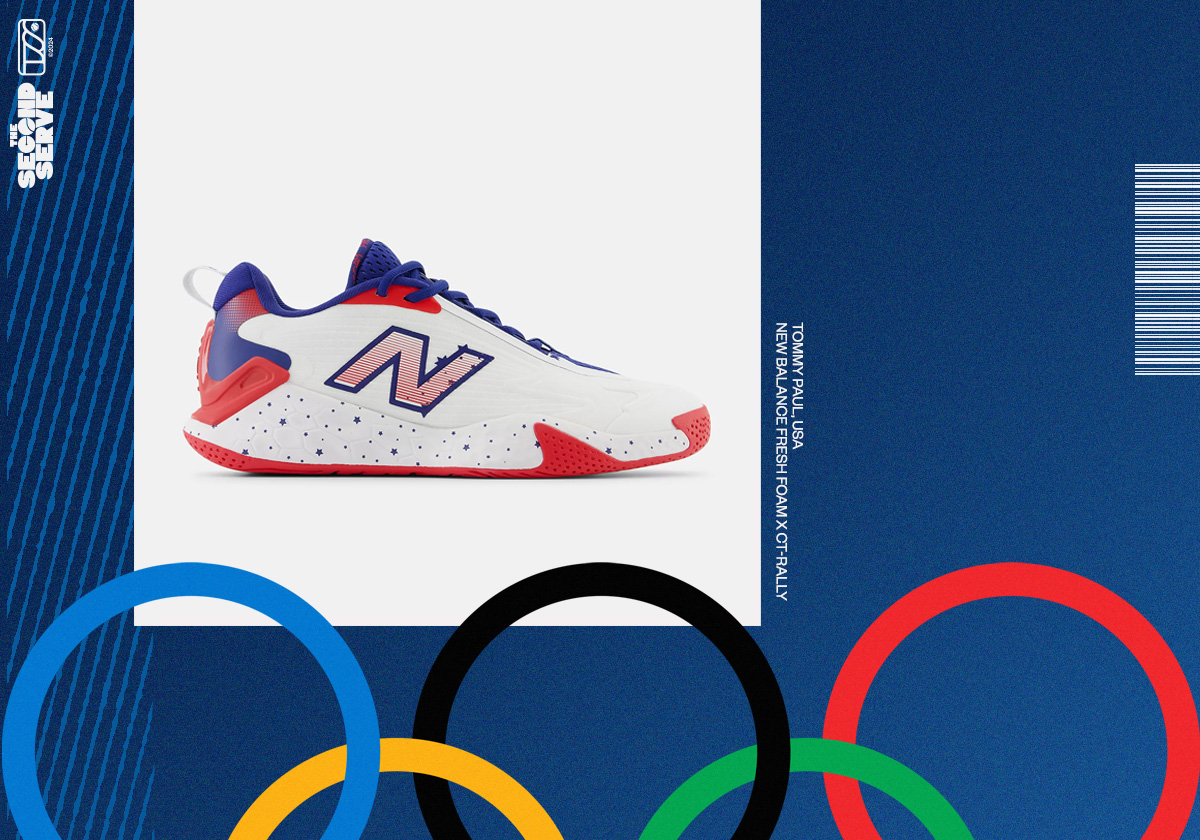
Image courtesy of New Balance
Image courtesy of New Balance
CARLOS ALCARAZ + RAFAEL NADAL
Nike Electric Pack
In what could be the final colorway Rafael Nadal wears on the Paris clay, Nike gave the King of Clay a player-edition version of the Electric Pack. While the brand made the Olympics-themed colorway available at retail in the Vapor 11 and GP Challenge 1, they didn’t do the same for the Cage. Don’t fret; Rafa got his shoes, with his signature logo still seen on the heel and tongue. In what is a fun argument for doing brand themes, Nadal and Alcaraz paired in doubles sporting matching footwear colorways.
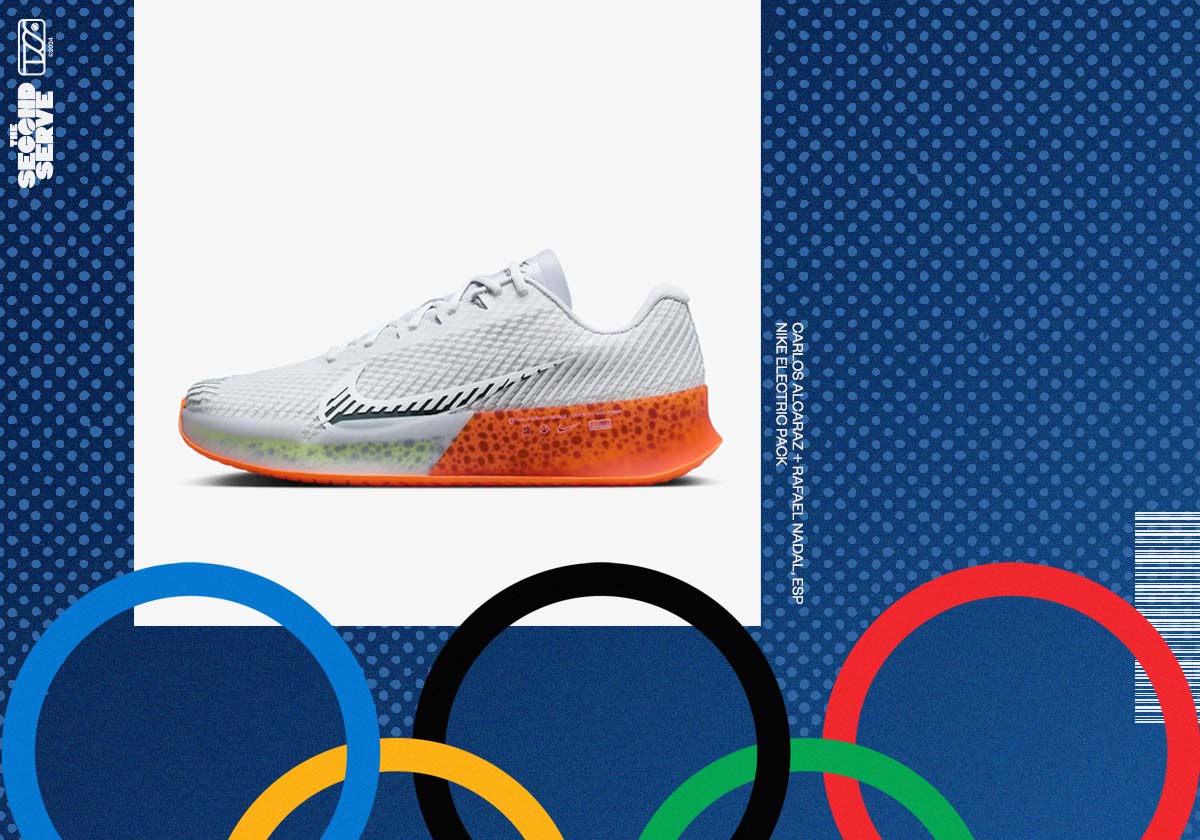
Image courtesy of Nike
Image courtesy of Nike
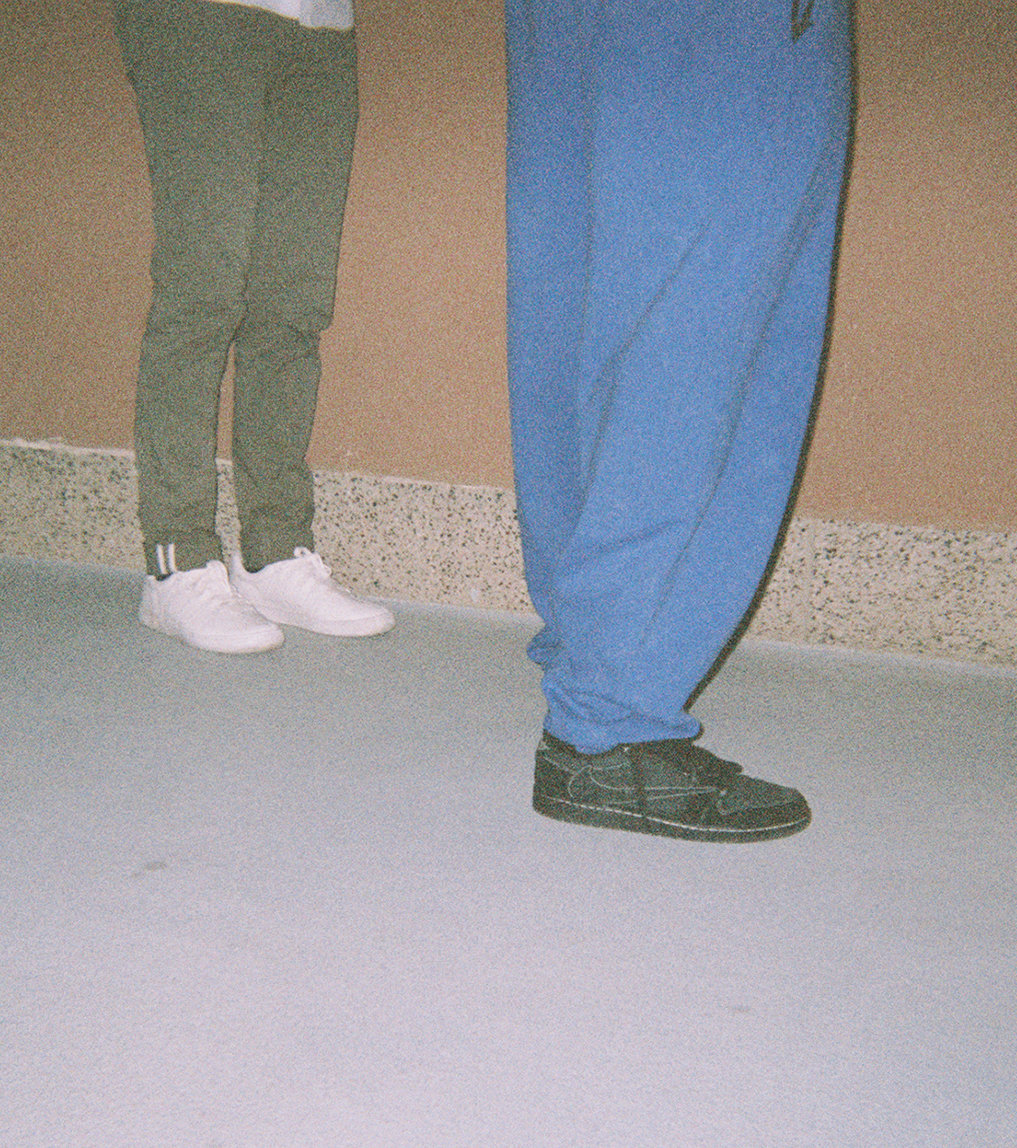

— Yonex really embraced country-specific colorways for this Olympics. The two best are the shoes for Casper Ruud, which is a mostly blue design with the Norwegian flag and “Ruud” on the heel, and the Stan Wawrinka personalization, which features the Swiss flag and his name on his heel.
— Nike’s Electric Pack, which appears across 55 footwear styles at the Paris Olympics, merges an ostrich print first seen on the brand’s Air Safari in 1987, designed by Tinker Hatfield, with a bright orange.
— Asics embraced a bright yellow and accents of orange for its “Paris” colorway. These are certainly the loudest of the shoes we’ll see in Paris.
— Adidas went with an Olympics-themed brand colorway, dubbed the Flame Collection, that is available for Adidas tennis athletes across the Barricade, Cybersonic, Ubersonic, and Avacourt.
— With Andy Murray retiring after the Olympics, this could be the final time we see Under Armour tennis shoes.
— Marta Kostyuk is quickly becoming one of the most fashionable tennis athletes on tour, and her Wilson kit offers up a blue Rush Pro 4.5 to match the blue dress the Ukrainian athlete is wearing.
— Oh, Leylah Fernandez, how you intrigue us. The Lululemon athlete doesn’t have a footwear deal and is sure making things interesting in that department. She wore Puma basketball shoes at the 2023 US Open, has switched between On and Asics in 2024, and is now showing off a completely new option in Paris in all red. Fernandez appears to be one of the first to ever wear Aesem Athletica, a brand that says it will have a limited-edition model available at retail “soon.”
Follow Tim Newcomb’s tennis gear coverage on Instagram at Felt Alley Tennis.
SIGN UP — YOU'RE ONLY AS GOOD AS YOUR SECOND SERVE.
Sinner's Strange Summer
Sinner's Strange Summer
Sinner's Strange Summer
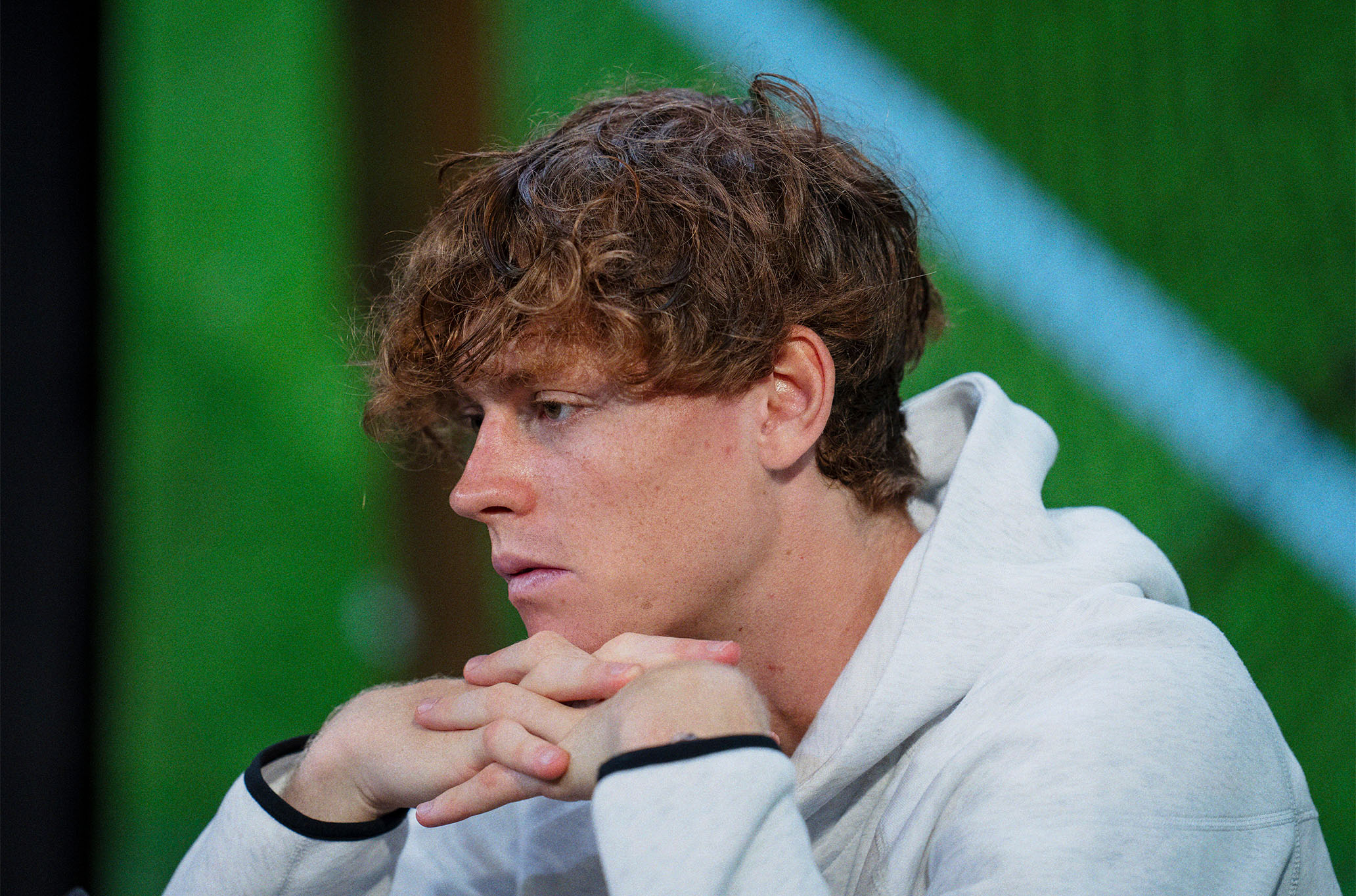
As injuries and illness mount, Jannik Sinner hasn’t lived long at the nexus of good form and good bodily fortune.
As injuries and illness mount, Jannik Sinner hasn’t lived long at the nexus of good form and good bodily fortune.
By Giri Nathan
July 26, 2024
Jannik Sinner’s reign at No. 1 has occasionally been a bummer. // AP
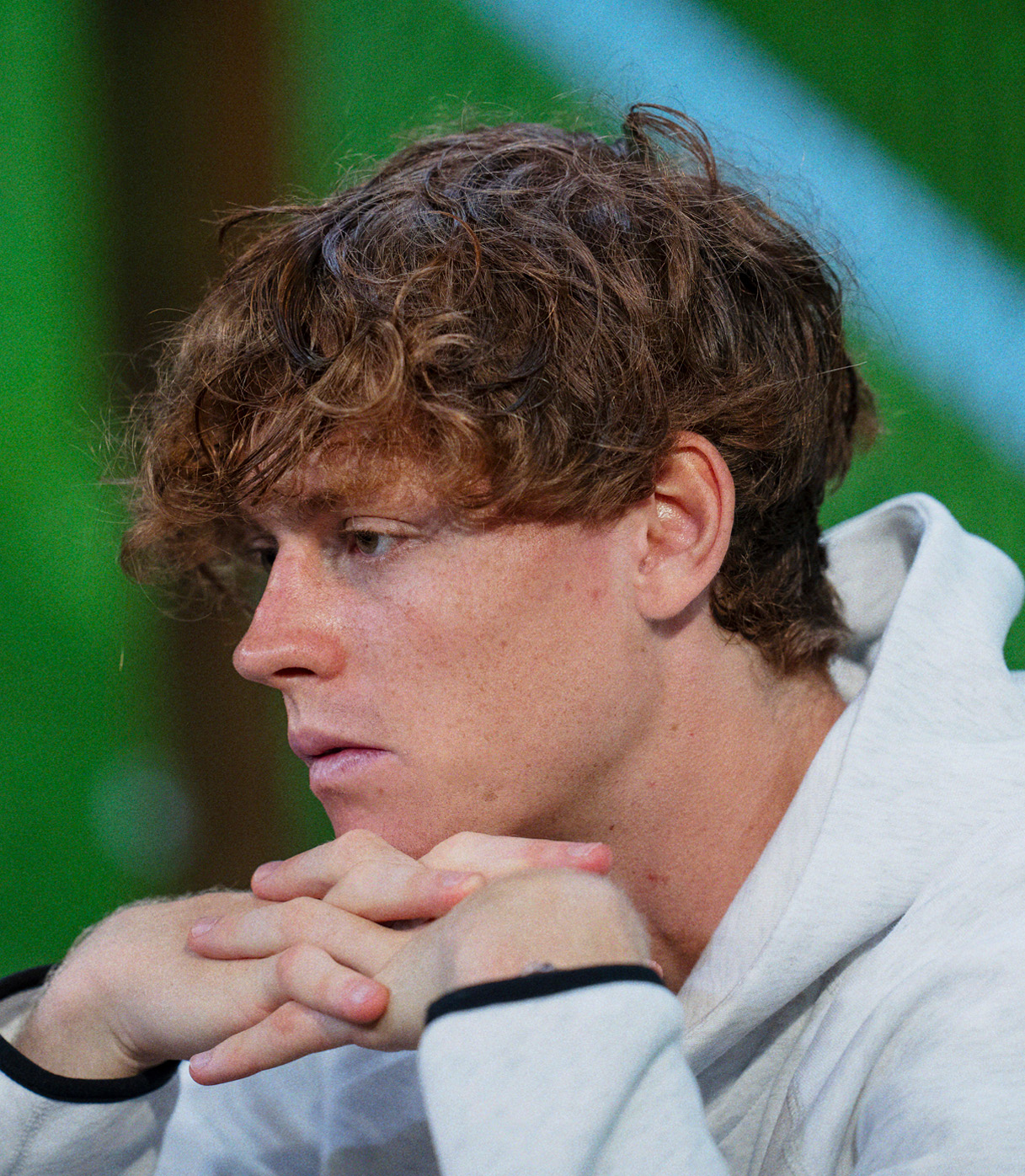
Jannik Sinner’s reign at No. 1 has occasionally been a bummer. // AP
Peer consensus moves faster than the actual ranking system. Jannik Sinner was the best player on the men’s tour, and everyone in the office figured it out before the computers did. Back in March, Tommy Paul borrowed a flavorful idiom from his Argentine fitness trainer and said that Sinner was “absolutely playing naked.” Gatekeeper of youth success Novak Djokovic issued his ruling in Monte-Carlo: “Best player in the world so far in 2024.” Chief rival Carlos Alcaraz said in Indian Wells that Sinner was “the best player in the world, without a doubt” (and went on to beat him). By June, Sinner had amassed the ranking points to claim the No. 1 slot for the first time in his career, at the age of 22, courtesy of an absolutely murderous run over the previous nine months, and yet he also somehow…has had an underwhelming summer? How can one underwhelm when you’ve just become the 29th man in history to claim the top ranking? Sinner’s 42–4 start to the season would be the envy of any player to pick up a racquet. He won the Australian Open, Miami, Rotterdam, and Halle. He has made deep runs at all majors and beaten every other top player. But as we approach the strange interregnum that is Olympic tennis, and Sinner’s out with illness, his fans must feel sad that he hasn’t gotten to fully enjoy his reign at the top. He hasn’t lived long at the nexus of good form and good bodily fortune.
Physically speaking, Sinner had some endurance issues in the past, and he had yet to prove that he could carry this level of tennis, with this kind of workload, through a whole season. The first scare came at the start of clay season: a right hip injury, never explained in full detail, likely aggravated in Monte-Carlo. After his semifinal loss to Stefanos Tsitsipas, he took five days off without touching a racquet before Madrid. It flared up in his second match, but he played another, got an MRI, didn’t like what he saw, and withdrew from his quarterfinal. Next was a full-on press conference, where he explained to a heartbroken Italian press that he wouldn’t be playing at the country’s flagship tournament in Rome. This is the burden of a world No. 1; now you’ve got to hold a whole press conference to explain why you’re not playing a 1000-level event. But in that conference, Sinner also made a passing remark about not wanting to “throw away years of my career,” which left open the door for dire speculation about the severity of the injury. The Italian writer Emanuele Atturo offered this charming armchair diagnosis of his tortured countrymen: “A widespread, social feeling of anxiety, hypochondria and medical alert on a national scale. His suffering has become ours, at least in the form of phantom pain, of constant thoughts about that hip.”
Leading up to Roland-Garros, it was unclear whether or not Sinner would play; tea leaves were read in Instagram training photos. He showed up to media day and said he was physically fine, just out of match shape, but I didn’t find his words all that convincing. Far more convincing were his first five rounds of flawless victory. Even his eventual loss to Alcaraz was impressive, in its way, as both of them labored through cramps and dull patches—the tour’s twin stars both flickering, then sporadically meeting each other in brilliance. Sinner went up two sets to one, and if he’d closed that out, perhaps we’d be looking at the relative status of these two players quite differently right now. But it was Alcaraz’s day to win in five sets, and he went on to win the next match and claim what is surely the first of many Coupes des Mousquetaires.
But Sinner, a multi-surface threat, got right back to winning as dirt turned to grass. Entering his first-ever tournament as the world No. 1, he won at Halle, even solving the miserable problem of the Hubert Hurkacz serve on grass. At Wimbledon, he nimbly danced through a challenging draw. Nobody wants round 2 Matteo Berrettini on a lawn; Sinner understood the task, played three immaculate tiebreaks, and seized the win over his friend. Big-serving Ben Shelton was a straight-sets exit in round 4. Only in the quarterfinal against Daniil Medvedev did Sinner’s body begin to fail him. Some of this is due to Medvedev’s own dark designs, as he dragged Sinner into pulverizing rallies of 24 shots and 32 shots in the first-set tiebreak alone. But partly it’s just bad luck. Sinner explained later that he’d woken up ill that morning, and we could all see the evidence in his ashen complexion, visible discomfort, and the peculiar 11-minute break in the third set after the physio recommended that he leave the court due to dizziness. Sinner returned to make a five-setter of it, but not at his full power, and he later said he was frustrated to see his good tennis waylaid by illness. “It’s tough, because I was feeling the ball in a very positive way,” he said. “It’s a tough one to swallow.”
The world was deprived of another Sincaraz matchup; Alcaraz went on to win a second consecutive major. Afterward, displaying a level of humility bordering on dishonesty, he continued to call Sinner the best player of the season. It would have been wonderful to see them match up at the Olympics, back on the same clay where they played their last nasty five-setter. But on Tuesday we heard the first murmurs out of Italy that Sinner had yet to travel to Paris for the Games, due to a non-COVID illness, and on Wednesday Sinner announced that he would be skipping the Olympics completely due to tonsillitis, per doctor’s advice. Things turn so quickly. At one point in the late afternoon of June 7, Sinner was a set away from putting away his rival, and four sets from evening the Slam count at two apiece. Instead, Alcaraz ran up the score four to one by taking Roland-Garros and Wimbledon, and lands in Paris as the prohibitive favorite to win the gold medal, while Sinner is (I hope) at home eating soothing ice cream. He’s still got the No. 1 ranking for now, but I bet he would happily trade it in for any one of those three precious chunks of metal.
The Hopper
—From Clay magazine, Rafa may withdraw from the singles in Paris.
—But if he does play, he’ll face Novak in the second round.
—And Elena Rybakina has pulled out altogether.
—Angelique Kerber will retire after the Olympics.
—Leander Paes and Vijay Amritraj have been inducted into the Hall of Fame.
—Olympic tennis not enough? Don’t forget the ATP is in Atlanta this week?
—From Defector: An appreciation of the Tour de France winner, Tadej Pogacar.
—Is Amazon building a sports media empire?
SIGN UP — YOU'RE ONLY AS GOOD AS YOUR SECOND SERVE.
Novak's Big Moment
Novak's Big Moment
Novak's Big Moment
A gold medal is the only prize that’s eluded Djokovic.
A gold medal is the only prize that’s eluded Djokovic.
By Van Sias
July 26, 2024
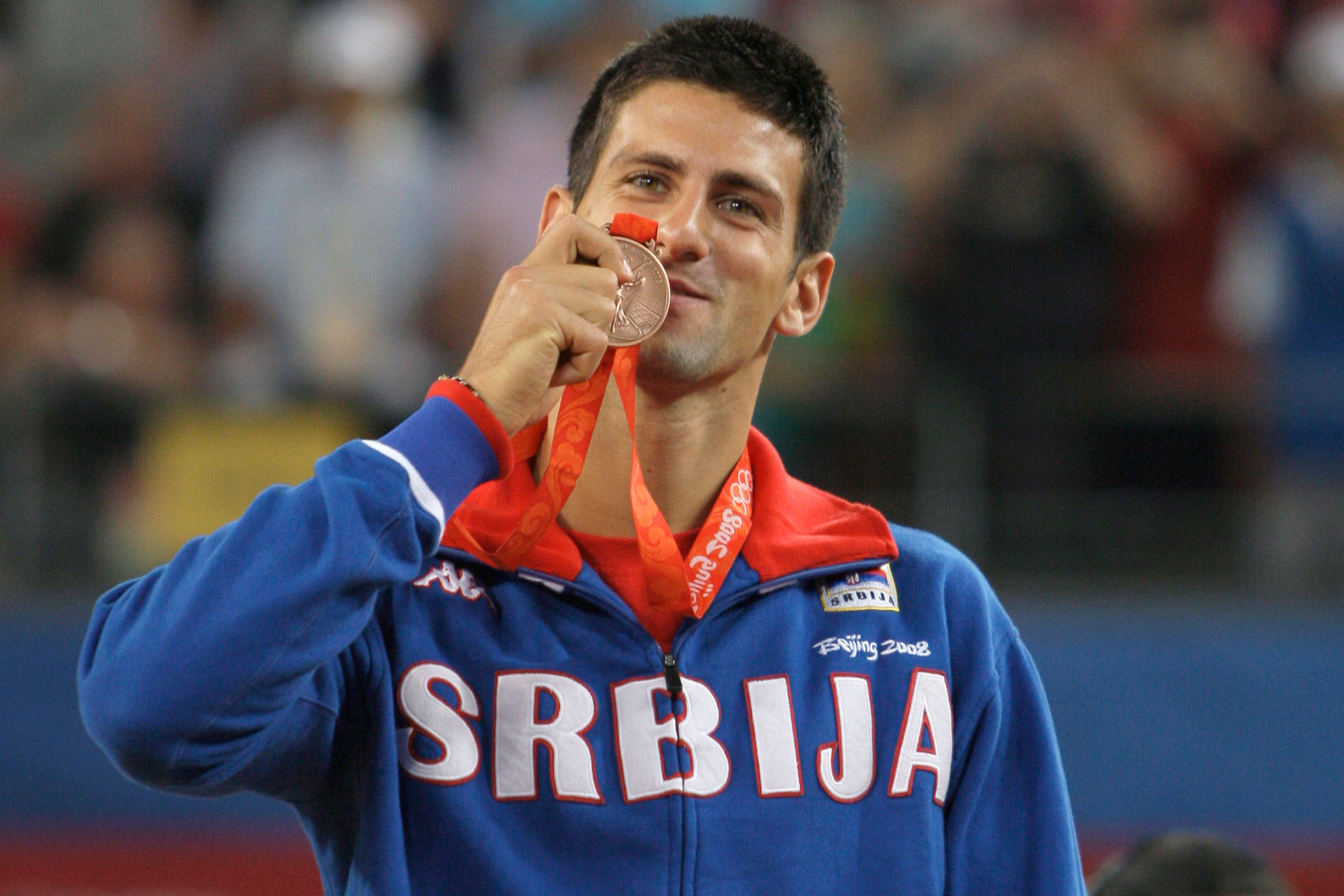
Novak would love to improve on bronze in Paris. // AP
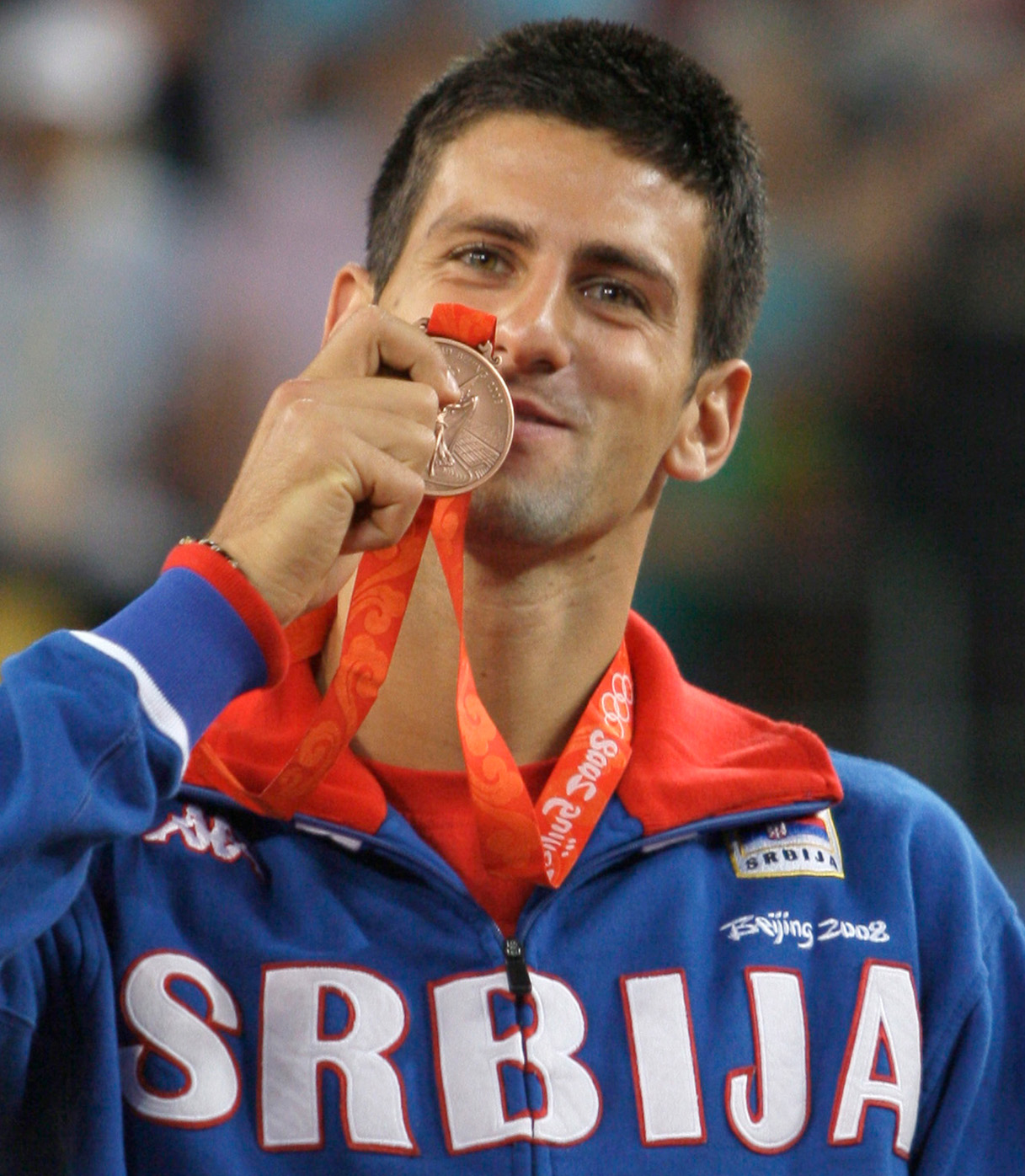
Novak would love to improve on bronze in Paris. // AP
At this point, it’s pretty much a done deal: Novak Djokovic will end up with more Grand Slam singles titles than his greatest rivals, Rafael Nadal and Roger Federer. He’s also blown by them as far as time spent atop the rankings goes.
The list of Djokovic’s accolades over the past decade-plus is nothing short of astonishing. However, one accomplishment has escaped his grasp, and that’s being the last man standing atop the medal podium at the Summer Olympics. In fact, he’s only made it to arguably the most hallowed place in sport once, with a bronze-medal finish in 2008.
Of course, no one can win every tournament—even though Djokovic almost has. Like Federer and Nadal, he’s the owner of a career Grand Slam and at least one Davis Cup title. He’s also the winningest player at the year-end championships, a tournament that always stymied Nadal, but one where Federer found success. The Swiss did retire with an Olympic gold medal, claimed in doubles, while Nadal has two of his own in singles.
There’s only one male singles player in the history of the sport who’s triumphed at all of the most prestigious events, and that’s Andre Agassi, who wrapped that up 25 years ago with his unexpected French Open win.
Djokovic has been vocal about chasing records as he goes about staking his claim as the GOAT. Olympic gold would have more of an impact on his legacy than it does for the Rossets, Massus, and Zverevs of the world (or even the Nadals and Murrays). Win it and he equals one of the rarest achievements ever in men’s tennis. Lose, and he’s left to ponder “what if?” What if he doesn’t draw Juan Martin del Potro in a first round or drop a three-setter to a player he had a 6–2 head-to-head lead against in Sasha Zverev?
With Jannik Sinner’s pre-tournament withdrawal, Djokovic—fresh off a run to the Wimbledon final on a surgically repaired knee—is now the top seed, but he isn’t the favorite. That lofty designation belongs to Carlos Alcaraz, the reigning French Open and Wimbledon champ who just showed how well he can handle the clay-to-grass transition—though he’ll be going in reverse this time.
This is likely Djokovic’s last Olympics—at least as a serious contender. It’s hard not to imagine a 40-plus-year-old not taking a crack at it again, especially if he doesn’t win this go-around as he navigates a brutal draw in Paris, one that includes a potential matchup against Nadal in the second round. He’s mostly thrived under pressure but isn’t immune to it—as evidenced when a calendar-year Grand Slam is on the line. This time, a shot at history—and a legacy-defining win—awaits.
SIGN UP — YOU'RE ONLY AS GOOD AS YOUR SECOND SERVE.
Newport Takes a Bow
Newport Takes a Bow
Newport Takes a Bow
Farewell to tradition and chaos in Rhode Island.
Farewell to tradition and chaos in Rhode Island.
By Ben Rothenberg
July 18, 2024
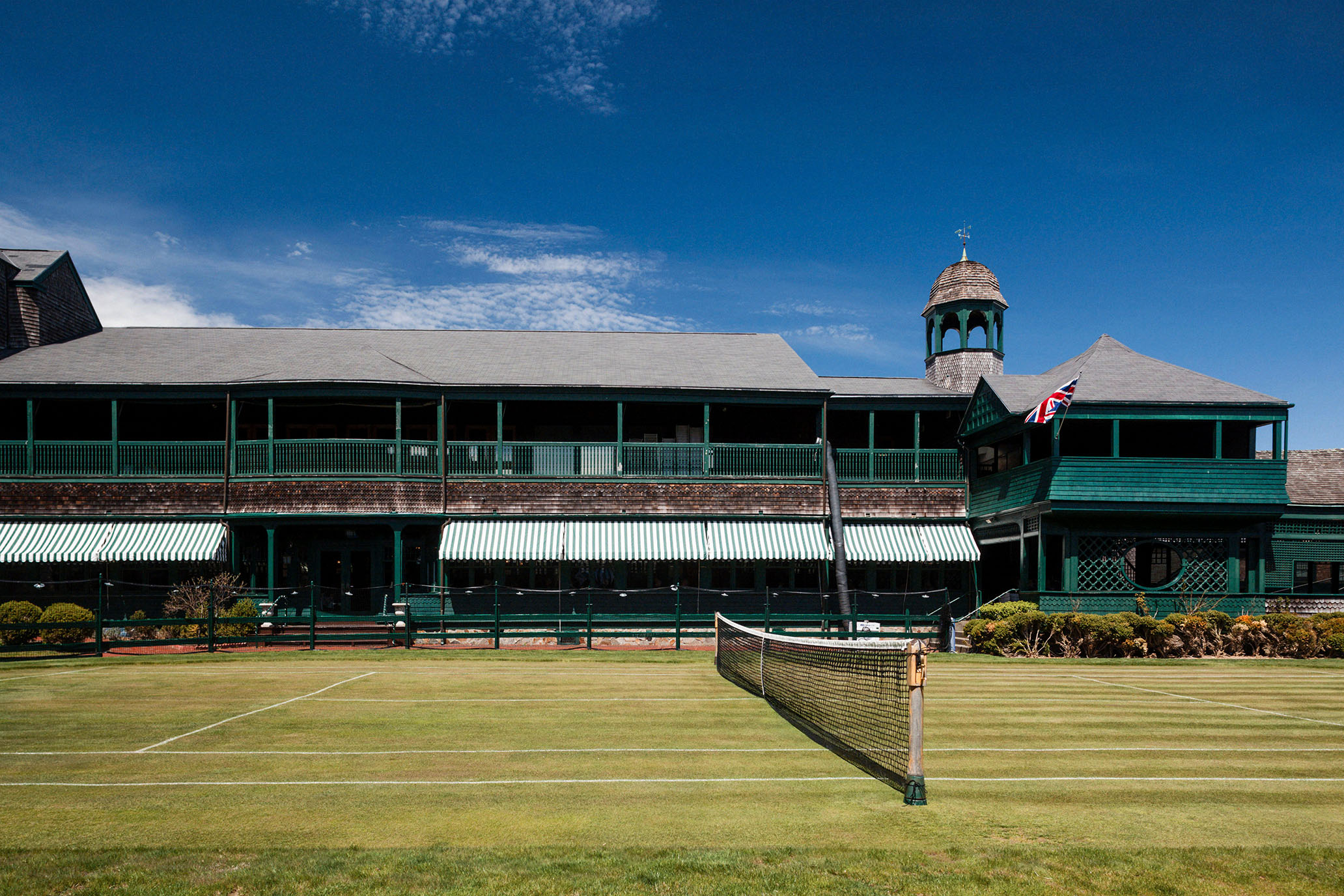
Newport Casino now. // Alamy
Newport Casino now then (below). // Alamy
The ATP Tour is losing some texture after this week, lumpy and patchy though it may be.
A casualty of the tour making its biggest events even bigger, this week marks the final edition of the Hall of Fame Open in Newport, R.I., as a tournament on the ATP Tour. Held on the grounds of the International Tennis Hall of Fame at the Newport Casino, which hosted the first U.S. National Lawn Tennis Championships in 1881, the tournament is the lone grass event in North America and the only one after Wimbledon. It’s annually a unique mix of tradition and chaos, producing strange bounces and unexpected champions since 1976.
“Littered with crazy bounces and kind of just a wacky tournament in the sense that anything can happen; that’s the mentality that the players took,” four-time champion John Isner said in an interview this week.
The bounces haven’t been quite so bad in Newport since a 2019 renovation of their grass courts, but the tournament’s reputation as an oddball full of crazy caroms and reliably random results has remained, with a patchy field by ATP standards that has led to many less-established players earning the best results of their careers.
Rajeev Ram, who earned the nickname “Rampras” for his throwback style of serve-and-volley play, won his only two ATP titles in Newport, in 2009 and 2015. Bryan Shelton, father of current top-20 pro Ben Shelton, also won his only two ATP titles in Newport, in 1991 and 1992.
Prakash Amritraj, a Tennis Channel host whom most viewers probably don’t realize was a tour player himself, made his lone ATP final in Newport in 2008; Prakash’s father, Vijay Amritraj, who will be inducted into the Tennis Hall of Fame this weekend in Newport, won the tournament three times.
Tim Smyczek, whom most fans would likely best remember for a match in the second round of the 2015 Australian Open where he led Rafael Nadal two sets to one, was a fixture at Newport in the 2010s. With a career-high ranking of 68th, Smyczek played in 85 ATP main draws over the course of his career and reached only one semifinal in those events, at Newport in 2018. Three of the eight wins Smyczek had over top-50 players in his career at ATP events came in Newport, including a win over top-seeded Sam Querrey in 2013.
“Over the years I was going there, you did see a lot of upsets,” Smyczek said in an interview this week. “I had some of my better wins while I was there. And it probably had a little something to do with the court and the unsteady footing, surprise bounces, that sort of thing. But I kind of liked it, because I was often the underdog in those matches, and I felt like you had to be pretty mentally tough to deal with all that throughout the course of the match or tournament.”
The winningest champion in Newport’s 48 years as an ATP tournament is Isner, who won four times—2011, 2012, 2017, 2019—each time as the top seed in one of the weakest ATP fields of the season (though Isner did beat a stronger field in 2012 when the London Olympics’ tennis event was being held on grass weeks later).
Newport had been the first ATP tournament of Isner’s career in the summer of 2007, after receiving a wild card following a successful collegiate career at the University of Georgia. It was not love at first mishit.
“I could not stand the courts,” Isner said. “I swore it off. I said I would never play Newport again because I couldn’t stand the courts. But lo and behold, I did not stay true to my conviction.”
Isner, whose serve was one of the toughest to return in ATP history, came to embrace that his game was even more unplayable with an unpredictable surface underfoot.
“The shittier the court, the better for me,” Isner said. “I mean, when I beat Federer at Davis Cup in Switzerland, it was a temporary clay court, indoors, and it was just littered with bad bounces. And that was a big advantage for me. [Newport] didn’t play like a typical grass court. Towards the end of the week, a kick serve would bounce crazy high on the courts; it wouldn’t necessarily skid. It just did not play like a typical grass court. I’ve always played a lot of smaller guys. I mean, I played [5-foot-6 Olivier] Rochus one year in the Newport finals, and he’s tiny and he couldn’t touch my serve at all.”
Ten of Isner’s 16 career ATP titles came in this stretch of the dog days of July, with four in Newport and six in Atlanta (a hard-court event with slightly stronger fields, which is also set to hold its final edition next week).
“The ‘Newport Challenger,’ for sure—I don’t take offense to that,” Isner said of the tournament’s common nickname among players. “But, you know, you look at it as an opportunity as well.”
Wins in Atlanta and Newport set Isner up for success when he’d encounter more of the game’s best once they came ashore for Washington, Cincinnati, and the US Open.
“I don’t care what surface you’re playing on,” Isner said. “On the ATP Tour, when you win four or five matches in a row to win the tournament, that’s going to give you a lot of confidence.”
Confidence can already be seen growing in this year’s field, including in Reilly Opelka, another enormous fellow with a huge serve, who is returning to the ATP Tour after two years away with injury and knocked off top seed and defending champion Adrian Mannarino in the second round.
Blair Henley, an on-court host at tournaments of all sizes around America including Newport, is an enthusiastic ambassador for the event, where she is working this week.
“I often get asked, ‘Which tournament should I go to if I’m going to pick one on the calendar?’” Henley said. “And I always will recommend a 250. If you can make it to Newport, I’d probably recommend this tournament. You get to be up close and personal in a way that you don’t experience at a 500 or 1000 or a Grand Slam. That piece, I think, is pretty consistent throughout all 250s. But here in Newport, I think when you add in the historic location, the quaint Northeastern town, the fact that the Hall of Fame is right there, I think there’s maybe even more of a sense of closeness.”
As the Hall of Fame undergoes major renovations later this year to prepare for big crowds expected for fast-approaching induction ceremonies of recently retired megastars like Roger Federer and Serena Williams, so too is the tournament being reimagined. Next year the event will reincarnate as a combined ATP-WTA Challenger event at the 125 level held during the second week of the Wimbledon main draw. The announcement Wednesday that women’s tennis would be reintroduced in Newport drew loud cheers from the crowd in Newport.
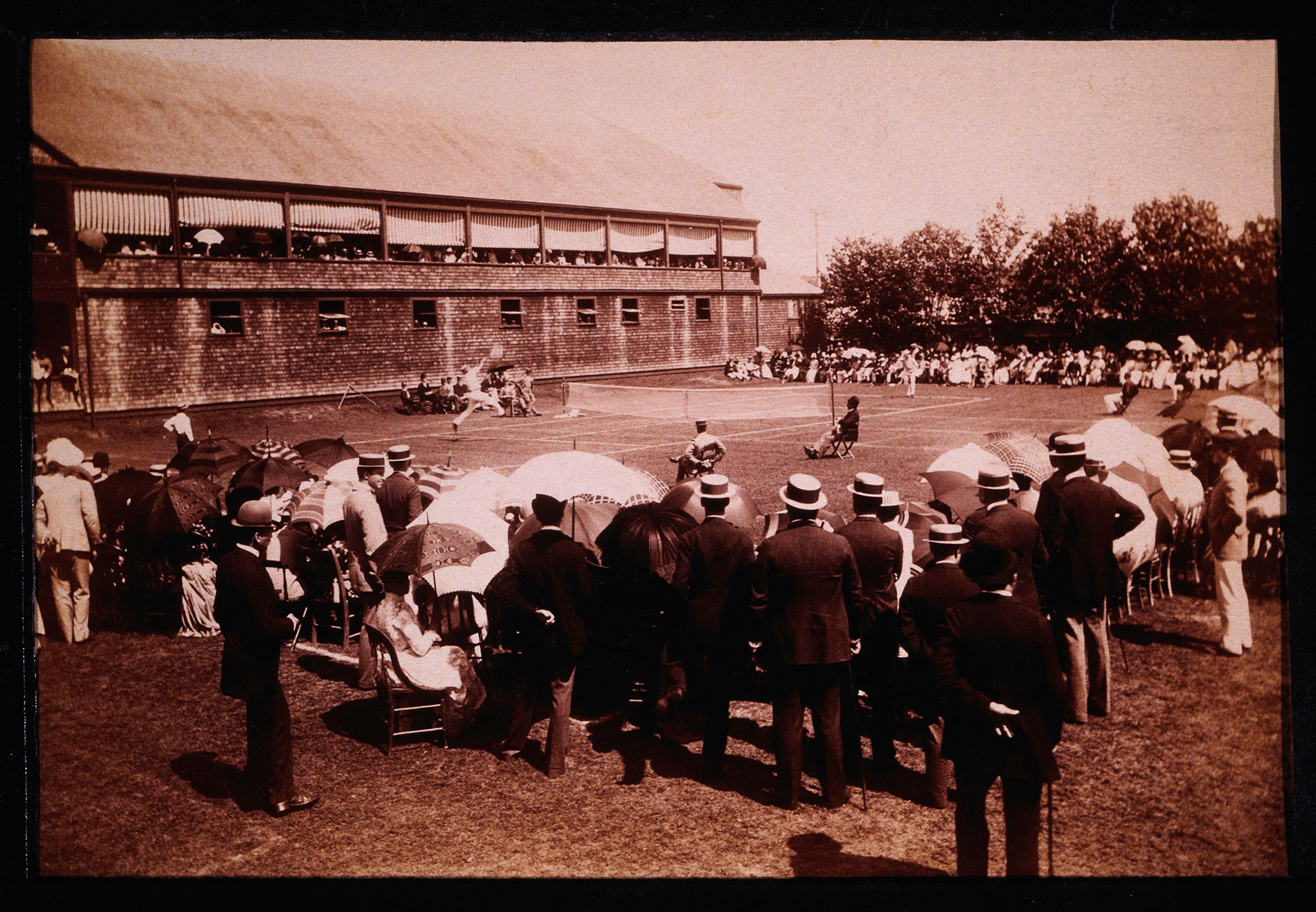
Newport Casino then. // Alamy
Newport Casino then. // Alamy
SIGN UP — YOU'RE ONLY AS GOOD AS YOUR SECOND SERVE.
England Swings
England Swings
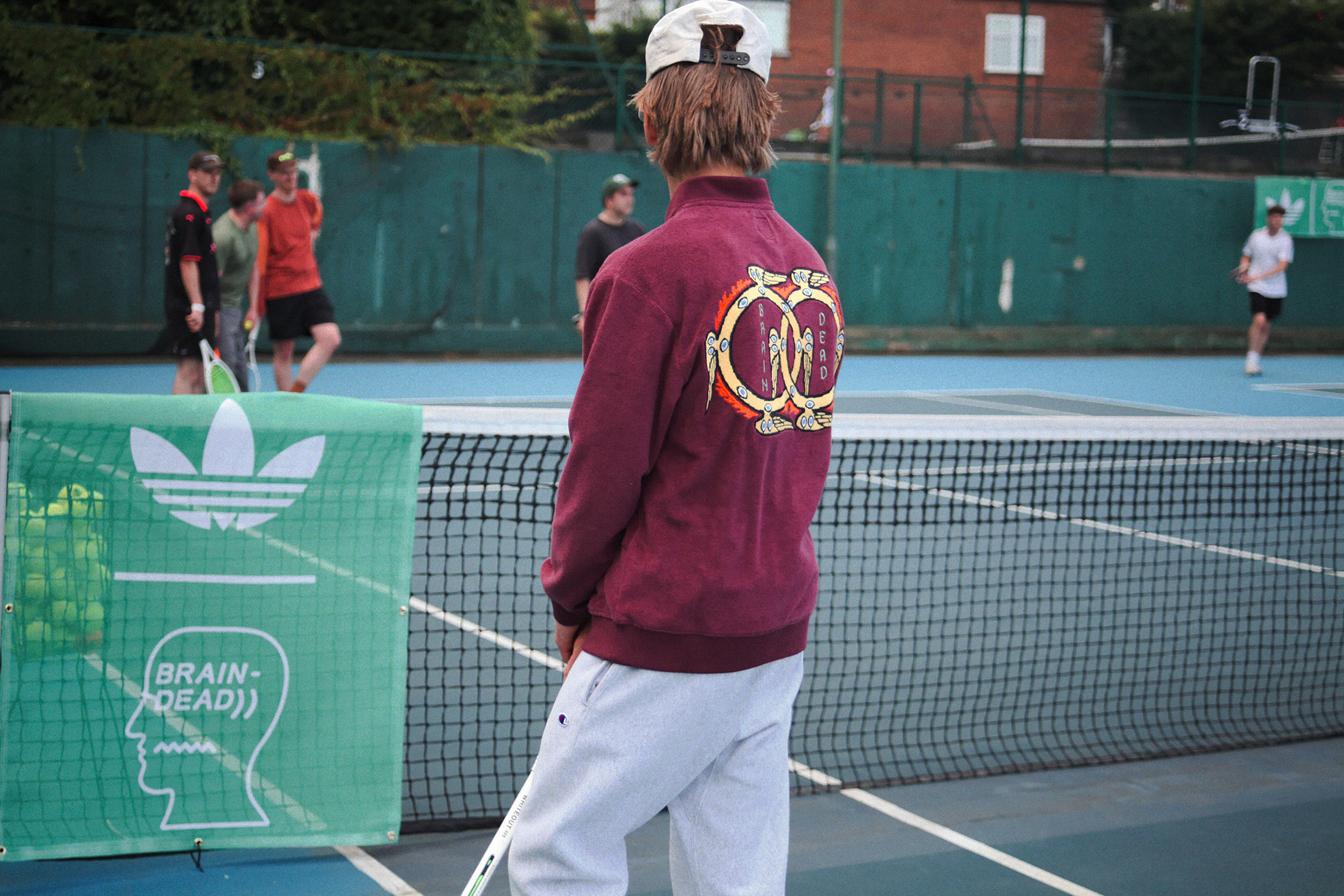
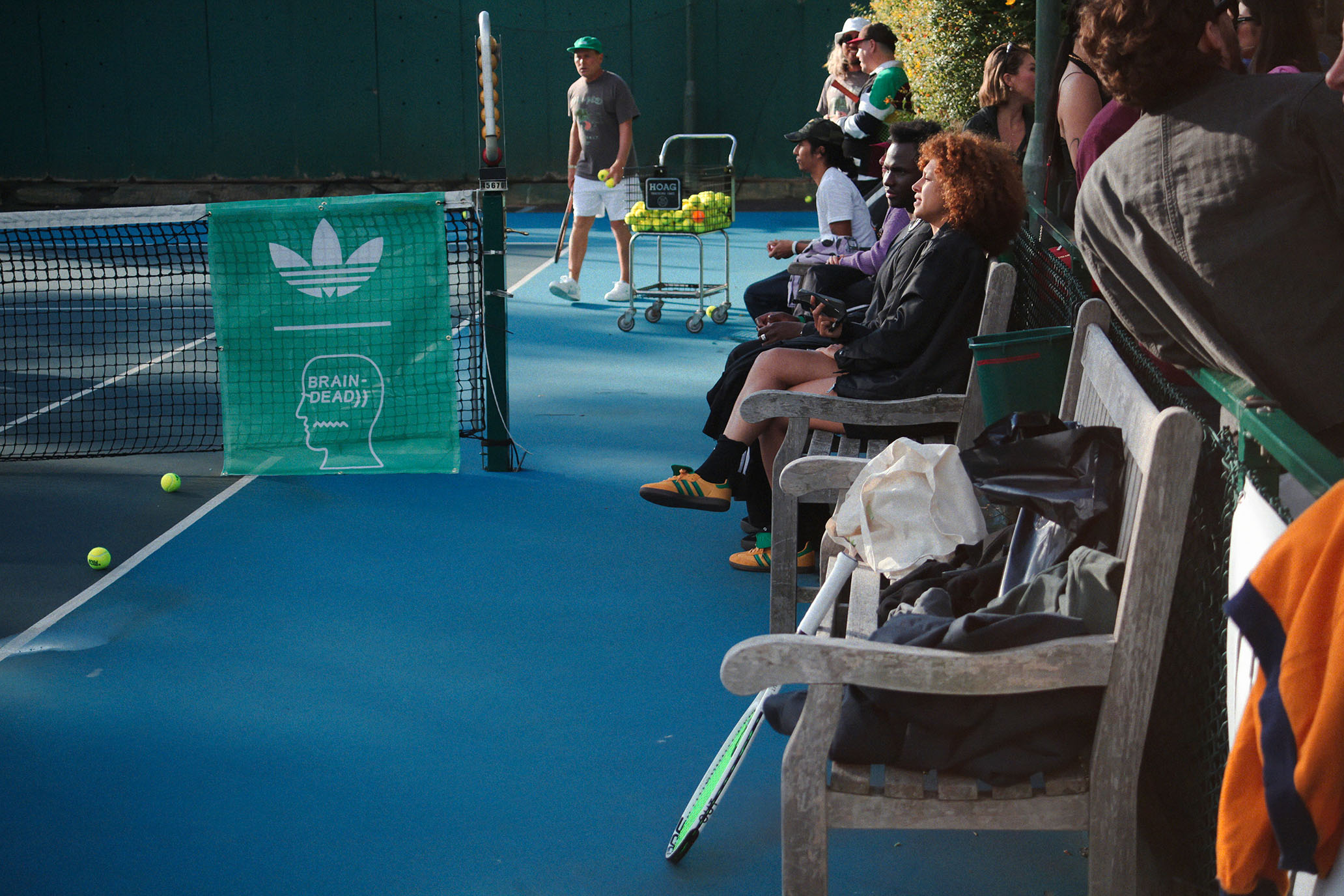
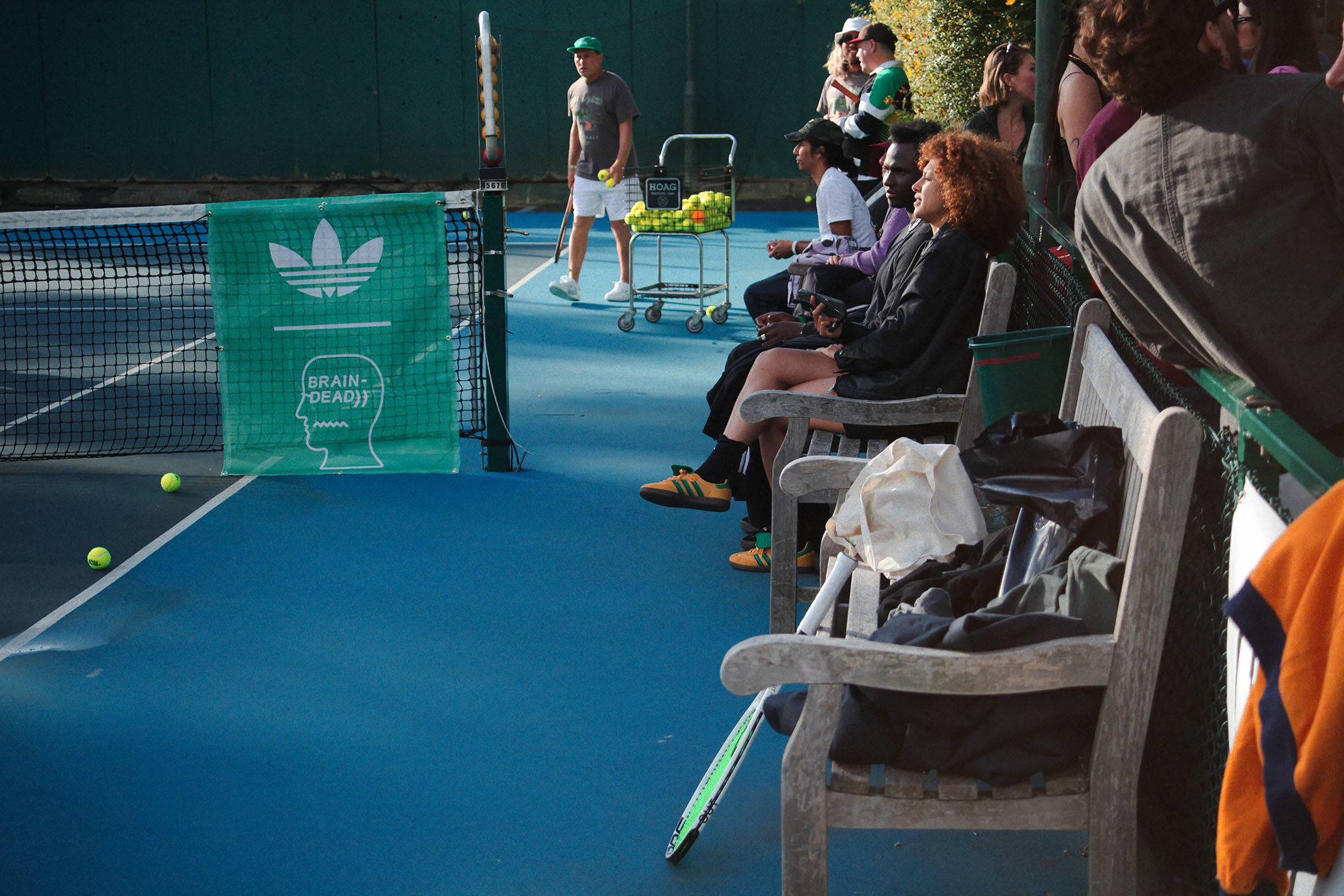
Braid Dead and Adidas launch the “unstructured" Stan Smith shoe at their Tennis Jam in London.
Braid Dead and Adidas launch the “unstructured" Stan Smith shoe at their Tennis Jam in London.
By TSS
July 12, 2024
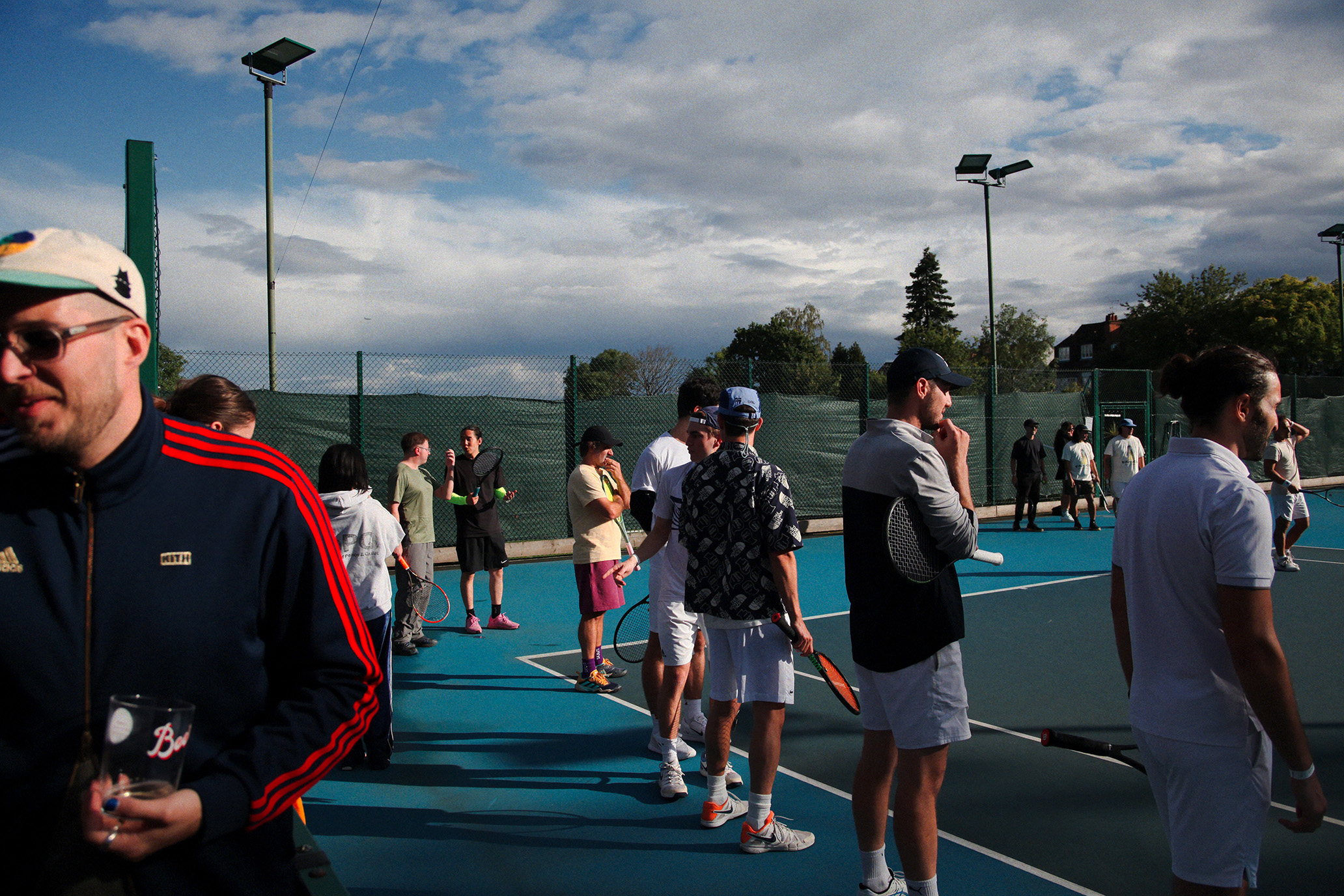
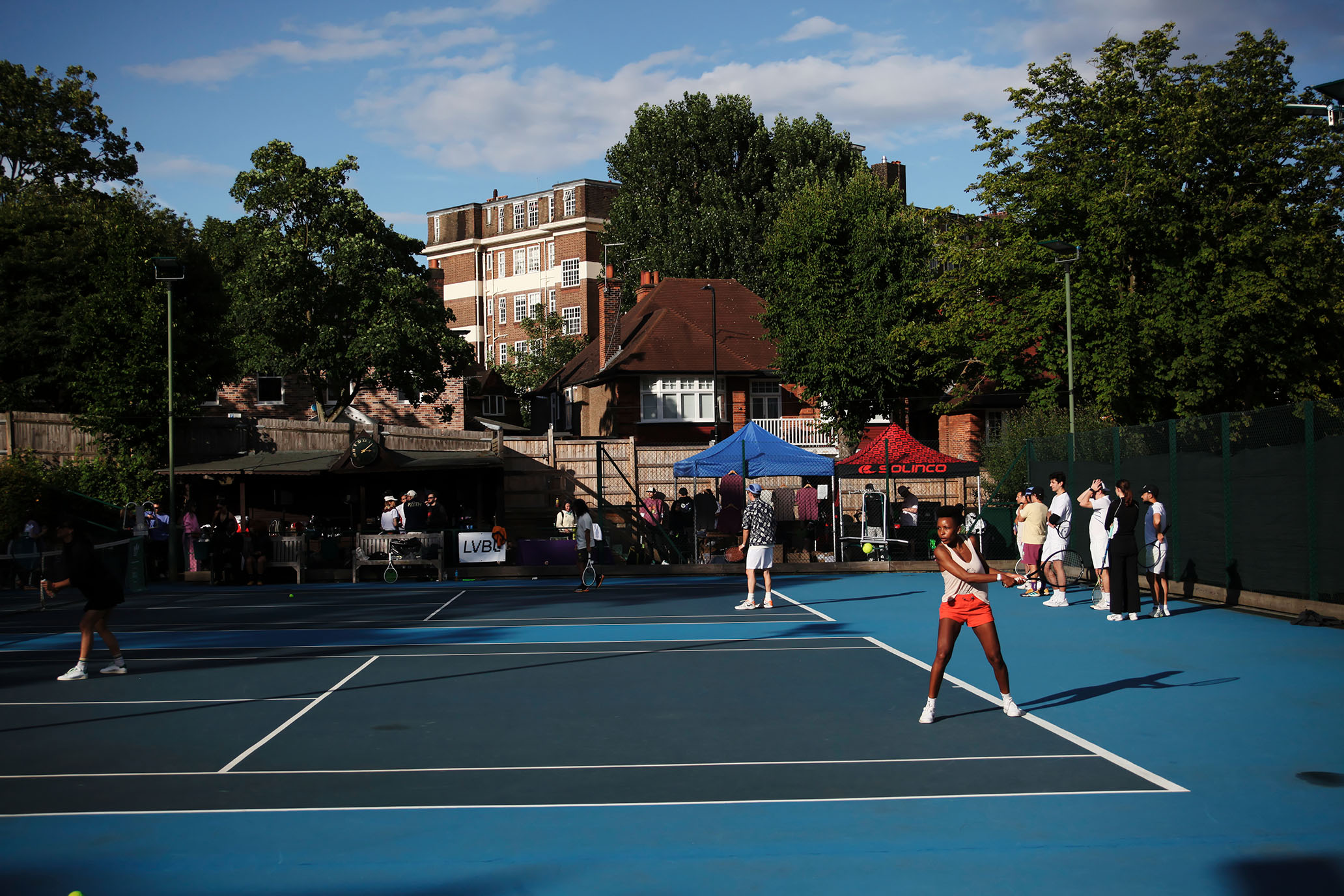
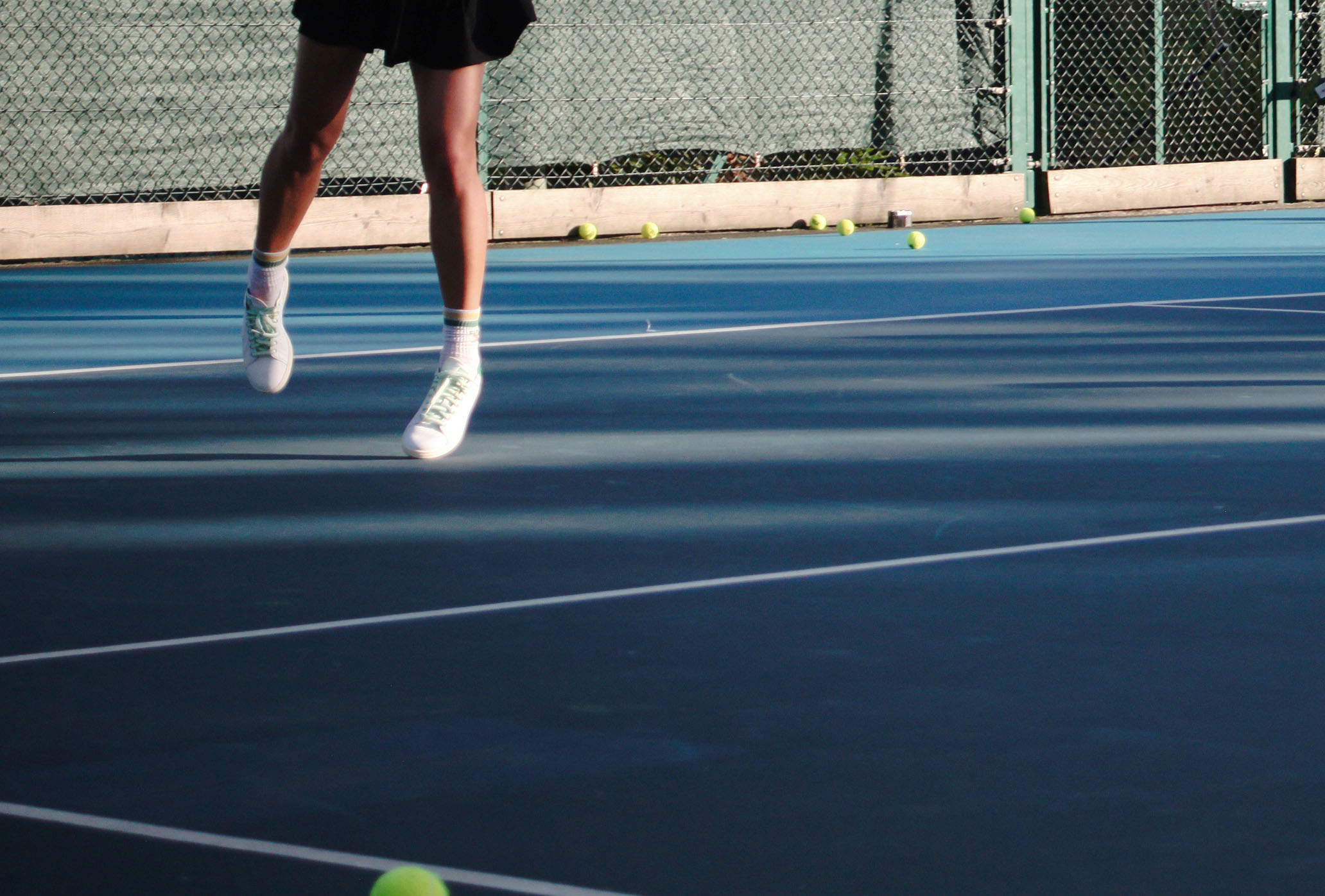
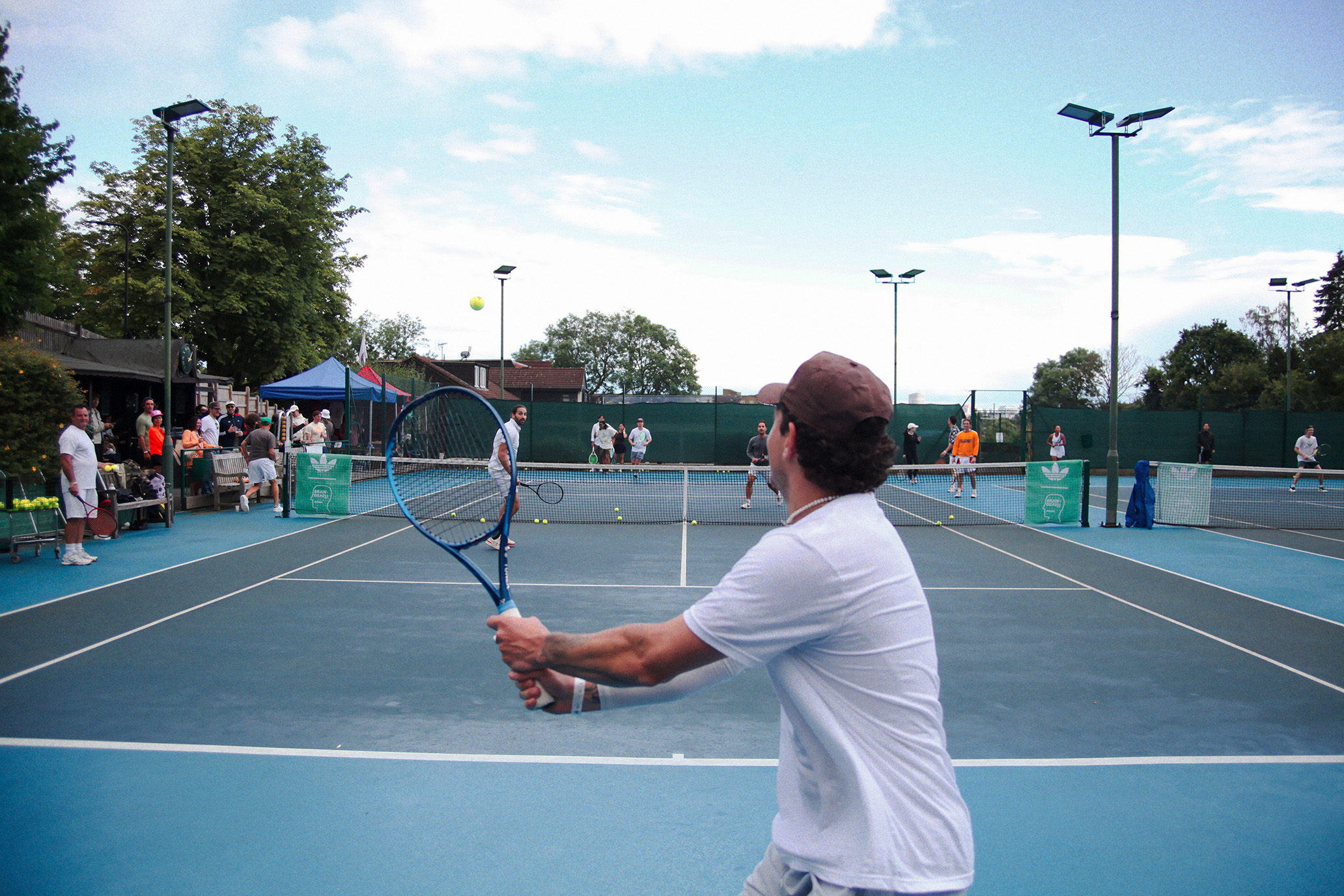
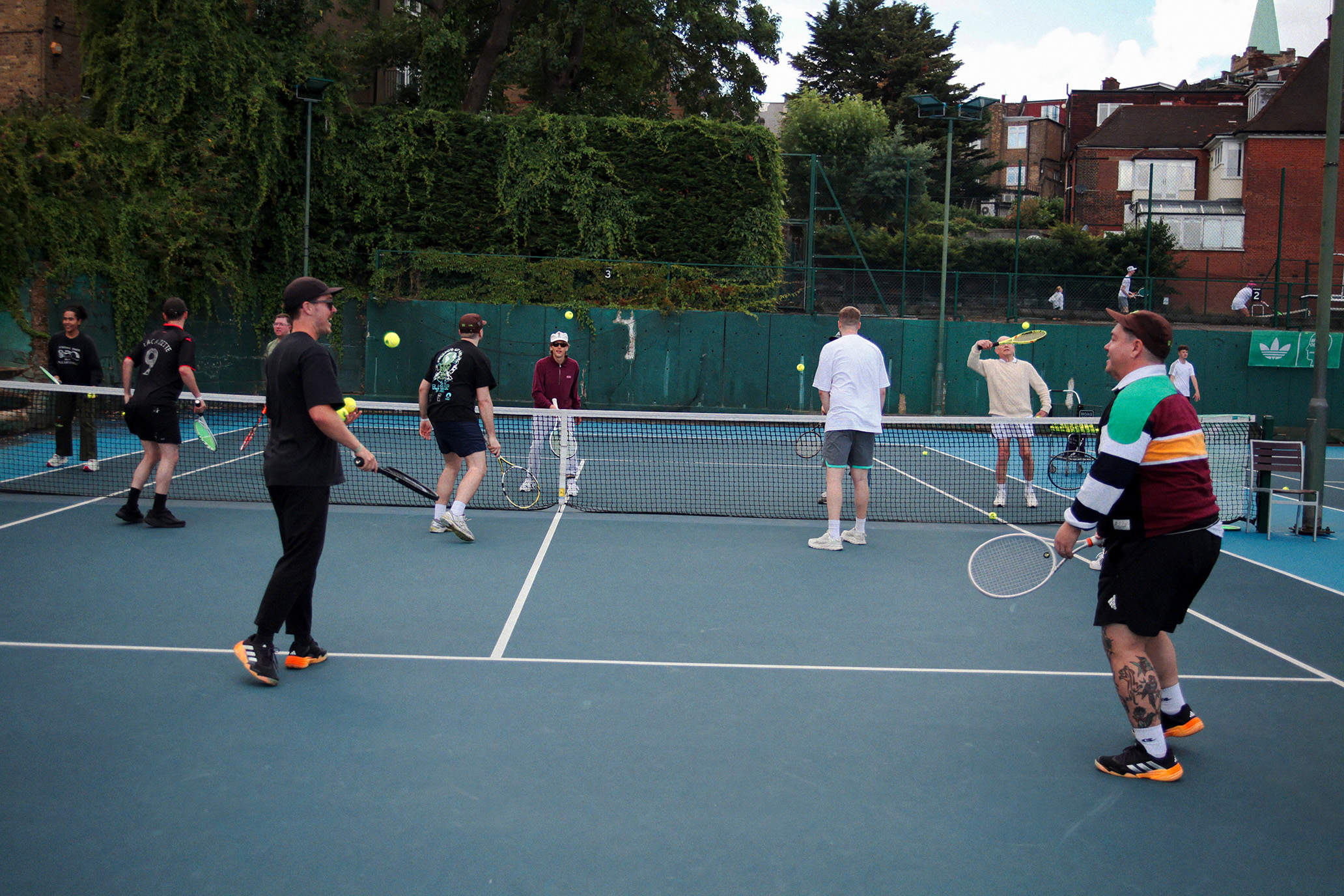
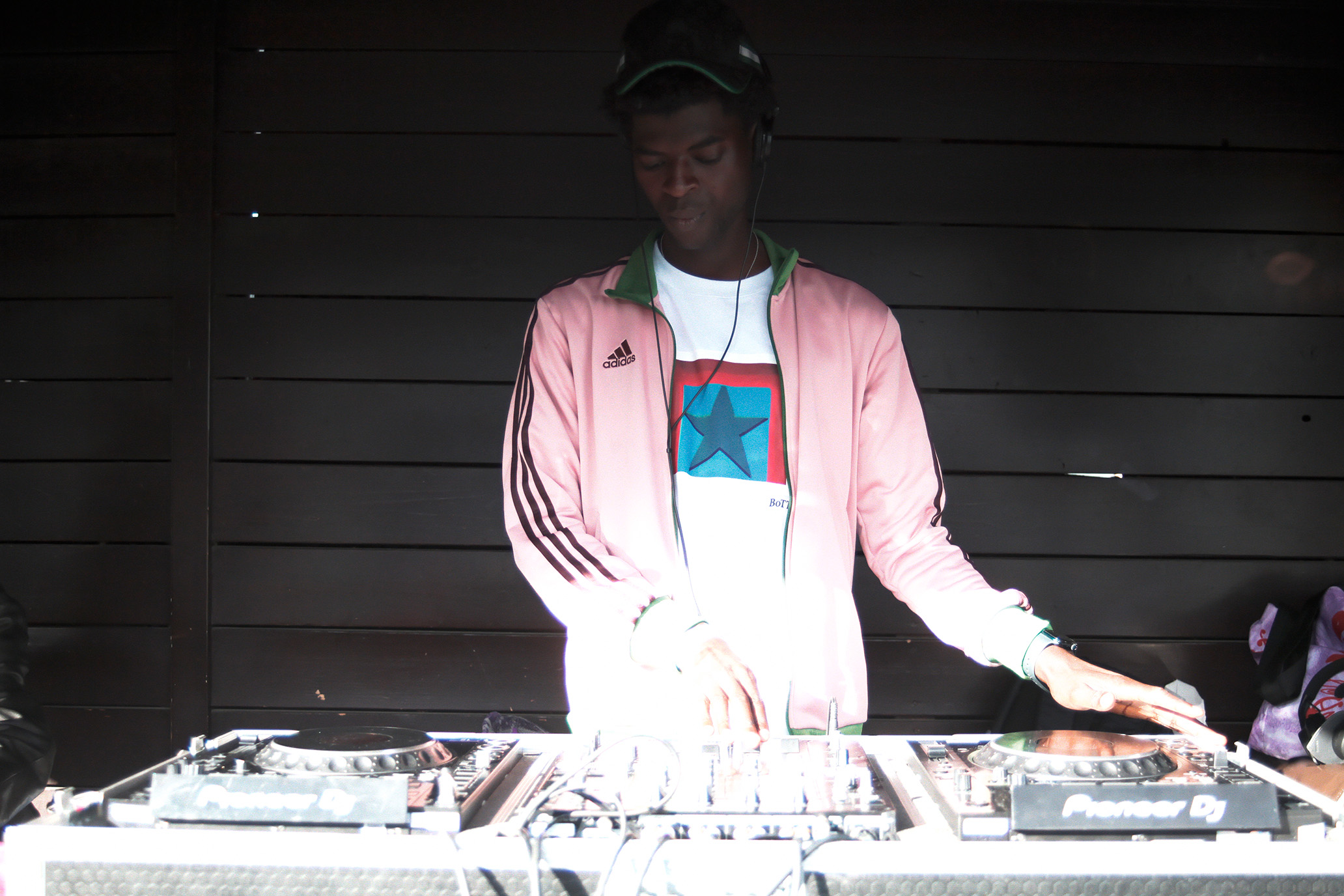
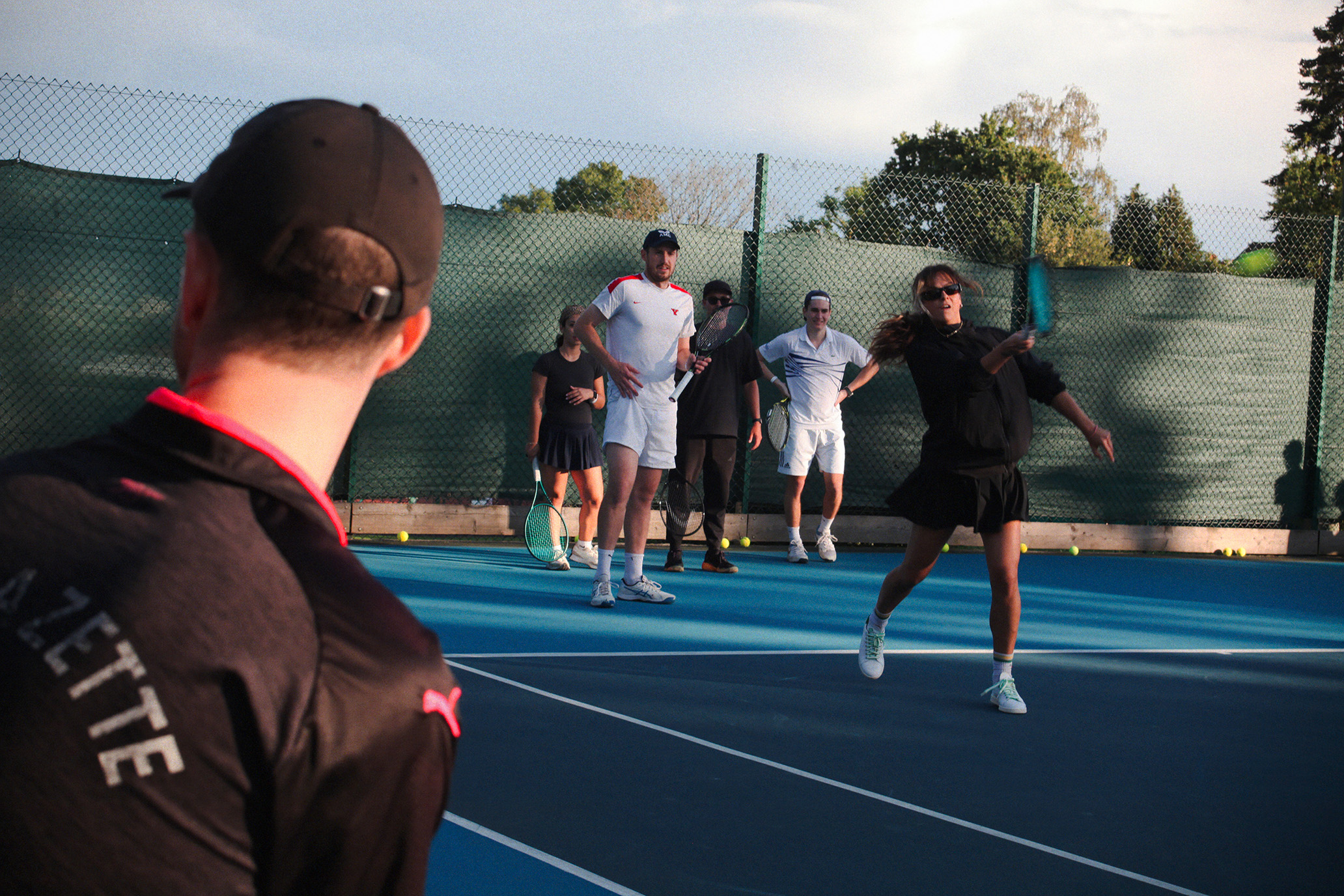
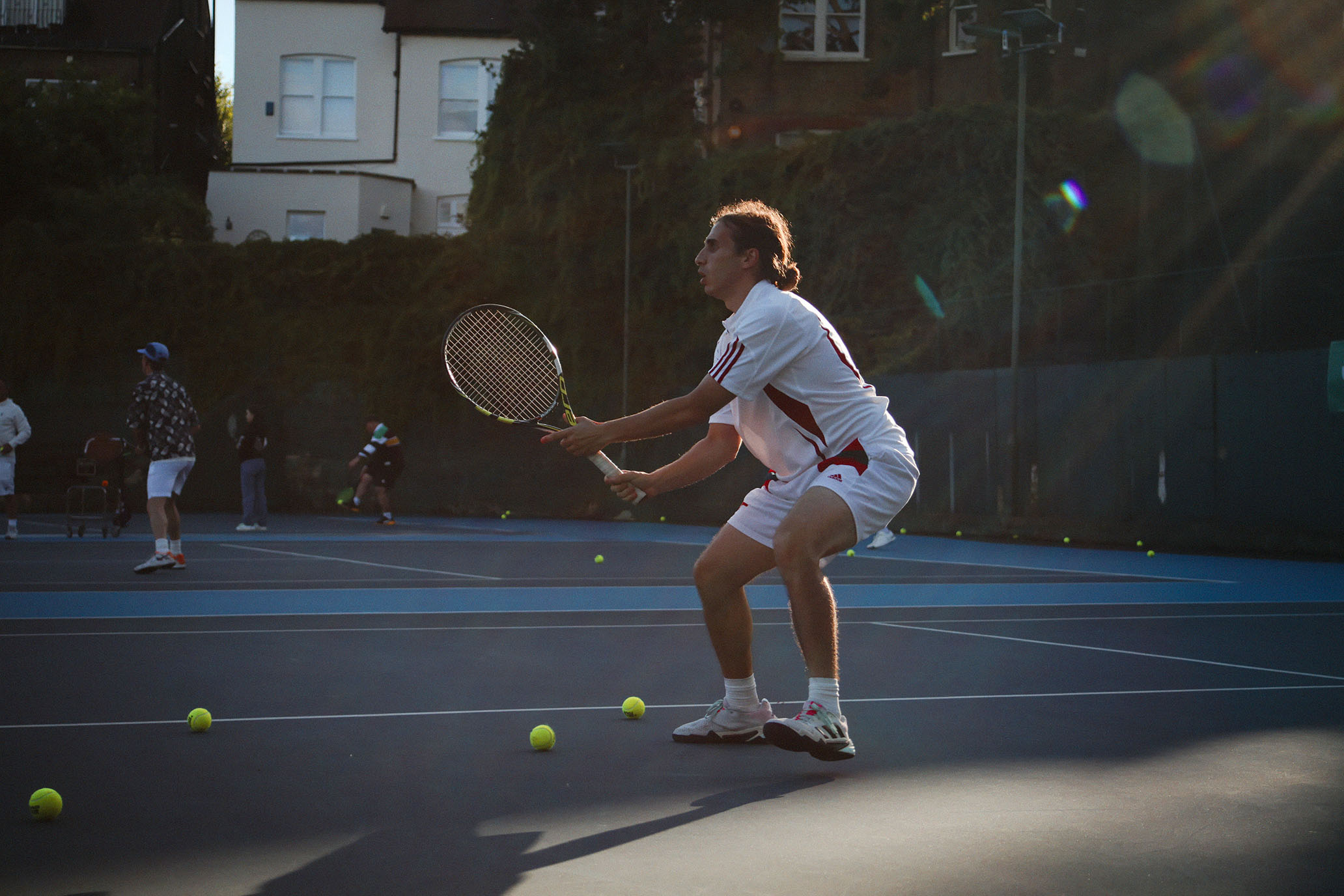
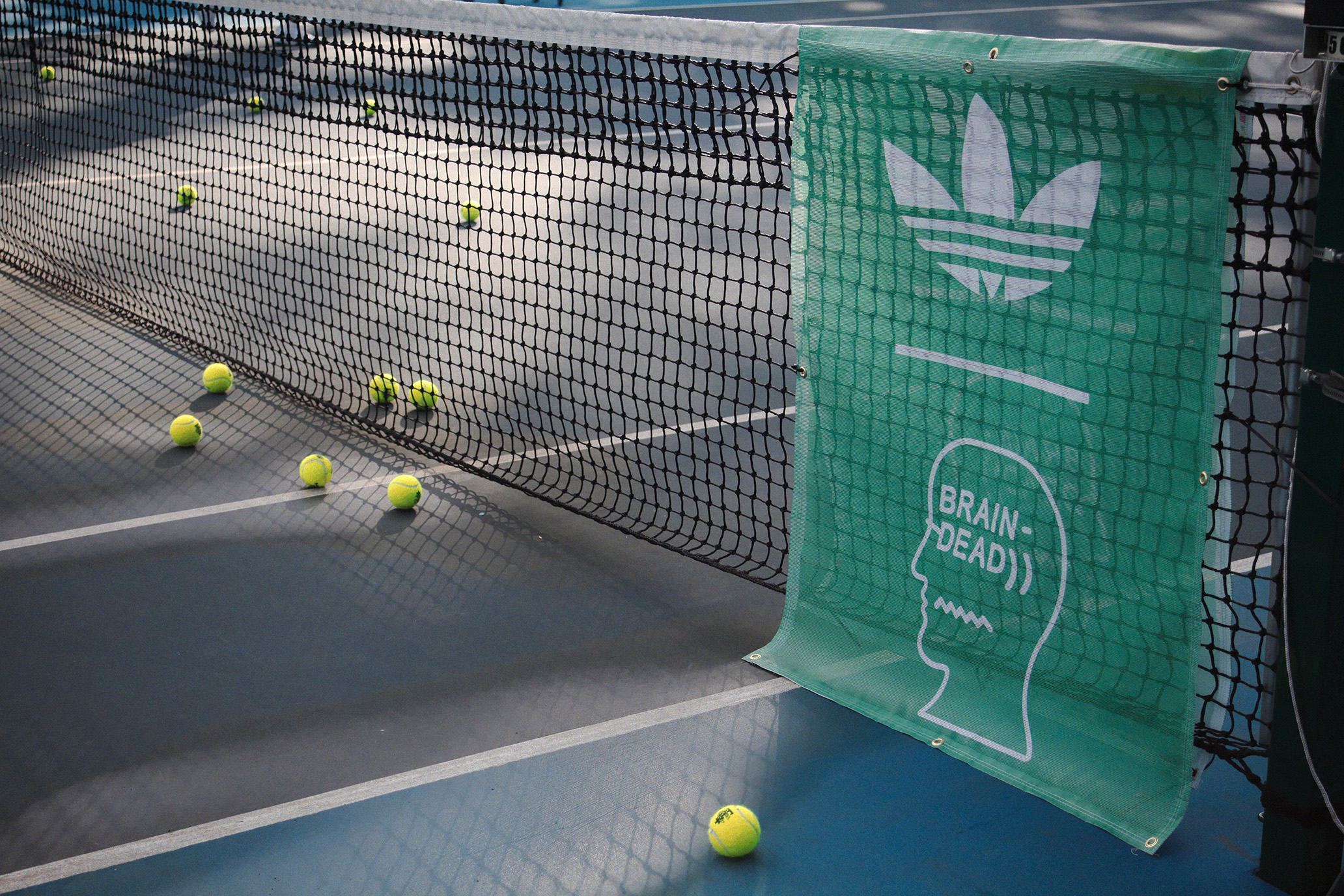
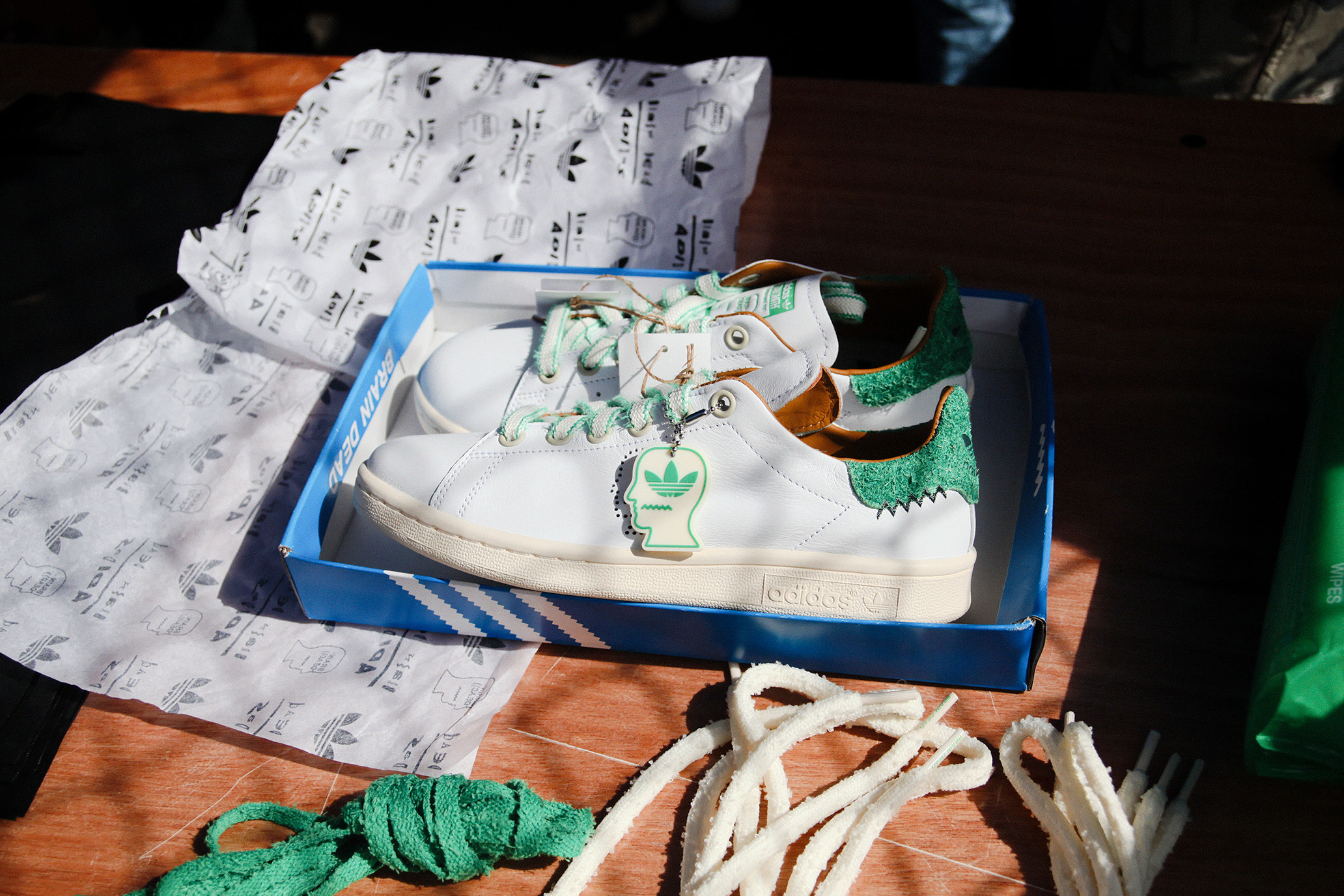
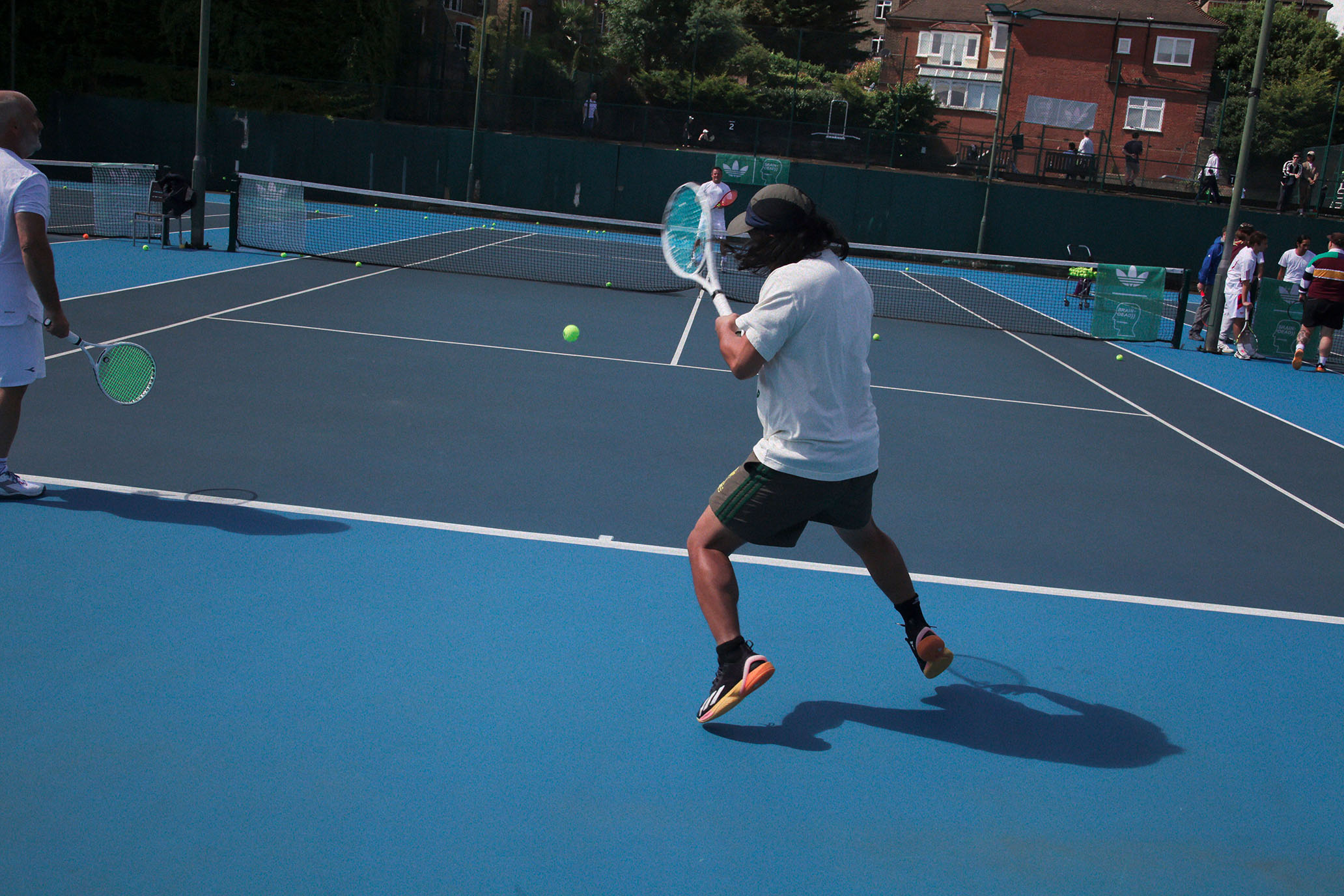
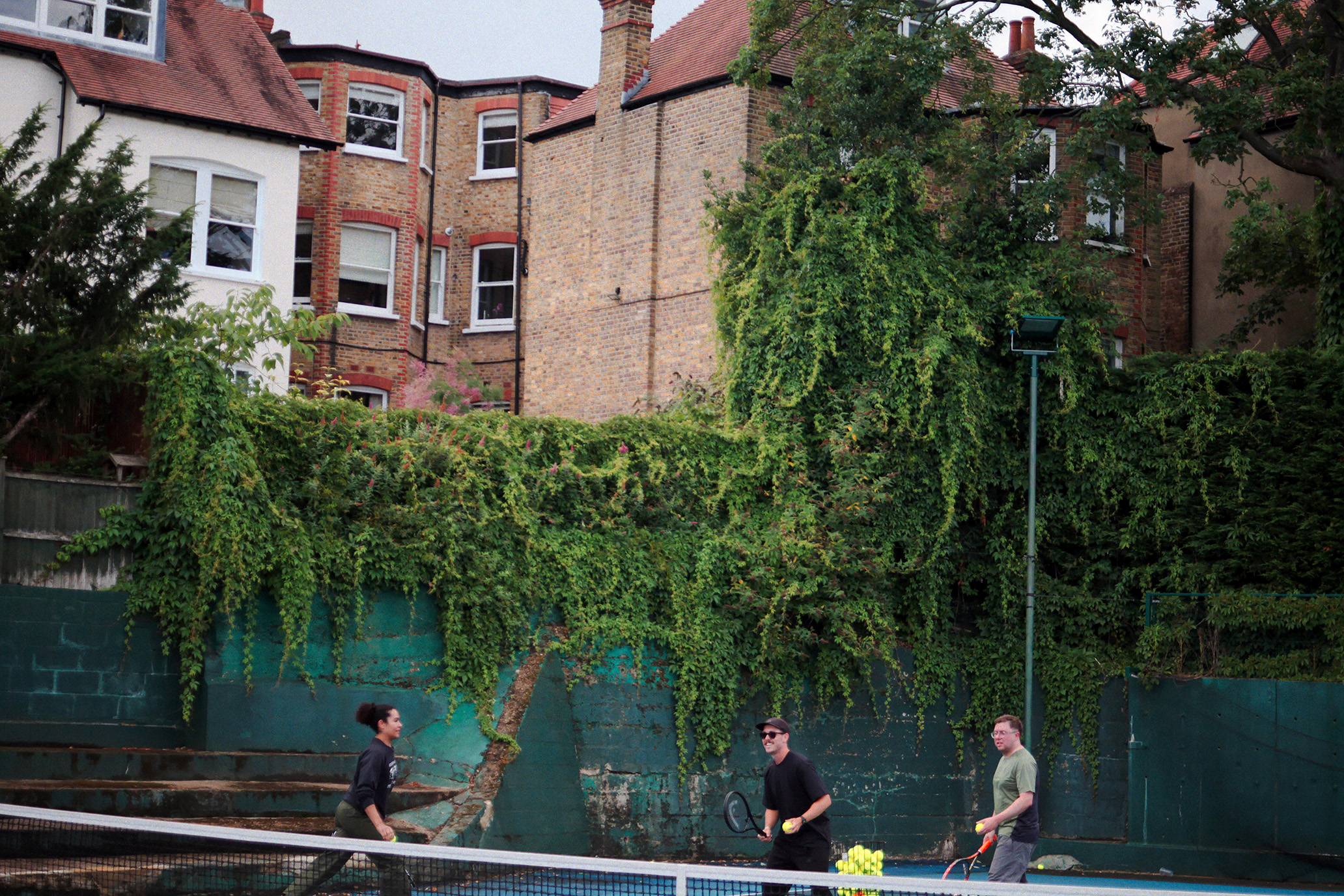
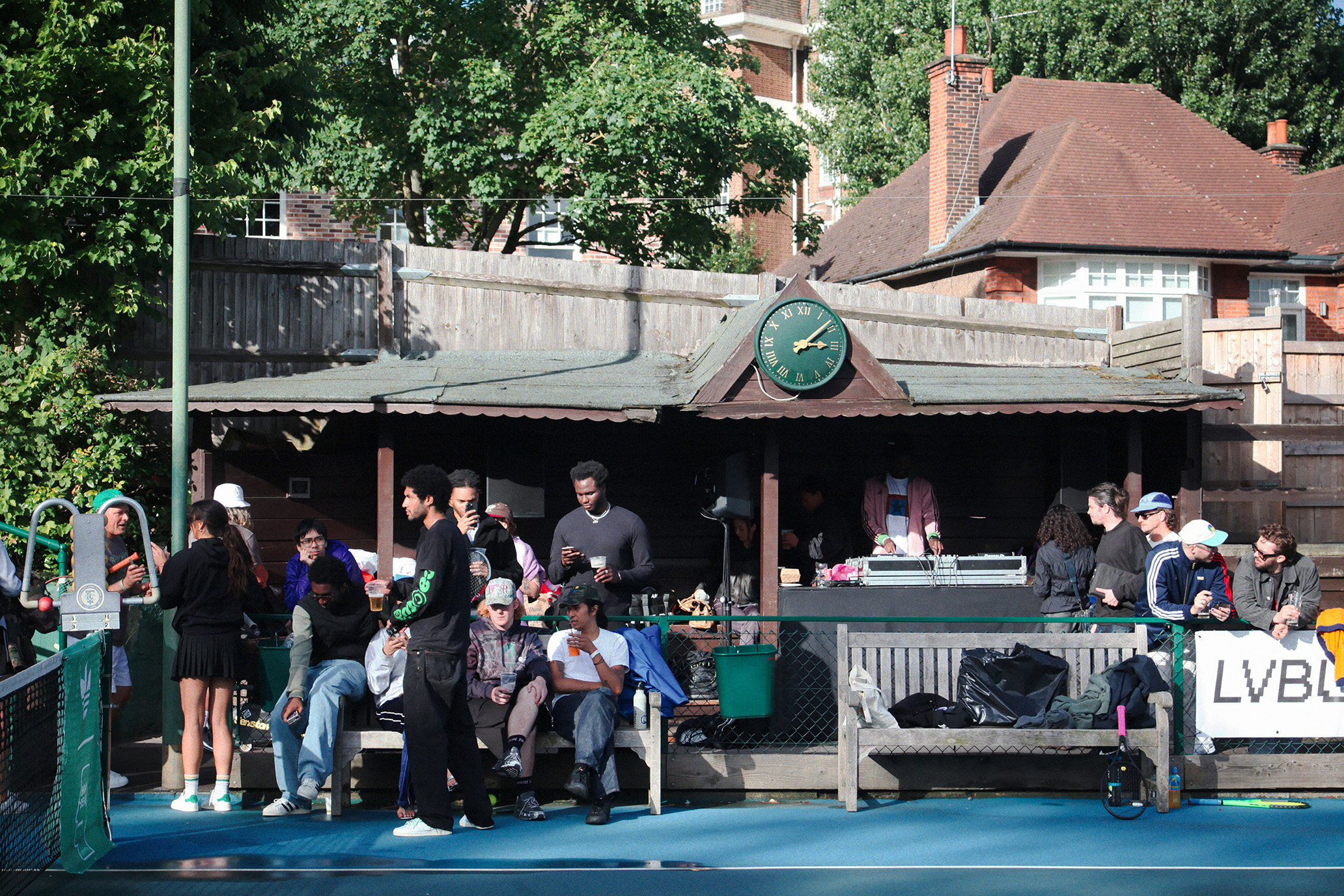
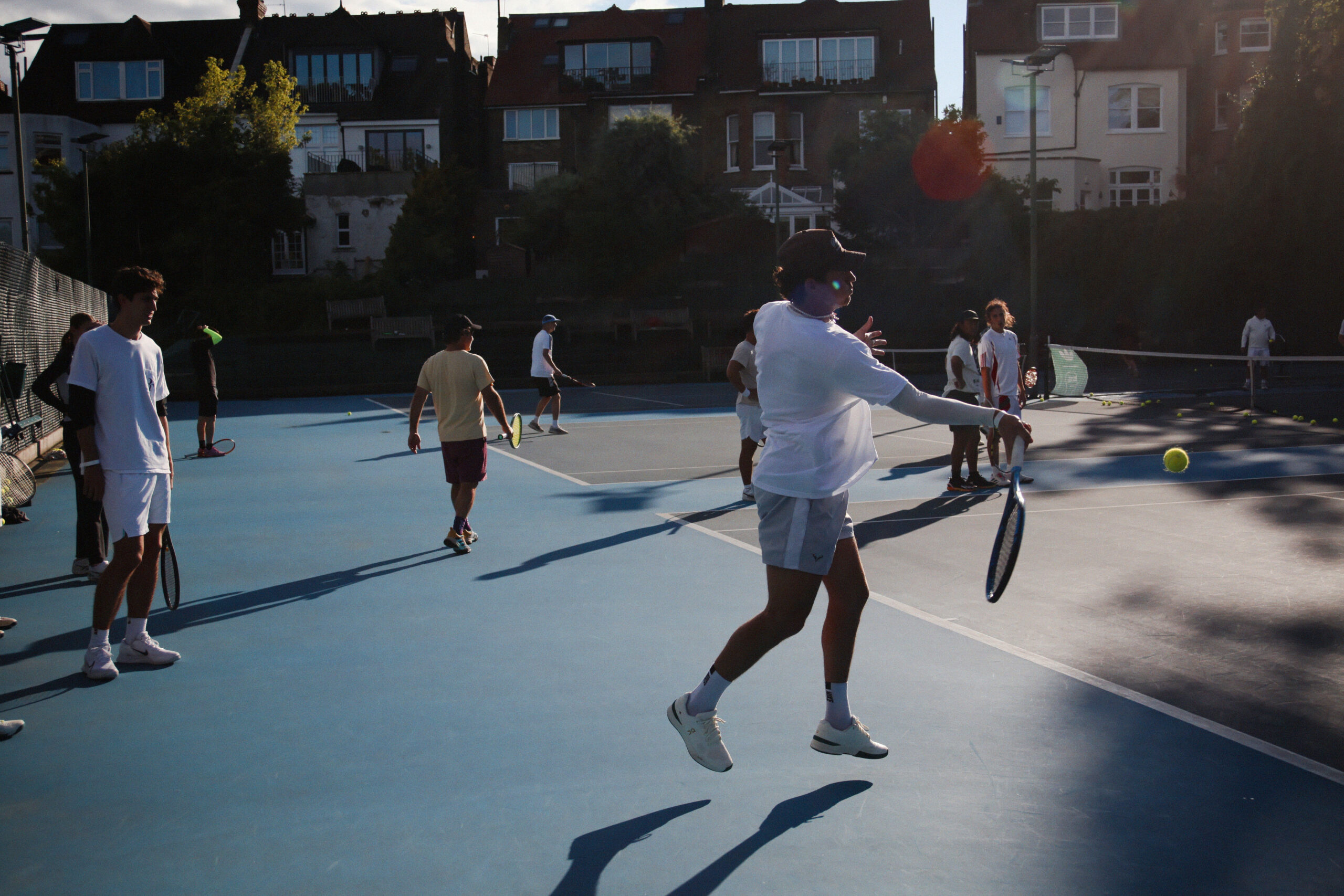
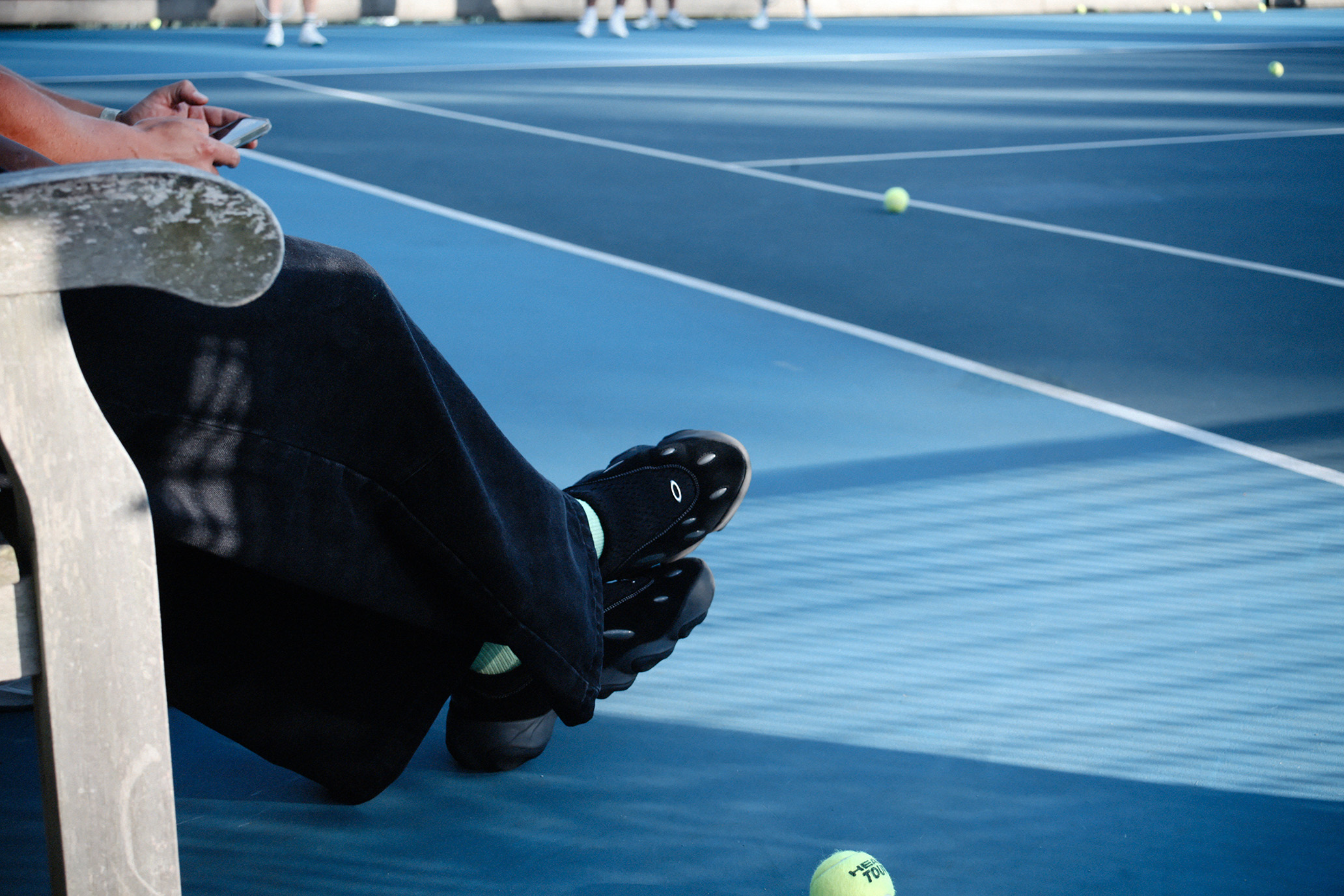
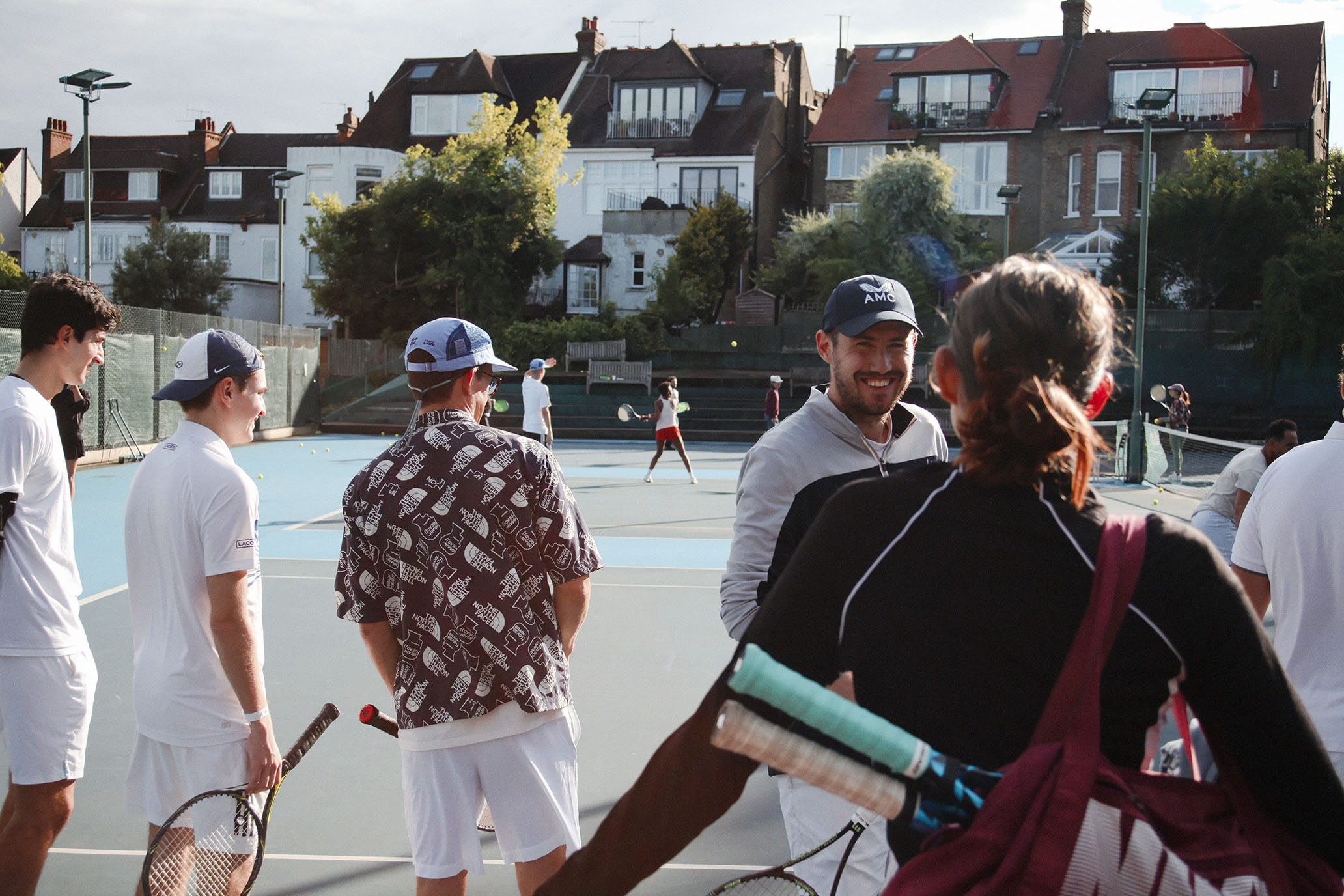
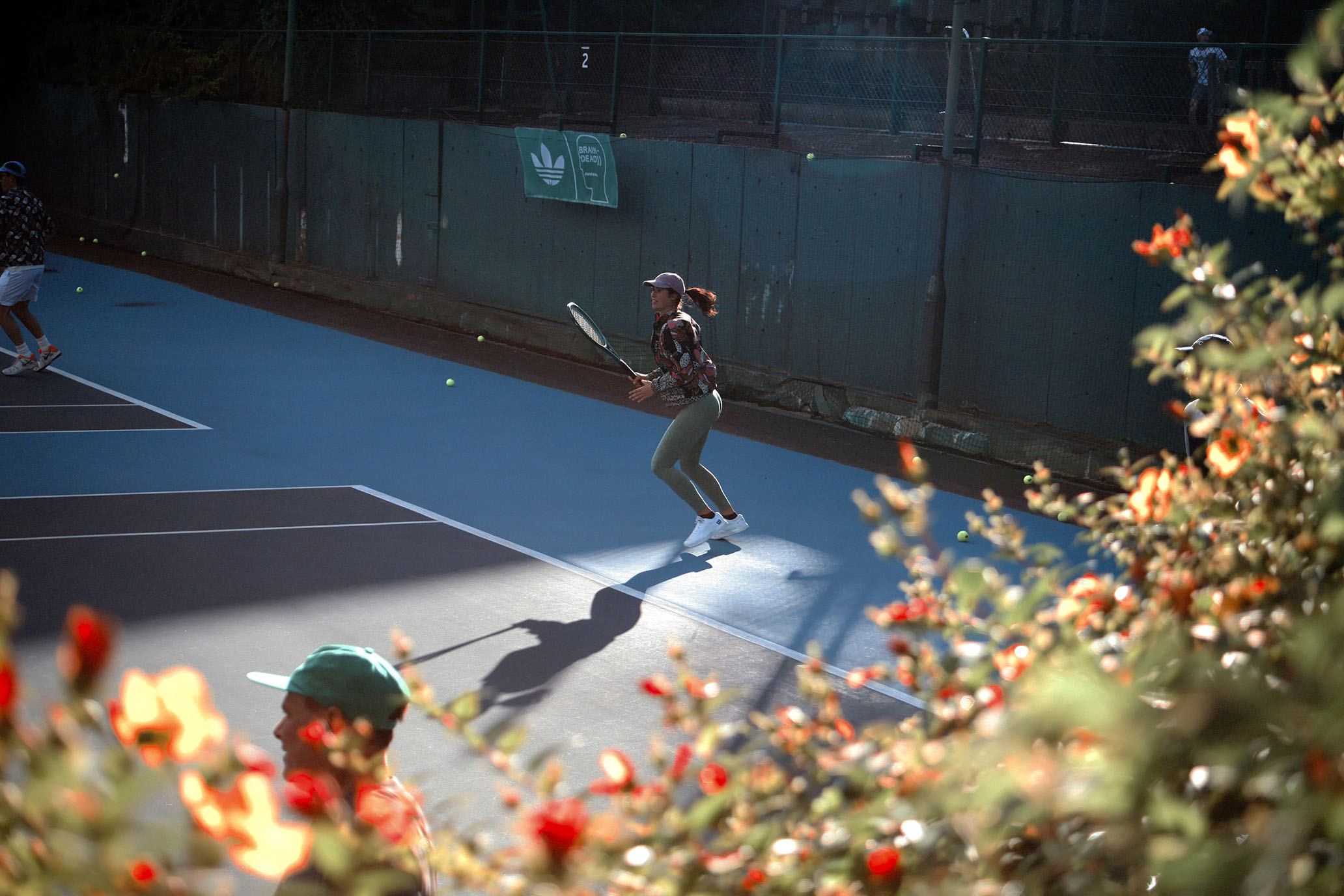
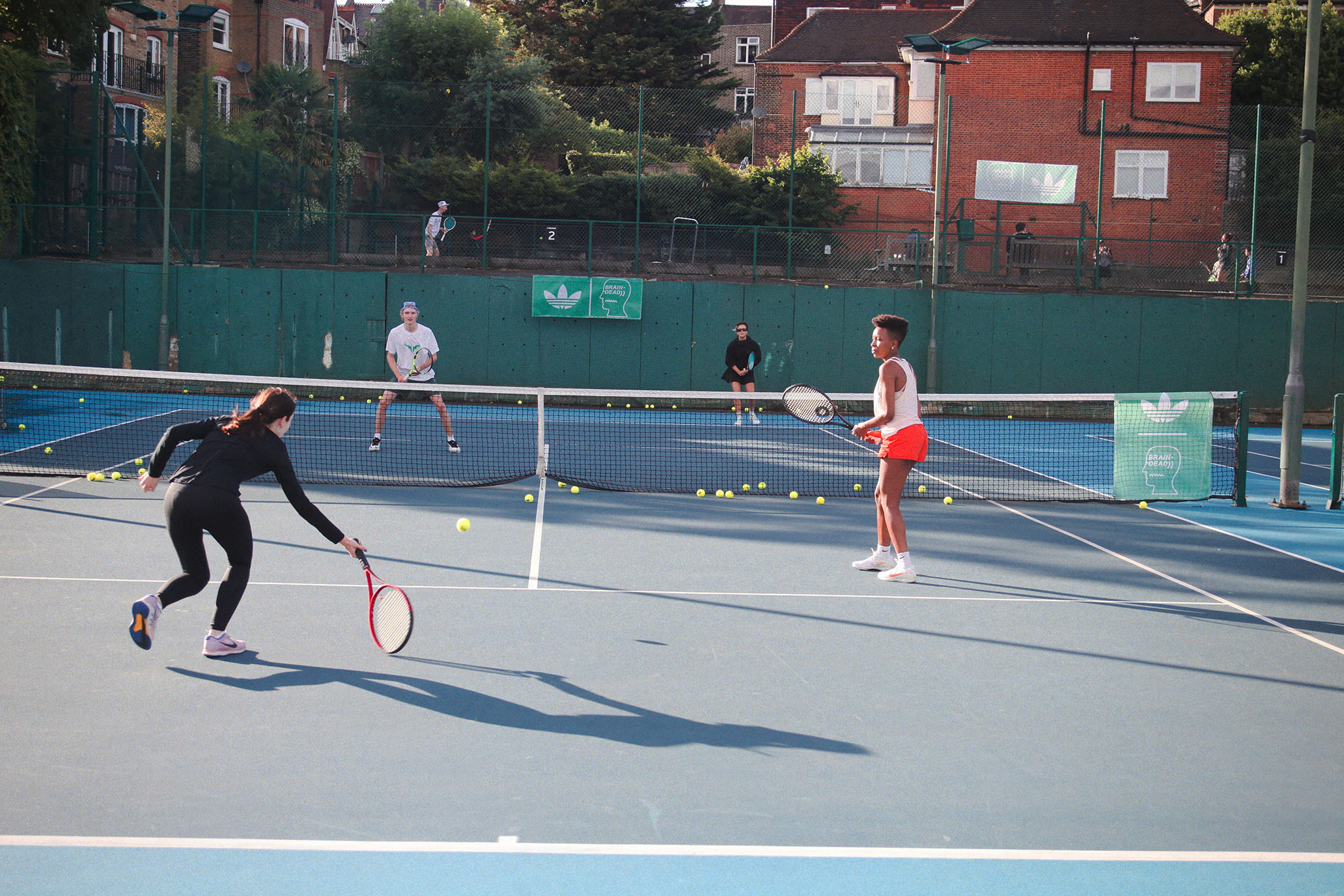
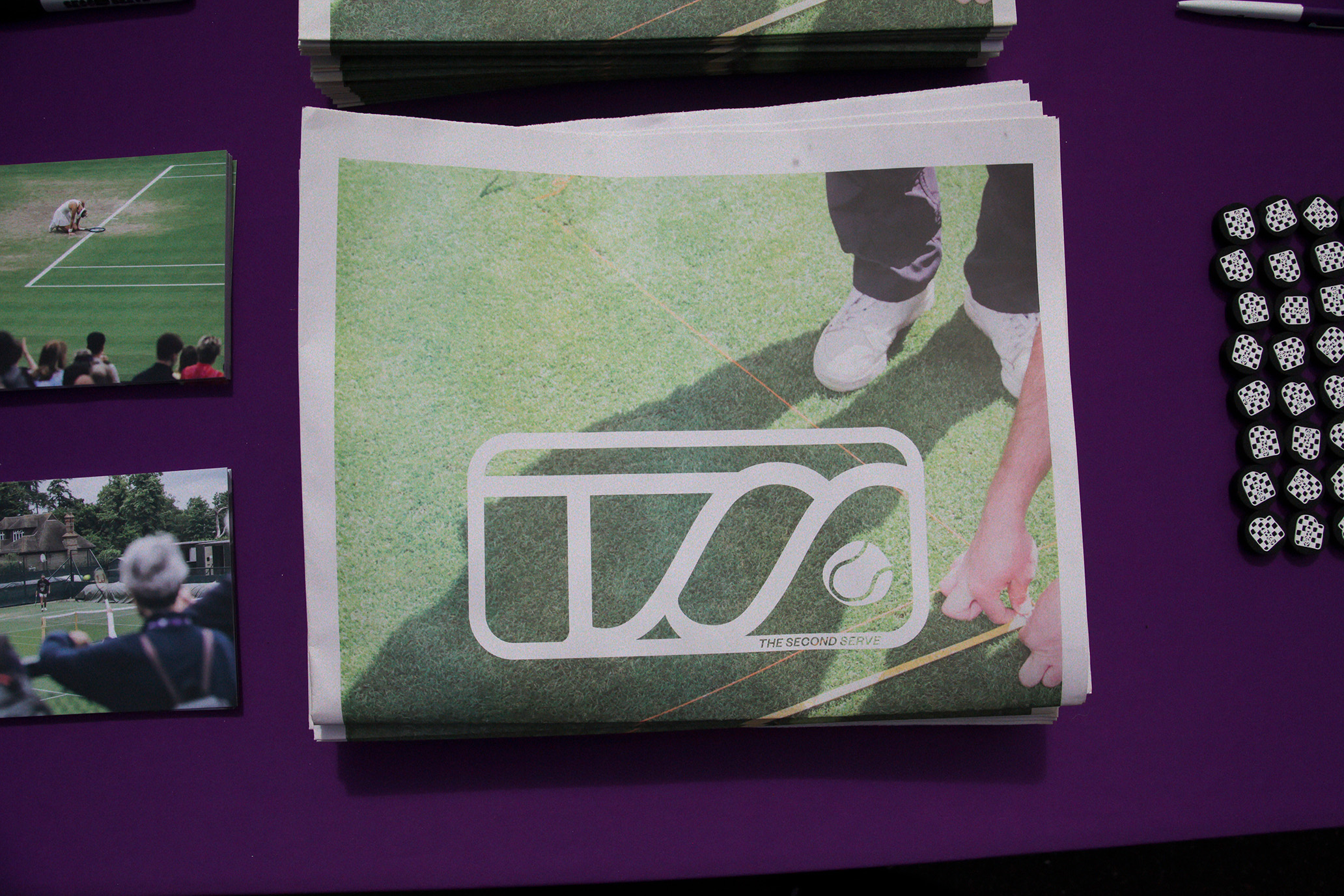
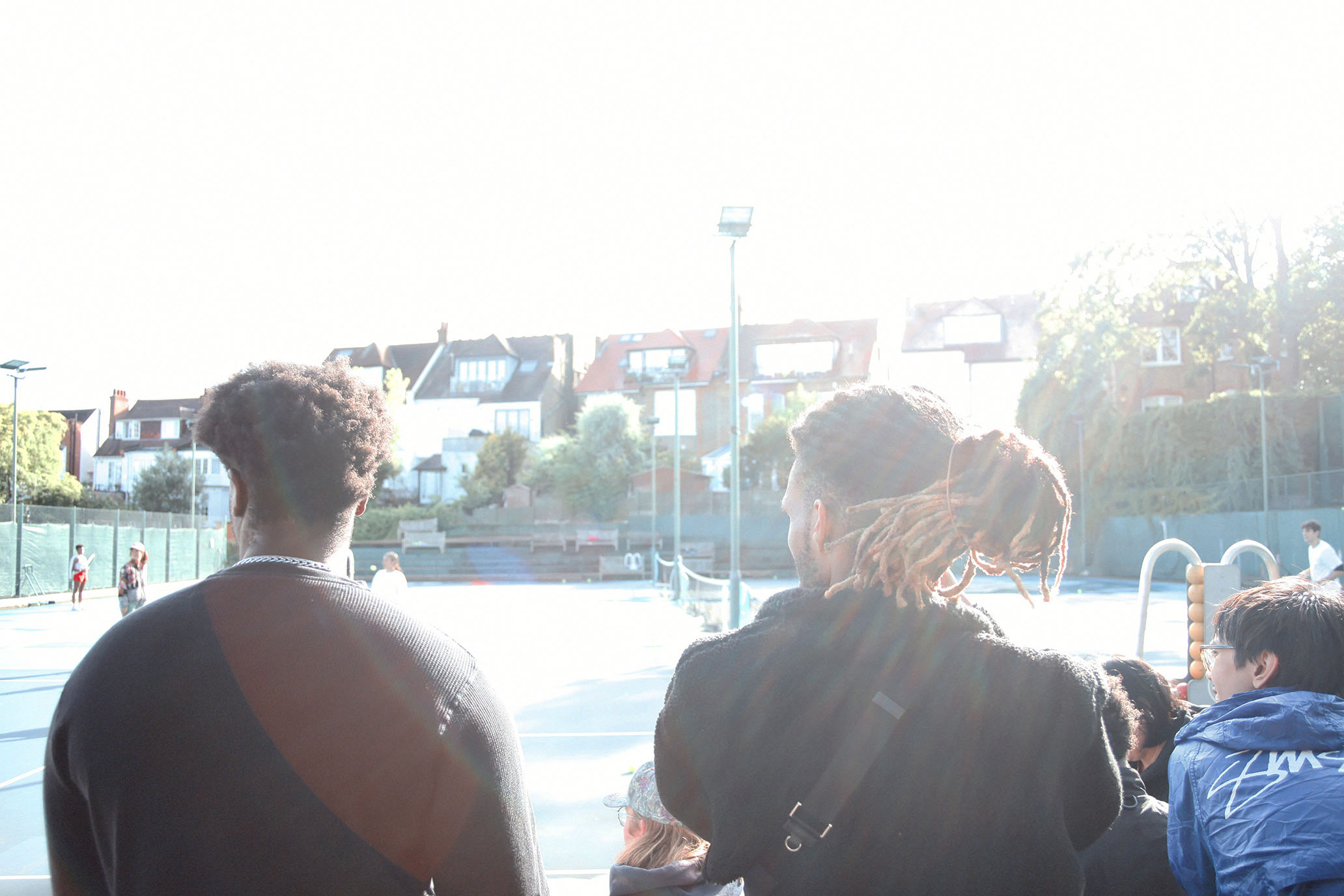
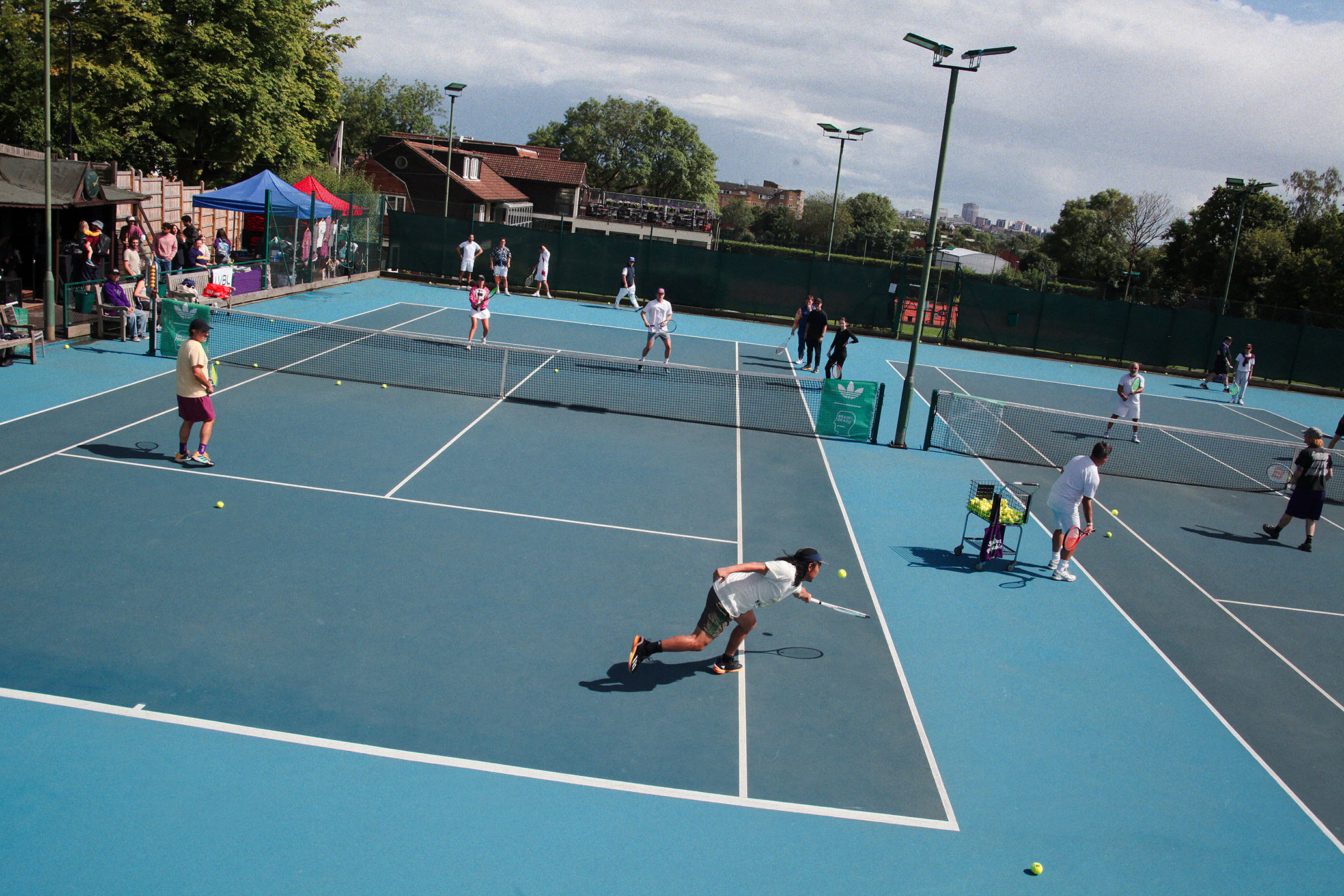
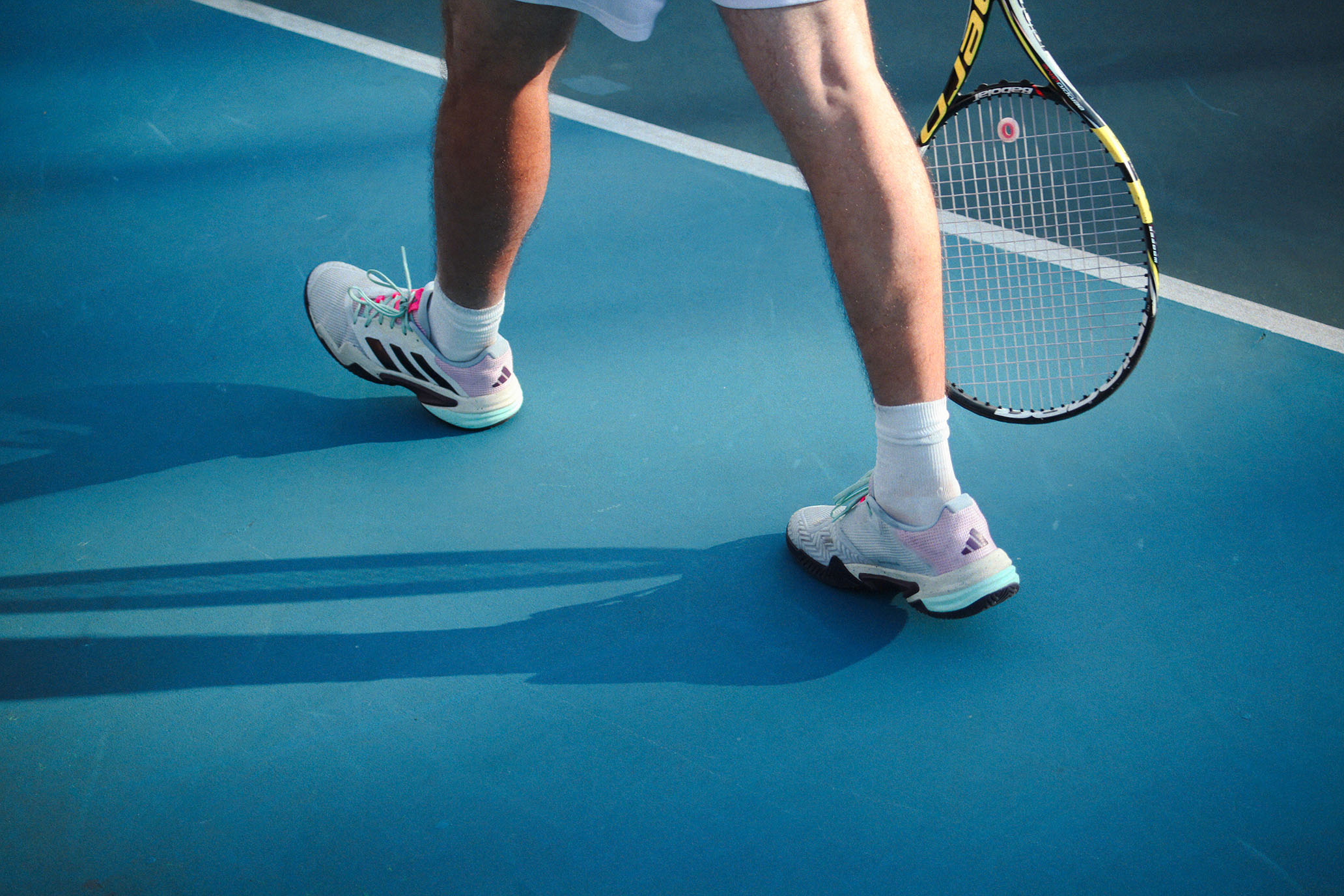
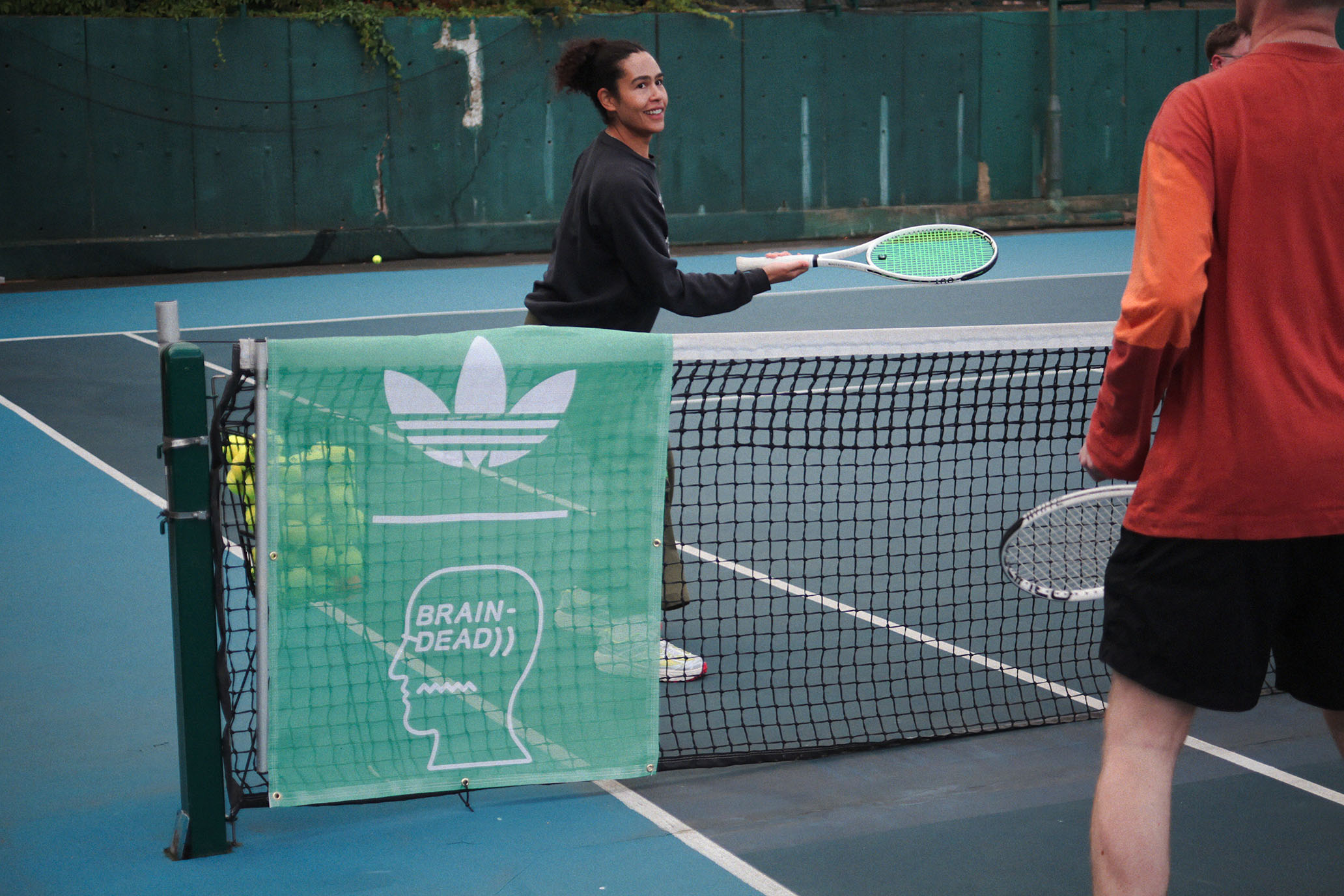
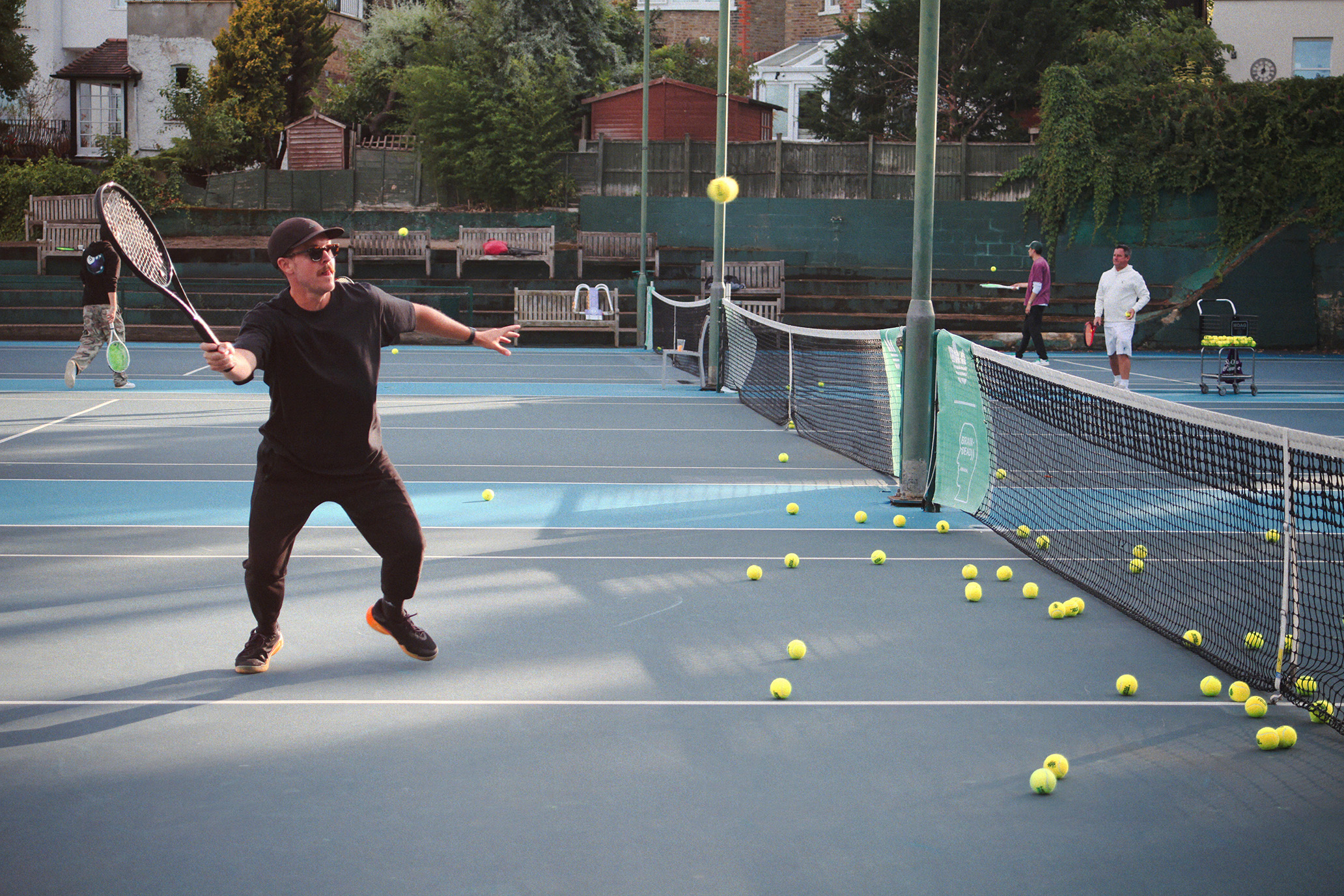
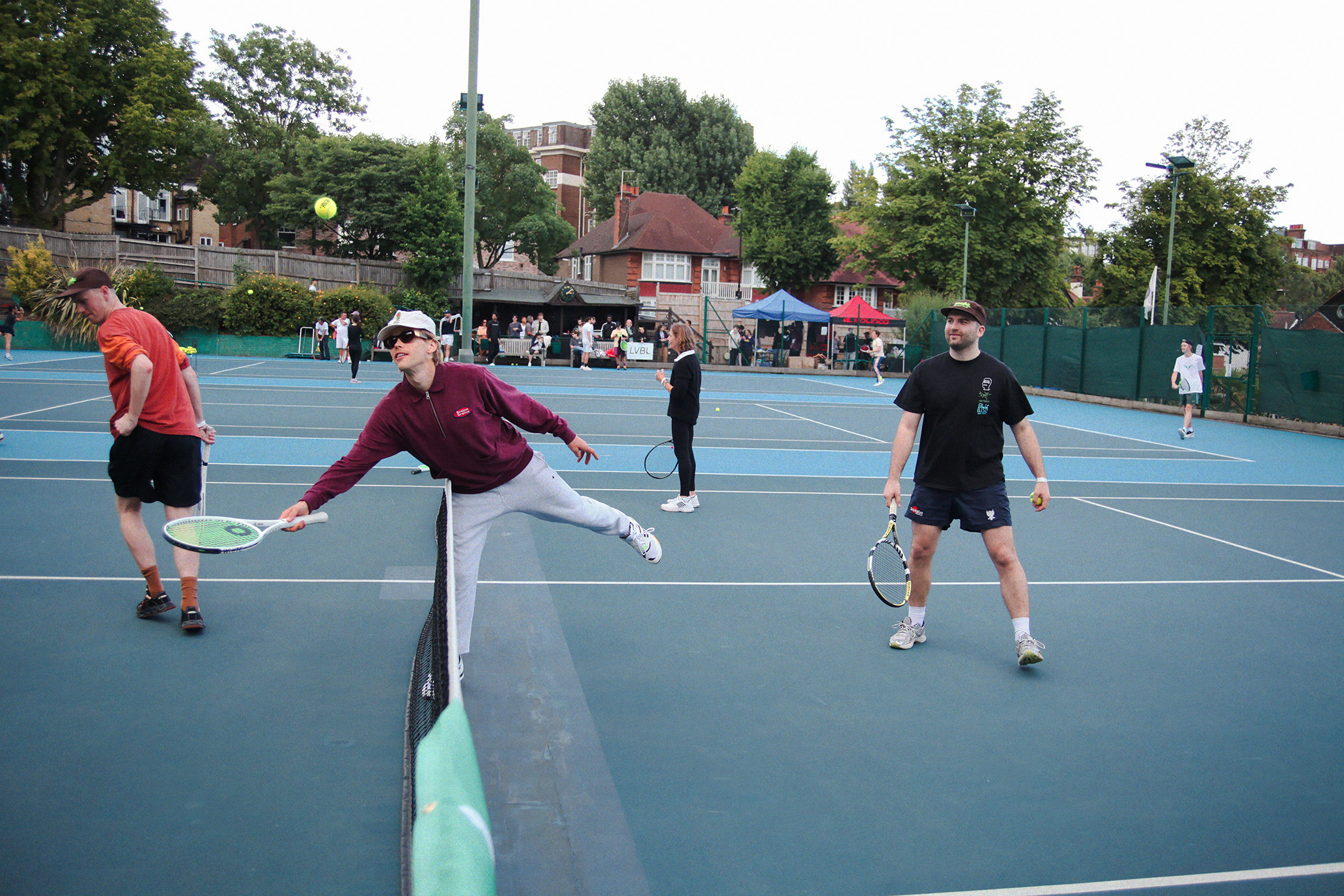
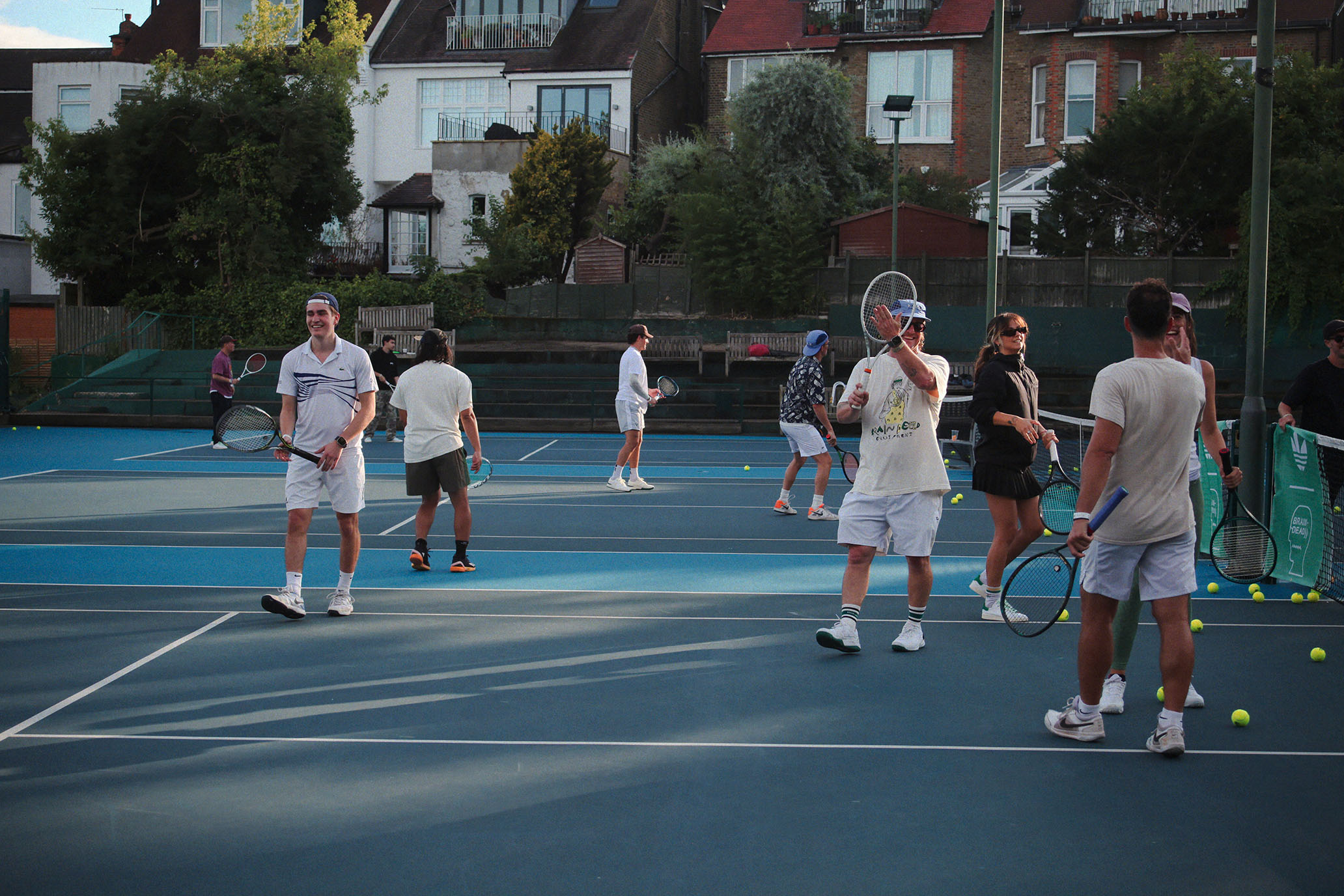
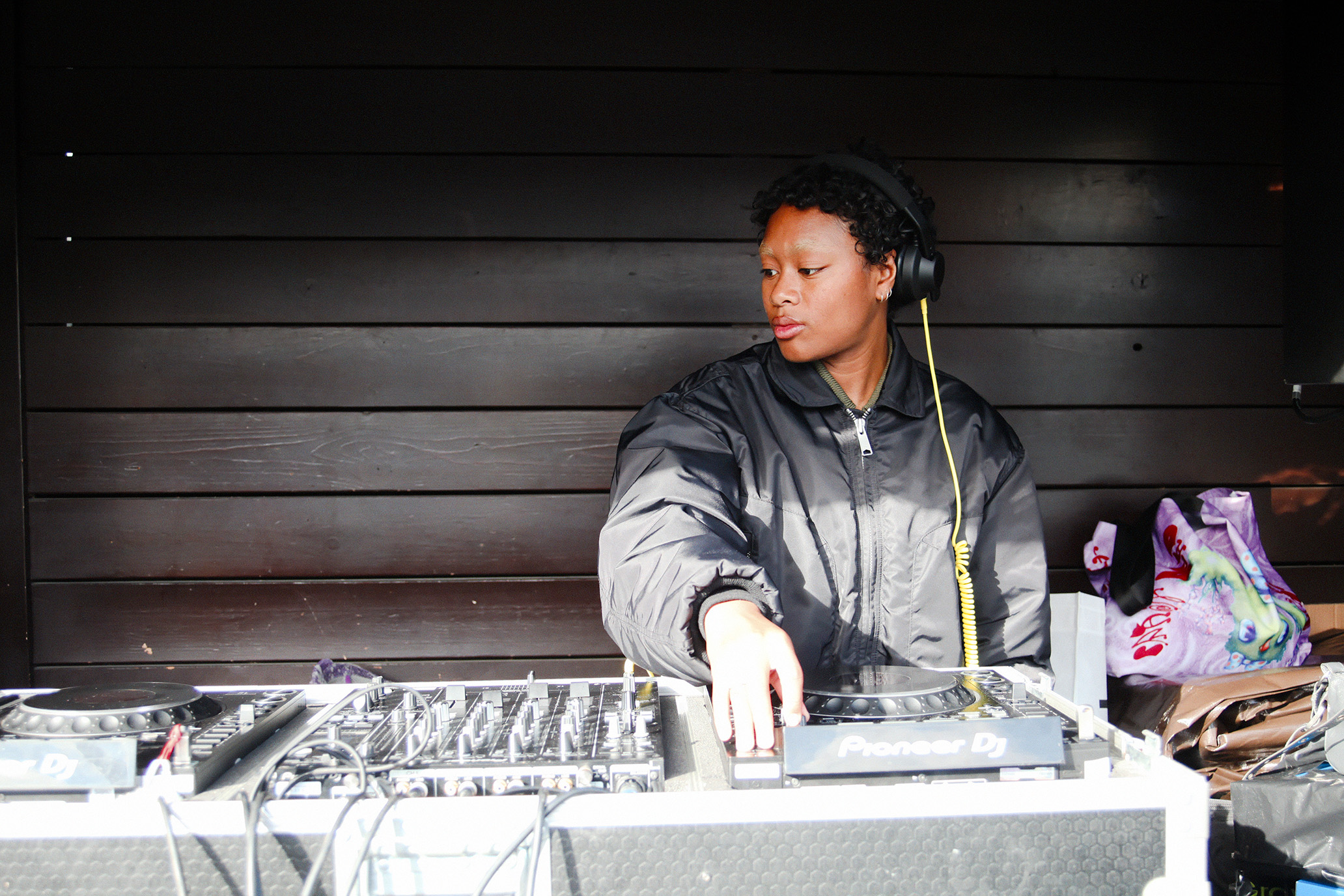
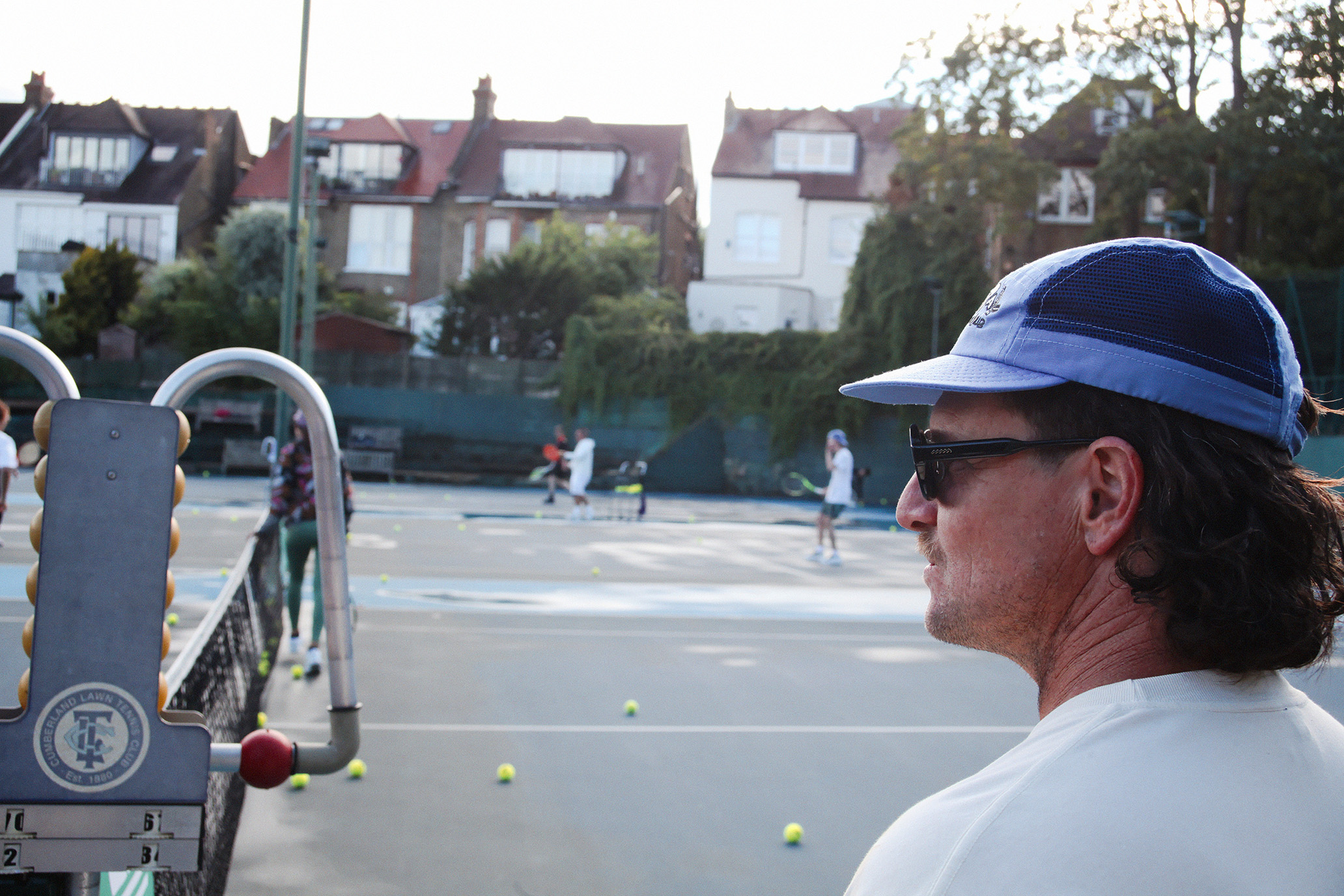
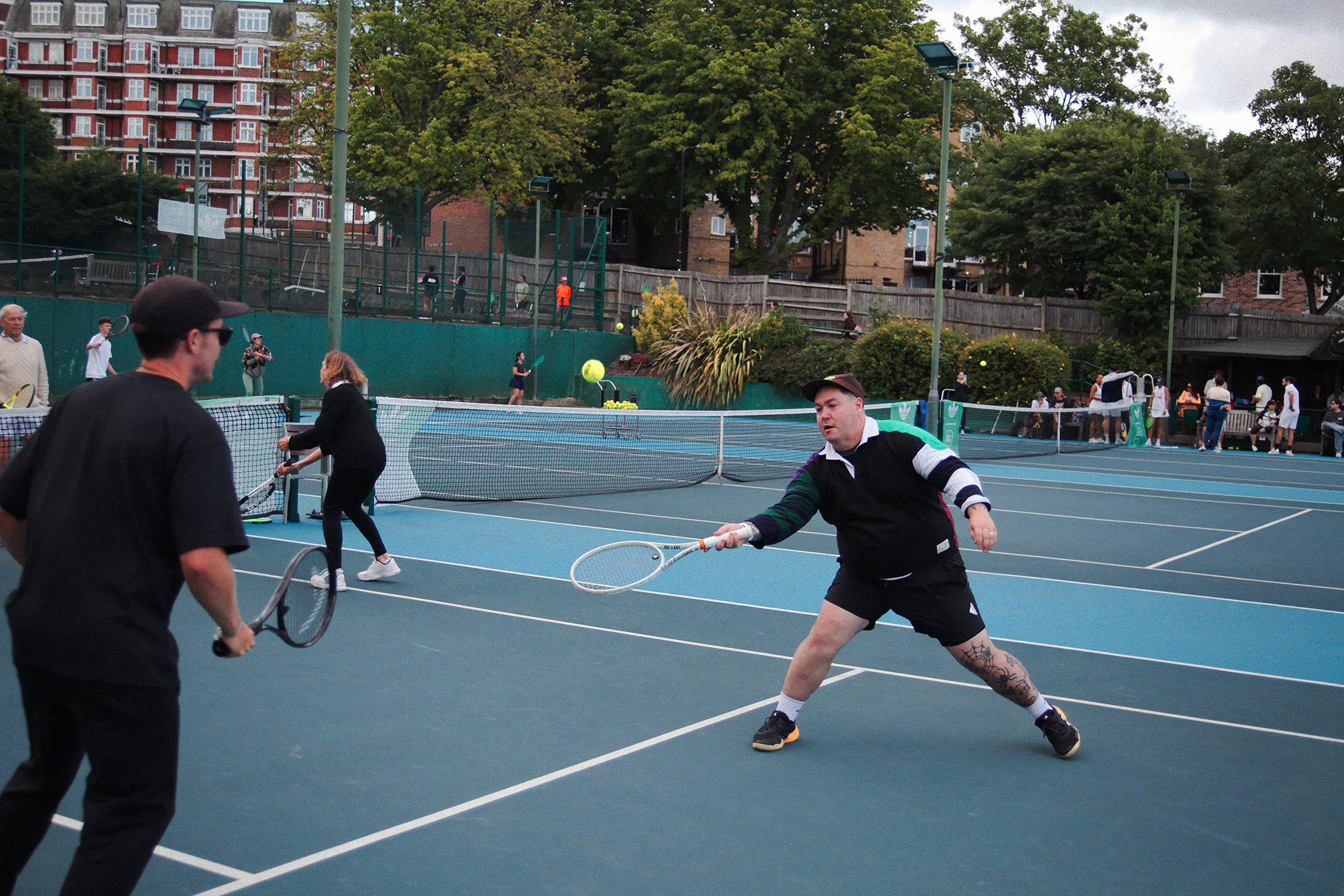
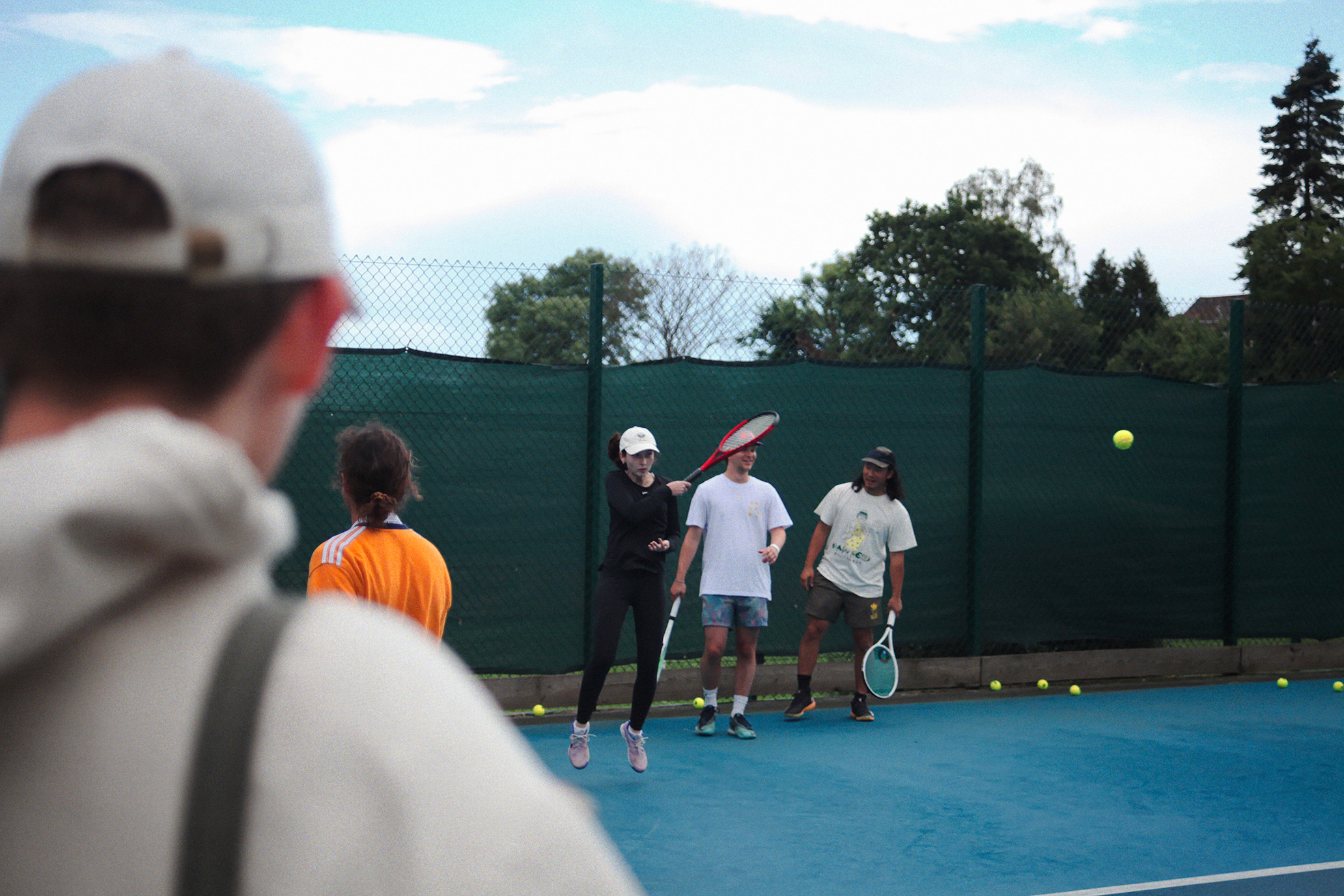
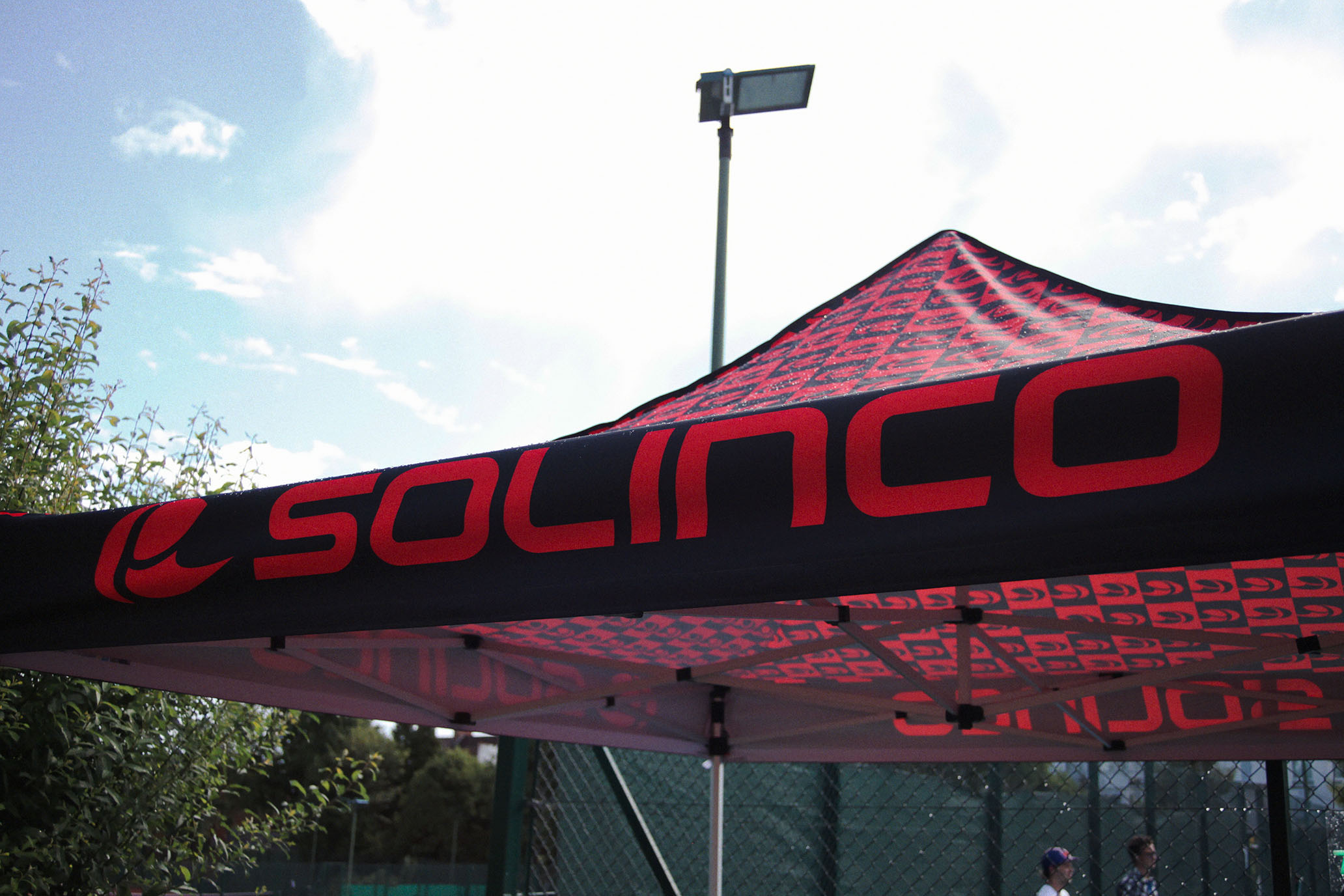
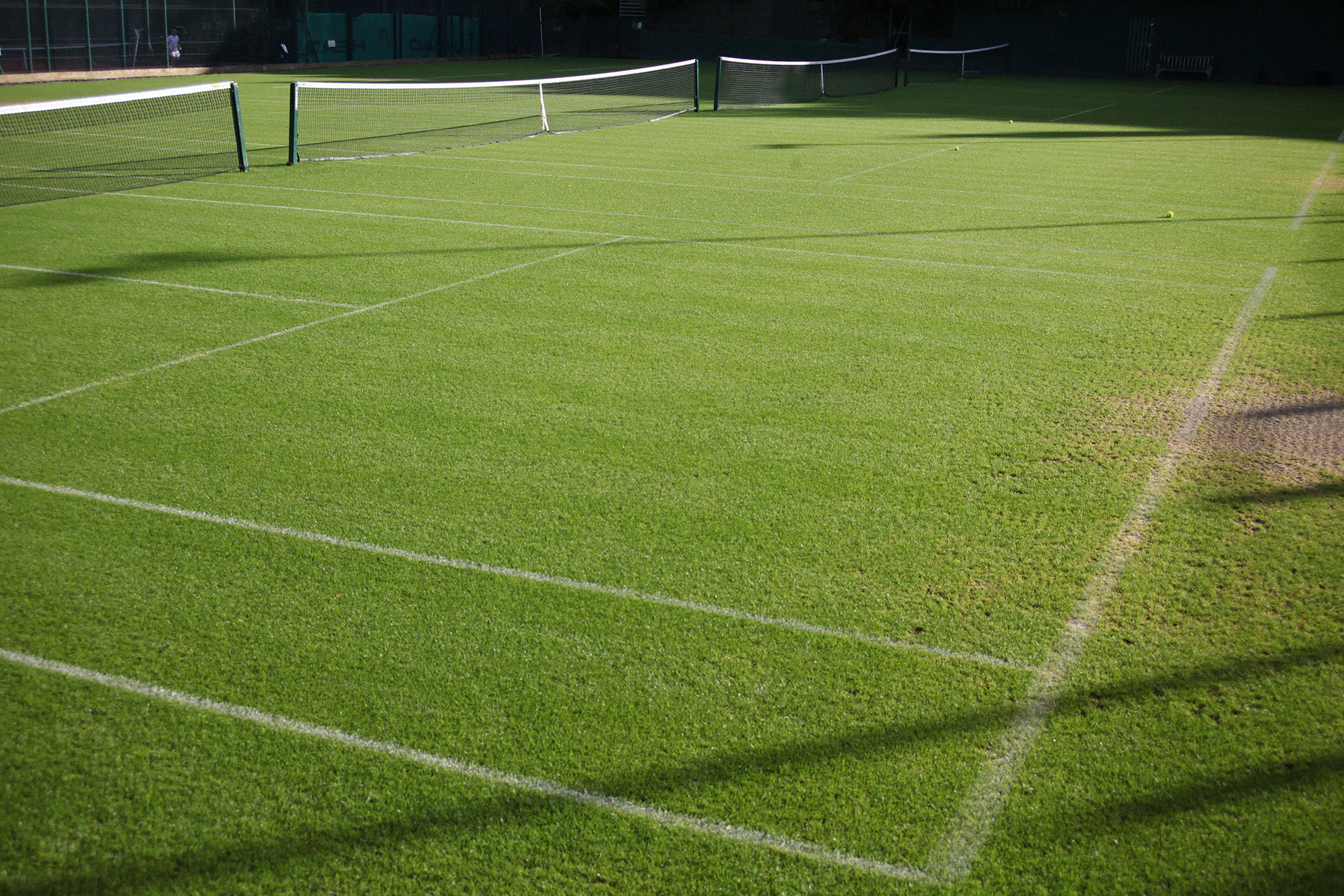
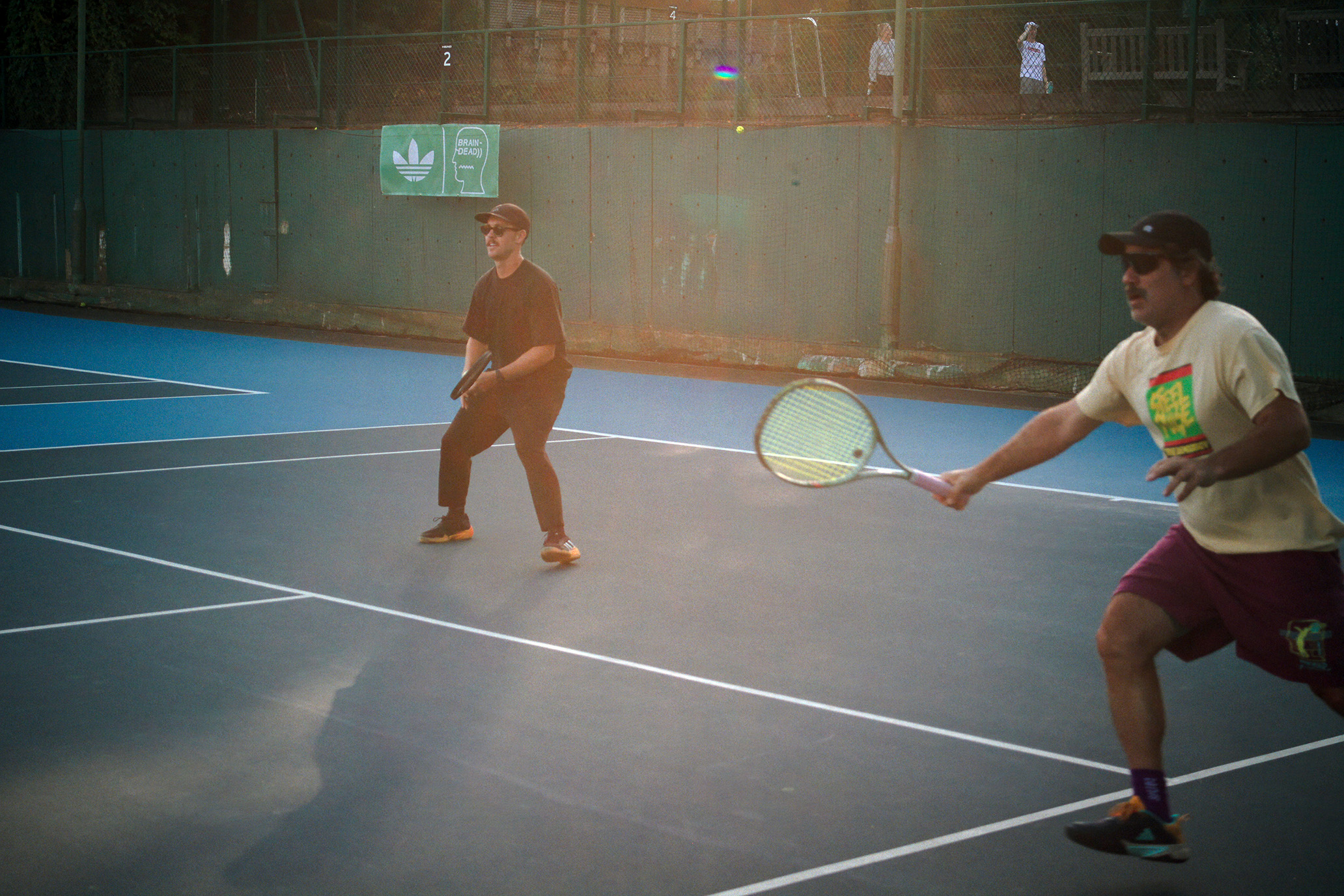
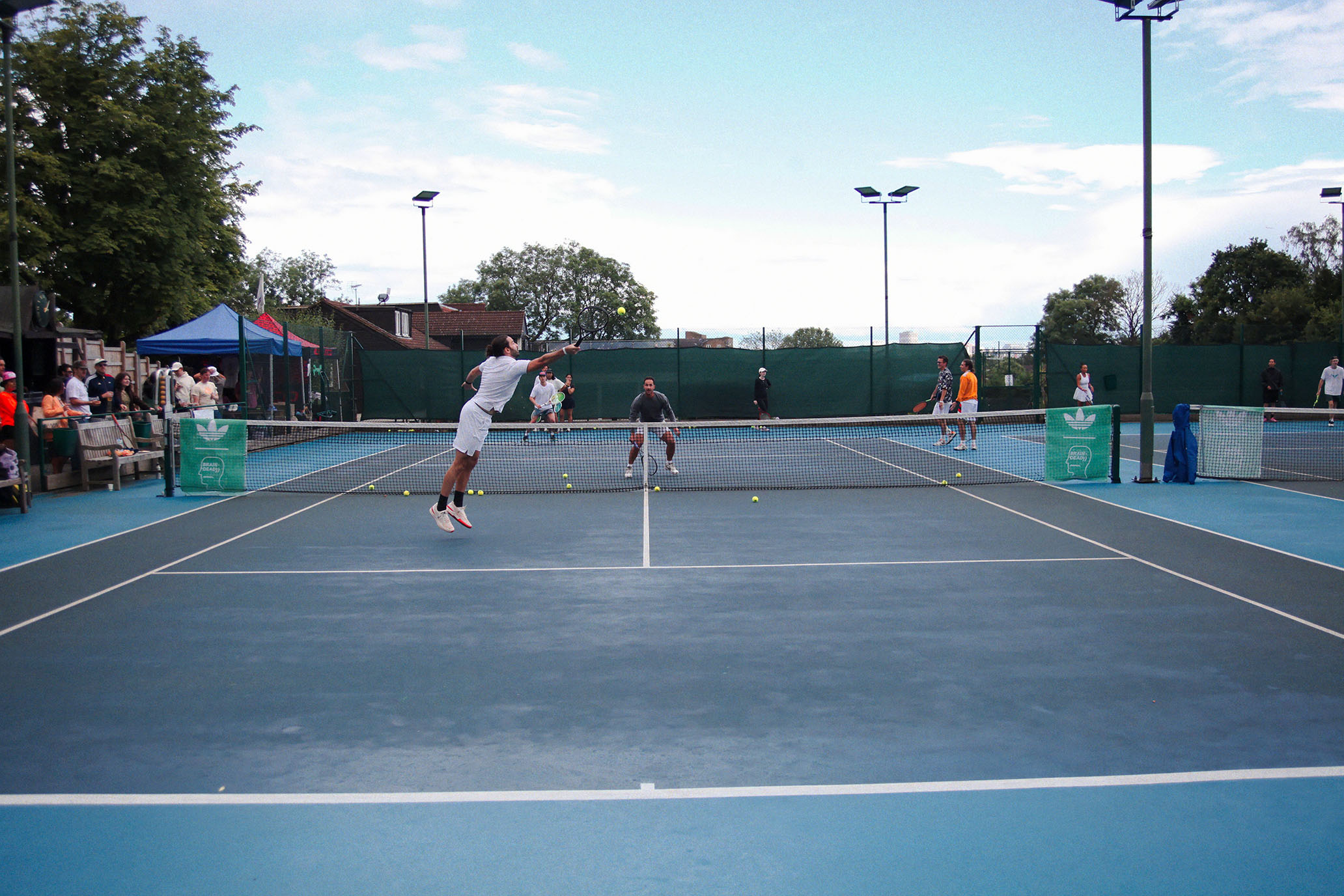
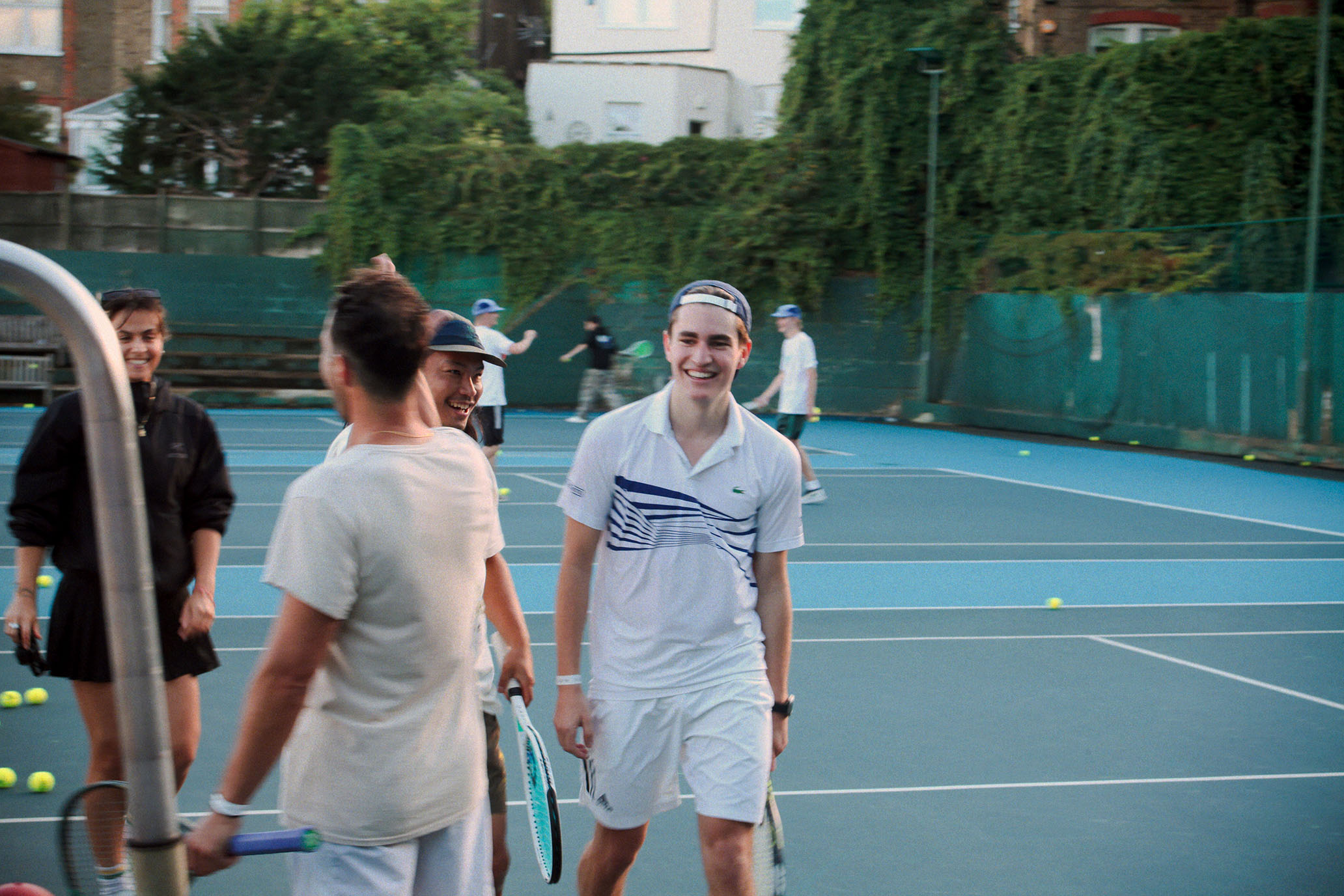
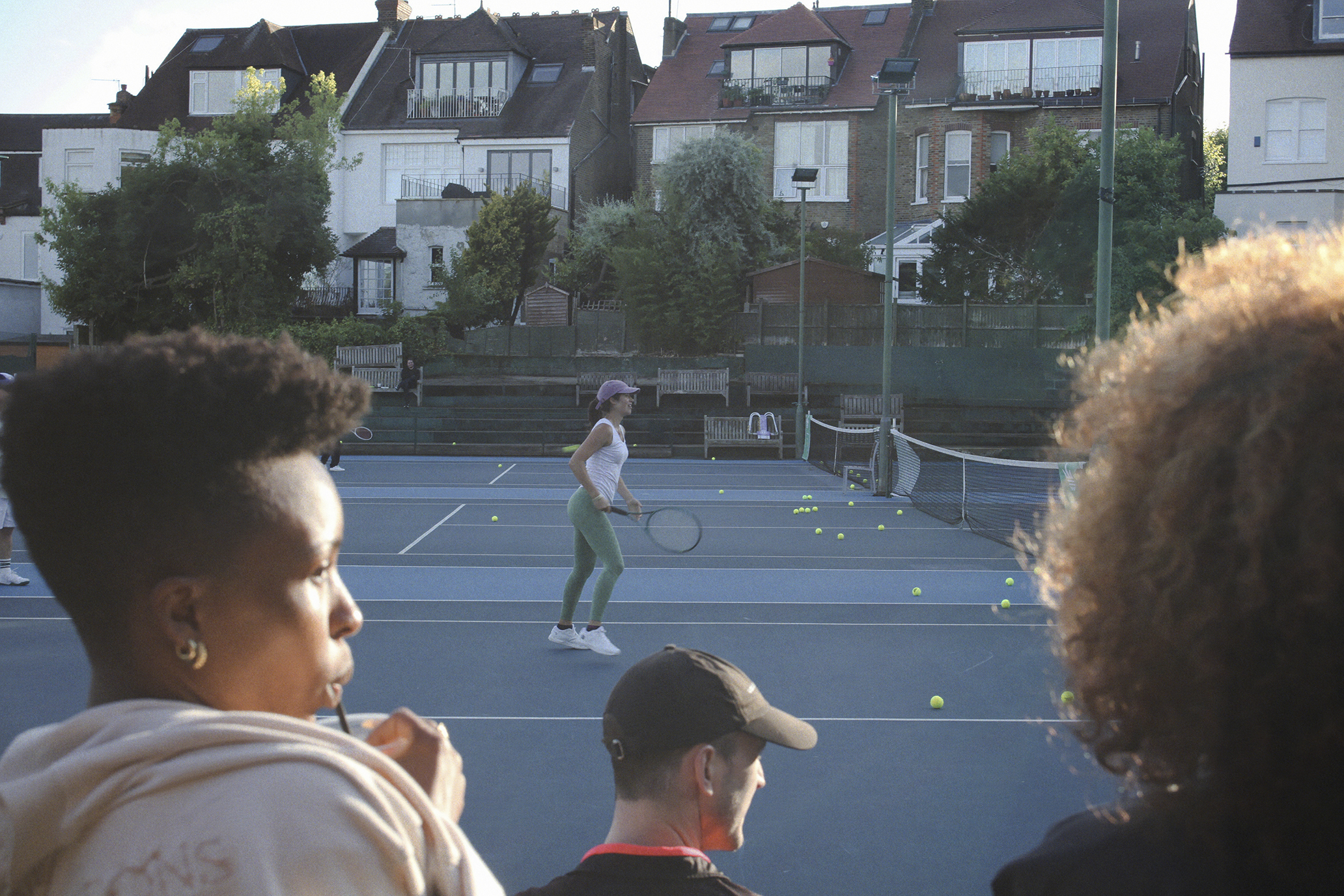
As if by miracle, a soggy fortnight saw a break in the clouds long enough for the LA-based brand Brain Dead to pull off a smashing, super vibed out event with partners Adidas, LVBL, Solinco and The Second Serve, as they launched the first iteration of their “Unstructured” Stan Smith sneaker, which was available exclusively at the event—held at the Cumberland Lawn Tennis Club—and Dover Street Market, London.
While winking at future collaborations with Adidas and offering a peek into their latest tennis drop, the Brain Dead x Adidas Tennis Jam also brought LA’s LVBL culture and format to the courts of London for the first time. Along with private coaching from popular UK YouTube tennis instructor, The Tennis Mentor, players and spectators alike were treated to a rare, revelatory tennis event which showed how the game combined with community, music, and authentic culture can grow the sport in unprecedented ways.
SIGN UP — YOU'RE ONLY AS GOOD AS YOUR SECOND SERVE.



SIGN UP — YOU'RE ONLY AS GOOD AS YOUR SECOND SERVE.
An Avatar of Fluidity and Feel
An Avatar of Fluidity
and Feel
An Avatar of Fluidity
and Feel
There’s an Italian man in the Semis, and it’s not who you’d have expected.
There’s an Italian man in the Semis, and it’s not who you’d have expected.
By Giri Nathan
July 11, 2024
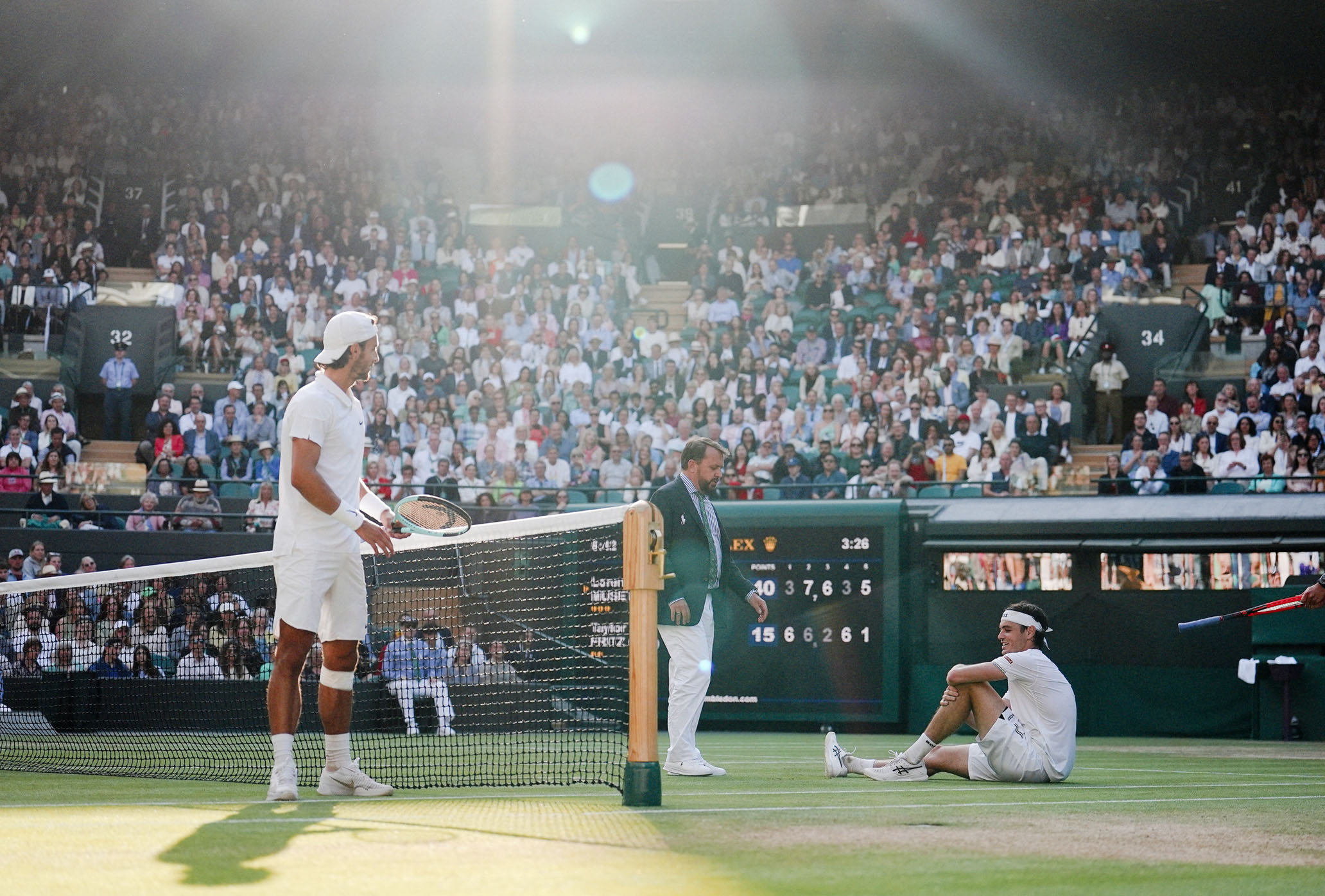
Lorenzo Musetti is left standing after a knock-down-drag-out match against Taylor Fritz. // AP
Lorenzo Musetti is left standing after a knock-down-drag-out match against Taylor Fritz. // AP
Hey, look—not all at once—there’s an Italian man in the Wimbledon semifinals. It is not, however, the Italian man you were expecting to see. It’s probably not your second guess, either. Those two guys slugged it out last week, and Jannik Sinner survived that testy second-round stress test from Matteo Berrettini. Sinner, playing in his first-ever major as the top seed, floated through the next two rounds, never in much of a patch of peril, only for his Wimbledon to be cut short in the quarterfinals by a vengeful octopus. Daniil Medvedev, who, after winning his first six matches against Sinner, had lost the last five in a row, managed to stop the bleeding here on the lawns of SW19. It was an exacting, resourceful performance from the player who lost to Sinner in the Australian Open final despite a two-sets-to-none lead, a reminder that Medvedev is more than talented enough to trouble the two prodigious punks who’ve passed him by in the rankings. Sinner, who looked ashen-faced in the middle of the match and took an 11-minute medical time-out for dizziness, has already pulled out of what would’ve been some pre-Olympics clay warm-up in Bastad next week. But meanwhile, on the other side of the draw, another 22-year-old Italian went where Sinner could not: the No. 25 seed with the whooping ground strokes, Lorenzo Musetti.
Musetti is a born stylist on the court, an avatar of fluidity and feel, and many have hoped he’d close the gap between how fun he was to watch and how good he was at tennis. Early in his career he had a whiff of prodigy about him, entering the top 100 as an 18-year-old in the spring of 2021, but he plateaued over the next year, which he attributed to increased pressure and some post-breakup blues. (He has since become a married father!) He clearly has some skills that bother even the best players, and the statement wins would trickle in every so often, typically on clay: Carlos Alcaraz in Hamburg 2022, Novak Djokovic in Monte-Carlo 2023. (Just don’t ask poor Lorenzo about the two separate instances at Roland-Garros where he won two sets against Djokovic before having the life slowly smushed out of him, boa constrictor-style, in 2021 and 2024.) Amid hard-court struggles, it seemed for a while that Musetti would top out as a clay specialist. He is a true dirtballer, controlling rallies with shape and depth. But he seems to be developing a taste for dirt with grass growing in it, too. He is enjoying perhaps the most consistent grass-court season of anyone on tour, with a semifinal in Stuttgart, a final at Queens Club, and now five more wins in gray London.
There are aspects of Musetti’s game that serve him well on both of the natural surfaces. There’s the movement, which is precise and versatile, nullifying the challenges of each, allowing him to defend well on grass and set up his offense well on clay. He can tweak it as needed. This week he has looked just as comfortable playing in Medvedevian deep court positions as he has playing cat-and-mouse points in the front court. And there’s all the pure talent in his hands. Musetti’s got some unteachable touch, which is most apparent in his drop shots and slices but also shines through in his return of serve. For many a one-handed backhand, the return spells death; see dire entries for “Shapovalov, Denis” and “Tsitsipas, Stefanos.” The ball comes in too hot and heavy to time cleanly, and they lack the added stability of a second hand, so they end up slashing at the serve in desperation, with brutally shanky results. But Musetti is a refreshing counter to this trend, even on grass, where the sliding balls complicate the returner’s task even further. Musetti’s deft hand skills open up a whole world of chip returns, letting him block the ball into play with little risk of error and still keep the ball at an awkward height and depth for the opponent.
Those returns tormented Taylor Fritz throughout their five-set quarterfinal on Wednesday. Fritz, who has had to deal with Novak and Rafa misery in all four of his previous major quarterfinals, probably felt cool relief at the sight of a mere Musetti across the net. But he never found a workable solution for the Italian’s variety, for the slice and depth-related high jinks, backed up by some standard-issue baseline bashing. Musetti often liked to chop the ball shallow in the court, daring the net-averse American to move forward and dance at the net. It was the right tactic against Fritz, who has improved his movement throughout his career but won’t be confused for a natural all-court player; just keep him scrambling, never let him feel balanced, and he won’t be able to dial in those technically flawless ground strokes. Musetti said as much afterward: “With a good baseliner like Taylor, if you play every time flat, I cannot win a point. I mean, I’m playing his game. So probably it was the strategy to try to mix every ball and try to lead the game.” He noted that variety has been fundamental to his tennis since he was a kid, and that he never liked being—bless the curious English of tennis players—“mono-automatic on the court.” Musetti saved his best for the fifth set, which he blew open with a double-break before securing the 3–6, 7–6, 6–2, 3–6, 6–1 win.
I would’ve bet good money that Musetti’s first major semifinal would come in Paris, but he’s done it here instead, having survived an in-form Fritz and the service hellfire of Giovanni Mpetshi Perricard in the last two rounds. The dubious reward for his newfound grass-court brilliance: a well-rested Novak Djokovic, who erased Holger Rune in the fourth round and got an Alex de Minaur walkover instead of a quarterfinal. Musetti will need something new for that familiar opponent. The Fritz game plan would not be so effective against Djokovic, who, despite being a month removed from meniscus surgery, is still scooting and sliding around the court the way he has for years and is far more practiced at finishing points at the net. Musetti will have to rummage around amongst his many options and find something else. And if he somehow manages to win two sets, he’ll have to stay cool and block out any intrusive memories of how that’s gone for him, historically. Woof!
SIGN UP — YOU'RE ONLY AS GOOD AS YOUR SECOND SERVE.
Leave Blood on the Court
Leave Blood on the Court
Leave Blood on the Court
It is always possible to find an Australian-related tennis anniversary.
It is always possible to find an Australian-related tennis anniversary.
Joel Drucker
July 10, 2024
Leave Blood on the Court
Leave Blood
on the Court
It is always possible to find an Australian-related tennis anniversary.
It is always possible to find an Australian-related tennis anniversary.
Joel Drucker
July 10, 2024
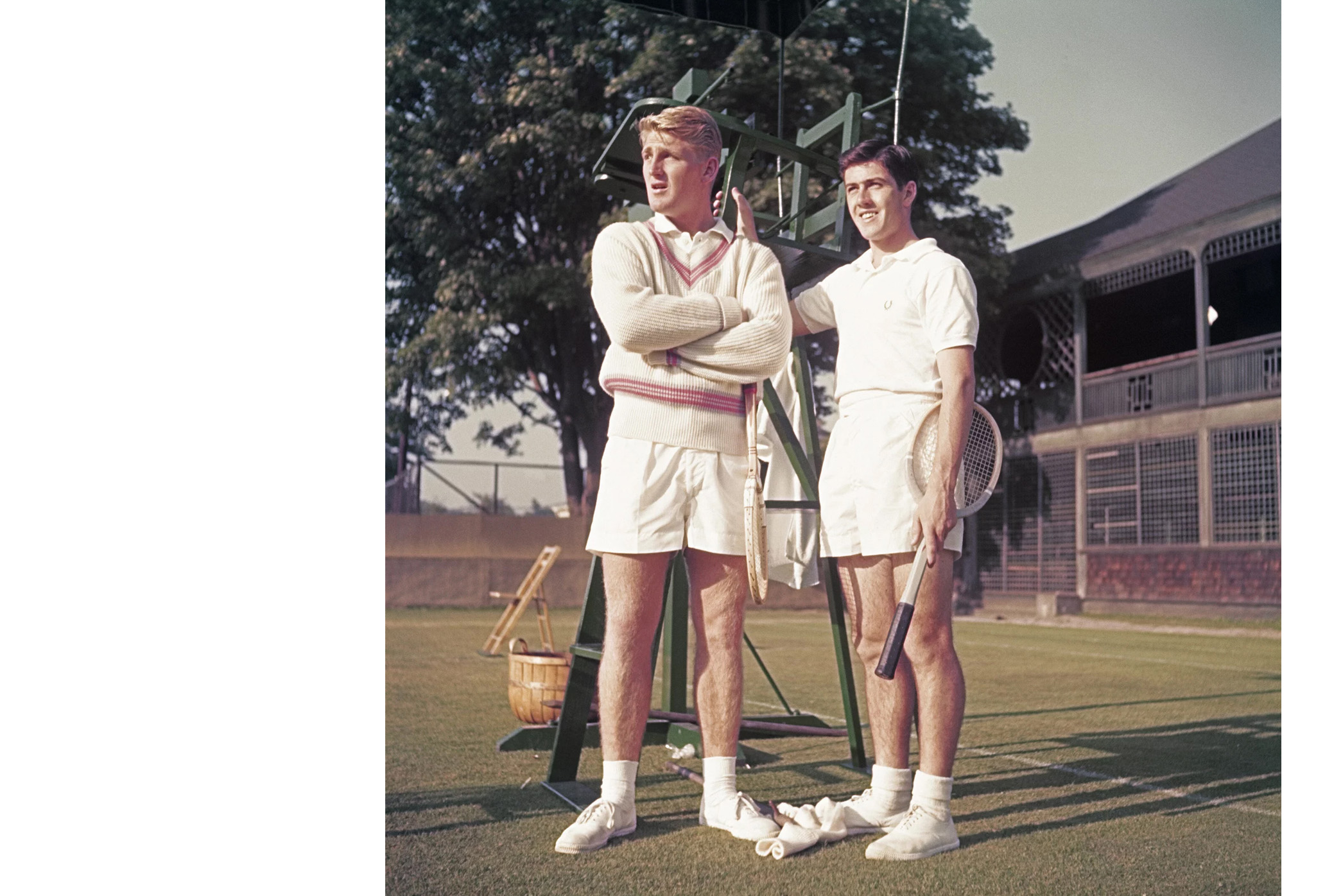
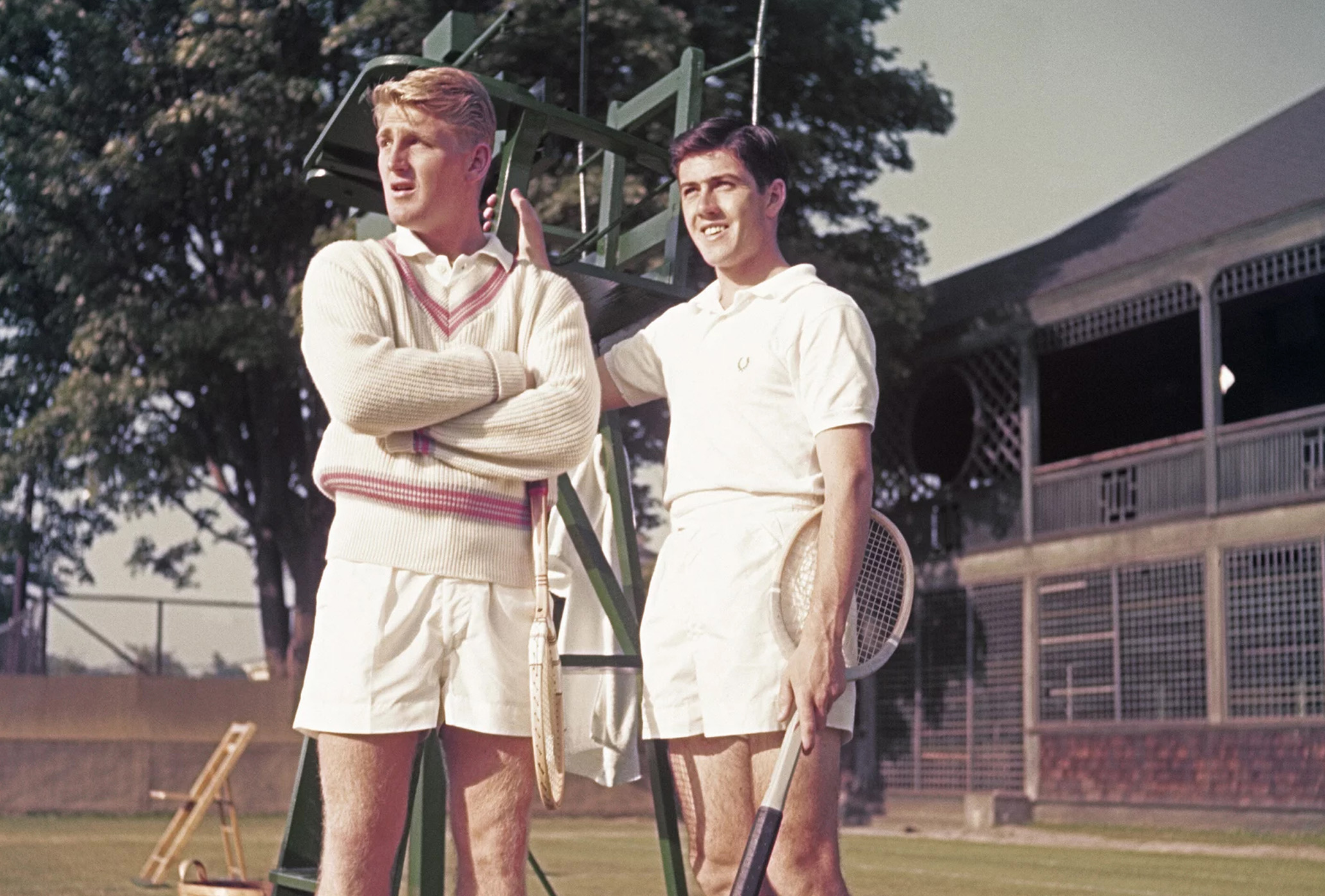
Lew Hoad and Ken Rosewall photographed by Slim Aarons // Getty
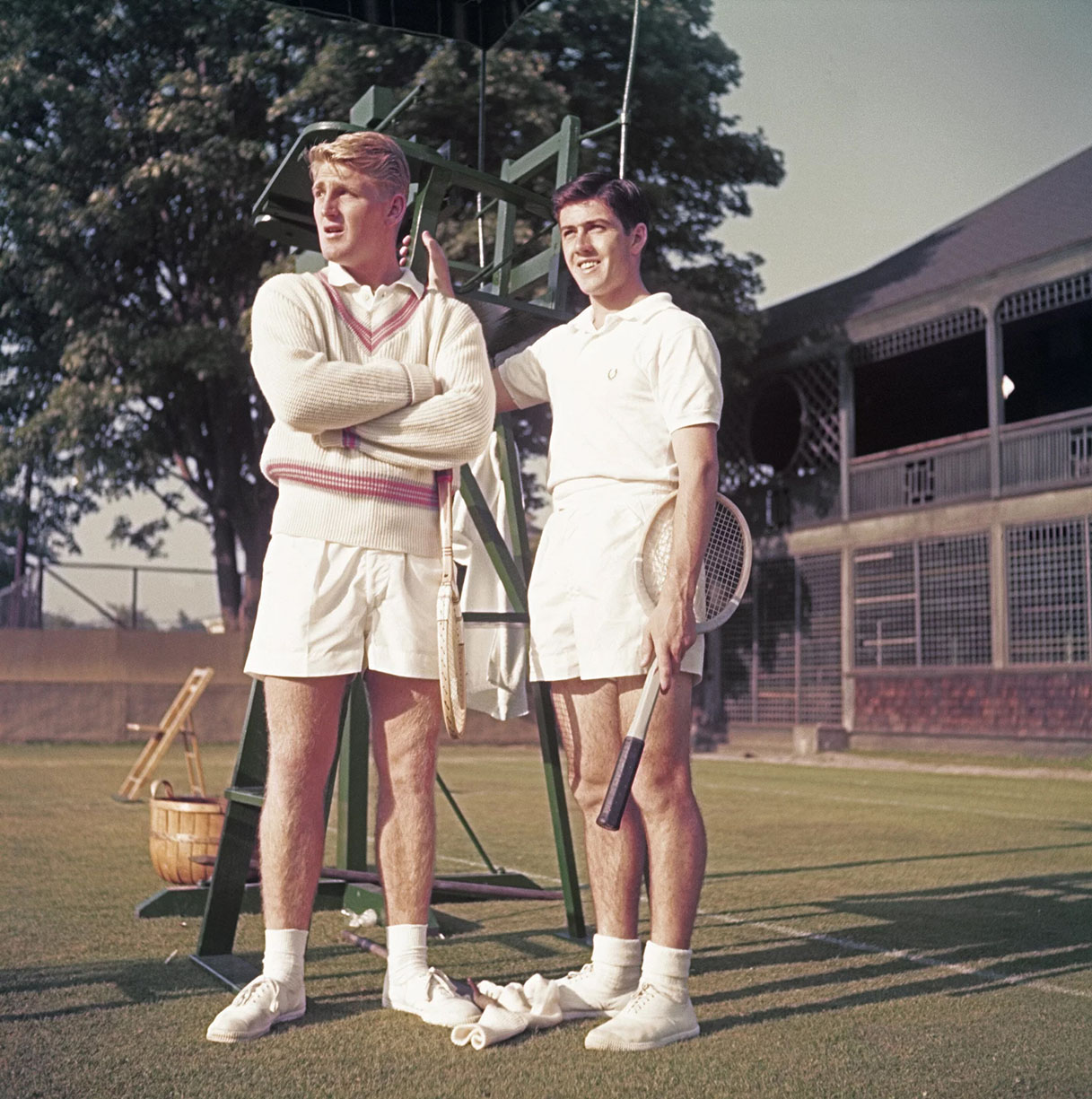
Lew Hoad and Ken Rosewall photographed by Slim Aarons // Getty
On a rainy Friday night in SW19, a five-minute walk from the All England Club, approximately 250 Australians gathered for a mid-tournament party conducted by Tennis Australia to celebrate a number of Wimbledon anniversaries. Festivities and history: a perfect Aussie tennis combo.
It’s been 20 years since Rennae Stubbs won her second women’s doubles title; 30 years since the Woodies earned their second of six at the All England Club; 40 years since Wendy Turnbull took the mixed; 50 years since Ken Rosewall reached his fourth Wimbledon singles final, the John Newcombe–Tony Roche duo won the Wimbledon men’s doubles title for the fifth time, and Evonne Goolagong took the women’s doubles; 60 years since Roy Emerson’s first of two singles victories, Fred Stolle captured the men’s doubles, and Margaret Smith Court and Lesley Turner Bowrey earned the women’s doubles. Turner Bowrey and Stolle in ’64 also won the mixed.
Those accomplishments were the party’s theoretical news hook. Of course, it’s always possible to find an Australian-related tennis anniversary. Many subcultures have their certain exemplars. In winemaking, there’s France. In painting, Italy. In tennis, no nation more than Australia personifies tennis’ supreme values. Emerson, winner of a men’s record 28 Grand Slam titles, articulates those principles as well as anyone: “Leave blood on the court or don’t bother playing,” goes one signature recommendation from the man lovingly nicknamed “Emmo.” Another addresses sportsmanship: “If you’re injured, don’t play. But if you’re not injured, there are no excuses.” And one particularly cutting comment from this friendliest of nations: “I have never played him when he was well.” But in the bigger picture, in the world of Australian tennis, words always take a back seat to action.
Less than 12 hours after attending Friday night’s party, I engaged in one of my favorite Wimbledon rituals. Many a Wimbledon morning, I’ll arrive on the grounds of the All England Club sometime between 8 and 10, take a seat on the vacated Centre Court, put on my headphones, listen to some personally meaningful music, and ponder the heart and soul of tennis. As Newcombe likes to say, “Centre Court is where you’ll be asked all of life’s questions.”
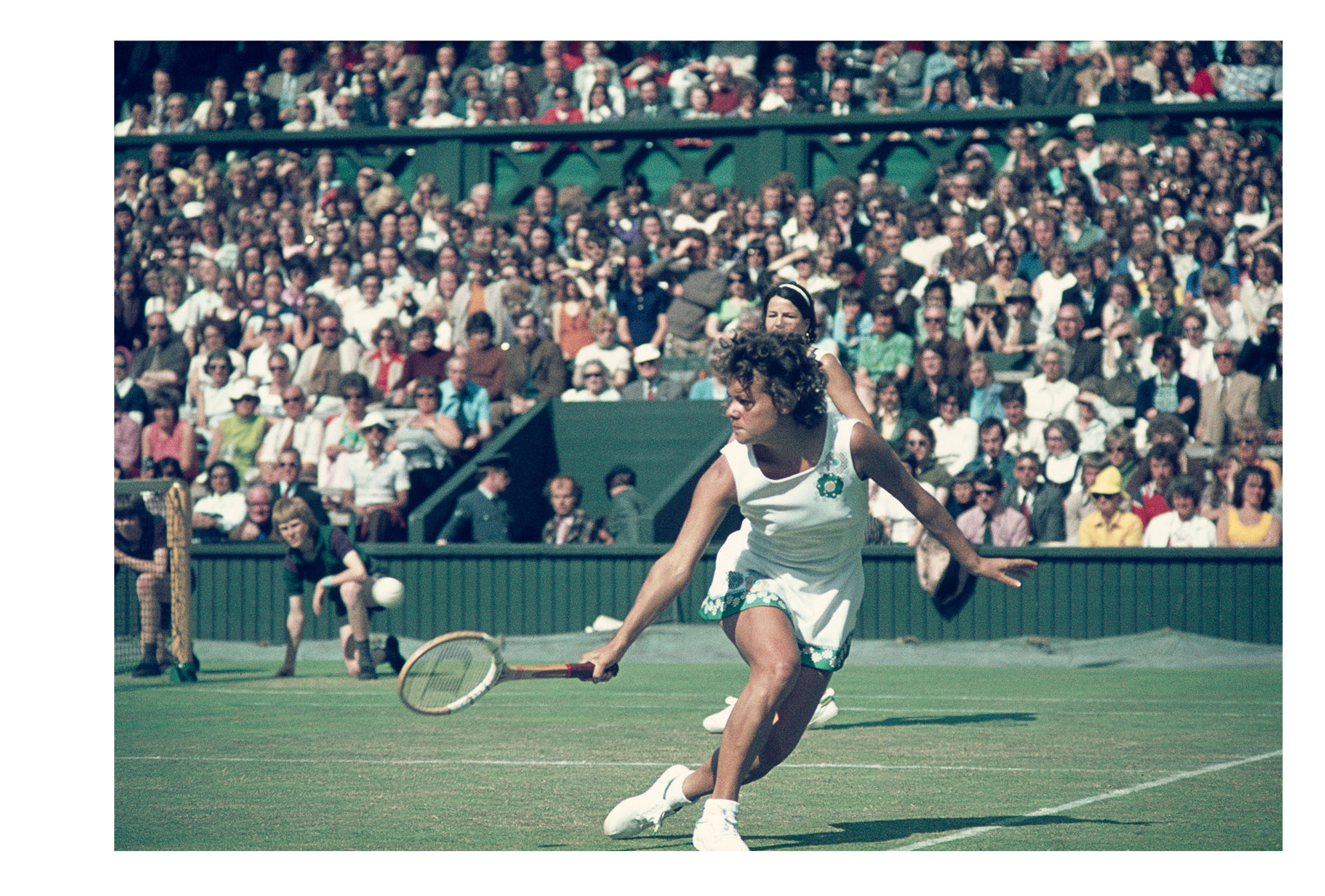
Evonne Goolagong at Wimbledon in 1974, when she won the doubles with Peggy Michel. // Getty
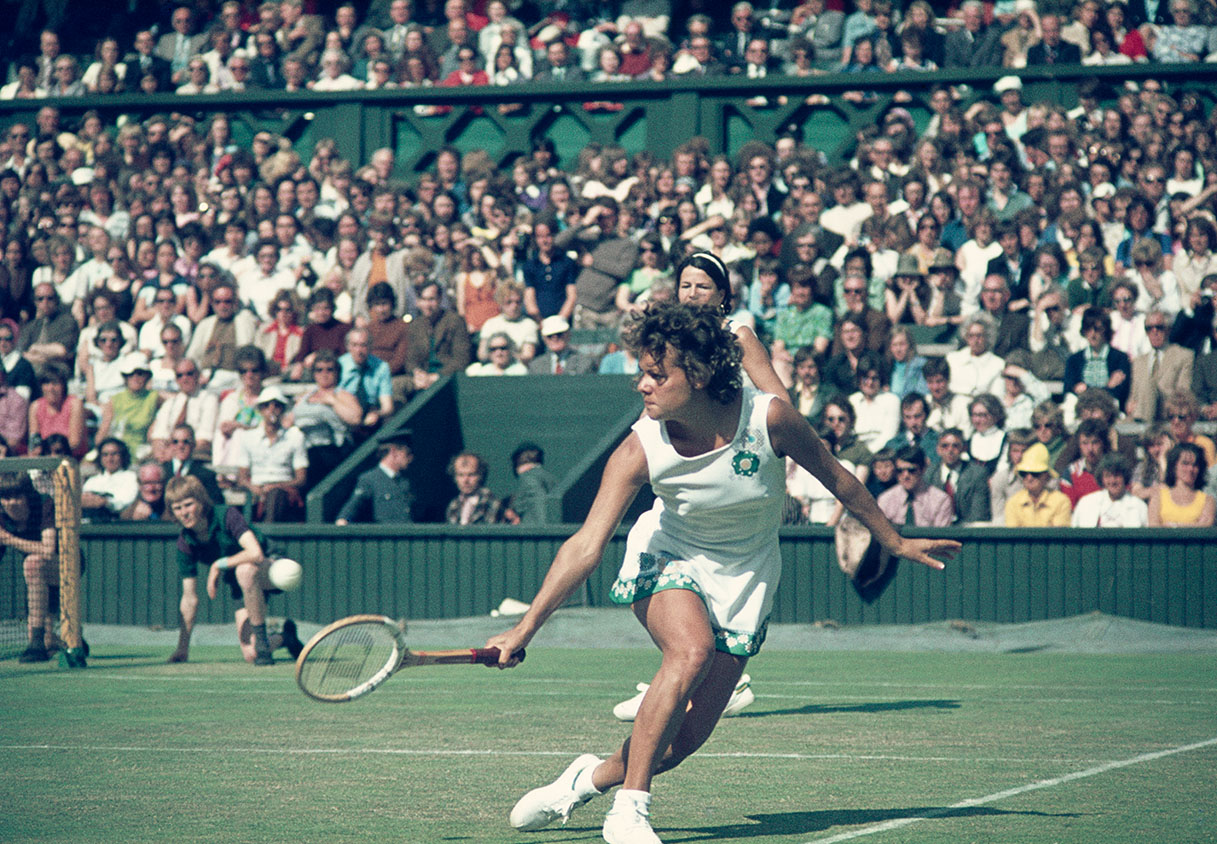
Evonne Goolagong at Wimbledon in 1974, when she won the doubles with Peggy Michel. // Getty
In the wake of Friday’s party, I clicked on the song “Cast Your Fate to the Wind,” then headed 71 years and nearly 10,000 miles southeast from contemporary Wimbledon. The year was 1953, and a 14-year-old boy on a farm in Queensland listened on a transistor radio to the heroics of another Australian teenager, this one from Sydney. The younger lad’s name was Rod Laver, taking in the great deeds of Rosewall, who at the age of 18 won titles that year at both the Australian Championships and Roland-Garros.
These two super-geniuses were present at Friday night’s party; Laver now 85, Rosewall 89. Laver is the four-time Wimbledon champion who also earned two calendar-year Grand Slams. Rosewall is the four-time Wimbledon finalist who ranks with Rafael Nadal and Pete Sampras as the only men to have earned majors in their teens, 20s, and 30s. The Laver-Rosewall rivalry spans hundreds of matches and thousands upon thousands of dazzling sequences and shots.
Though Laver won more often, in their finest battle, Rosewall emerged the victor. It happened in May ’72, at the WCT Finals, a tournament then considered even more prestigious than the current ATP Finals. Held in Dallas, the WCT tournament carried an unprecedented reward of $50,000. It also aired on NBC, at the dawn of tennis receiving significant airtime. Over the course of nearly four hours, with 21 million people watching, the two covered every possible inch of the court and closed out the match in a fifth-set tiebreaker—first man to seven points. With the 33-year-old Laver serving at 5–4, the 37-year-old Rosewall struck two glorious backhands—his signature shot—and extracted a return error from Laver to win the prize.
Friday night, Laver recalled his early teens. “I listened to what Ken was doing and thought, ‘I want to do that,’” he said. As he came of age, Laver modeled his game after Rosewall’s peer Lew Hoad. A few years later, the boy named Rod earned his way onto the traveling Davis Cup squad, where one common task was to squeeze orange juice, and another was to spend 8 to 10 hours a day at work—everything from a long run to five-set practice matches to two-on-one drills, doubles, and, as night fell, a series of sprints.
In his newly published and highly engaging book The Fox, a biography of Harry Hopman, Australian tennis’ head honcho from the ’30s through the ’60s, Aussie journalist Michael Sexton writes, “What they shared was peak physical fitness, an adherence to sportsmanship and a zeal for the contest.”
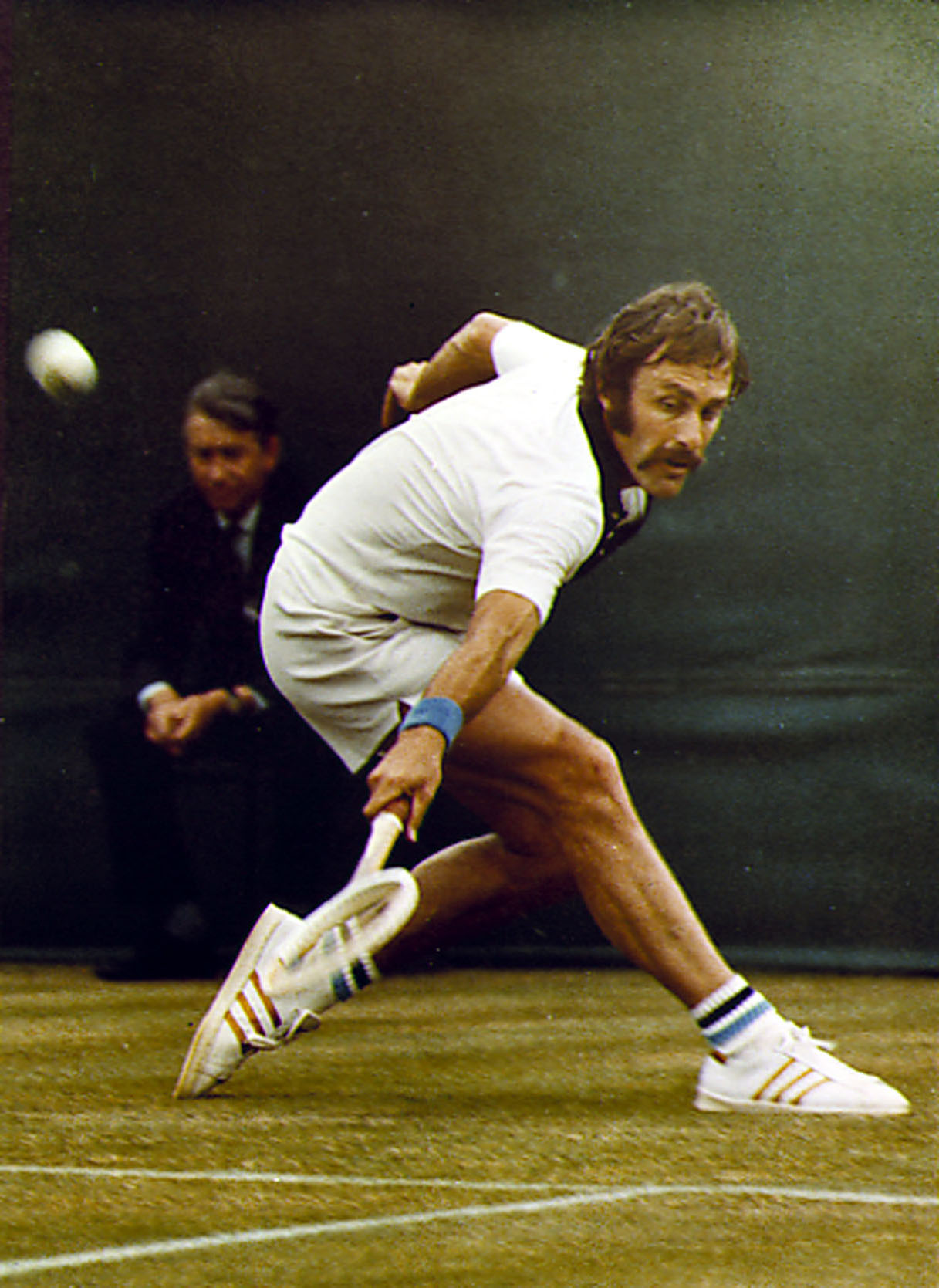
John Newcombe in 1974, the year he won the doubles with Tony Roche for the fifth time. // AP
John Newcombe in 1974, the year he won the doubles with Tony Roche for the fifth time. // AP
Hand in hand with the strong work ethic is the great Australian virtue of camaraderie. Aussies treat tennis as a team sport. Stubbs on Friday evening gave a shout-out to another attendee, Liz Smylie, a four-time Grand Slam champion who’d hit with Rennae when she was a teenager. Those cross-generational connections happen frequently Down Under; all part of Australia’s pursuit of collective glory. “We looked out for each other,” the late Owen Davidson once told me. “We practiced by day and enjoyed ourselves by night. And I’ll tell you this, mate: You’d always have another Aussie there to watch your match.” Based on all this, the case can be made that the Australian devotion to hard work is propelled less by personal ambition and more due to the spirit of friendship and loyalty. Could this nation’s relentless desire to win such events as Davis Cup be fueled most of all by love for one another?
Laver authored a book several years ago titled The Golden Era—that period from 1950 to ’75 when Australia dominated tennis. The legends from that brilliant quarter century are now in their 80s. While their period of on-court excellence has long passed, Australians remain right in the thick of the tennis dialogue. Their national championship, the Australian Open, has over the past 30 years greatly risen in stature, propelled most of all by its superb facility, Melbourne Park, and the arena named for Laver. Thanks to Roger Federer, who for a time was coached by Roche, the Laver Cup has created a unique place for itself in the game’s landscape.
Federer has also spoken about his high regard for Rosewall. For many years Down Under, Rosewall handwrote a note to Federer, wishing him good luck at the Australian Open. Subsequently, Rosewall would leave the missive with the locker room attendant. Asked why he didn’t bring it to Federer personally, Rosewall said, “I wouldn’t want to impose myself on Roger.”
Beyond the understated yet powerful presence of those two titans, Aussies pervade the sport in many other ways. Fitting indeed that a major reason for Jannik Sinner’s ascent has been the addition to his team of an Australian, Darren Cahill. There are also tons of Aussies offering their insights into the world of analysis and storytelling, from announcers like Cahill, Woodforde, Woodbridge, Stubbs, and Louise Plemming to cinematographer Matti Hill, producer Kim Knox, and strategy guru Craig O’Shannessy. Woodforde, Woodbridge, and Stubbs are playing the Wimbledon invitational doubles event, joined by their mates Lleyton Hewitt, Mark Philippoussis, Samantha Stosur, Ashleigh Barty, Casey Dellacqua, and Alicia Molik. An entire crew of print journalists are also at Wimbledon this year, including Australian Tennis magazine editor Vivienne Christie, Tennis Australia writer Leigh Rogers, Melbourne Age writer Marc McGowan, and Fox Sports reporter Courtney Walsh. Even the roguish Nick Kyrgios is giving a go at TV commentary. And let’s also cite long-standing WTA Tour supervisor Pam Whytcross.
The 2024 celebration of those years was of secondary importance to Australia’s deeper tennis footprint and its status as the sport’s torchbearer. Australians can always make news at a tennis tournament. But the story they’ve told for decades runs much deeper than any transitional occurrence. “Literature,” said poet Ezra Pound, “is news that stays news.”
Joel Drucker is happy that he was able to, as the Aussies say, “have a think” about this great nation’s massive tennis legacy.
SIGN UP — YOU'RE ONLY AS GOOD AS YOUR SECOND SERVE.
Stallions Only
Stallions Only
Stallions Only
Matteo Berrettini and Jannik Sinner bring Week 2 energy to the second round.
Matteo Berrettini and Jannik Sinner bring Week 2 energy to the second round.
By Giri Nathan
July 4, 2024
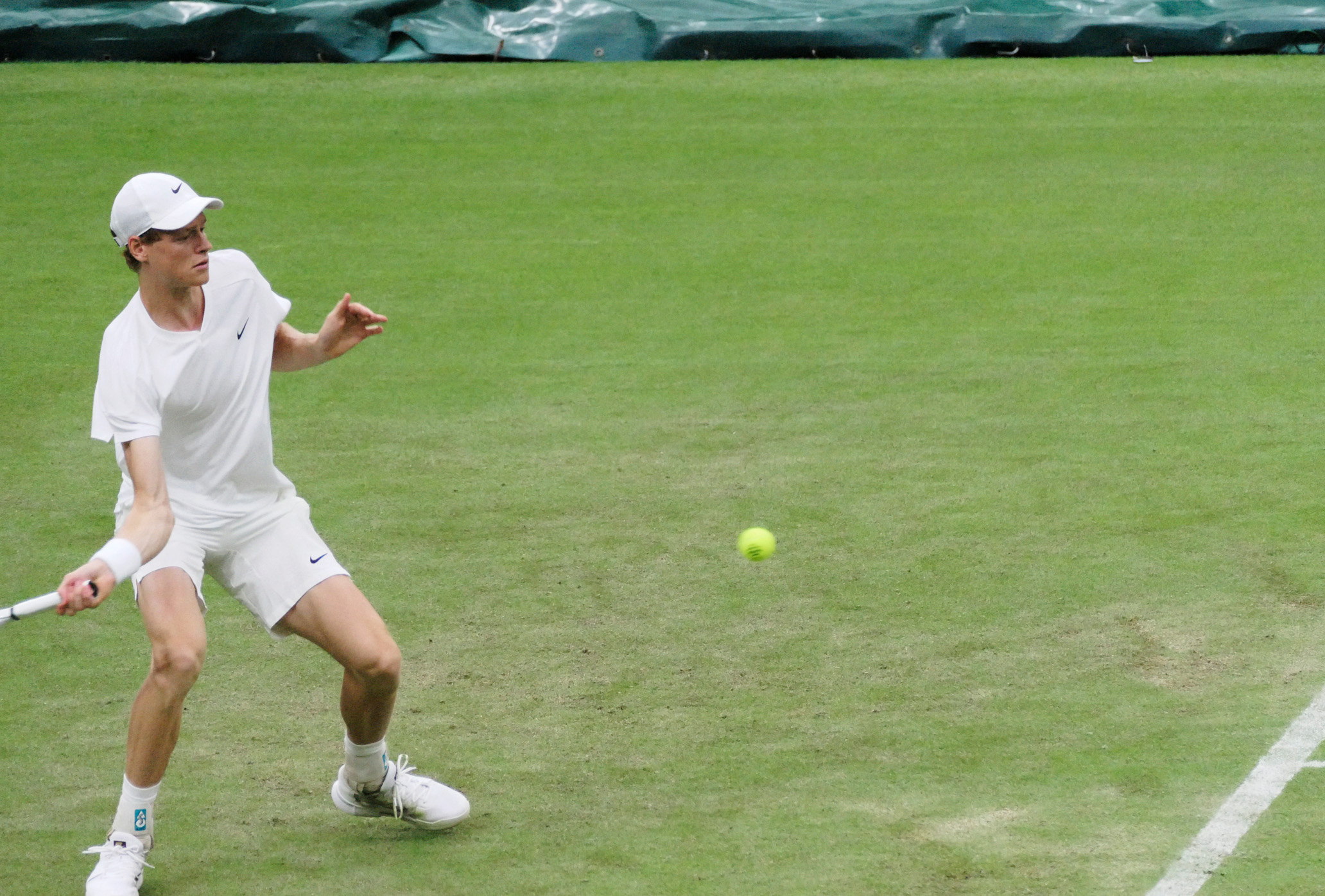
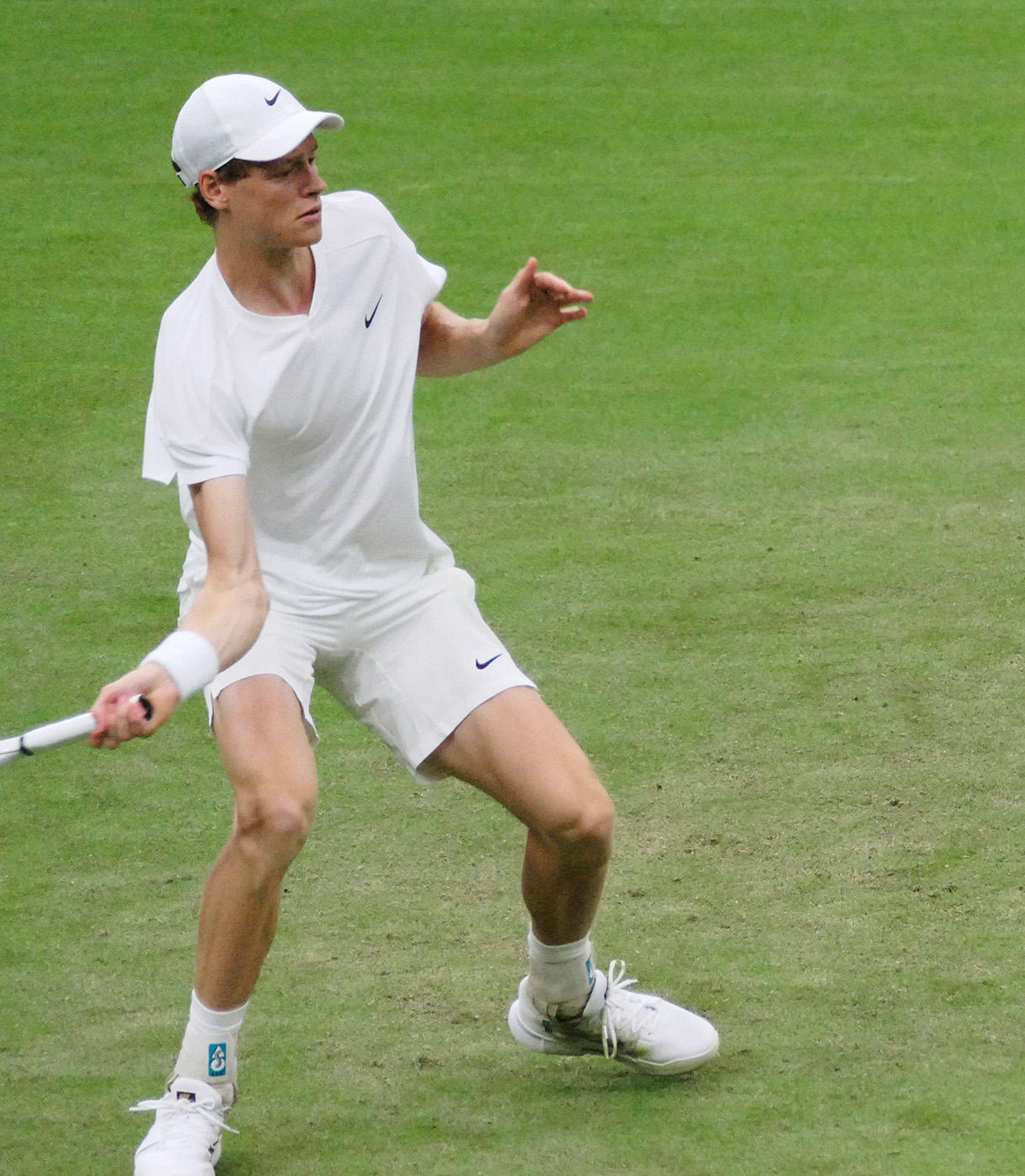
Sinner striking. // Craig E. Shapiro
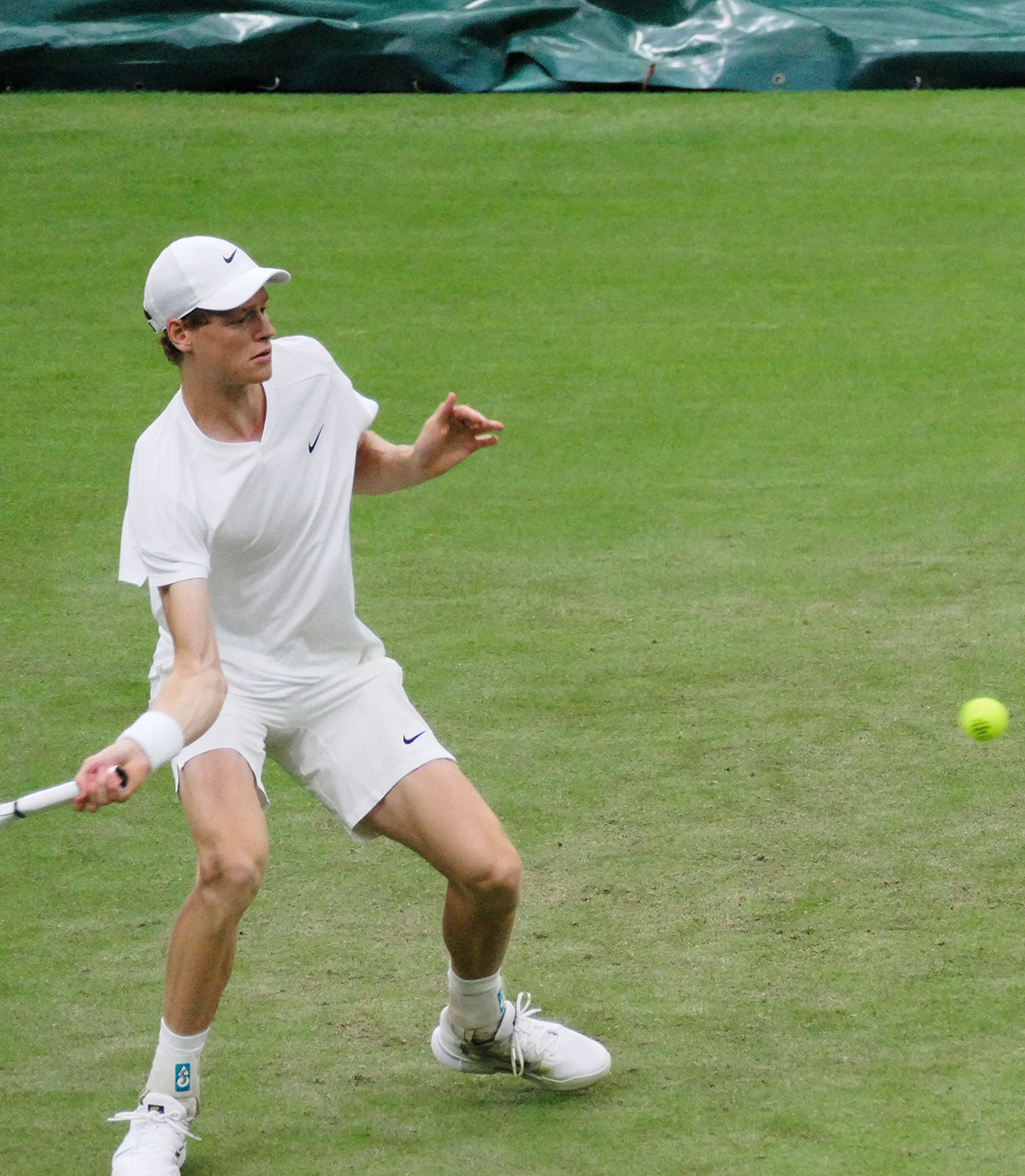
Sinner striking. // Craig E. Shapiro
Wednesday night at Wimbledon the press box on Centre Court was densely, vibrantly Italian. That was only right: Matteo Berrettini and Jannik Sinner stood on the grass before us, a contest so promising that you wish it was taking place deep into week 2. But this was just a second-round match, since Berrettini, the finalist here three years ago, is still working his way up into the top 50 after some loss of form and a six-month injury layoff. That meant that he wasn’t present in the office to witness his countryman’s rather abrupt transformation into the top player in the world. “At the end of last year I was injured and I wasn’t on tour to see him live with my eyes. And then I had the chance to go to the Davis Cup and it was unbelievable,” Berrettini said earlier this week. “It was like we were looking at each other saying, ‘Is this guy real?’ Because he wasn’t missing. Hitting every ball full power.”
At that Davis Cup, Sinner led Italy to the title, dispatching Novak Djokovic for the second time in a two-week span, and then he more or less sustained that rampage until the present day. He’s gone 38–3 since that moment, and now the 28-year-old Berrettini is the one drawing inspiration from the man six years his junior: “Personally, it gives me so much energy to just try to be there and to play against him and to be at his level. For me, it’s really useful.” On Wednesday, he spent the better part of four hours staying right on Sinner’s level, enforcing his own brand of heavyweight tennis and losing only by the tiniest of tiebreak margins, 7–6(3), 7–6(4), 2–6, 7–6(4), a Berrettini-on-grass scoreline if I’ve ever seen one. The tail end of every set always turned up to brilliance; the crowd was often lured onto its feet by the sheer quality; the Italian press corps was chirping, pontificating, and lightly admonishing one another not to openly cheer for the elder underdog Matteo Berrettini. In the end the top seed kept hacking his way through what projects to be a vicious Wimbledon draw.
Over my first watch of Berrettini on grass in person, his history of success on this surface became more legible to me. Even the parts I already understood on paper. It’s one thing to read 129 mph on your TV screen, and it’s another to see it just slide irretrievably off the turf, past a brilliant returner who has even guessed correctly. I was most struck by his court sense and comfort using the attributes of a grass court to his advantage. Sinner’s game plan was obvious from the get-to, and it’s not an uncommon one against this particular opponent: Take the pain to Berrettini’s backhand side, since his stiff two-handed backhand is a ghost of his potent forehand. But the big man compensates that with a backhand slice I knew to be effective but didn’t fully appreciate until I saw, up close, how accurately he places it, how its slow movement through the air buys him some time to recover in rallies, and how it barely bounces off the grass. It’s one of the finest slices on tour, and Sinner tested it with his endless backhand crosses—a match-long cross-examination that rarely elicited a flinch. In the rally of the match, he sent one slice around the net post that had me hooting. Berrettini even liked to cheat his court position over to the ad side, shrinking the possible space where Sinner could find his backhand and daring Sinner to take his backhand down the line, which he shied away from for much of the match, perhaps because of how difficult it was to lift that low slice up and over the net and into the court. Berrettini throws big punches, but it’s that defense and craft that keep him alive in these contests against better players.
Even as Berrettini approached his old grass-court glory, Sinner steadily revealed the extra substance in his game, seen most clearly in the tiebreaks, where he was better equipped to win any given point on either side of the ball. Sinner is so balanced, so consistent a threat in every moment, on both wings. While Berrettini came away with four breaks of serve compared with Sinner’s two, that’s slightly misleading, because it was the world No. 1 who placed more pressure on return throughout the contest, winning 59 points on return to Berrettini’s 38. I loved watching him bob and weave around the Berrettini service bombs. One second he’d be throwing his gangly limbs out of the way of a body serve, the next he’d be blanketing a second serve with perfectly grooved timing. He tinkered a little with his setup, and I asked him afterward how he thinks about return positioning when playing a server as good as his friend Matteo. He said that the way the ball slips off grass makes it hard to get too experimental with positioning, but he tried to mix it up on second serves. “It’s also a little bit a gut feeling, no? Which can help you, and you just have to go for it.” In a match against Berrettini, you might just have to have the correct gut intuition five or six times to turn the whole contest in your favor. When Berrettini appeared in press, he was equal parts disappointment and relief. “I think he missed three balls in the whole match. It didn’t give me that oxygen that sometimes you need,” he said. “But I think he surprised me, and I surprised myself also, how I was handling the level.” After a long time away from the sport’s elite, it must feel good to know you can still hang.
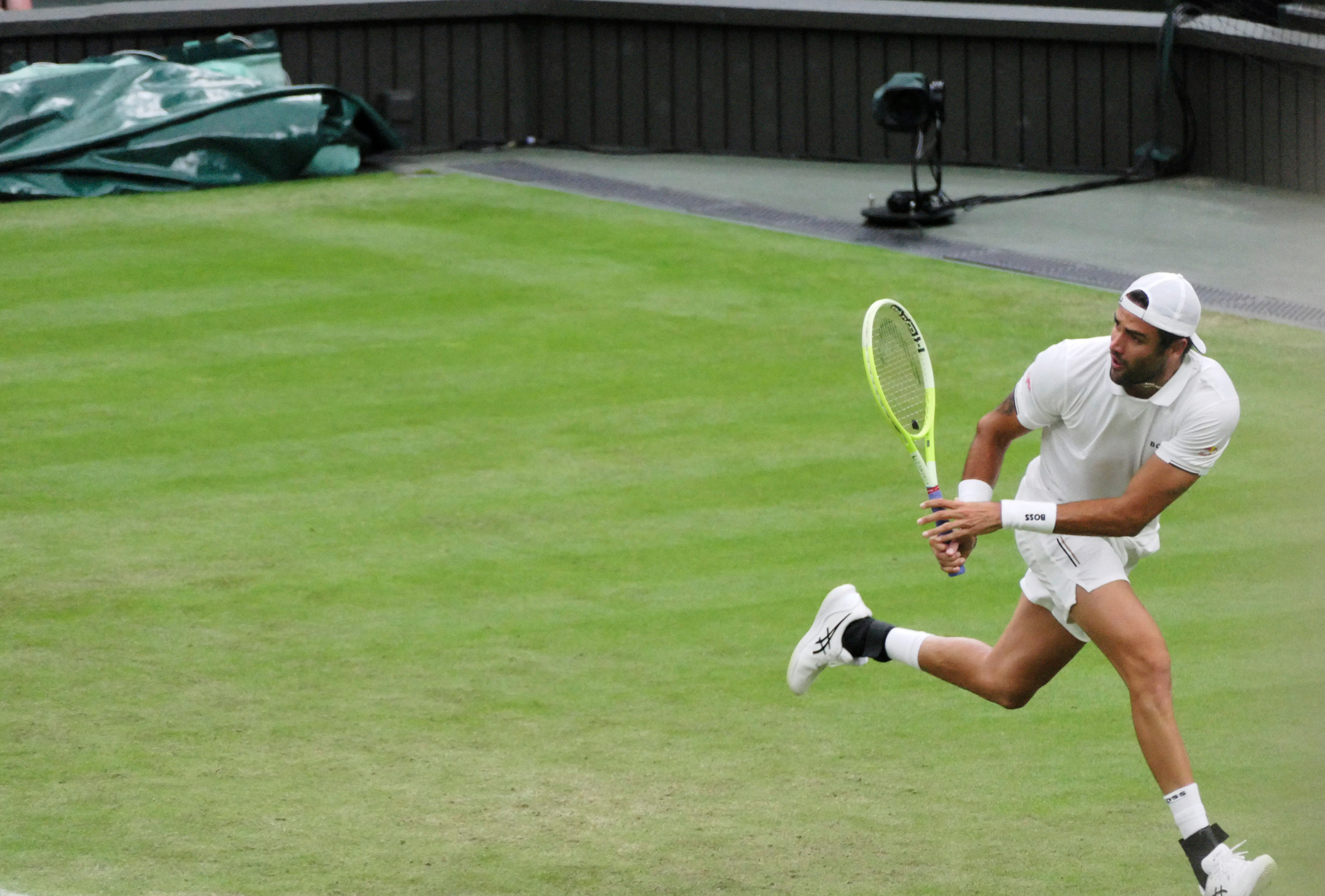
Berrettini battling. // Craig E. Shapiro
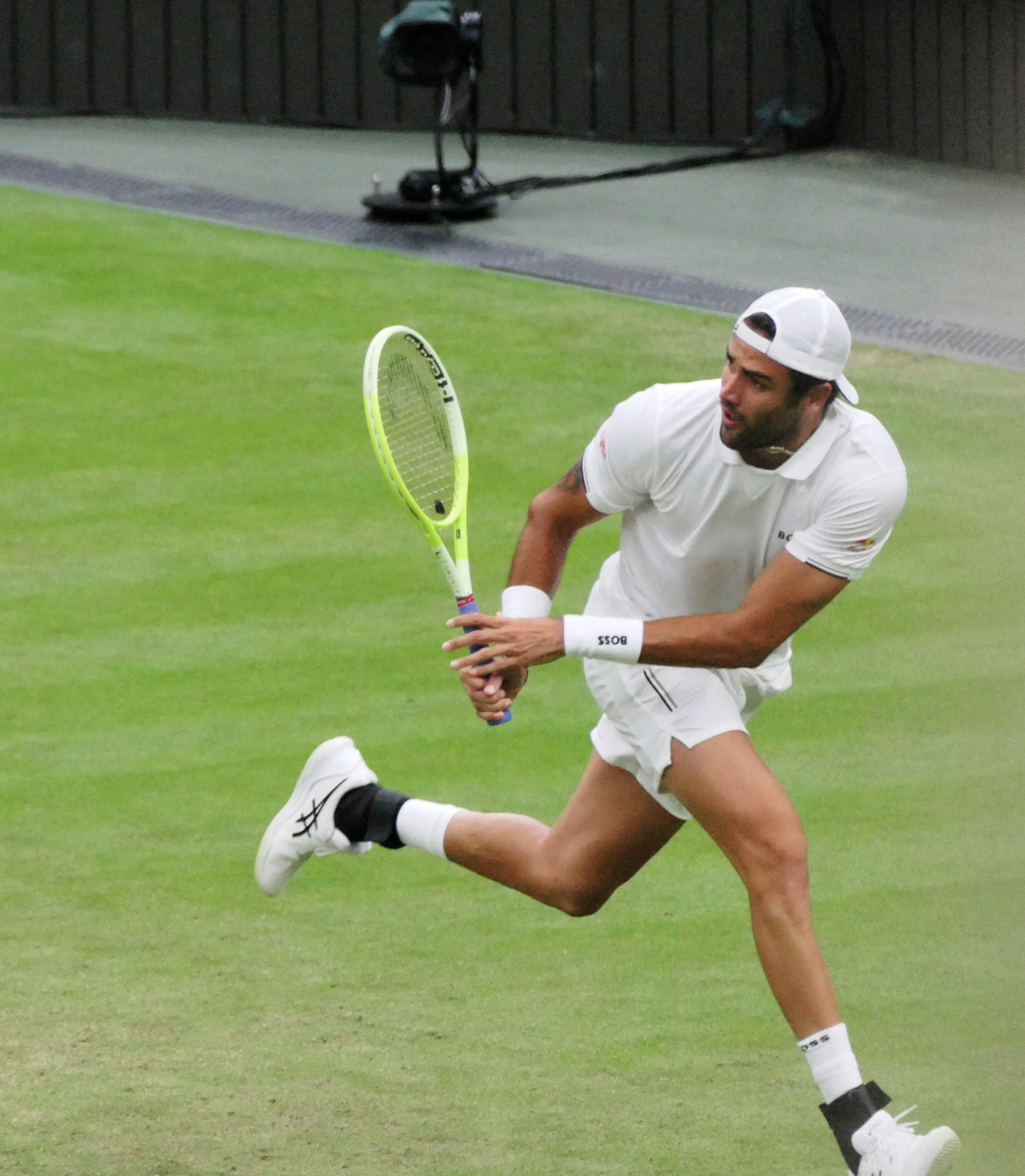
Berrettini battling. // Craig E. Shapiro