
A Wizard's Last Spell
A Wizard's Last Spell
Kei Nishikori Prepares to Disappear.
Kei Nishikori Prepares to Disappear.
By Giri NathanSept 25 2026
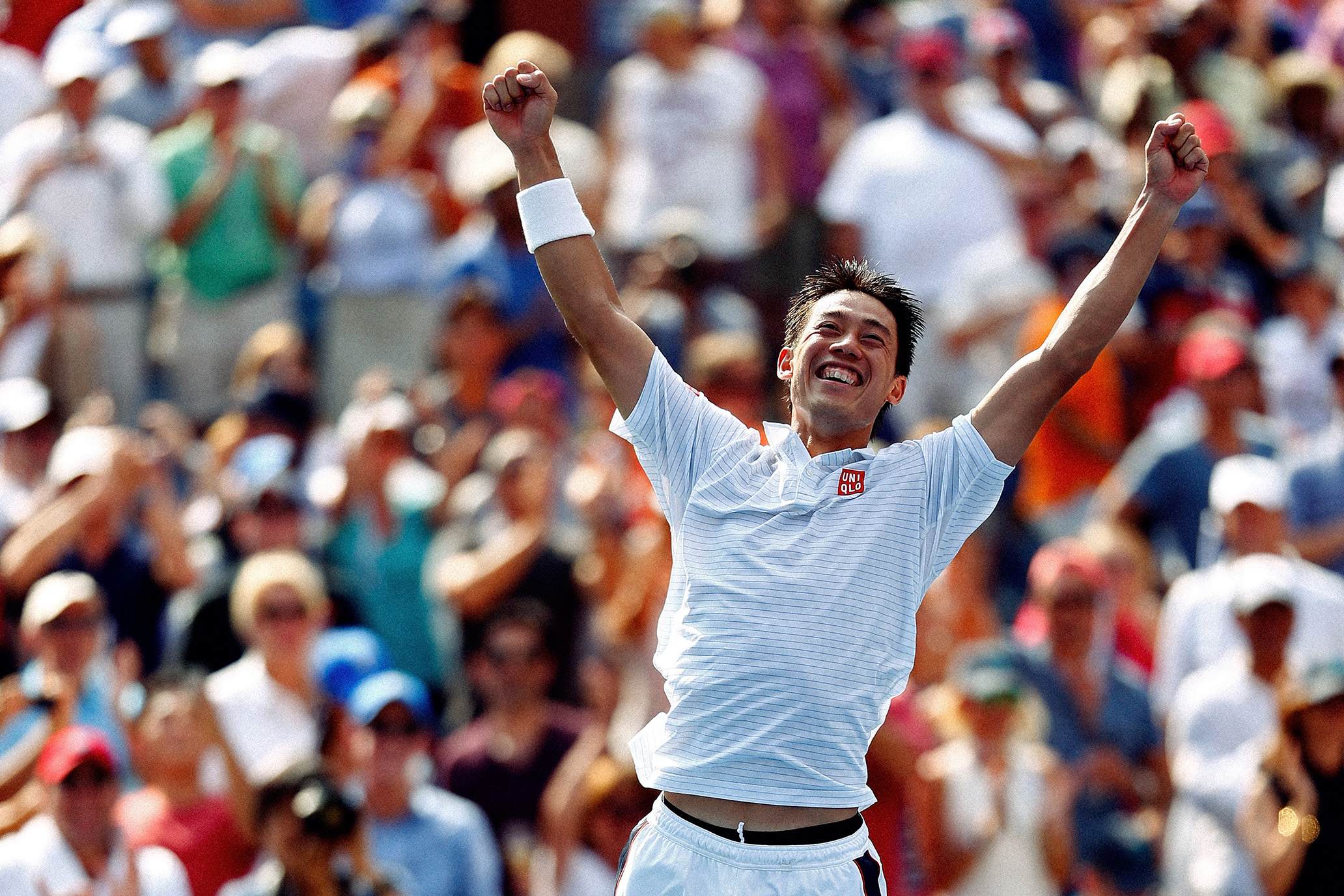
Kei celebrates victory over Novak Djokovic in the 2014 US Open semifinals. // Getty
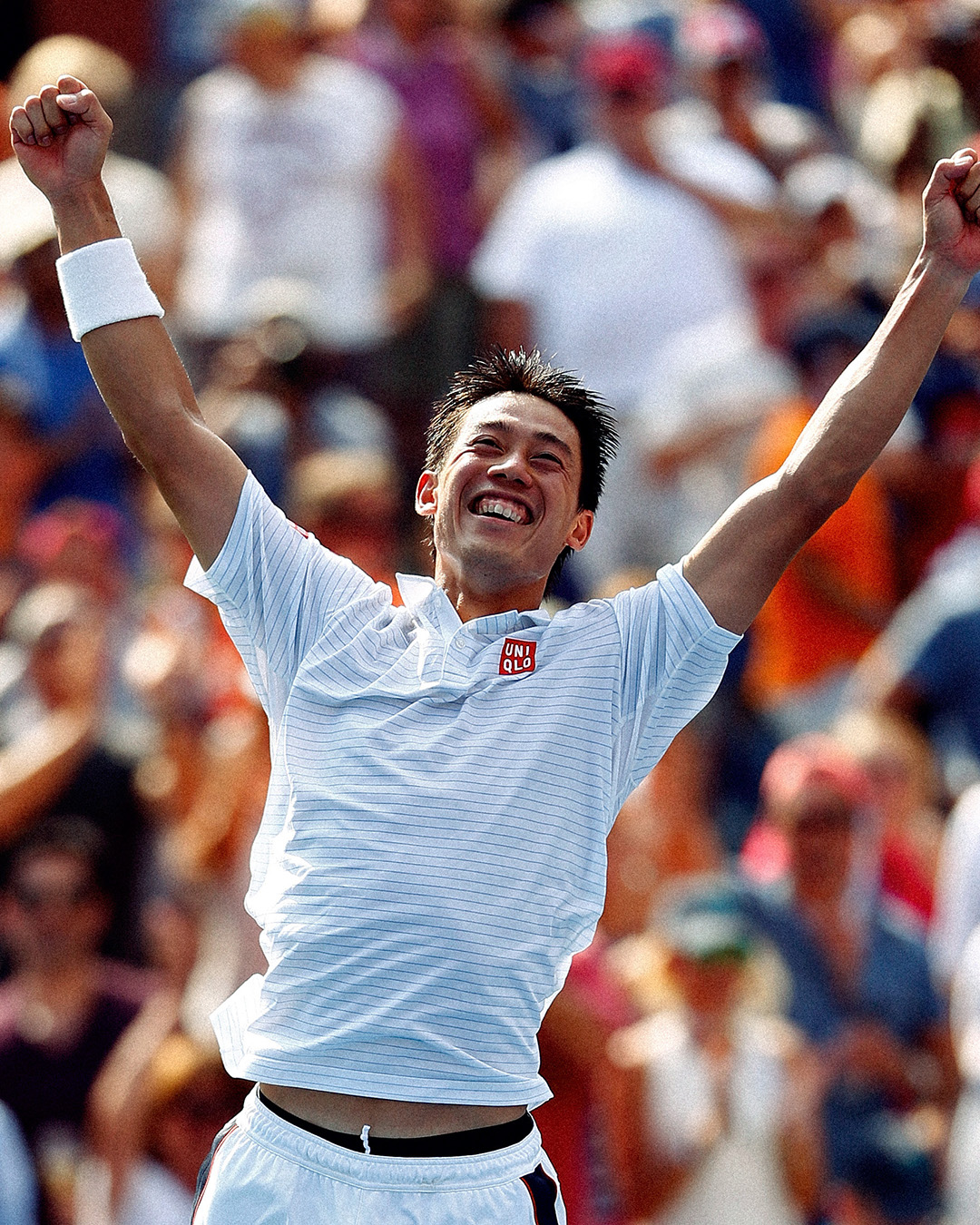
Kei celebrates victory over Novak Djokovic in the 2014 US Open semifinals. // Getty
Every time I step up to hit a two-handed backhand, I have a specific one in my mind. When I ask friends about their favorite two-handers in ATP history, I am bound to hear odes to Marat Safin, David Nalbandian, Andre Agassi, and all with good reason, I love those shots, even as I see Jannik Sinner and Novak Djokovic vie for the ultimate crown. But none of those legendary backhands have dislodged the one in my mind. That one belongs to Kei Nishikori. Economy of movement—here is a monument to it.
The racquet dips down unceremoniously, it comes up smoothly, and in between, all it does is make pure contact with the ball. The wrists are lax, and the timing is anything but. If racquet head speed is a game of getting the racquet to travel through a lot of space very quickly, he appeared to have found the most elegant solution, with the least moving parts, nothing superfluous that could crack under pressure. It is a vicious shot. Go back in time and ask Djokovic midway through the 2014 US Open semifinal what he thought of it. In an era where most backhands could be plotted on a spectrum from “liability” to “slightly above neutral,” that Nishikori backhand was an outright weapon, suited for all scenarios: taking the ball on the rise (especially), redirecting pace, making his own pace, jumping up to high balls, dipping the passing shots, springing for sudden winners. It’s on the short list of tennis shots I could watch all day. Half in real time, and half in slow motion, just for some variety.
In my various stops on tour, I’ve always made a point to catch some of a Nishikori match up close, no matter the opponent. If what your brain needs is a few minutes of ground strokes struck to perfection, he’s the medicine. Given that he was such a gifted baseliner operating in the era of baseline-dominant tennis, it’s no surprise that Nishikori hit No. 4 in the world. And as he brought Japanese tennis into the 21st century, he was met with colossal wealth and fame. It is tempting to hunt for reasons why this man didn’t accomplish even more than he did—12 titles, none above the 500 level—but you will find those reasons without much struggle. It’s because those perfect ground strokes were attached to an injury-prone, serve-mediocre 5-foot-10 frame. And also, of course, because he was so often stymied by the three best players ever. He shares that plight with the other big ATP names retiring this year, Gael Monfils and Stan Wawrinka, who all maintained great levels well into their 30s but could not outlast these timeless GOATs. At the time that Nishikori collected the runner-up trophy at the 2014 US Open, he was up 2–1 against Novak Djokovic and 2–1 against Roger Federer; then came the 0–16 and 1–7 records he would compile from then on.
But for a guy who wasn’t getting any free points, who was grinding away in both service and return games alike, trying to win by virtue of raw baseline meritocracy, Nishikori took his career about as far as his physical tools could take him. Would his body hold up? That question supplied most of the narrative tension of his career, on the scale of an entire tennis season, a Slam, or an individual match. Nishikori was known for a rough bill of health, and was sidelined by a variety of injuries for long stretches of his career. But he also had a historically good record in deciding sets, and survived so many marathons in style. You could always rely on him for an unnecessary but electrifying five-set victory in week 1 of a Slam. By the time week 2 rolled around, it became clear he hadn’t played the energy conservation game quite right. Of an impressive 12 Slam quarterfinal appearances, Nishikori won only three. Despite mastery of the dominant style of his era, he had to fight just a little bit too hard en route to finish the job.
By the tail end of his career, they had started producing dudes who had technically sound ground strokes like his but were also much bigger and stronger, and realistically, there was no keeping up with where tennis was going. Nishikori enjoyed a brief but brilliant peak in the middle of the last decade, battling the greats from the baseline, before the game moved just beyond his grasp. (Perhaps we can at least speculate, as his old coach Michael Chang trains the current Nishikori avatar: Learner Tien, another baseline artist of modest stature, scraping by without a great serve.) These days, I suspect many tennis fans are hitting exhaustion with serve-dominant tennis, and they crave the salvation of raised nets or nixed second serves. As I revisited moments of Nishikori wizardry, I was reminded by what we actually look for in tennis, this thrilling interplay between opponents, rather than glassy serve-plus-one execution. We want to see the players not just play past one another but play against one another, to outwork and outwit one another, and even if the present parameters of the sport don’t optimize for that, we will always remember the players with that gift. When Nishikori retires in Tokyo next week, it’s those memories that will endure, the great balm of flawless ball-striking.
PURE, ORIGINAL TENNIS — SIGN UP!
RECOMMENDED
Pete Sampras: Wanna Bet?
FILM REVIEWS
Zac Farro: Life Preserver
CULTURE & ARTS
Coco Gauff: Prophecy in Progress
ATP & WTA