Tiger Style
Tiger Style
Aryna Sabalenka makes the grade—but tough tests loom.
Aryna Sabalenka makes the grade—but tough tests loom.
By Owen LewisSeptember 6, 2026
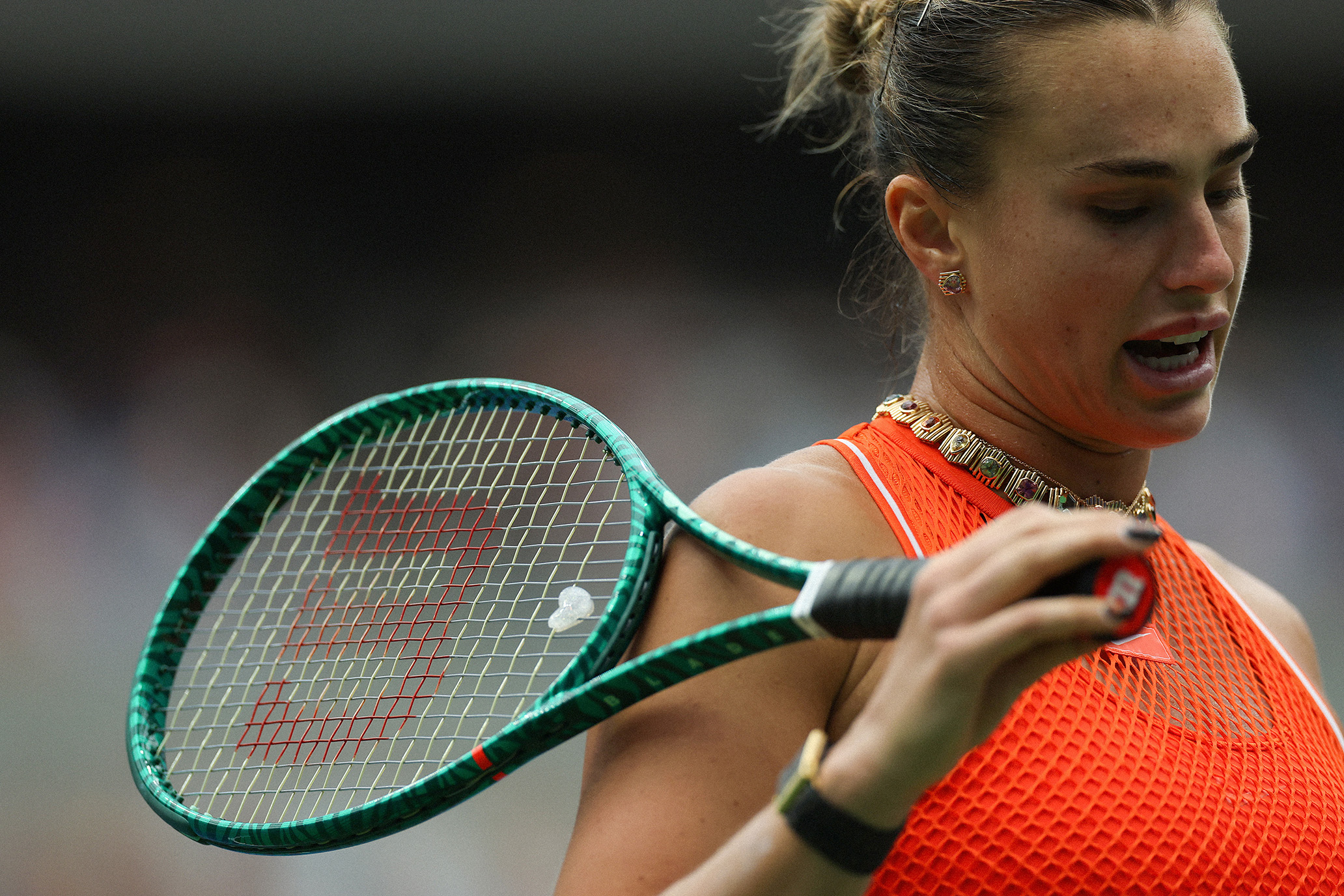
Aryna Sabalenka is back in the New York groove.
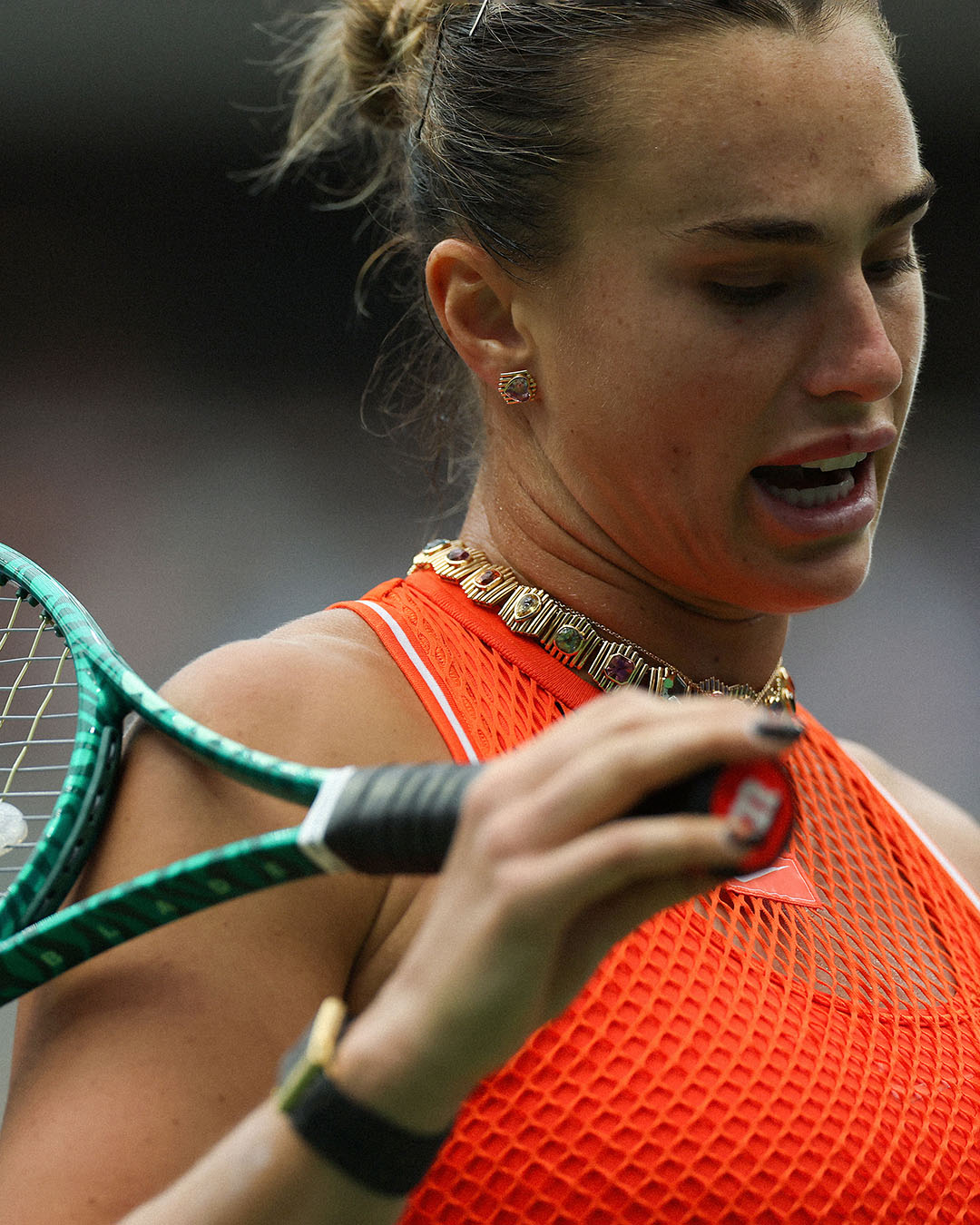
Aryna Sabalenka is back in the New York groove.
For the first time in years, Aryna Sabalenka’s early-round matches at a major held some apparent jeopardy. Between the 2022 US Open and Roland-Garros this year, her record is unmatched: four titles and not a single quarterfinal missed. (Her quarterfinal-to-title conversion rate, of course, leaves much to be desired.) Since the prime of Serena Williams, the WTA has bucked all would-be late-round stalwarts at majors. The field is too deep, the margins in best-of-three too slim, and there hasn’t been a player with little enough variance in their game to simply never lose early. Even Iga Swiatek, she of the 37-match winning streak in 2022, has five third- or fourth-round losses in majors since the end of that season. For a few years there, Sabalenka came as close to upset-proof as a player can get.
Now Sabalenka, the world No.1 for the past 98 weeks, is as vulnerable as she’s been in years. Since winning the Sunshine Double in March, she is a decidedly un-Aryna-esque 20–7 with zero titles. My theory is that despite optimizing her game to a fairly astonishing degree, she realized somewhere in either the Madrid loss to Hailey Baptiste (from six match points up) or the Roland-Garros loss to Diana Shnaider (from 6–2, 4–2 up) that she’d never be able to eliminate her trademark implosions late in majors. I imagine that realization having a trickle-down effect on her game. How engaged can someone’s footwork really be if they’ve just learned that the goal they worked toward for years will forever be out of reach? At Wimbledon, Sabalenka’s quarterfinal streak ended against a supreme Naomi Osaka, and she didn’t rebuild her momentum during the American swing. So, though the story of this Open would ordinarily be Sabalenka seeking a threepeat, she’s instead on upset watch.
At least, she was supposed to be. Through four matches at the Open, Sabalenka is yet to drop a set, or more than four games in a set. Her second-round match may have been against the widely unknown Polina Iatcenko, but Aryna’s 6–1, 6–1 demolition was a tasty vintage of her best runs at majors. She put on a serving clinic in round 3, with 10 aces to just one double fault. On Sunday, against home favorite Taylor Townsend, Sabalenka kept composed despite facing consistent pressure on serve, breaking seven times.
I’d like to be able to say that Sabalenka has her game back, that she’s emerging as the title favorite she really was all along, but there’s still reason to doubt. For one thing, Sabalenka is yet to face a top 50 opponent thus far in the tournament. For another, even in her authoritative wins so far, the little fissures in Sabalenka’s mindset remain visible.
Think about that third-round match against Kamilla Rakhimova, the 60th-ranked Uzbek with three pale green bows in her hair. (Sabalenka would probably react to a ribbon in her hair like it were a killer bee.) There was no real danger of losing. Sabalenka won the first set easily and had plenty of chances to go up a break early in the second. Though she missed them, it was obvious the break was coming. When it came, at 4–4—Sabalenka won a forehand trade—she reacted with annoyance. She’d slipped ever so slightly in the middle of the point, forcing her to roll a forehand crosscourt instead of eviscerating a winner down the line. There was a positive read here: She reacted well enough to the slip to still win the point, a vital point, and in a more arduous manner than simply thumping the ball past her opponent, proving her persistence. But instead she was fixated on a perceived flaw in the court.
Pick any other moment from the match you’d like: muttering to herself the whole walk back to her chair when Rakhimova drilled a backhand winner off the back foot (how could she have let that happen?), hanging her head after missing a first serve, applauding a Rakhimova drop shot retrieval but still haranguing herself afterward. Sabalenka did look happy after the match—she loves being a winner—but it doesn’t look like she loves the process of winning, at least when she encounters anything resembling a speed bump while doing it. The end of a match draws her forward like a magnet, hence her spectacular record in tiebreaks, or her bailing on the last few points of her loss to Sara Bejlek in Cincinnati. I think Sabalenka is still the best hard court player in the world. But it must be incredibly difficult to maintain that perch with a fundamental misunderstanding of how best to do it. Errors are the fabric of this sport, and slamming the panic button each time you encounter the simple fact of play seems exhausting.
She’s chosen chronic perfectionism in a sport that is chronically resistant to perfection. If she could sketch out her ideal version of a match, she would control every single point. That ideal being completely impossible does not stop her from seeking it out, or from unraveling when it (of course) eludes her. Her “Tiger” nickname is apt in so many ways—she’s fierce, she’ll tear you apart—but flawed in that unlike a real tiger, she’s offended when her prey fights back, or even runs away. She’d like for them to simply lie still and accept what she deems the inevitable, so that she can demolish them as completely as possible. Most great players accept the inevitable bad day at the office and use it to work out the kinks in their game. Sabalenka plays as if she feels she is above having kinks to work out in the first place.
All this is to say that I attribute Sabalenka’s form so far more to the fact that she and the Open have been simpatico in recent years—it’s the one tournament where she’s been able to truly banish some ghosts; she’s not lost here since her implosion against Coco Gauff in the 2023 final—and less to the idea that she’s fixed whatever’s been plaguing her since March. Just look at the friction in her press conferences so far, which are not exactly suggestive of a player secure in her form.
Next up for Sabalenka is Linda Noskova: a player who can tolerate the loss of five championship points in the second set of a Wimbledon final and calmly win the third set 6–3. In her last match here, against Marta Kostyuk, Noskova again had to stare into the abyss. She blew two match points on serve in the second set, then three more in the third set, and yet after all that, she found precise first serves on the final two points of the match to put it to bed. Like Sabalenka, she is quick to bruise mentally; unlike Sabalenka, she steels herself before she can bleed.
When they play, Sabalenka will try to blow her off the court, as she does with all her opponents. If that does not work, the world No. 1 will find herself in the type of fight she can’t seem to win lately. Still, Sabalenka has given herself an opportunity to salvage her season at the majors. She is deep enough in the tournament that if she crumbles, it’ll be because of an established weakness rather than a new one. If there’s not a title in that, maybe there’s some relief.