Stupor Bowl
Stupor Bowl
Who is Arthur Ashe Stadium for?
Who is Arthur Ashe Stadium for?
By Owen LewisSeptember 2, 2026
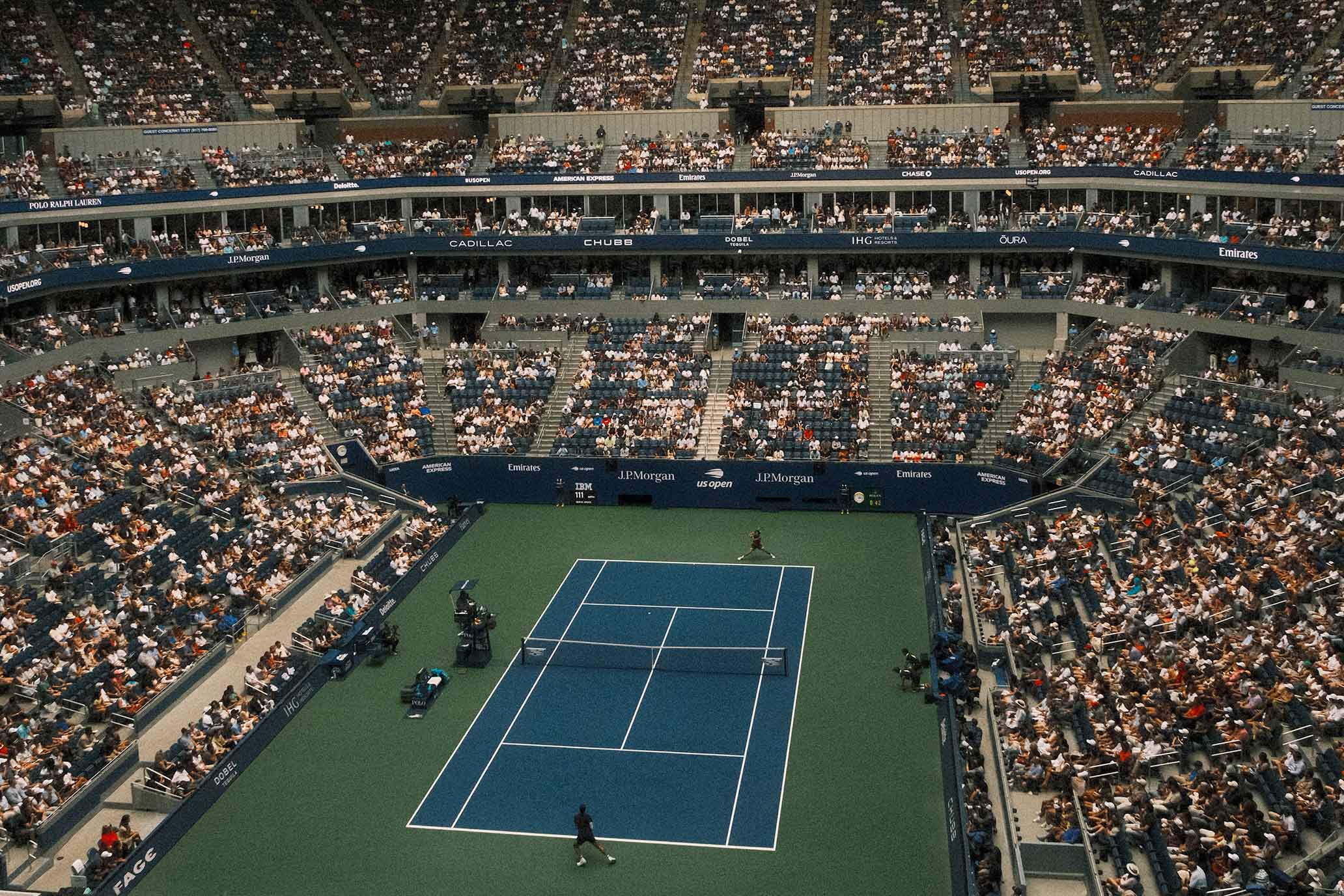
Arthur Ashe Sadium this week. 🧐 // David Bartholow
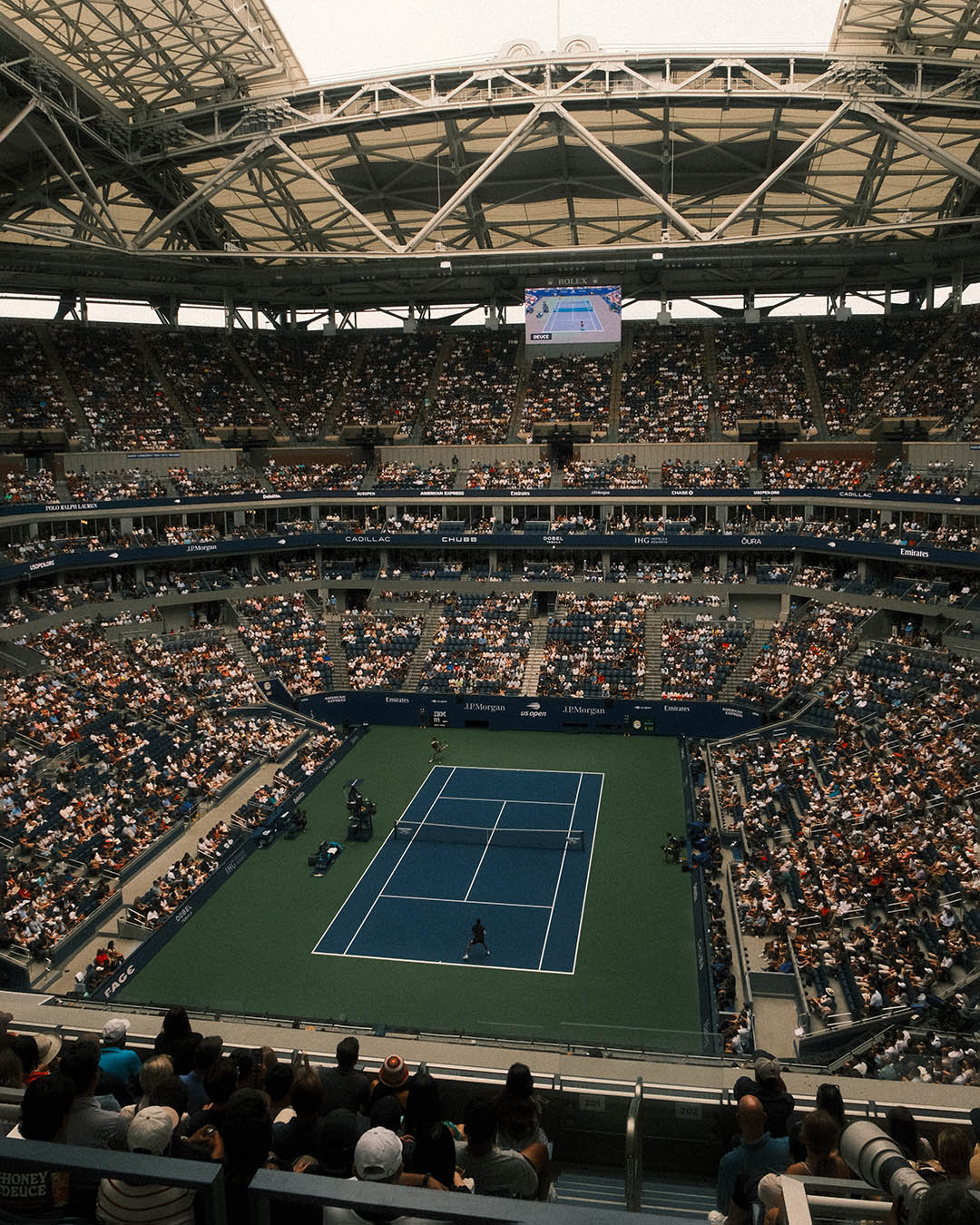
Arthur Ashe Sadium this week. 🧐 // David Bartholow
A half hour into my first trip to the US Open, my neck bearing a precious press credential and my ass in a press seat high up on Arthur Ashe Stadium, I wondered why my eyes were unfocused. It wasn’t that the match was boring. Jessica Pegula spurned eight break points against Elena-Gabriela Ruse in the third game, injecting an otherwise lopsided match with intrigue as all the missed chances hung over Pegula’s head (or so I imagined, as someone who would have proceeded to lose the set 6–1). When Pegula connected sweetly with the ball, it looked like she was half-volleying winners from the baseline. So why did it feel like I was watching from a blimp?
Arthur Ashe Stadium is the largest tennis arena in the world, its vertical sides making it more box than bowl, and seats a shade under 24,000 drunks. My problems probably started with the fact that the press section is at the bottom of the vertiginous upper bowl. (Other writers told me that courtside press seats were axed this year, as well as a triangle of seats from a more favorable angle, to sell tickets instead.) A hundred feet of air squashes the tennis court into a compressed rhombus, making it more or less impossible to gauge the quality or accuracy of a shot before it lands.
More confusing is the lack of atmosphere. This stadium might be too big to hold tightly to the noises within, but maybe there just aren’t enough of them. My fellow correspondent Giri Nathan has observed the ambient chatter that fills the arena like a flat drink, probably loud enough to make you crank the volume all the way up to hear whatever’s in your AirPods, certainly not loud enough to shake the feeling that this dense cluster of humanity is jarringly quiet.
Sugar-water pop songs play on the changeovers at least two clicks too loudly. “Get into the groove,” Madonna sings, but it doesn’t seem like anybody is. Good points produce cheers that lack intensity and dissipate quickly. The jumbotron locks onto celebrities during changeovers; Travis Scott gets a bigger ovation than Carlos Alcaraz does for anything until the last point of his first-round match, the first time he’s played in four months. “Who here in Arthur Ashe is ready for an upgrade?” an announcer teases a seat change, earning the high-water crowd reaction during two-time defending champion Aryna Sabalenka’s first-rounder. Someone tries the Roland-Garros BA-BA-BA chant and gets nowhere. Individual contributions from the crowd are so rare that I start slightly when I hear an isolated voice: “Come on, Aryna!” Next to me, a blonde woman and her friend record several takes of the former saying, “Guess what time it is? It’s US Open time!” They brainstorm other ideas: “It’s the US Open, guys!” “Come with me to the US Open!” During Daniil Medvedev’s postmatch interview with Andrea Petkovic following a surprisingly authoritative win over Hugo Gaston, just as I’m thinking I can’t hear anything he’s saying, Medvedev asks Petkovic to repeat herself because “it’s so hard to hear in here.”
Side courts are mercifully free of influencers. On Grandstand, a fan narrates the underpowered rallies between Lorenzo Musetti and Arthur Fery: “Good backhand. Oh, he’s got him. Put him away! I thought he had him! Wow, what a point.” I have to check to make sure he’s not a radio guy. A woman near me shrieks happily at every point Fery wins; she’s got a credential. The crowd out here knows ball.
On Ashe, the roof closing sharpens the acoustics and makes the matches feel a bit more official, though fearless Second Serve and OPEN Tennis leader David Shaftel, who watched most of Alcaraz’s match with me, says it floods the arena with BO and traps it inside. I hadn’t noticed; blame the starry eyes of an Open virgin. The arena is under construction, which can’t help the experience, but it doesn’t take much chatting to others in the press room to realize that these gripes have existed for years.
The media section is bare during the early day sessions of the tournament. There is a lot of hair (long, dark) underneath the seats. A camera sits in the perfect only spot in front of the serve speed display to prevent a soul in the section from seeing it. (I spend much of Alcaraz’s match wondering how hard he is hitting that damn serve.) A fan or two descends on the unlabeled block of seats; ushers immediately descend, as if appearing out of thin air, to tell them Sorry, this is the media section, you can’t sit here. (This is a marked difference from the Australian Open, where ushers I saw notified fans they were sitting in the media section but always let them stay if there was room.) This happens every 30 seconds. Every single fan at the US Open has tried to sit in the media section. It takes a few dozen cycles of this before I realize this might be why nobody is sitting in the media section. I’m not too fussed about whether or not fans sit here, but the waterfall-like stream of fans sitting down only to be immediately removed makes me feel like people are playing musical chairs around me.
There is one irresistible sight from up here, though: Wait till somebody hoists up a lob. The ball makes stunning contrast with faces in the crowd, pink and white shirts, empty blue seats. It seems to hang in the air for minutes before descending as the panicked tennis player tries to dash around it for the privilege of hitting a doomed scooped forehand.
During day 2, I think about whom the stadium was named for: a reluctant civil rights icon, a man who hardly celebrated his first US Open title, an introverted personality, a calm and thoughtful wordsmith even after he began to speak out. Not that a stadium has to reflect the exact personality of its namesake, but, well, it’s a bit like if they’d plopped Nadal’s footprint down on the Wimbledon grass instead of red clay. In the evening, I walk over to Court 17 to watch some of Learner Tien–Nuno Borges. The crowd there is everything the Ashe spectators aren’t. The cheers burst out of them; they murmur in excitement during great rallies. Ashe looms in the corner of my eye, flashing blue and white lights. I find it isn’t much of a distraction.