
Out Like a Lamb
Out Like a Lamb
Often, at the Tour Finals, the ATP season just seems to fizzle out.
Often, with the Tour Finals, the ATP season just seems to fizzle out.
By Owen LewisNovember 13, 2025
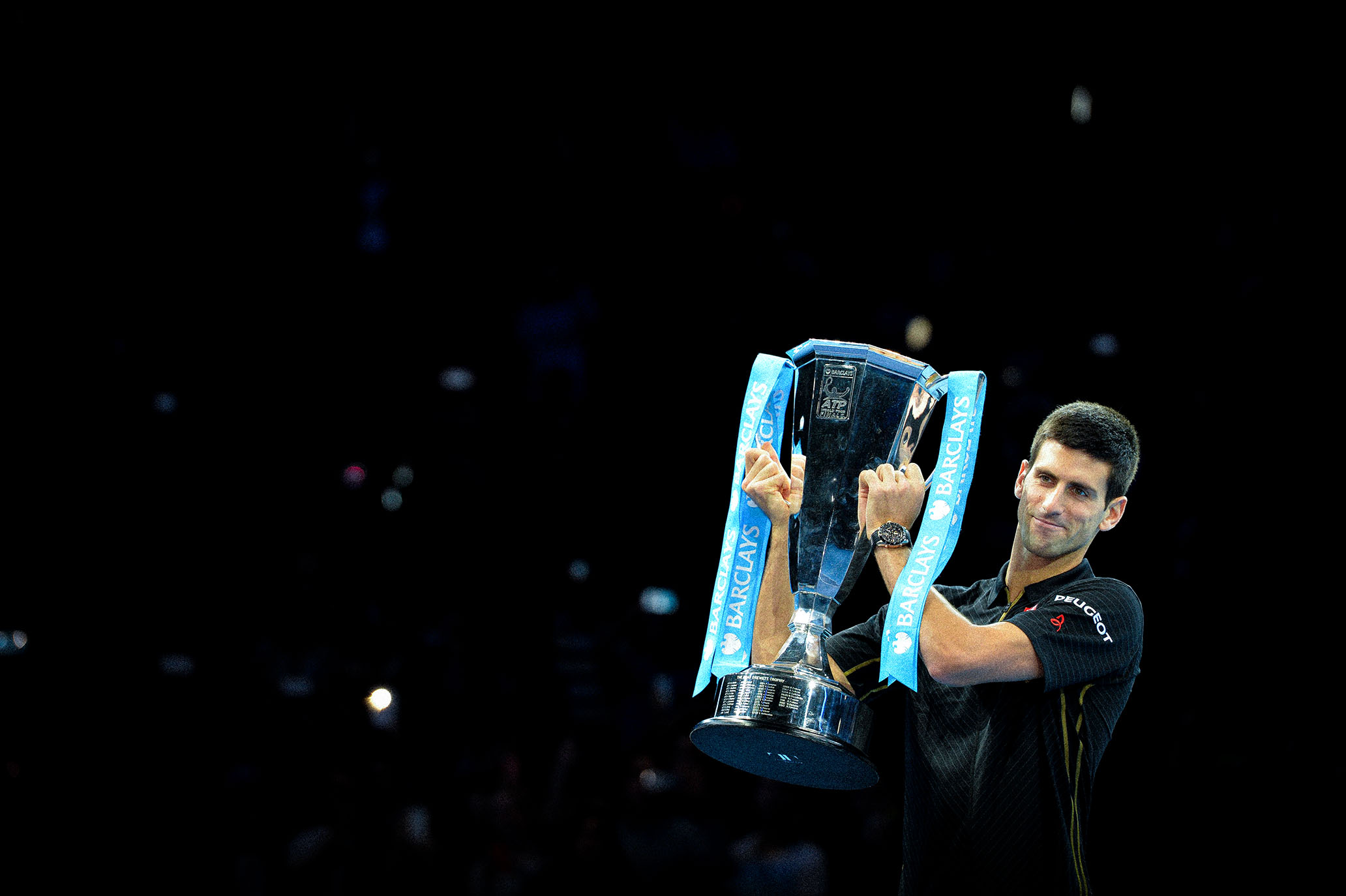
Novak Djokovic holds up the ATP Tour Finals in 2014 after Roger Federer withdrew before a single ball was struck. // Getty

Novak Djokovic holds up the ATP Tour Finals in 2014 after Roger Federer withdrew before a single ball was struck. // Getty
Day 3 of the ATP Finals this year couldn’t have been better. Taylor Fritz blitzed Carlos Alcaraz with arguably his most accurately aggressive tennis to date, only to choose the wrong side on a few putaways and fall inches short in an epic. Lorenzo Musetti and Alex de Minaur—underpowered players by comparison, whose matchup a friend of mine recently suggested would be a more apt for ATP 250 final—made the fast hard court look like clay in the evening. Rallies had to be won several times over. Just as de Minaur had twisted the match in his favor, he made a mess of a backhand volley and enabled Musetti to ride the Italian crowd’s rapturous applause and some sensational shotmaking to victory. Then de Minaur himself scored a cathartic win over Fritz two days later, his rubbery relief afterward so evident it was as if he’d freed himself from a lifelong burden. As Zendaya might say: good fucking tennis.
It also felt startling because the ATP Finals do not consistently produce good fucking tennis. On paper, the tournament looks like it can’t miss. With eight players, the best in the world, it’s all meat and no fat. The round-robin format ensures you get to see each player at least three times. A quick indoor hard court protects the participants’ dilapidated bodies from caving in entirely. Except the ATP Finals do miss, a lot. Can you remember any particularly interesting matches from the 2018 tournament? 2021? What about 2022, outside Daniil Medvedev’s tragicomic week, in which he served for two of his three round-robin matches, reached deciding-set tiebreaks in all of them, and came up winless? Or 2024, in which Jannik Sinner hardly left first gear? I’m seriously asking, because I watched most of these editions, yet memories of genuine entertainment escape me like dreams, or my sanity after 10 months under the Trump administration. After Sinner polished off Felix Auger-Aliassime and his sore calf during this year’s edition, social media freelancer Bastien Fachan noted that 18 of the previous 21 matches at the ATP Finals had ended in straight sets.
I have some thoughts on the origins of this epidemic of boredom at the ATP Finals, though I’m not sure how treatable it is. The indoor hard court may be the only humane choice at the very end of an unfailingly attritional season, but it often reduces typically intriguing matchups to a serving contest. They also don’t closely simulate the conditions at any of the four majors. The Finals’ placement in the calendar ensures the players compete under the full weight of said attritional season. Longtime tennis.com writer Steve Tignor suggested to me on Bluesky that the round-robin format robs the event of other tournaments’ ability to steadily build momentum from one round to the next. Then there’s the flagging depth on the ATP Tour: Carlos Alcaraz and Sinner have left their peers in the dust, to the extent that anybody else posing a satisfying challenge is more happy surprise than reasonable expectation. (Last week’s WTA Finals were very entertaining mostly thanks to Amanda Anisimova and Jessica Pegula, seeded fourth and fifth, respectively, featuring in multiple epics.)
Even in the years of the vaunted Big Four, clashes at the ATP Finals tended to underwhelm. Nadal laid down for Djokovic in the 2013 final, who did the same for Andy Murray in the championship match three years later. The anticipated 2014 final between Federer and Djokovic didn’t happen at all because Federer’s back wouldn’t cooperate. (Djokovic is bafflingly credited for a win over Federer on the ATP’s official page for the rivalry, despite not playing a single point that day.) Not that there haven’t been bangers between those two, like the 2012 final, or wholly interesting events some years. Dominic Thiem became the first player to take the racquet out of Djokovic and Nadal’s hands in vital tiebreaks with pure aggression at the 2019 and 2020 editions, and was so compelling in his bravery that he felt like the main character of both events despite not winning either of them.
But such theater at the ATP Finals is far less frequent than we’d expect or like. Nadal, tennis’ greatest warrior, never really showed up there as more than a diminished version of himself, beaten down by his efforts in the first 10 months of the season. Haters call the event a glorified exhibition. Though 1,500 ranking points are on offer, short only of a major, I see what they mean. You can theoretically lose twice and win this tournament; you can advance out of a group while somebody who beat you head-to-head stays behind; a given matchup can occur twice in the same week. It’s goofy, and different enough from all the other tournaments that it can feel overvalued.
In a perfect world, I’d put the ATP Finals on clay—it’s softer on the joints and more likely to draw spectacular rallies out of the participants—or a slower hard court. They’d be much earlier in the season (as long as the qualifying period lasts one year, it can start and end at any time) or modified to a standard, single-elimination tournament to reduce the workload on the players. For some novelty, maybe the eighth spot could go to an intriguing wild card instead of the numerical No. 8, who is generally unlikely to make much of an impact.
As things are, the 2025 tournament has indeed been excellent and might provide an Alcaraz-Sinner encore in the elimination rounds. Demon’s week, which began in misery, will now continue into the semifinals. It’s easy to imagine an even better ATP Finals in 2026—Jack Draper and Joao Fonseca making impactful debuts, maybe, and the return of the stars in this year’s field. When it comes to this tournament, just don’t count on practice looking as pretty as theory.

PURE, ORIGINAL TENNIS — SIGN UP!
RECOMMENDED
A Mixed Blessing
OPEN TENNIS — VOLUME 3
Review: “Novak Djokovic: The Wolf in Winter”
FILM REVIEWS