
Demon the Hunter
Demon the Hunter
Alex de Minaur can't beat the big dogs—but it's fun to watch him try.
Alex de Minaur can't beat the big dogs—but it's fun to watch him try.
By Owen Lewis
November 4, 2025
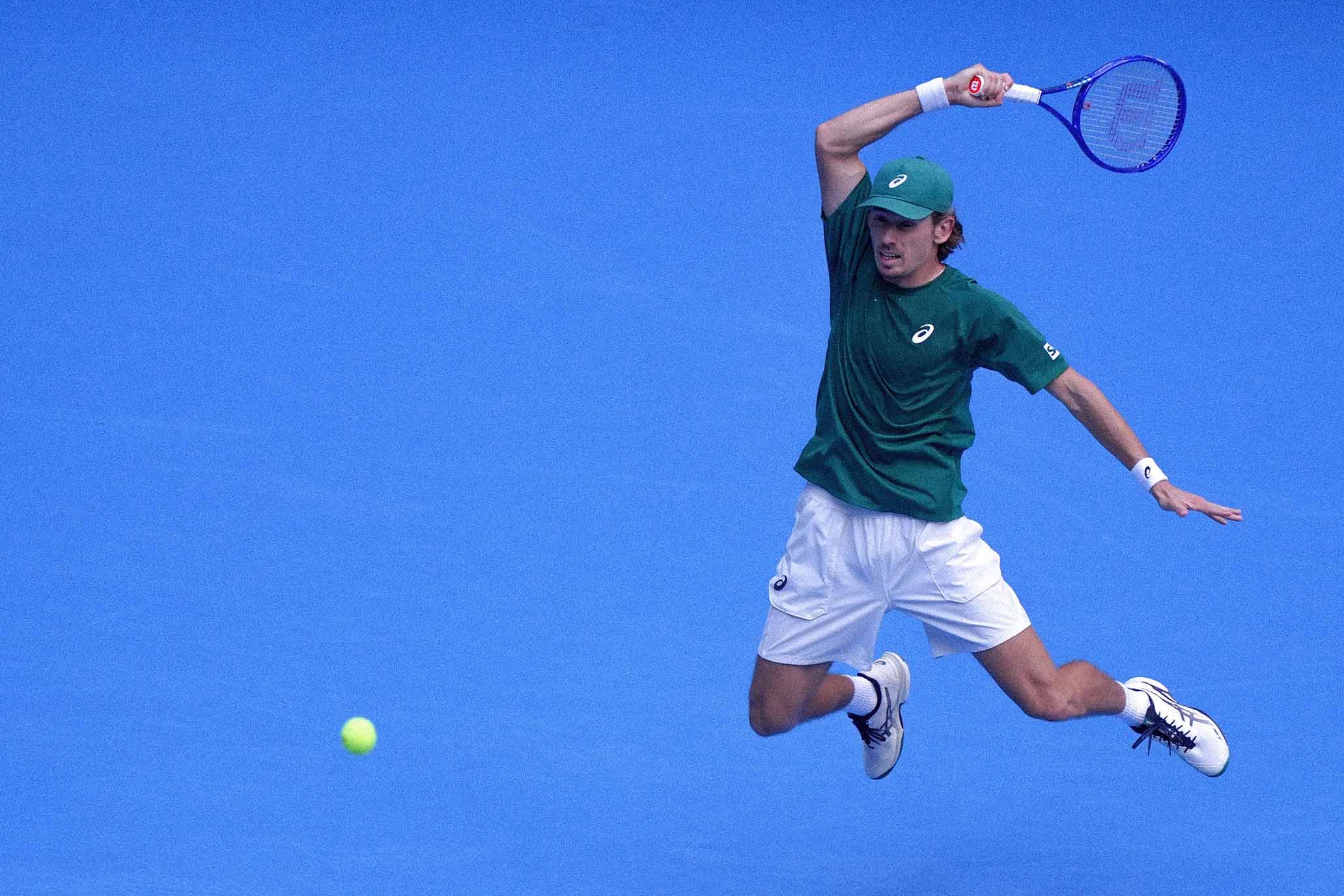
Alex de Minaur on the hunt in Beijing. // Getty
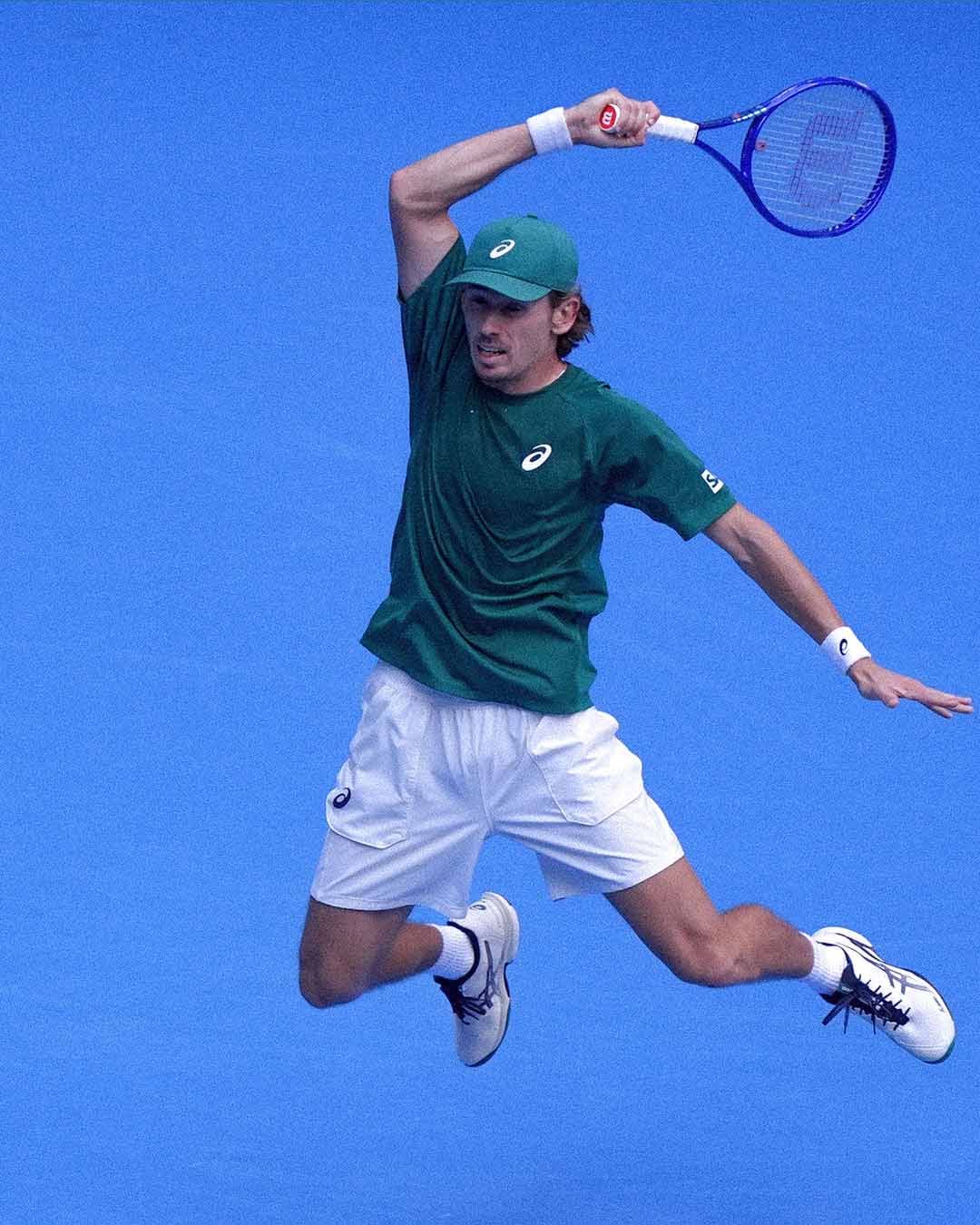
Alex de Minaur on the hunt in Beijing. // Getty
Alex de Minaur is listed at six-foot-even on the ATP’s website, but it sometimes feels like he is 12 inches shorter. His slight frame prevents him from easily generating the napalm-grade power you need to have to challenge for a major title these days. When he does blast a ball, he hurls his entire body into the air, and you can feel the effort through the screen. Sometimes I expect him to leave his shoes behind. Even when he exhibits his most supernatural skill—his speed—it’s used for desperate defense most of the time, in reaction to the opponent’s offensive abilities. The man known as “Demon” has a scrappier, less deceptive style than the tag would suggest. Without a forehand that can outpace speeding cars on the highway, he relies on exquisite timing, sneaking to the net and slicing sharp, angled volleys there and flitting over the court like the disk of light the sun sends bouncing off a screen and flying around a room. He is quiet, plays beneath a cap, and has a mustache as wispy as his build. He should play the industrious no-hoper in the next sports movie (Challengers 2: Electric Boogaloo?). Timothée Chalamet should star in his biopic. But for all the underdog spirit de Minaur projects, this underpowered roadrunning Australian has risen to seventh in the world and will participate in the year-end finals for a second straight year. His career has outpaced the notions we measure him against.
Not that he isn’t still helpless against certain foes. Recall your most humiliating mercy rule loss from Little League, then imagine it happening in front of a few tens of thousands of people rooting for your team. You’d come up with something vaguely as traumatic as the 2025 Australian Open quarterfinal loss to Jannik Sinner, the nadir (so far) of what’s currently the goriest recurring matchup in tennis. Sinner won 6–3, 6–2, 6–1, though the score line felt generous to de Minaur. My clearest memory from that match is de Minaur putting all his weight into an excellent backhand down the line that achieved the near-insurmountable task of moving Sinner off his favored spot on the baseline. The problem was that Sinner got to the ball and immediately passed de Minaur with his forehand, and the other problem was that none of the other points that day were remotely as exciting. If they’d had to play one more set I think it would have revealed some fundamental, unfixable wound in the fabric of the sport. David and Goliath might come to mind if David had less power on his slingshot and Goliath was too smart to get hit smack in the forehead and too tough to fall over even if he did.
That arguably wasn’t even the most lopsided defeat de Minaur had choked down in Melbourne, an honor that goes to his annihilation via Novak Djokovic two years earlier. Djokovic had hurt his hamstring before the tournament and looked in dire straits at times in the previous round against Grigor Dimitrov. After winning an athletic, strenuous rally to win the first set against Grigor, Djokovic collapsed to the ground—which now happens at practically every tournament, but felt like a striking show of mortality back then—to the point that I seriously believed, for a moment, he was about to retire from the match. Instead, he didn’t lose another set all tournament. The three he won against de Minaur, 6–2, 6–1, 6–2, were played with such haughty mastery that there might as well not have been another player on the court.
“I thought he was moving pretty well,” de Minaur said after the match. “Either I’m not a good enough tennis player to expose [the hamstring issue], or…it looked good to me. He was just too good in all aspects.” To me, it was clearly the former: No matter how hard he swung, de Minaur couldn’t produce a shot of enough heft to make Djokovic move with any violence. At times he’d rip a forehand into the corner, and Djokovic wouldn’t even have to slide to get there. Novak, meanwhile, dismissed shots for winners at will, from any part of the court. I spent some time after that match wondering how de Minaur could ever reassemble the self-esteem that Djokovic must have blown into a million pieces.
Yet somehow, de Minaur has played Djokovic competitively every time since that 2023 indignity. Sure, Djokovic’s decline finally kicking in helps, but it’s remarkable nonetheless—I’d have intentionally contracted the most convenient communicable disease to avoid rematches. In 2024, Alex beat Djokovic handily at the United Cup and lost in a tight two at Monte-Carlo. Most recently, in July, de Minaur thrashed Djokovic in the first set of their Wimbledon fourth-round and, though he lost the next three, had golden opportunities to win the fourth. He lost, but he pushed Djokovic hard enough to lay bare the aging lion’s vulnerabilities.
So maybe it shouldn’t have been a surprise that de Minaur has played Sinner closer since his exsanguination in January. But watching him struggle just to win points against Sinner in Melbourne, I never thought I’d see the day. Sinner does everything better than de Minaur, including defense: He may not be quite as quick of foot, but he has a more muscular style that allows him to better block back incoming missiles once he reaches them.
In Beijing in September, though, de Minaur showed out. He took a set off Sinner, just his second in their entire head-to-head, and he had break points in both the sets he lost. I watched the full match last week, and I’m still floored at how well de Minaur played to win that set. At break point down at 3–3, de Minaur won the most incredible rally—after Sinner survived an early overhead smash, the men traded baseline blasts, all taken on the rise and hit squarely with the sweet small middle of their string beds, for what felt like forever. This type of rally is unrecognizable from the points played even five years ago and is a plain different sport from the serve-and-volley days. Finally, de Minaur timed a crosscourt forehand exquisitely just as Sinner started to slow down, which afforded him a put-away that he nailed. That de Minaur won this type of point against a player who does everything better than him struck me as more impressive, relative to each of their abilities, than Sinner eventually winning the entire tournament.
In the quarterfinals of last week’s Paris Masters, de Minaur ran up against his antithesis, the bold, brash, tempestuous, powerful, inconsistent Alexander Bublik—strike that, let’s use his nickname, Sascha, lest he be confused with de Minaur in any way at all. On set point for de Minaur in the first set, Bublik hit a solid backhand down the line, and de Minaur redirected it violently crosscourt with a brilliant flick. It was the type of magical, unteachable shot that I thought belonged solely to those with greater shotmaking instincts. He served exceptionally throughout the match, too, racking up 12 aces and dependable win percentages on both first and second serve. Then he double-faulted the vital break away at 5–5 in the third set, and Bublik served out the match. It seems he can’t yet sustain that perilously high level yet.
Maybe de Minaur’s destiny is not that of David but Fingolfin, the Tolkien character in The Silmarillion who pecked, poked, and punctured the towering evil god Morgoth in single combat before finally dying, and even when being crushed to death still made sure his sword went through Morgoth’s foot. Let’s not forget that Fingolfin was a king himself. Alex followed up his brave stand in Beijing by losing to Sinner in straights in Vienna, though he still broke serve twice, which amounts to worthy resistance given that Sinner dropped serve three times across five matches in his title run in Paris. I still don’t think de Minaur can beat Sinner, but watching him try is becoming kind of fun.
As the only tournament all year in which a majority of the participants are better players than de Minaur, the upcoming World Tour Finals promise to be cruel. Last year, he lost six of the seven sets he played. Logic suggests de Minaur will lose heavily, maybe more than once. But if he remains this utterly committed to resistance, he might be able to shatter that narrative as well.

PURE, ORIGINAL TENNIS — SIGN UP!
RECOMMENDED
Review: Coco Gauff’s “The Zina Effect”
FILM REVIEWS
Postcard from the Japan Open
JAPAN OPEN