
Medheads, Rejoice
Medheads, Rejoice
We are now re-entering an era of Peak Medvedev.
We are now re-entering an era of Peak Medvedev.
By Giri NathanMarch 20, 2026
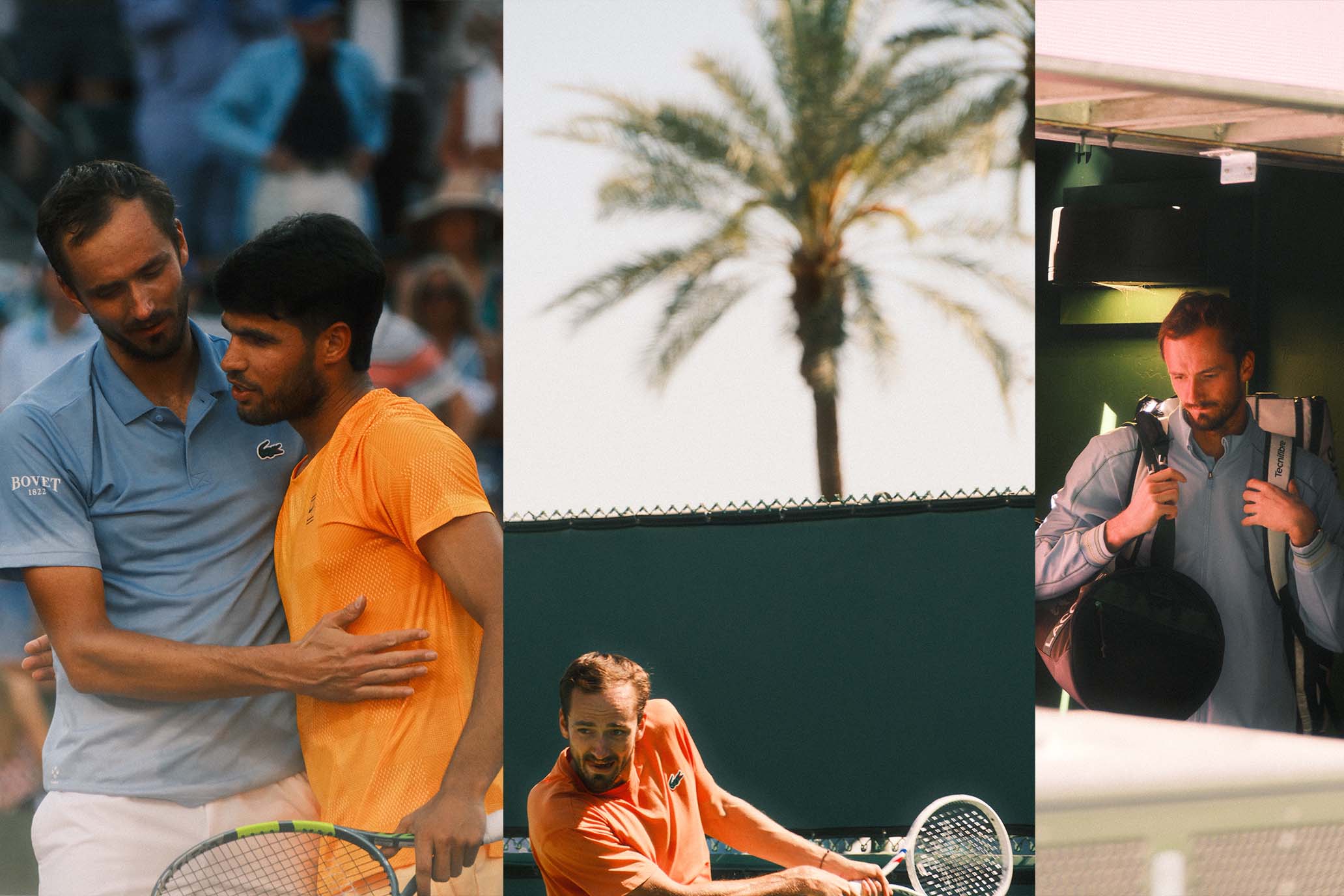
Photo by David Bartholow.
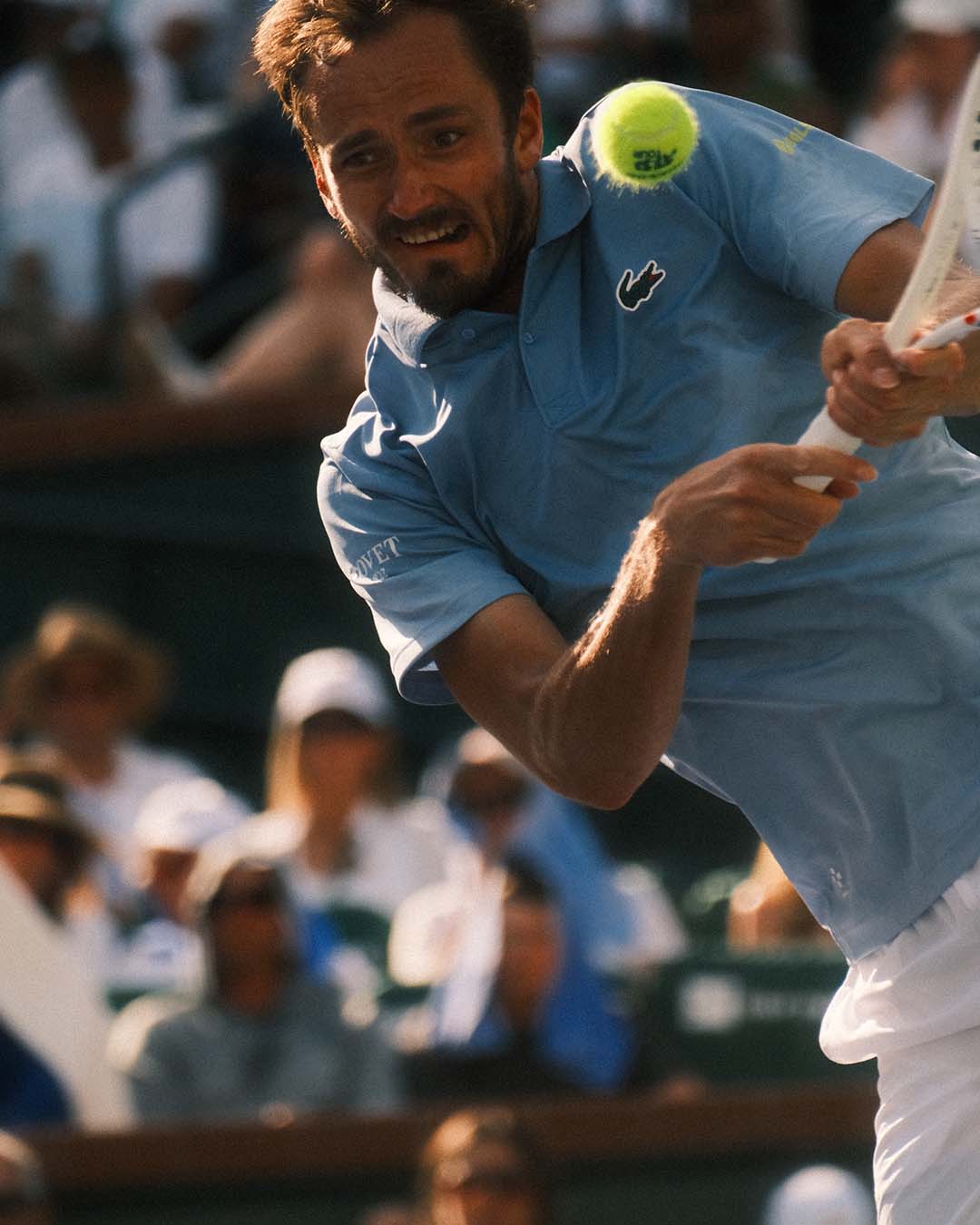
Photo by David Bartholow.
Sometimes I compile a wish list at the start of the tennis season. I forgot to do it this year, but if I had, at the top would have been a Daniil Medvedev resurgence. Not that I would have written it down without any sheepishness. As much as I believe in his peculiar game, more than I believe in anyone else’s game in the rapidly obsoleting ’90s-born generation, the case for Medvedev’s relevance was getting shakier by the day. His 2025 season was a wasteland. His trademark on-court meltdowns continued at the usual rate, but he forgot to counterbalance them with the actual match wins. Not much fun when those proportions are off
I found myself in too many conversations where I insisted, “He’s the only guy that has recent wins over both of them at Slams,” only for the months to keep on passing by, such that a 2023 US Open win over Carlos Alcaraz and a 2024 Wimbledon win over Jannik Sinner got harder and harder to hang an argument on. And in the interim, Novak Djokovic took over as the guy with the most recent wins over both of them at Slams. Plus, Medvedev was entering his 30s, while the two boy-kings of the tour were barely into their 20s. Why exactly were anyone but his dead-end obsessives supposed to care about the man who won the 2021 US Open and reached world No. 1 in 2022, but in the meantime lost his potent serve and spent years attributing his decline to shoddier manufacturing of the tennis ball?
But Medvedev shook things up at the end of last year, splitting with longtime coach Gilles Cervara, replacing him with Thomas Johansson and Rohan Goetzke. Almost immediately he won a 250-level title in Kazakhstan, a sole bright spot at the end of a dim season. Then he started the 2026 season with two more early titles: a 250-level in Brisbane and a 500-level in Dubai. Though a fresh war severely complicated Medvedev’s travel plans—Dubai to Oman to Istanbul to Los Angeles was his eventual solution—he did make it to Indian Wells in time to compete in the year’s first 1000-level event. He had match momentum, and perhaps more important, the environment had been tweaked to his liking. The Indian Wells hard courts, known for being the slowest on tour—so slow that Medvedev complained in 2023, “I’m a specialist on hard court. This is not hard court”—sped up appreciably this year. That meant it would be easier to finish points, and given his persistent complaint that it is impossible to hit a winner on tour anymore without Sincaraz-level power, it would be a welcome change.
And Medvedev thrived. From Dubai through the first four matches at Indian Wells, he won 16 consecutive sets. His serve was big and accurate again, reminiscent of his peak years. And he’d managed to inject some much-needed pace back into his ground strokes. The core magic of Medvedev’s game is the infuriating trajectory of his ball through the air, and after the bounce—a flat, low projectile that cannot easily be attacked—but some extra pace and placement make him even more dangerous still. While Medvedev over the past few seasons had taken on the reputation of a defensive player prone to low-powered shots and lengthy rallies, it was fascinating to hear how differently he conceives of his own game. As he put it after his fourth-round win:
When I’m in confidence, I’m an aggressive player. If you look, like, the Grand Slam matches when I was making finals, I’ll play, like, Rublev or Felix, the guys you cannot be more aggressive than them, but I would hit more winners than them, because I would be great in defense to try to reduce their winners, but whenever I had opportunity, I could move in.
So of course when I’m a bit playing worse, that’s where I become defensive, but it’s not by choice, it’s more by when I’m playing not great, my shot power and everything drops a bit down, the percentage of the serve, et cetera.
So when I’m hitting the ball the way I hit now, I can be aggressive and can put a lot of pressure on my opponents and still being able to be great in defense, and that’s what makes it tough.
With that renewed aggression he restored a vision of peak Medvedev: the one who rattles off quick, unreturnable serves, barely pausing between points, holds, and then sinks deep behind the baseline, where he can put a lot of returns into play and stretch out the resulting rallies. Short and easy service games for him, long and excruciating service games for you—that’s how he looks when everything is clicking.
The Medvedev who took out Jack Draper in the quarterfinal looked like that. And the one who went on to upset Carlos Alcaraz in the semifinal, 6–3, 7–6(3), looked even more confident still. Sixteen matches into the season, Alcaraz finally lost his first match of 2026, and said afterward, “I have never seen Daniil playing like this.” The Medvedev forehand in particular was struck with a conviction I hadn’t seen since that win over Alcaraz in New York back in 2023. Since that day, he’d lost four matches in a row to the Spaniard, and this match in Indian Wells could have started turning in that direction when Alcaraz lined up two set points at 5–4 in the second. But Medvedev held his ground. He has internalized that he cannot win this matchup without taking slightly bigger risks and playing closer to the lines; any passivity can be punished by Alcaraz’s ability to end points at will, with his infinite menu of options. But Medvedev managed to reverse his fortunes against a player who had seemingly surpassed him for good.
The other player who fits that descriptor, Jannik Sinner, awaited Medvedev in the final. If Medvedev wanted to capture the last 1000-level hard-court title that still eludes him, he would have to consecutively beat the two players that no one else can manage to beat even once. (It might’ve been roughly comparable to David Nalbandian reeling off consecutive victories over the Big Three to win Madrid back in 2007.) Sinner had won their last three meetings since the upset at Wimbledon 2024, and he is the rare player on tour who does not fear backhand-to-backhand battles against Medvedev. It was a brilliant battle, a stress test of the renovations to Medvedev’s game, and, despite some real chances, a narrow loss, 7–6(6), 7–6(4). On the strength of the past few months, however, Medvedev reenters the top 10. He has very few points to defend the rest of the year and has shown that he can still hang with the untouchable duo at the top of the tour, despite using tools quite different from their ultra power and spin. I second Sinner’s post-match assessment: “I do believe that tennis needs him. He’s a very unique style of playing. Seeing him back at this level, it’s great.”
PURE, ORIGINAL TENNIS — SIGN UP!
RECOMMENDED
Sunshine Daydream
INDIAN WELLS

The Great Outdoors
SNEAKERS — NEW BALANCE
Jack Draper Reminds Us How Good He Is
INDIAN WELLS