The Ghost Writers
The Ghost Writers
Amazon’s got AI churning out tennis biographies by the dozen, but to what end?
Amazon’s got AI churning out tennis biographies by the dozen, but to what end?
By Simon CambersIllustration by Dalbert B. Vilarino Featured in Volume 3 of OPEN Tennis — BUY
The Ghost Writers
The Ghost Writers
Amazon’s got AI churning out tennis biographies by the dozen, but to what end?
Amazon’s got AI churning out tennis biographies by the dozen, but to what end?
By Simon CambersIllustration by Dalbert B. VilarinoFeatured in Volume 3 of OPEN Tennis — BUY
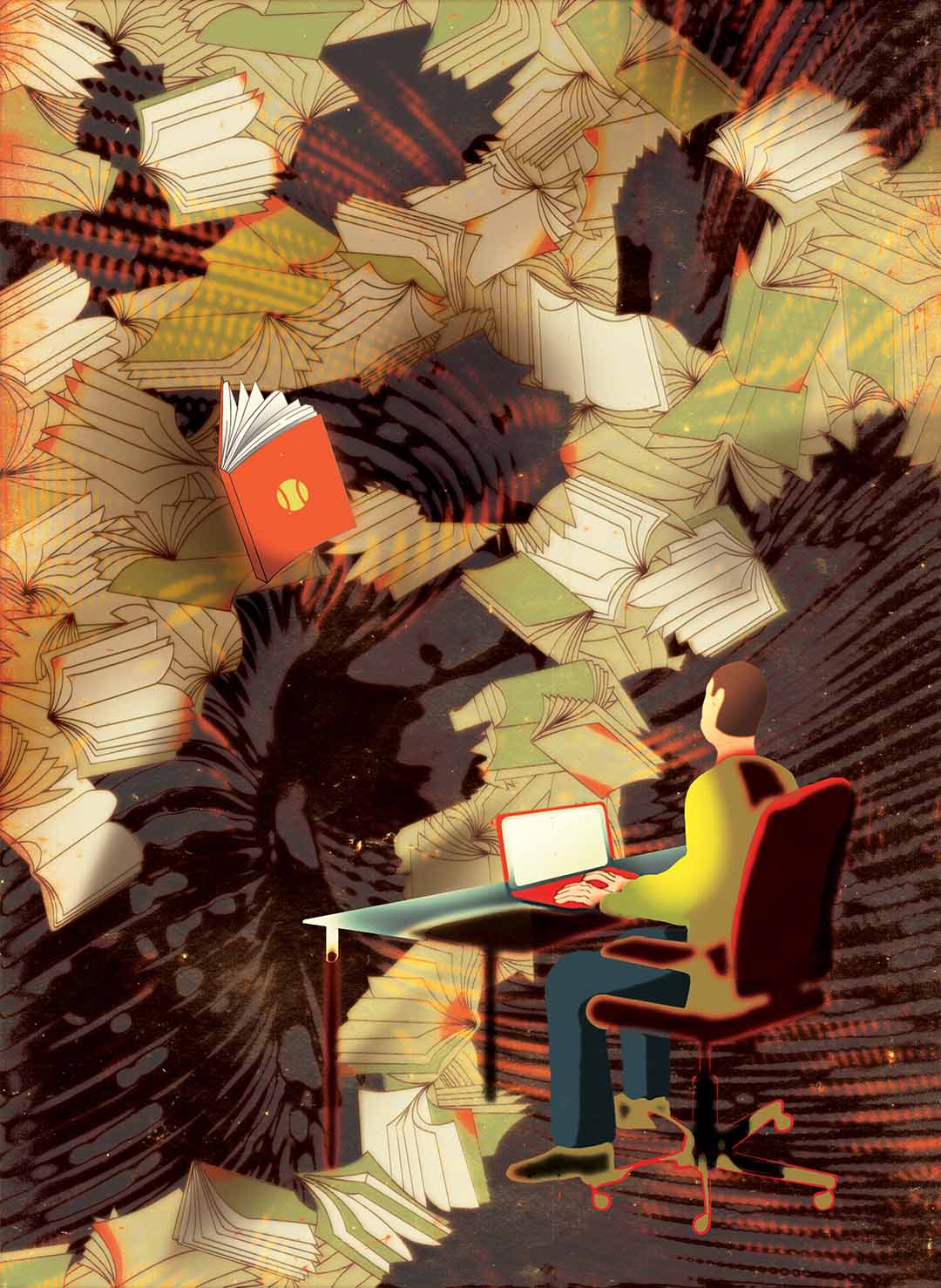
Illustration by Dalbert B. Vilarino
Illustration by Dalbert B. Vilarino
Anyone who has ever written a book—be it on tennis, on other sports, or in fact on any subject—will know how difficult it is to make it a success. Unless you happen to have invented Harry Potter, it is incredibly hard to produce a bestseller. For the vast majority of authors, writing books is not a path to riches. And it is becoming even more difficult, thanks to AI.
Three years ago, I was lucky enough to have a book published. The Roger Federer Effect, cowritten with my friend and colleague Simon Graf, came out in October 2022. Timed somewhat fortuitously with Federer’s retirement, it was well received, with the German version selling well in Switzerland.
In the days and weeks after publication, I became somewhat addicted to checking the Amazon bestselling lists, a habit that has proved hard to shake off, even now. But those Amazon lists also serve a purpose: They’re the easiest way to get at least an idea about how your book is doing.
Type “Roger Federer biography” into a search on Amazon, and you’ll find a host of books about the 20-time Grand Slam winner. These include books by well-known writers like Rene Stauffer, Christopher Clarey, Chris Bowers, and even our own. However, there are also a number of books—ahead of ours in the list—all self-published, all with similarly laid-out covers, all slightly artificial-looking.
Wanting to know a little more, I clicked on one: Roger Federer biography: Mastering the Court: The Unstoppable Rise and Enduring Legacy of a Tennis Icon, by “Graham Newberry.” Not recognizing the author was a red flag in itself—the tennis world is a small one—while its cover was slightly disturbing, picturing someone resembling Federer, but wearing Asics shoes instead of Nike or On, and some random, rogue letters—“RIIS”—in the title on the cover. On further inspection, things became clearer. Newberry is a prolific “writer,” with several titles to his name. Impressive, right? Well, no. A closer look reveals that many of these books—covering the likes of Jack Nicklaus, Wayne Gretzky, and Lionel Messi—were published within days of one another. He even managed to write four biographies of former U.S. presidents on successive days.
Newberry is far from alone. Check out “Juan T. Parker,” “Sydney J. Prince,” and “George Clinton,” among many, many others. Clinton has written biographies of Jannik Sinner, Carlos Alcaraz, Novak Djokovic, Aryna Sabalenka, Iga Swiatek, Coco Gauff, Alexander Zverev, Elena Rybakina, Emma Raducanu, Naomi Osaka, Nick Kyrgios, Casper Ruud, Taylor Fritz, Frances Tiafoe, Anastasia Pavlyuchenkova, Madison Keys, Stefanos Tsitsipas, Belinda Bencic, and Olga Danilovic. None of these authors have a digital footprint outside of Amazon, and almost none of them have any reviews.
Some of these clearly AI-generated books are comical. Chapter 1 of Newberry’s Federer book is all about…Serena Williams. Ahem. Some are even laugh-out-loud, like the books by Charles B. Prints (or Charles A. Prints), which reimagine Petra Kvitova and Ons Jabeur—and Jake [sic] Draper—as famous table tennis stars, but use all their tennis and life backstories to do so.
Some books are downright weird, like Harrison F. Cole’s biography of Carlos Alcaraz, the cover of which is definitely not a photo of Alcaraz; it’s no tennis player I’ve ever seen and looks vaguely like an actor or a singer in a boy band, wearing a collared, sleeveless top. His biography of Jannik Sinner carries a cover photo that does not even try to make it look like the Italian, instead showing a woman.
Many of these books pop up in the days after a big event. When Coco Gauff won the French Open in June, a number of suspicious titles appeared. Sabrina M. Ellsworth managed to publish an Aryna Sabalenka biography in September, two days after she penned one on Jasmine Paolini.
AI has made all this possible, allowing factories (or individuals) to produce books en masse. Writing in the New Yorker in October, Stephen Witt reported that there are thought to be almost 4 hundred trillion words on the indexed internet,” but many of them are useless—high quality text is rare, and the supply is finite. “Since A.I. chatbots are recycling existing work, they rely on cliché, and their phrasing grows stale quickly. It’s difficult to get fresh, high quality writing out of theme—I have tried,” Witt wrote.
But perhaps a bigger problem than lousy prose is the lack of regulation. Amazon is more than happy to allow these books to flood the market, pushing legitimate titles down its search engine. Some of these books are even sponsored.
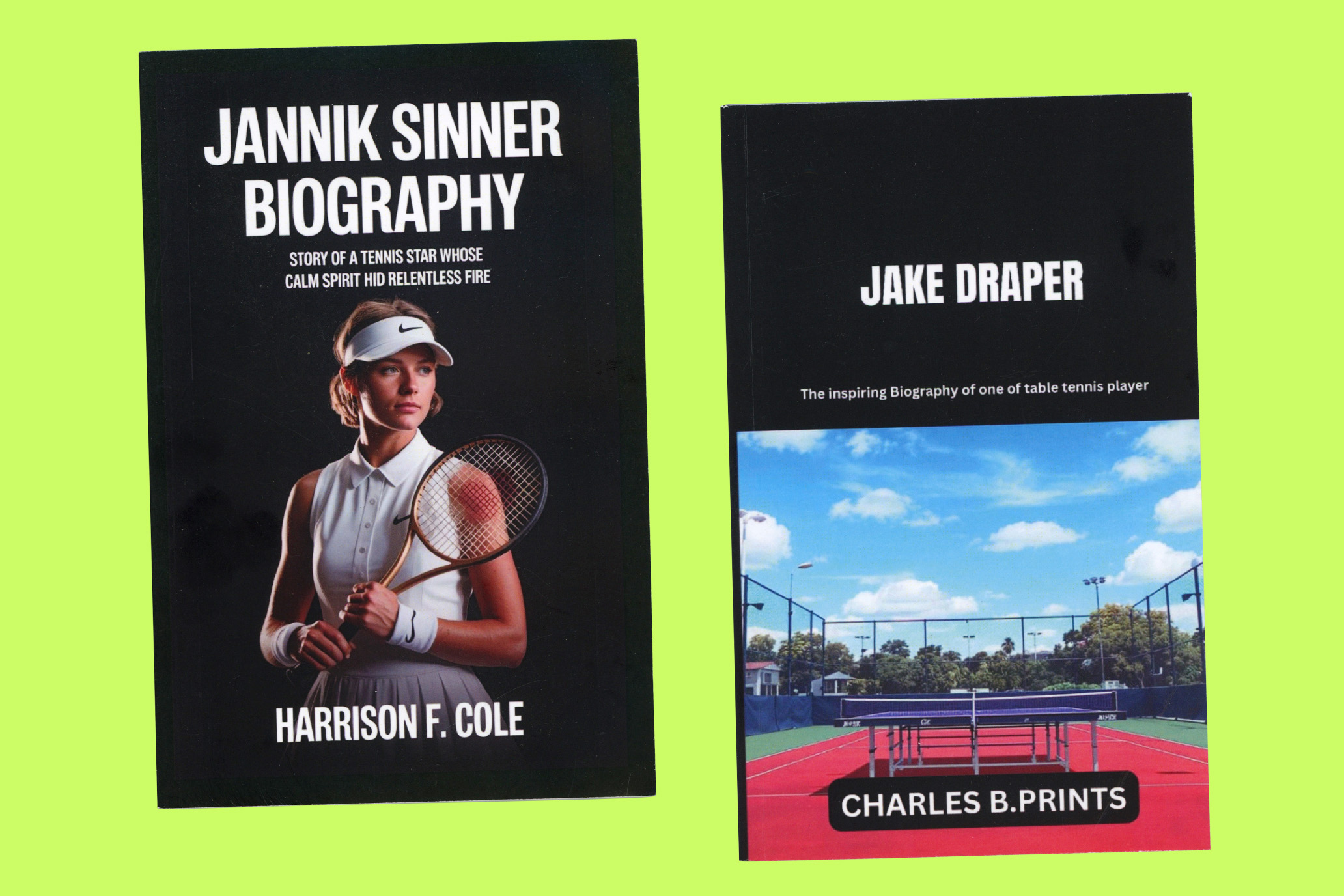
Recent "works" by Harrison F. Cole and Charles B. Prints.
Recent "works" by Harrison F. Cole and Charles B. Prints.
In theory, if a book is entirely AI-generated and published via the Kindle platform, the author must tell Amazon. However, Amazon doesn’t pass on that knowledge to buyers. If it’s “AI-assisted,” then the author can keep quiet. It took them until late 2023 to bring in a rule restricting authors to the number of books they can self-publish on a given day, to three. It took me 18 months to cowrite one book.
“If you make a keyword search for a particular topic or even an author, you have to wade through several pages of often irrelevant results,” said George Walkley, a U.K.-based expert in AI and publishing. “I think that’s probably the biggest short-term impact for publishers, that it may deter people from finding the book that they were looking for.”
Walkley says the low production costs mean authors of AI books have to sell only a few to make a profit. “I think that really points to what the long game is,” he said. “It’s a volume play. They only need to sell a few copies, whereas you or I would have to be looking to hundreds or thousands of sales of a book in order to earn back the investment we made in it, in terms of time.”
Walkley agrees Amazon should do more to regulate but doesn’t think they should promote traditionally published books above self-published ones, because not everyone has the luxury of finding a publisher. “Amazon can attempt to use software to detect what is AI-written and what is written by human beings. But again, this isn’t 100 percent reliable. I think Amazon has a real challenge here in trying to keep an open publishing ecosystem in an era where AI is available.”
There’s another danger, thanks to AI: plagiarism. During my research, I found another book on Federer, the sample of which revealed that it was almost identical to The Master, by Christopher Clarey. The author—“Shelly Phomsouvandara”—had also written a book on the former boxer Ed Latimore, which turned out to be stolen from Latimore’s autobiography. I contacted both Clarey and Latimore, and, with the help of their publishers, the books were removed.
Clarey says Amazon needs to do more. “It just seems so easy in the age of AI to be able to do these things,” he said. “I think it’s on Amazon and the people who are providing the links to the sales to at least do all they can to avoid this being put up online, maybe raise the bar in terms of how hard it is to get a book on there. Amazon responded to my initial request to explain the guidelines, wanting to know my deadline, but then didn’t get back to me.
“The bigger question for me, really, is the AI aspect of it, and what happens to sports book authors and book authors going forward. Because it’s just so easy to produce a work, probably, of decent quality with very, very little effort by aggregating all the known published thought on a particular figure.”
AI can’t go out and talk to people and can’t witness events, which gives journalists an edge. But when it comes to historical books, it is improving all the time. Nevertheless, even in the tennis titles I’ve seen, there is not a single example of quoted speech. No information is ever attributed to anyone, and no notes on sources or indices are forthcoming.
“I certainly don’t think it can be done as well as a top biographer, or somebody who’s really spent, like I did, two years on a book about [Rafael] Nadal [The Warrior], using all kinds of new reporting and my old references, my old material, and my perspective over those many years. But certainly, somebody can produce something that’s able to compete with something that I put a huge amount of sweat and effort into, very quickly. So that’s really the challenge: how it dilutes the market, floods the market, and makes it thrive.”
Given all that, it’s remarkable to see that these “books” have the temerity to include a disclaimer discouraging anyone, for reasons that are something of a mystery, from reproducing any of their content without permission.