
More Than Hype
Vicky Mboko: Way More Than Hype
Vicky Mboko: Way More Than Hype
The Canadian phenom’s title in Montreal has been in the making all year.
The Canadian phenom’s title in Montreal has been in the making all year.
By Carole Bouchard
Aug 8, 2025
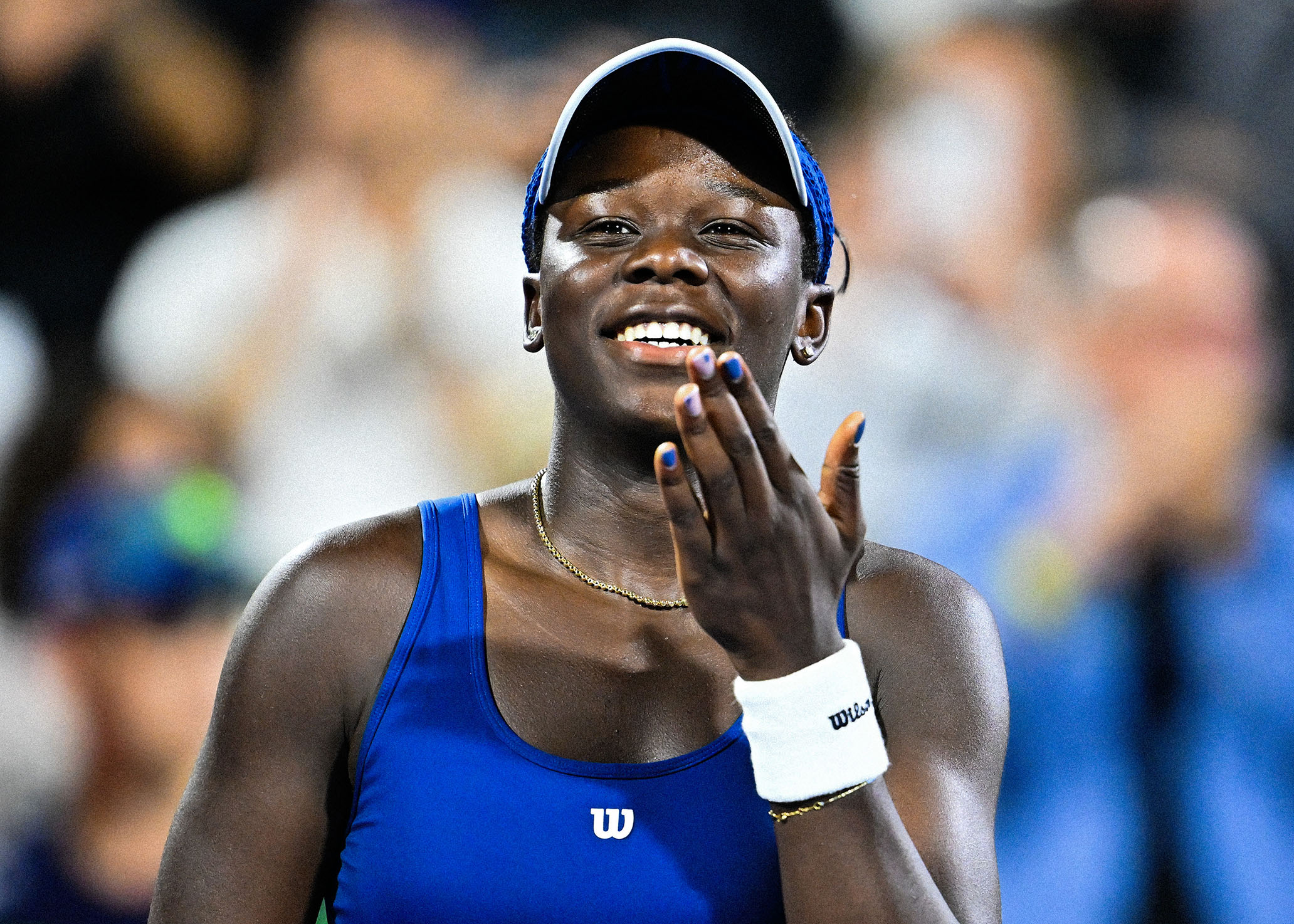
Vicky Mboko is all smiles during her title run in Montreal. // Getty
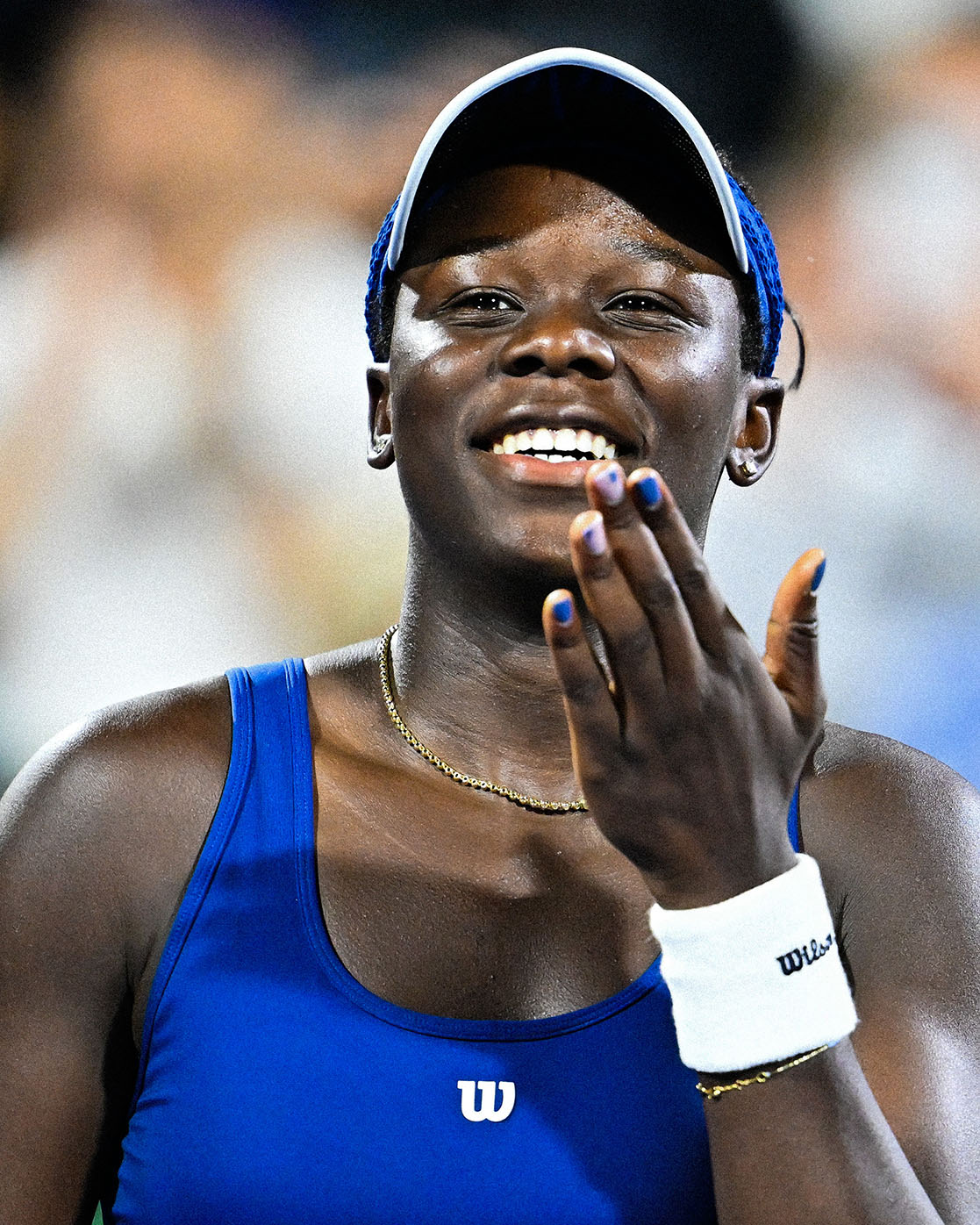
Vicky Mboko is all smiles during her title run in Montreal. // Getty
Victoria Mboko is the tennis tornado the game needs. We all love a prodigy narrative, and there’s nothing like a teenager tearing through draws. And nothing like a teen entering her home tournament, a WTA 1000, with a wild card, and ending up with the trophy after beating another former teen wonder, Naomi Osaka, to clinch the biggest title of a career that has just started.
After Carlos Alcaraz, who’s been defying gravity since winning the US Open at 19 in 2022, and Mirra Andreeva, who’s become a solid top 5 to top 10 player at just 17, the mantle, it seems, has now been passed to Victoria “Vicky” Mboko, an 18-year-old wonder from Canada.
Mboko ended the 2024 season ranked 350th in the world, and now, not even a year later, she is guaranteed a spot in the top 30 (24). “I want to win every match I play,” Mboko told me back in March, and she still sings the same tune in August, saying after dispatching Coco Gauff in the round of 16 in Montreal last week: “When you play a tournament, the goal is to win it.” Tennis, made simple.
As Montreal is rightfully losing its mind over the epic run of the teenager, those who’ve been following Mboko’s season closely saw it coming. On her home soil, the Ontario native, from French-speaking Congolese parents, is displaying why she’s been, outside of the Slams, one of the best stories in the game.
After beating Elena Rybakina to reach her maiden WTA 1000 final, Mboko became the first Canadian to defeat three former Grand Slam champions (Rybakina, Gauff, and Sofia Kenin) in a single WTA event in the Open Era. Osaka made four. And in one single match, she showed why she was turning all heads around this year: She has learned in less than a year how to play and manage matches like a top 10 player. She plays as if she already belongs.
It takes less than a minute for anyone watching Mboko play to stop, gasp, and wow. She possesses a level of effortless power and charisma that draws crowds, along with the risk-taking temperament that comes with it, and an infectious positive energy. She will leave opponents meters away from the ball, whatever their ranking or experience. Her tennis is the definition of bold and unimpressed. She also shows a nice tennis IQ and solid variety in her game. At 18, she walks out there and plays as if she has been playing that way for a decade. Of course, we know it’s easier at that age to swing freely, and that pressure will keep mounting. “We shouldn’t forget that it’s important she keeps smiling out there,” Noelle Van Lottum, who is on Mboko’s coaching team and is also head of women’s tennis at Tennis Canada, told me this year. “What’s most important is that everybody remains calm around her and that we keep helping her improve. Vicky needs to keep that joy to play.” It will be key to keep now more than ever.
Yet her honeymoon phase is fascinating to witness, especially because it’s been percolating for a while. People discovering Mboko through her Montreal run need to understand she’s not a one-week wonder, because Mboko has been improving steadily all year. In the first six ITF events she played in 2025, she won five. When I had my first chat with her back in March, when Mboko was awarded a wild card for Miami’s WTA 1000, her record was 27–1. And she was as bubbly-but-determined about it all as she is now with her 53–9 record.
Mboko is here to win big, that is all. She’s not a longtime Serena Williams fan for nothing. Yet she won’t get ahead of herself, as she already experienced how rough the journey could be when she got sidelined for six months last year due to a knee injury. That’s the thing we don’t want to dwell on, for fear of jinxing her—that Mboko’s main worry moving forward won’t be developing her game but managing her body. After the final, Mboko announced that she will skip Cincy to rehab a wrist injury she picked up during her semifinal against Rybakina, ahead of the US Open. The sport has just one job here: not burning that kid out. “I don’t have so many people around me, and it’s kept me very calm and very comfortable,” she told me this summer. Quiet off the court but enjoying the frenzy of a big court’s crowd is also Mboko’s recipe: She’s been swinging in Montreal in front of a packed crowd entirely devoted to her without being overwhelmed; another sign of a solid foundation. More? You can see she’s enjoying it.
People will say that, with such power and physicality, one tends to move up the ladder quicker. True. But what is also making Mboko’s ascent to the top fascinating, like Andreeva’s, is how quickly she learns. She took over the ITF level in a winter, won her first match in a WTA 1000 in Miami in March, qualified for Rome and won a match before losing to Gauff in three sets in April, then qualified and got to the third round at Roland-Garros, was a match away from qualifying for Wimbledon, then got a lucky loser spot and won her first-round match. And she’s now in her first WTA 1000 final, becoming only the third wild card to achieve this in Canada in the Open Era after Monica Seles (1995) and Simona Halep (2015). She lost against Gauff in Rome and beat her in Canada. She lost against Rybakina in Washington and beat her in Canada. She learns at a speed that will scare a field already busy managing the Andreeva rise. What’s also both scary for her rivals and absolutely amazing for the rest of us is that Mboko is already that good despite having a huge margin of improvement. When they say the sky is the limit, she’s the definition of it.
The last Canadian woman to play in a final at home was Bianca Andreescu, who won there in 2019 and went on to win the US Open. She could be a good example for Mboko, as her rise was also spectacular, but the journey kept getting harder. Mboko, like Andreescu, isn’t a hype; she’s the real deal. It’s no guarantee to become the next Serena, Maria, Iga, Aryna, or Naomi, but it’s a great chance to have a fair shot at it. “To get this result in a tournament like this is a huge turning point for me,” said the teen wonder in Montreal, already aware of how a tennis journey can be slowed or fast-forwarded. In Montreal, it may have skyrocketed.

PURE, ORIGINAL TENNIS — SIGN UP!
Genie Bouchard's Long Goodbye
Genie Bouchard’s Long Goodbye
Genie Bouchard’s Long Goodbye
It’s been a wild ride for tennis’ original influencer.
It’s been a wild ride for tennis’ original influencer.
By Giri Nathan
Aug 1, 2025
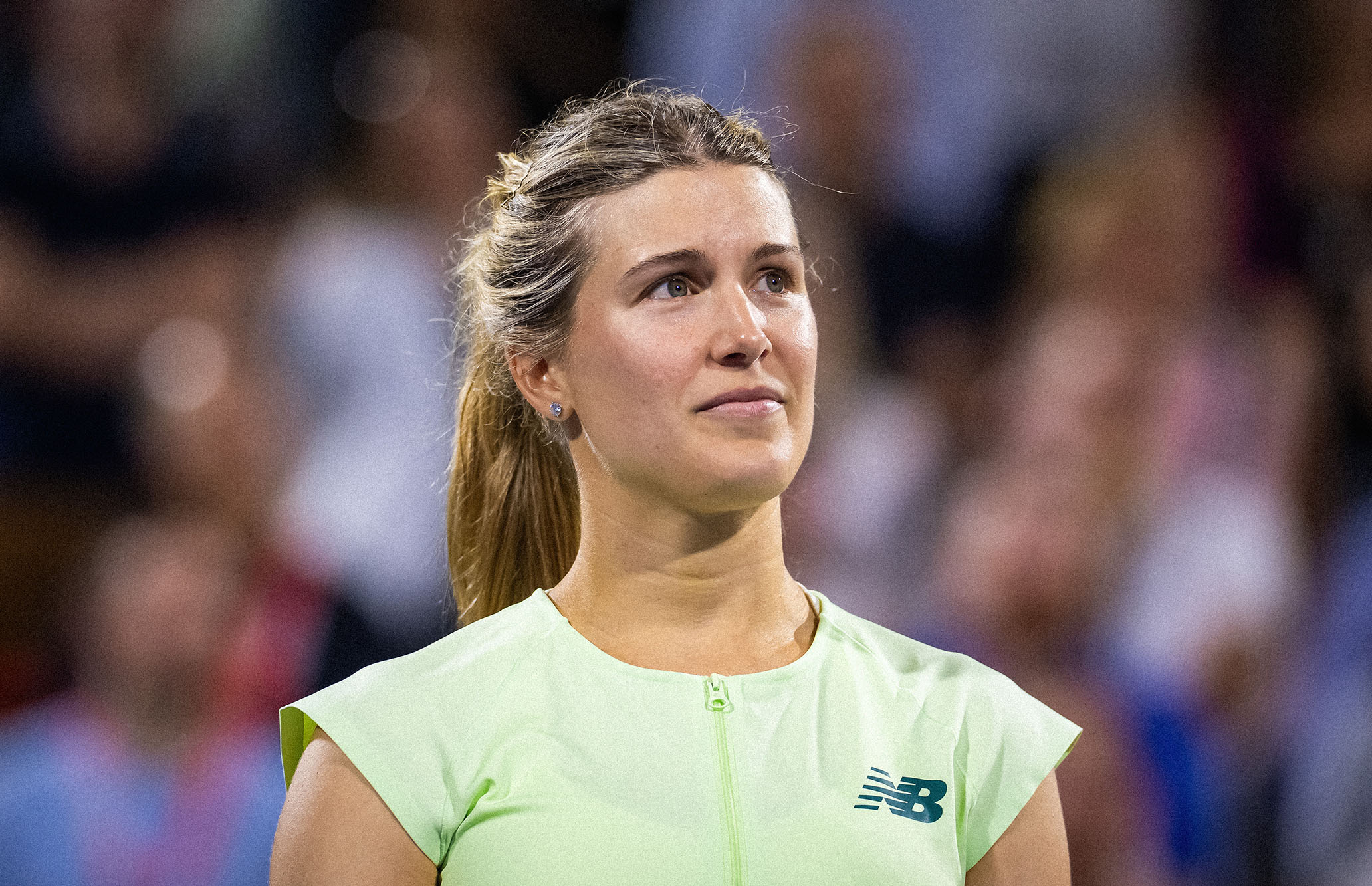
Genie Bouchard says goodbye at the National Bank Open in Montreal. // Getty
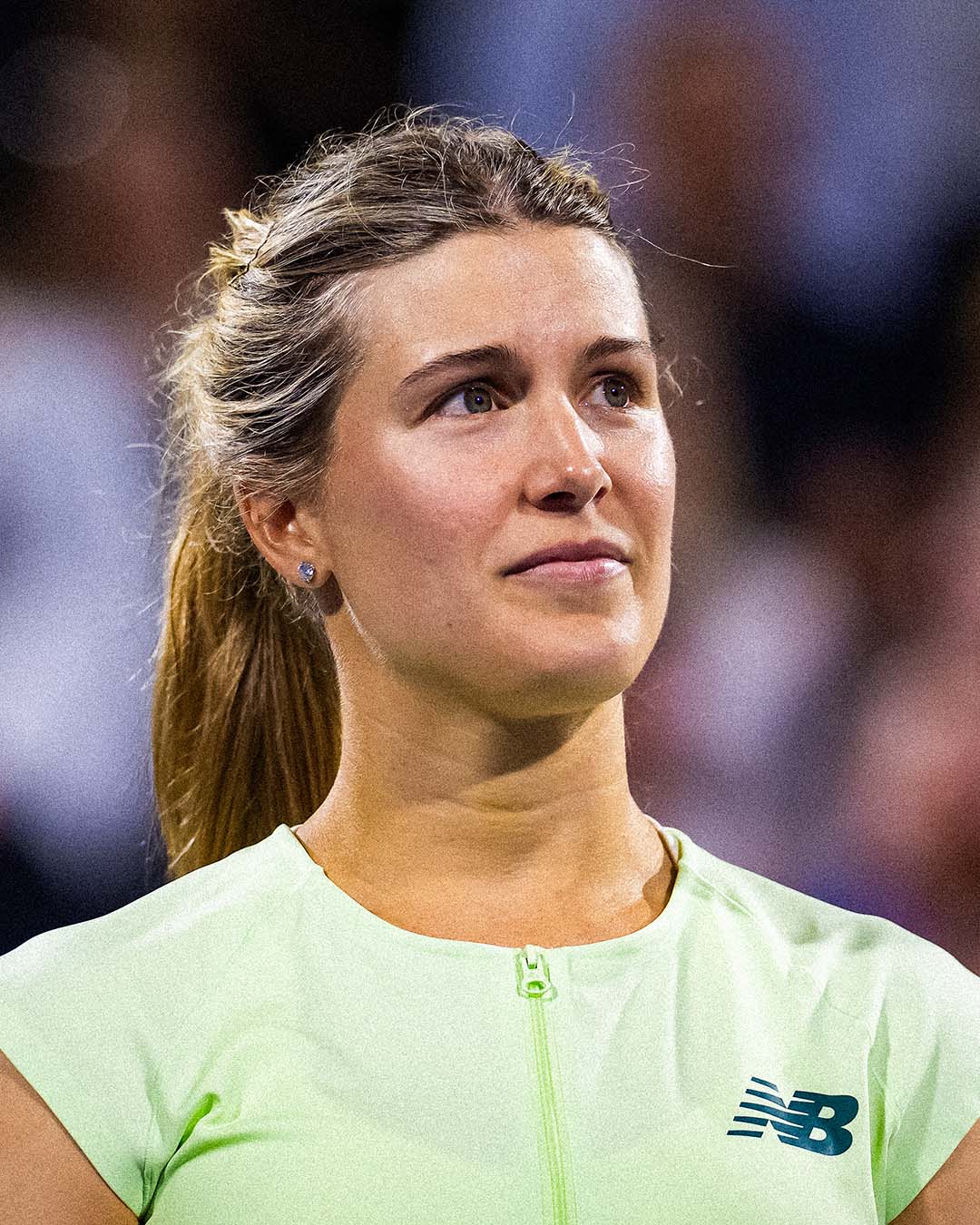
Genie Bouchard says goodbye at the National Bank Open in Montreal. // Getty
Tennis success is so fickle. In the 2014 season, Eugenie Bouchard turned 20 years old and shot up the rankings. She had an aggressive style, sitting on the baseline and taking the ball early with compact, almost stilted ground strokes. She was a semifinalist at the Australian Open, semifinalist again at Roland-Garros, runner-up at Wimbledon. By the end of the season, she was No. 5 in the world. Bouchard achieved many firsts for Canadian tennis. After a run like that, she appeared to be on course for a Hall of Fame career.
As we now know, that isn’t how her career played out. In the following 2015 season, her results settled back down to earth. During a strong fourth-round run at that year’s US Open, Bouchard slipped on a tile floor in the locker room and suffered a concussion, an injury that forced her to withdraw from the tournament and, as her lawyers would later argue in U.S. federal court, hampered the rest of her career. (In 2018, Bouchard and the USTA reached an undisclosed settlement.) Sadly, I might have followed this legal saga more closely than her on-court highlights from this point onward, all the way up to her retirement from tennis this week.
If the post-concussion symptoms that followed that fall were as serious as those alleged in the lawsuit, that would indeed be tragic. It is also possible that, for any number of reasons unrelated to that fall, Bouchard just happened to produce her career masterworks before embarking on her 20s, like a Nas or Rimbaud. It was always going to be a challenge to try to replicate the magic of 2014. Sometimes tennis players start out hot, only to get solved by opponents over time. It happens. Here, though, the decline was shockingly abrupt. Bouchard was ranked No. 47 in the world at the end of 2016, then No. 81 in the world at the end of 2017. A few months later she was out of the top 100, where she would remain for almost the whole remainder of her career.
Through it all, Bouchard was still very much…around. In fact, she was making some of the best money of any female athlete in the world, according to Forbes lists published in 2017 and 2018, the same years of her on-court decline. No matter how the tennis matches were going, brands continued to deem her a compelling saleswoman. She modeled. She posted a lot of “lifestyle” images on social media. She did some cheesy stunts, like agreeing to go on a date with a random internet user after a wager on the outcome of the 2017 Super Bowl. When the prize money dried up for Bouchard, she found that she could still monetize attention. Eventually the traditional high-end tennis sponsors stopped renewing the contracts. One day you’re peddling Babolat racquets, the next day you’re peddling an e-book about cryptocurrency.
This is the move that probably soured many tennis fans on Bouchard: becoming a hybrid professional tennis player/influencer. Perhaps the fans felt that a genuine athlete shouldn’t stoop to this stuff. Perhaps she was just too abrasive and frequent with the posts. Perhaps this “secure the bag” mentality wasn’t going to win her much sympathy, given her preexisting reputation and upbringing. (She was born to an investment banker dad, who tried to devise a scheme so her tennis training costs would count as tax-deductible business losses, only to be denied in Canadian court, which ruled that these were actually just personal expenses and a 9-year-old Eugenie did not have the capacity to sign away future earnings.)
Or perhaps Bouchard was just a little ahead of her time. Because that’s pretty much what all the top players do now, without much hate—shill things on Instagram. On-court prize money has always been a fraction of what players can make on ads. As a society we have figured out how to spend even bigger chunks of our days consuming such ads, often dressing them in the guise of things that are not ads. With the memory of her spectacular 2014 season fading, Bouchard was like so many people at this dire moment in culture: trying to take a short bit of fame and spool it out into a longer-lasting revenue stream.
Amid all those extracurricular activities, Bouchard did keep touring, and in spite of injuries and struggles with form, she had an interesting result here and there in her late career. She only let up in 2024, when she accepted the fate of a near-terminal tennis player: pickleball. For a time she played both games professionally. Earlier this year the 31-year-old Bouchard announced that she would be retiring from tennis at her home tournament in Montreal, where she played some excellent matches this week. She won a three-setter against Emiliana Arango, and in the second round she nearly pulled off the upset of world No. 20 Belinda Bencic. As for what’s next? She’s not sure yet. But it’ll probably be hard to miss.
PURE, ORIGINAL TENNIS — SIGN UP!
For Foki's Sake
Alejandro Davidovich Fokina dreams big.
Alejandro Davidovich Fokina dreams big.
Despite finals setbacks, Foki has his sights set on the majors.
Despite finals setbacks, Foki has his sights set on the majors.
By Karina Niebla // CLAY
July 30, 2025
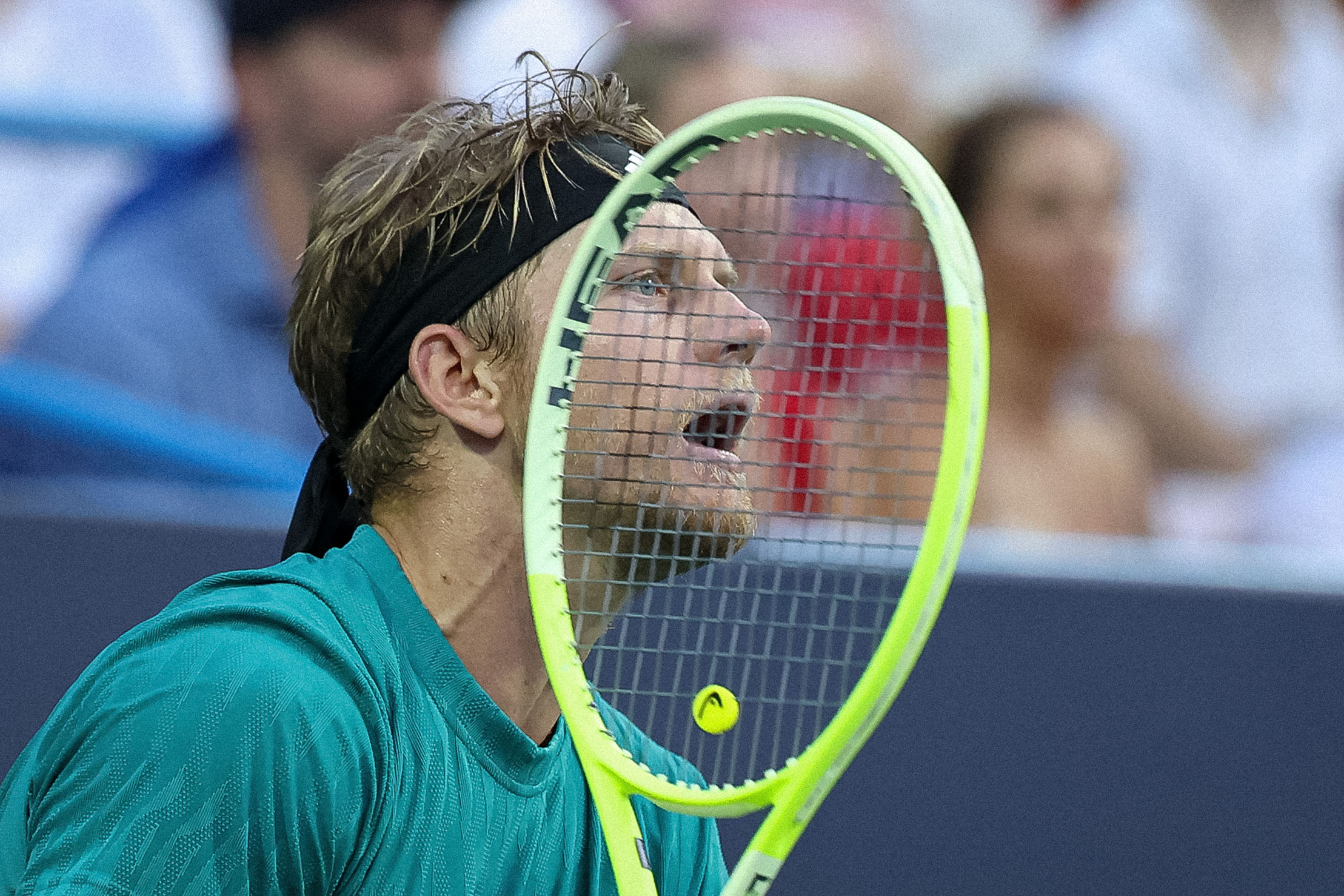
Foki tries to go the final mile in DC. // Getty
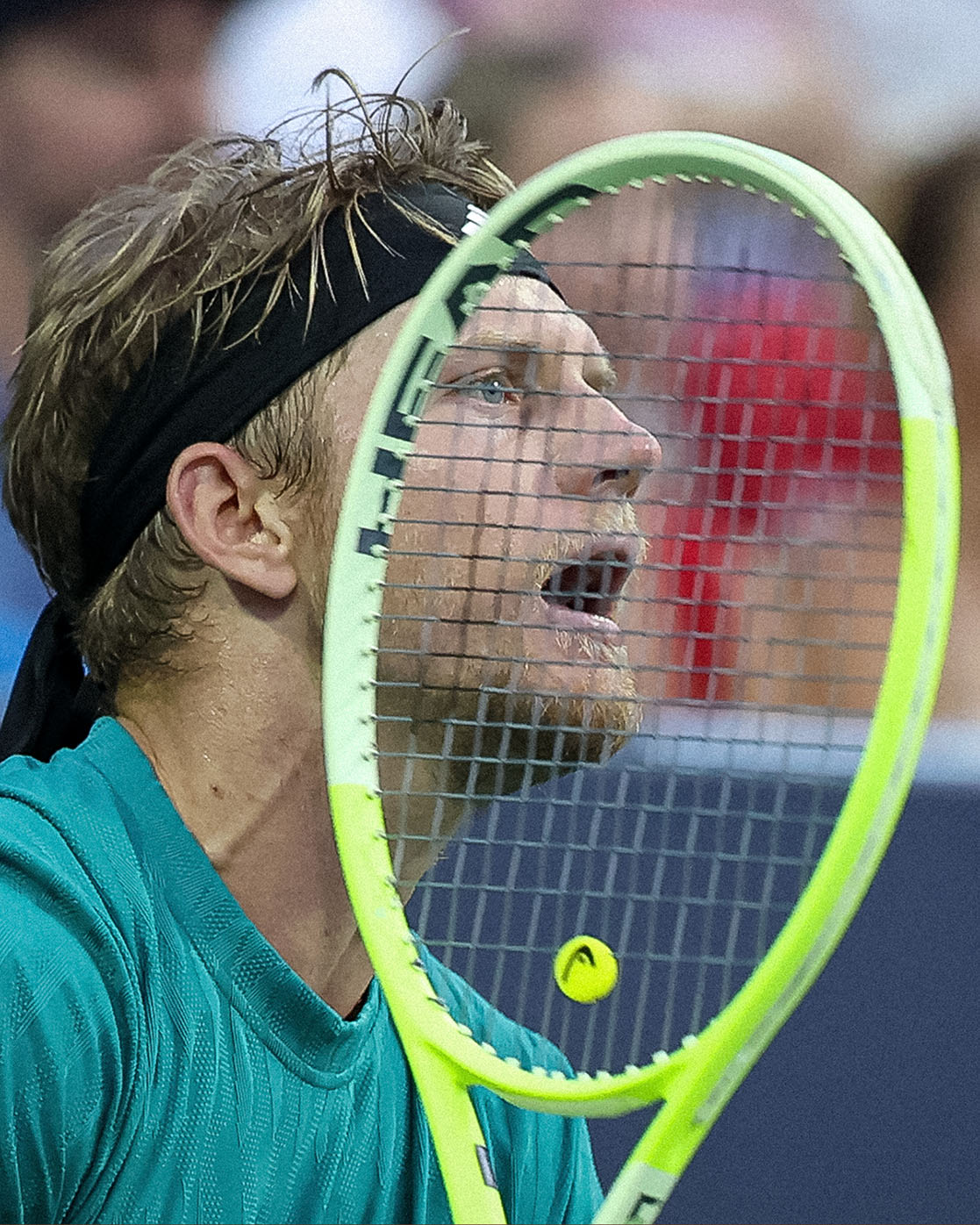
Foki tries to go the final mile in DC. // Getty
HAMBURG—Reaching a final, if not actually winning one, is most likely the goal of any pro tennis player. Losing them every time is certainly not, but that’s the recent reality for Spain’s Alejandro Davidovich Fokina: He’s played four finals on the ATP Tour and lost all four, the most recent being his gut-wrenching loss to Alex de Minaur in D.C. on Sunday. And cracking the top 20 for the first time, it seems, was no consolation.
“I’m happy to be in the top 20, but the goal was to win the title,” Davidovich Fokina said after his most recent finals defeat, in which he was up a break in the third set and with match points on his racquet, before ultimately losing the match—a near mirror image of his loss in February in the Delray final against Serbia’s Miomir Kecmanovic. Another final was lost to Tomas Machac in Acapulco in March.
CLAY’s Karina Niebla sat down for a long chat with Foki this year at the Hamburg Open. Known for his sometimes harsh demeanor and sharp tongue—and for being superstitious enough to have been playing in one white and one black sock since he was 15 years old—the Spaniard revealed himself to be a sensitive, at times candid, person, although he describes himself as sometimes having the bearing of “a volcano.”
You’ve been very close to winning a title on several occasions. How do you deal with the mix of hope and pressure that comes with being so close?
This is the year I’ve felt closest to winning that first title. The year is still long, there are many tournaments, and obviously every week I try to go further and beat better players. But above all, I try to enjoy being on court and give my best version.
You’ve had some very important wins this year, like the ones over Taylor Fritz and Andrey Rublev. Was there any change in your game or in how you approach matches that’s helped you take that step forward?
It all started in May last year when I left the coach I’d had my whole life and decided to make a change. I moved from Spain to Monaco, where the top players train, and I rebuilt my team. It’s true that until November someone from the old team was still with me, but it felt like starting from scratch. It wasn’t easy. I was pretty out of it, wanting the season to end because the decision wasn’t easy, but I don’t regret for one second stepping out of that comfort zone and facing those fears.
How did you face them? What kind of mental work did you do?
When I was younger I worked more with a psychologist, but I haven’t done that in a long time. I don’t think it helped me much. It’s more about a shift inside you and what you want to do. In the end, if you decide to do something, it doesn’t matter if 20 people tell you. And if you don’t want to do it, you won’t. The only way to face those fears is to decide for yourself that you don’t need anyone’s help to do it. And that’s what I did.
Speaking up helps too, right? In a post-match interview after failing to close it out—and even serving underarm when you were close to match point—you were very honest and said, “I shit myself.”
After Wimbledon, yes. It was a very tense moment, and I admitted it was a mistake, but that’s how it goes. At other times, I don’t feel that pressure or don’t go for the underarm serve, and nothing happens.
If you could choose any tournament to win your first title, which one would it be?
Roland-Garros.
Do you feel like there is much more pressure at a Grand Slam, like it’s another dimension?
All Grand Slams are very special for everyone, and you have to play best-of-five…. At the end, I’m one of the players with the best percentage in long matches, so it doesn’t feel that tough. Of course, I’d like to win more matches in straight sets, but everyone plays well. There are lots of ups and downs. Matches are long, so it’s normal to lose a set or two. You have to adapt to the situation.
What did you think of Nadal’s very brief farewell in your hometown, Málaga? The tribute in Roland-Garros seems like it’ll make up for that, at least in part.
I thought it was really sad. I think they had a proper farewell planned for later, but since Spain lost in the first round, it turned out like that. When I saw it, I said, “A tennis legend doesn’t deserve a send-off like that.” And not just in tennis, but off the court, too. For me, every tournament in the world should honor him. Roland-Garros is one of them. Nadal is the one who’s won this Slam the most, so it’ll surely be a beautiful moment.
What’s the hardest part of this sport?
Staying at the top. Many players get there, but staying is the hardest thing.
How do you deal with a loss? Do you isolate, do something else, move on quickly?
Now I know how to handle losses well. I know that in tennis, you win and lose every week, and you have to manage that. If you’re well supported, your team understands that. They know you’ll have another shot the following week. It’s about seeing it as a process, learning from your mistakes, and correcting them.
Does the ranking weigh on you? Or do you try not to think about it?
It weighed on me more when I was ranked 70th, at the beginning of the year. I think I’m lucky to be where I am now, and it doesn’t bother me. I want to keep moving forward and enjoy every week. I have to stay humble with every moment and everything that happens around me.
Have you gone through rough patches or moments where you thought it wasn’t worth continuing?
Last year I had a moment like that. If I’d known what was coming, I would’ve signed for that bad end of the year to start the best year of my career. In the end, going out there and losing over and over made me stronger.
PURE, ORIGINAL TENNIS — SIGN UP!
Transit of Venus
Venus Williams Gets Her Benefits On
Venus Williams Gets Her Benefits On
At 45, the legend is back on court.
At 45, the legend is back on court.
By Giri Nathan
July 25, 2025
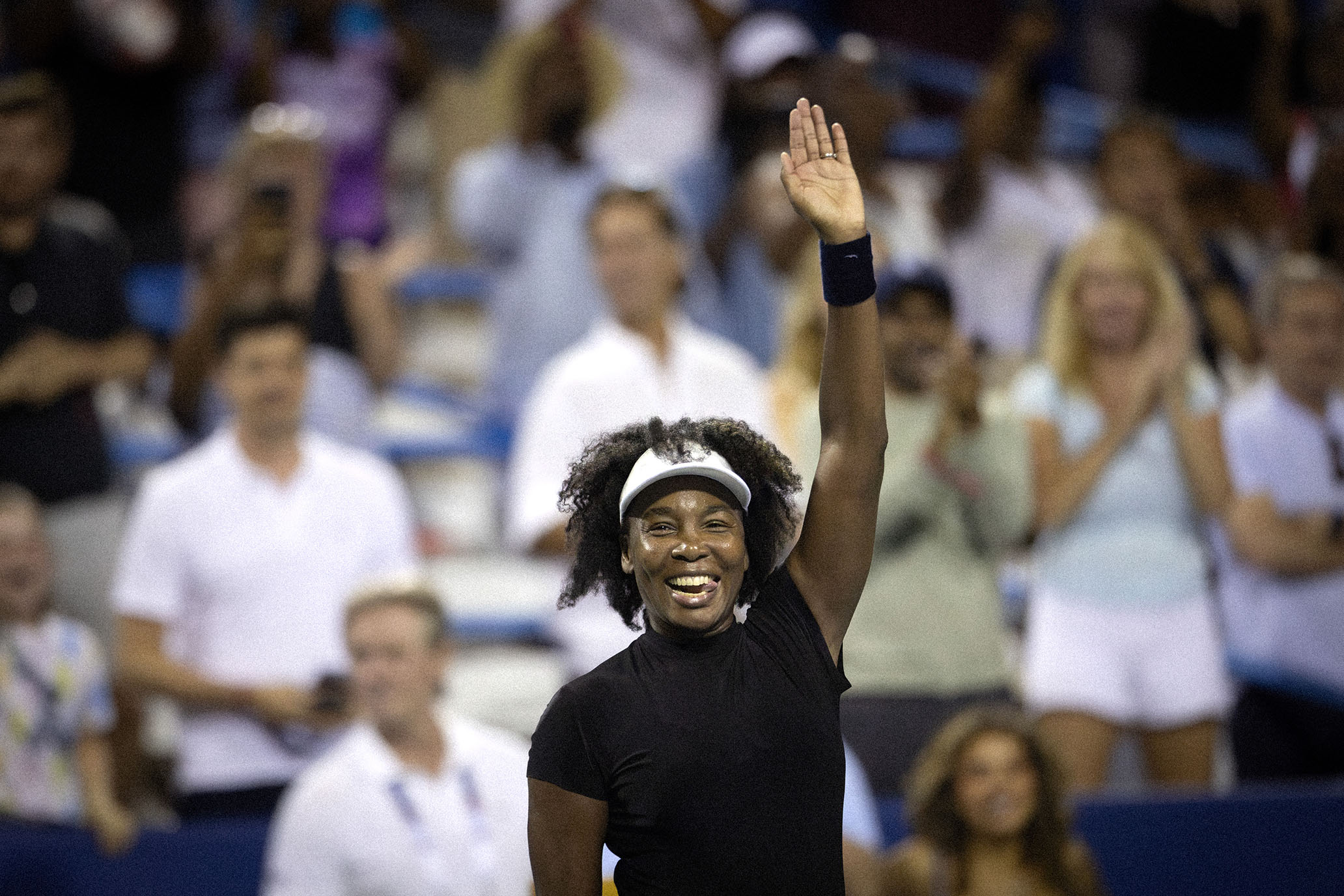
Venus Williams is all smiles after defeating Peyton Stearns in DC. // Getty
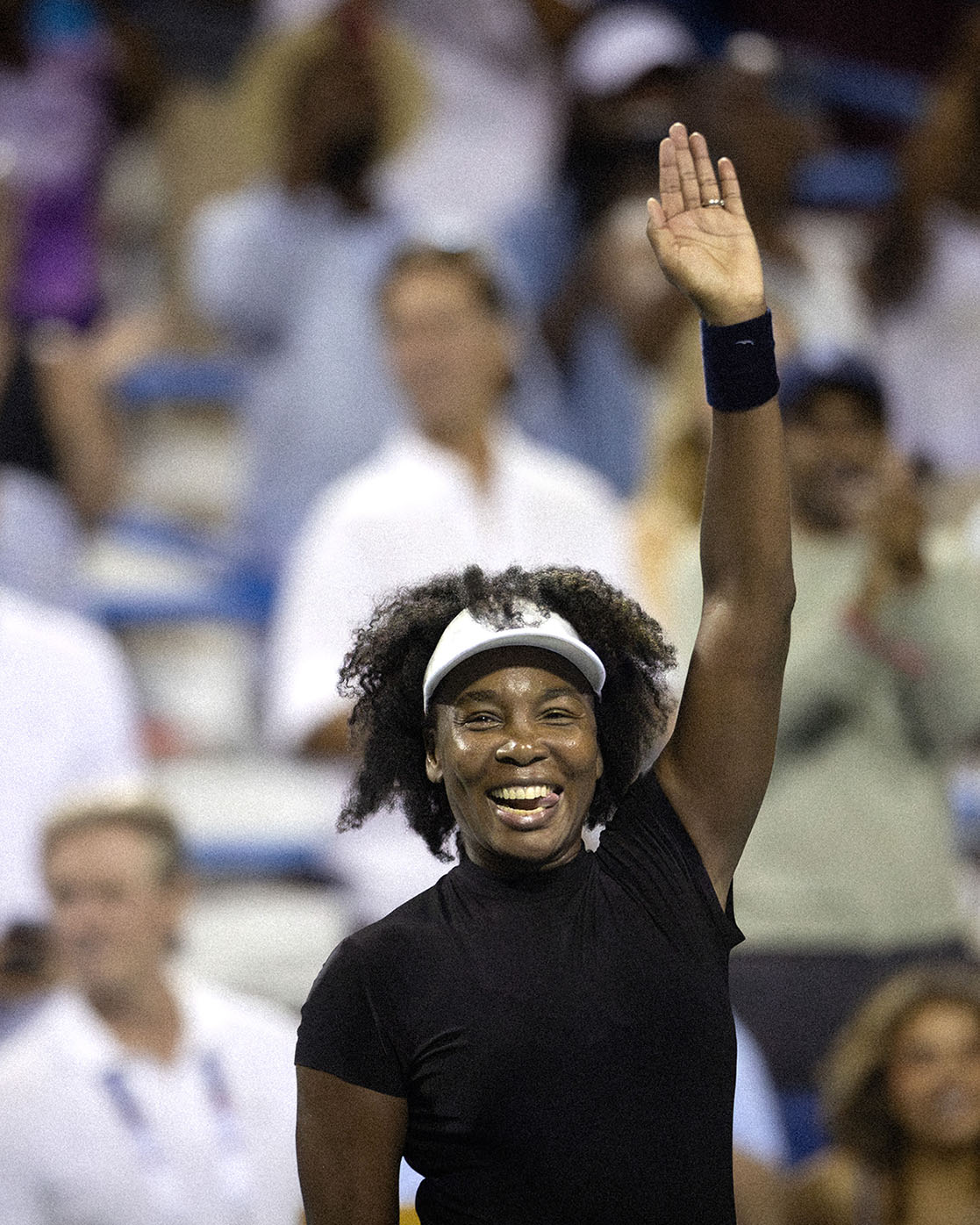
Venus Williams is all smiles after defeating Peyton Stearns in DC. // Getty
The 45-year-old Venus Williams, long absent from the tour, returned to the tennis court in Washington, D.C., this week, thanks to a wild card into the WTA 500 event.
Like so many other wild cards granted to aging legendary players, it seemed like the goal was to delight fans, rather than to invite a player who could realistically advance in the tournament. Williams had spent much of last year recovering from a surgery to remove uterine fibroids, a condition she had been dealing with for decades. She hadn’t played a match since March 2024, and she hadn’t won a match since August 2023. But when she proposed the idea of a comeback to her friend, the billionaire tournament owner Mark Ein, he immediately embraced it.
What should we expect? A pleasant homage to one of the sport’s greats—but not much of a real tennis match. At least, that was the cynic’s outlook heading into Tuesday evening, when Williams wound up becoming the oldest player to win a WTA singles match since Martina Navratilova in 2004. The elder Williams sister had clearly tuned up her game for more than a quick nostalgic hitting session, and she defeated world No. 35 Peyton Stearns, 6–3, 6–4.
In those two sets we saw many of the familiar stamps of Venus’ tennis. The graceful baseline power, courtesy of long levers moving with immaculate timing. Sometimes, watching an older player, you can see clearly that the game has passed them by; they haven’t yet invented ball-striking that can outclass a Williams sister. In her best rallies, the pace and depth coming off of Venus’ racquet were on par with the heaviest hitters of the present. It had been a long time since I saw her distinctive super-early preparation and low take-back on the backhand, running out to the ball with the racquet already stowed away, ready to fire. And since few things in a tennis game age better than a serve, she was in a deadly rhythm throughout the match, breaking the 110 mph mark several times and racking up nine aces.
After she pulled off the upset, Williams offered the crowd a big smile, a twirl, and a concise commentary on American health care. “I had to come back for the insurance, because they informed me earlier this year I’m on COBRA. So I was like, I got to get my benefits on, started training,” she said in her on-court interview. “Let me tell you, I’m always at the doctor, so I need this insurance.” (Sen. Bernie Sanders shared the video on social media to argue that the country needed Medicare for All, if even its millionaires were struggling with the system.)
For all the age-defying thrills of Tuesday’s upset, Williams’ second-round match on Thursday proved that there are at least two things that become way, way harder for an athlete in her fifth decade: recovery and movement. It had been nearly two years since she’d had to play two professional singles matches in the same week. She also played two doubles matches this week, and the fatigue was obvious midway through the first set. Her second-round opponent, world No. 24 Magdalena Frech, had a good enough finesse game to send her slices and short balls that kept Williams scrambling along the court’s vertical axis. Add in the fact that Williams herself couldn’t find the same rhythm on serve, and she wound up with a relatively uneventful 6–2, 6–2 loss.
“Oh, I had so much fun,” Williams said afterward. “Definitely not the result I wanted, but still a learning experience. The part about sport [and] life is that you never stop learning.” She’ll be back on court soon in Cincinnati, where she’s got another wild card, and then again at the US Open, where she will be playing, at the very least, in the star-studded mixed-doubles tournament. While she’s been coy about her precise plans for this comeback, and one might reasonably read “retirement tour” as the subtext, this week has made me even more curious about the tennis she still has left to give.
PURE, ORIGINAL TENNIS — SIGN UP!
The Goat in Winter
The Goat in Winter
The Goat in Winter
How do we think—and feel—about Novak Djokovic now?
How do we think—and feel—about Novak Djokovic now?
By Owen Lewis
Jul 22, 2025
Is it too soon to count the Djoker out? // Getty
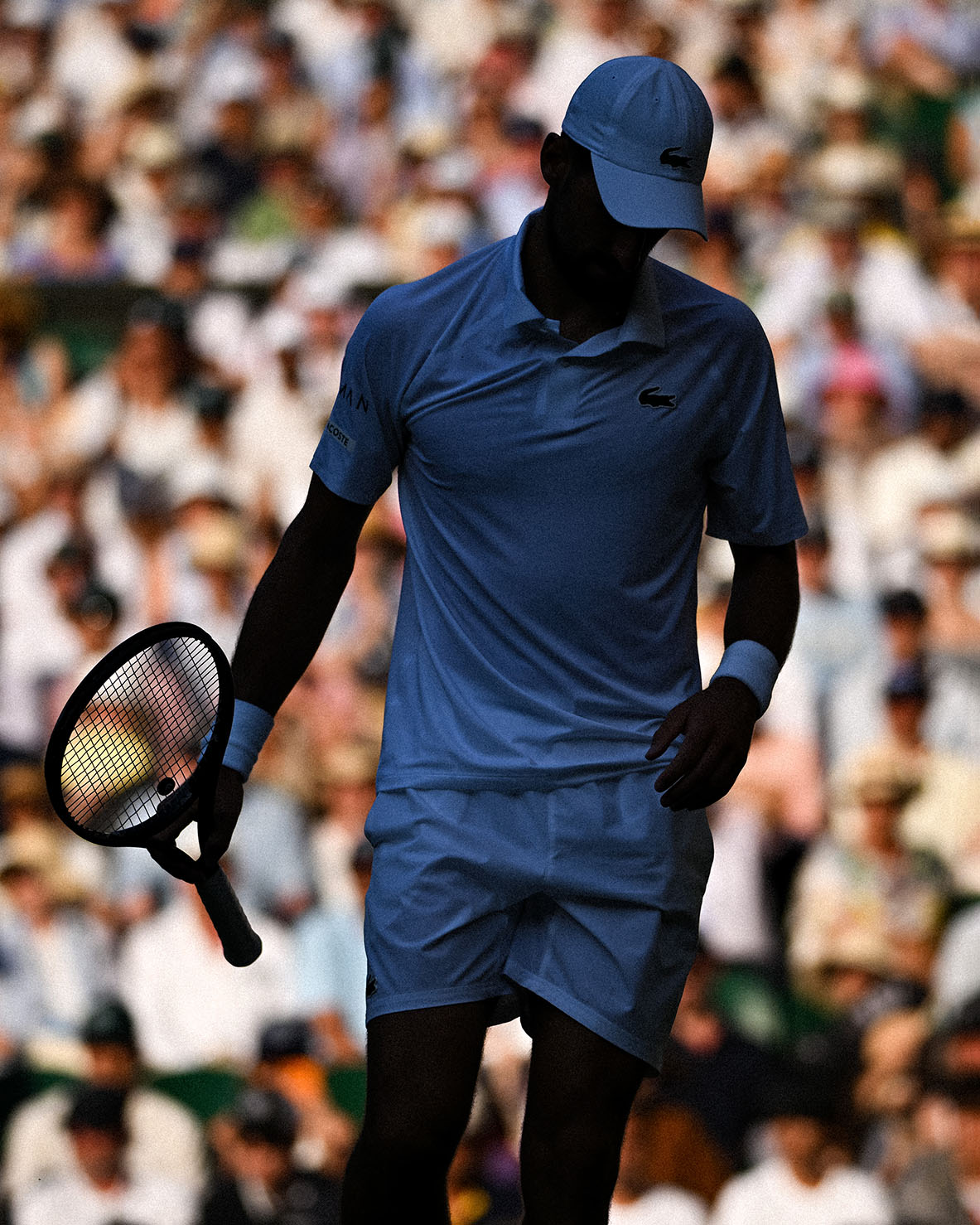
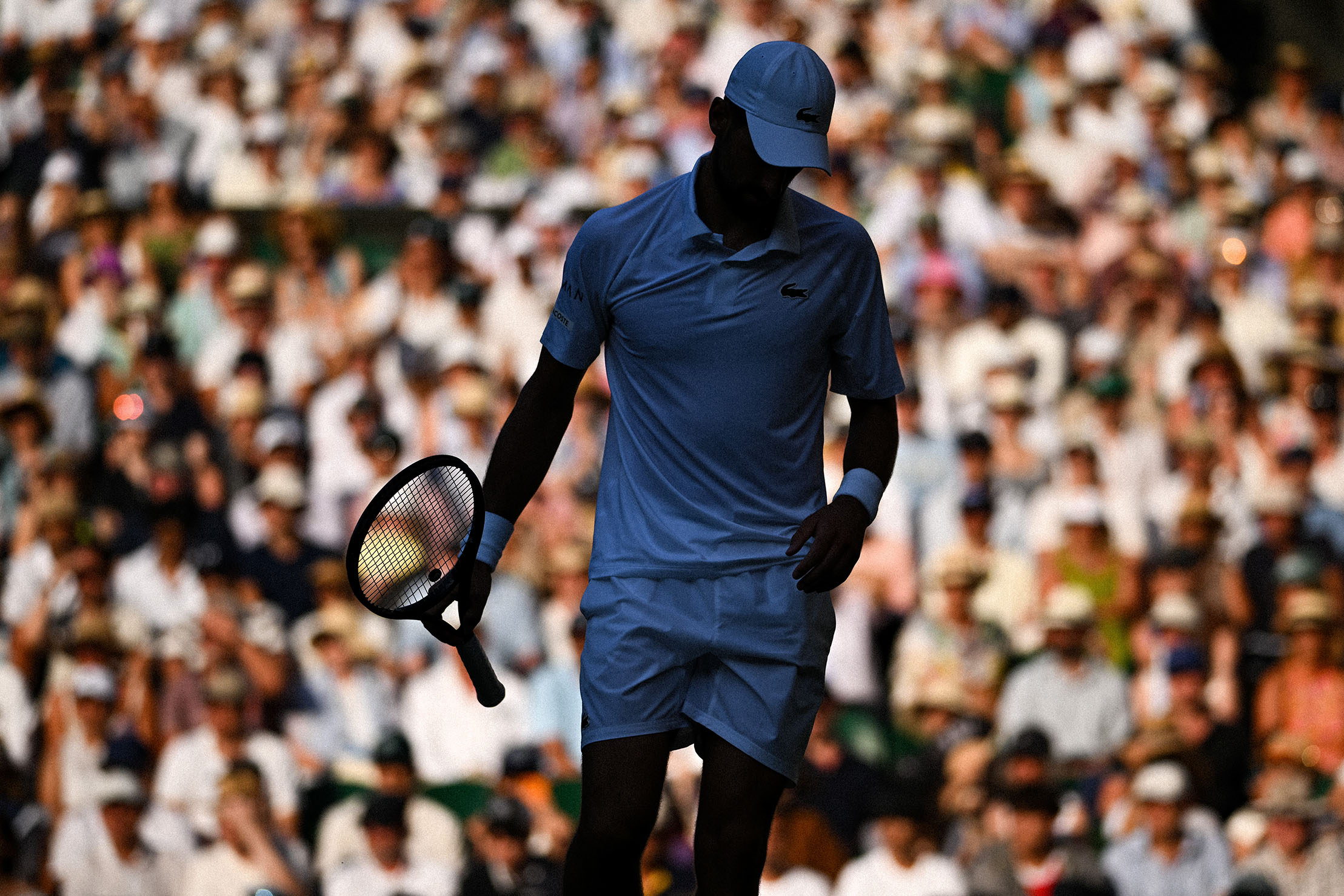
Is it too soon to count the Djoker out? // Getty
Twenty years into Novak Djokovic’s career, you’d think evaluating where he stands at any given moment would be easy. I still have no idea how to talk about him.
To be fair, Djokovic is a complicated guy. His best tennis is robotically perfect, but his demeanor as he plays it resembles a tortured, tempestuous mad scientist. He is powered by spite but guided by love. For all his kooky beliefs, he has had a fairly clean bill of health across his career. The vigor of his enduring army of haters is eclipsed only by the devotion of his army of fans. Djokovic’s quirks have enabled controversies, unexpected redemption arcs, and an improbable and unsettling bromance with Nick Kyrgios. Good luck keeping his next biography under 1,000 pages.
The Djokovician puzzle extends even to how he looks. When he plays through various gnarly injuries, he appears to be in agony—but his shots themselves are often unaffected. Even his opponents seem confused and distracted by the dichotomy: How much pain is he in? When he is down a set and a break and looks listless, is he tanking? Is he trying to make his opponent think he’s tanking so he can surprise them by trying his hardest later? Hell, how does that hair remain so thick and still on his head, as if encased in invisible amber? In lieu of Djokovic writing a book detailing the precise sensations he felt in his torso while winning the AO for a ninth time with an ab tear, I would accept merely knowing what type of shampoo he uses.
In 2025, Djokovic is introducing new mysteries directly relevant to how he might wind down his all-time-great career. The year got off to an auspicious start with a titanic four-set win over Carlos Alcaraz at the Australian Open. Djokovic tore his hamstring in the first set and spent the last three defying conventionality in every way possible (i.e., he hit his second serve like a first serve for hours on end without it ever really catching up to him in the form of double faults). Six weeks later, he’d taken the first of four straight sleepy losses. Judging from his demeanor in those matches, he could muster an honest effort for one set, but never two in a row. By the fourth loss in a row, Djokovic’s retirement at or before the end of the season seemed inevitable. He responded by making the semifinals at both Roland-Garros and Wimbledon.
At 38, Djokovic remains a clear cut above everybody not named Carlos Alcaraz or Jannik Sinner. He’s even proved a riddle Alcaraz cannot yet solve, though the matchup is played on more favorable physical terms for the youngster with each passing edition—Djokovic has won four of the last five. It’s the matchup with Sinner, though, that has been Novak’s undoing. Sinner has won their last five matches and their last nine sets. For all Djokovic’s returning prowess in the past, the slower version in the present can’t break Sinner’s serve with any regularity.
In 2024, I wondered if Djokovic viewed Sinner as a bastardized version of himself: someone who was similarly well-balanced on forehand and backhand, hit the ball even harder, and was yet to develop the finer touch and variety that Djokovic spent years perfecting. He seemed less effusive in press about Sinner than Alcaraz, whom he heralded as a completely unique opponent. Watching Djokovic lose five of six sets to Sinner that year without producing a single break point, I thought he had essentially punted on the matchup. Djokovic may have been a more complete player than Sinner, but he needed endurance that he no longer had to grind Sinner down, and it looked like Djokovic knew it. Novak has played Sinner with more vigor this year—particularly in a high-quality Roland-Garros semifinal. But he hasn’t been able to win a single set.
Is it worth it for Djokovic to keep playing, even as the third-best player in the world, if he can’t beat this guy? Should it be? I tend to think no, but if I imagine sitting in a pressroom and putting those questions to him, it feels a little like sacrilege. Part of that is because Djokovic is the best player ever, and implying that he can’t do anything, no matter how difficult, bears a strong risk of backfiring spectacularly. Part of it is his devoted, tribalistic fan base, primed to pounce on anybody who criticizes their man. It’s also hard to tell whether Djokovic has been entirely interested in these matches (he seemed to give all he had in a tight straight-set loss at Roland-Garros, not so much at Wimbledon or the 2024 Australian Open). Despite more data on Djokovic existing than ever, I can’t quite figure him out.
Other publications seem to be struggling as well. ELLE (not exactly a regular tennis read, but still) delivered a terrifying kicker that called Djokovic, a man who refused to take the COVID vaccine and once showed up to an interview with the knowledge he was testing positive for it, “our new favorite wellness guru.” Tennis Abstract, the invaluable tennis analytics site, rated Djokovic’s chances to win Wimbledon about three times higher than eventual champion Sinner’s going in. Prior to the 2024 Wimbledon final, in which Djokovic played Alcaraz, ESPN’s D’arcy Maine wrote in a prediction piece, “Thinking about this logically, it seems as if Alcaraz should win…. [This] is still Novak Djokovic, arguably the greatest to ever play the sport. I just can’t see him letting this opportunity—especially after the bitter disappointment of last year—slip away. Don’t ask me to explain it any further, I’m just going with Djokovic in five sets.” Alcaraz obliterated him—but Djokovic hit back to win the Olympic final weeks later, when barely anyone gave him a chance.
Maybe Djokovic takes pleasure in his slipperiness, in defiance, in not giving observers exactly the answer that they want. Each time someone mentions Djokovic’s unending drive to be the best ever, recall that he skipped multiple tournaments, including majors, rather than get the COVID jab. The spark he needed to beat Alcaraz in Australia was a local anchor making light of his 2022 deportation saga. What I think keeps him playing is less about trying to beat Sinner again than proving his doubters wrong one last time (did you see the smile on Djokovic’s face when Ben Rothenberg told him the oft-memed lady who held up a single finger as Federer had match point on Novak in 2019 now supported him?), it’s just that the two happen to align at the moment. When Djokovic lost to Sinner at Roland-Garros, his wave to the crowd looked unmistakably like a final goodbye; after the heavier loss at Wimbledon, he said he wanted to return to SW19 “at least” one more time. That’s defiance.
I think it’s also worth wondering, though, how admirable that defiance is at this point in his career. With all the records broken and all doubters silenced, what is really left to defy at this point? If anyone ever attempts to use the losing streak to Sinner as evidence for Jannik being the better player, any honest tennis historian will surely mention that Djokovic was clearly in decline in four of the five defeats. He’s safe, and you get the sense that somebody should tell him that. I’m also skeptical of the idea that being ranked third is a pleasure that entirely justifies his prolonged career—he’s been ranked first longer than anyone else in history. If those memories aren’t scratching the itch, he has plenty from his years as the perennial No. 3 during the Federer-Nadal era.
Maybe his drive comes from wanting to win a 25th major, a landmark that is no more meaningful for breaking a tie with Margaret Court than for being a quarter of the value of 100. After all, only one player is a stubborn roadblock for him, and that player could theoretically lose (but can’t you also imagine Sinner making the final of every major until the 2030s?). To me, at least, an athlete as hypercompetitive and accomplished as Djokovic winning a final big trophy by virtue of Sinner losing to somebody else would reveal less about Novak than if he retired right now. And is it really love of the game keeping Djokovic around? He rarely misses an opportunity to let us know he cares almost exclusively about the majors at this point.
His longtime rivals Federer and Nadal pushed their careers too far, and injuries ended them unilaterally. If Djokovic plays on, as I think he will, he risks the same fate. But maybe he can prove me wrong one last time.
PURE, ORIGINAL TENNIS — SIGN UP!
Hard Reset
Iga Swiatek's Hard Reset
Iga Swiatek's Hard Reset
She needed one. Her team obliged.
She needed one. Her team obliged.
By Carole Bouchard
July 18, 2025
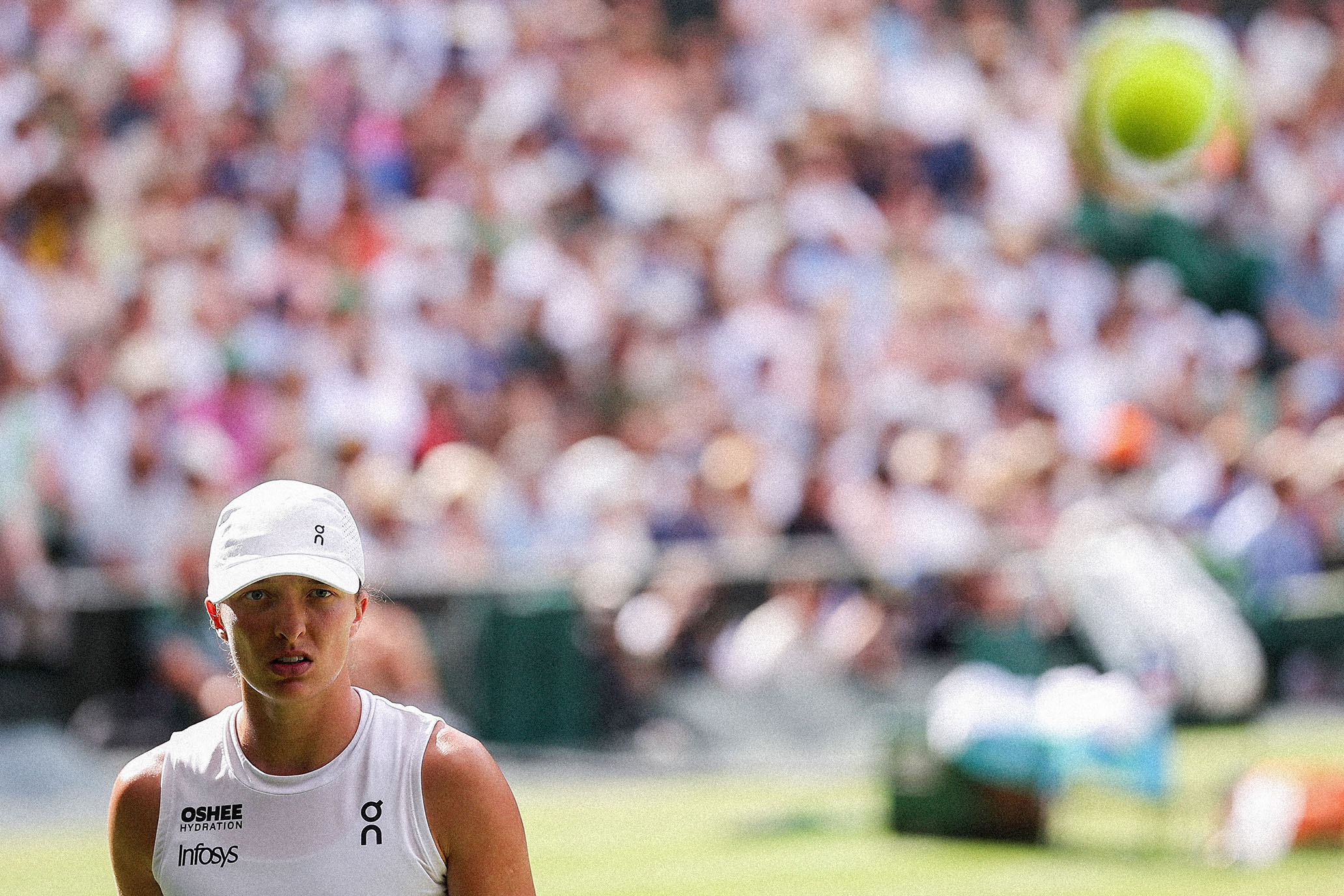
Iga Świątek buckles down during the Wimbledon final. // Getty
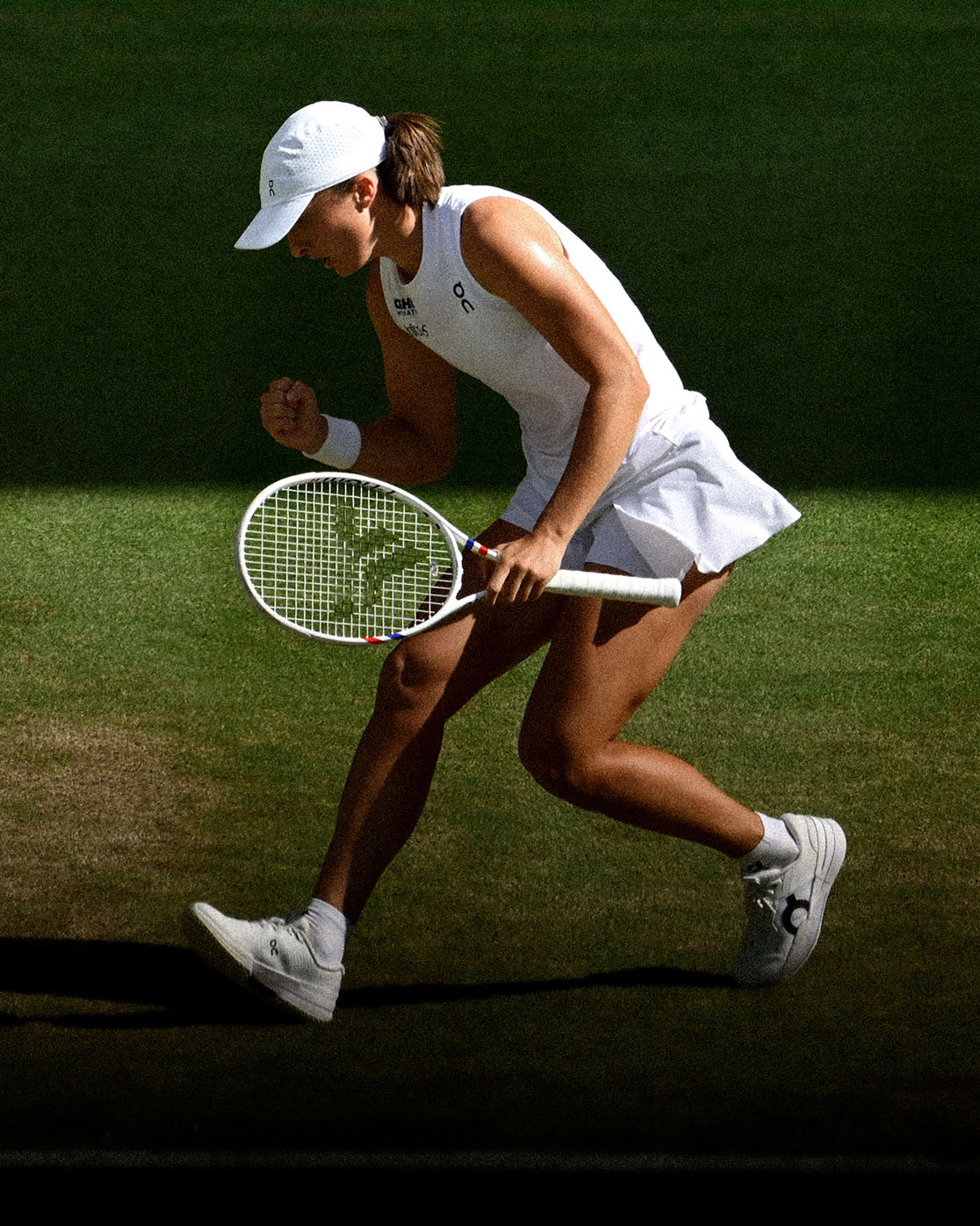
Iga Świątek buckles down during the Wimbledon final. // Getty
You don’t go from losing one of your best shots (the forehand) on a surface you have dominated on (clay) to finding it again mere weeks later on the surface that supposedly bedevils you the most (grass) without some kind of major intervention.
Sure, as Iga Swiatek’s coach, Wim Fissette, explained during Wimbledon, her team tweaked her serve and forehand and made adjustments to her footwork this spring, and that work was a key factor in Iga’s triumph on Centre Court on Saturday. However, we know that to be a champion the results won’t come without the proper mindset, no matter how much you tweak their actual games.
I spoke with Swiatek’s team after the Wimbledon final to understand just how they had rebooted her system. A few days before the final, Fissette had told me that the former world No.1 “wasn’t herself” this year until Paris. “In Madrid and Rome, she was probably at her worst from the past years,” he said. Daria Abramowicz, her performance psychologist, confirmed that the team sat Swiatek down and told her—and each other—some hard truths. It looks to me like Swiatek’s hard truths were about how her attitude needed to change.
“The big moment actually was between Rome and Paris,” Abramowicz said. “We had a few difficult conversations within the team, and the one thing that I can tell you about Iga is that she can listen to the tough stuff, and she embraces it. That also says a lot about her as an athlete and a human being. In Paris, we could see adjustments in the attitude, work, and mindset, on court, off the court, and I immediately thought that we were going in the right direction.”
Since then, Swiatek’s error count and her impatience and frustration on court have decreased. “It’s more a mindset of, ‘Winning is one thing, but now how am I becoming a better tennis player?’” Fissette said. “It’s better to be focused on that than be like, ‘I need to win every tournament.’ You need to become a better tennis player, and then the rest will follow.”
The reset worked so well that Swiatek returned to work with a huge hunger to improve, despite the loss in Paris. “After Roland-Garros, she jumped into the work, which was good to see and hear,” said Abramowicz. “She put in a lot of work in terms of attitude and reframing some beliefs. There was no turning point, but the process gradually changed since Rome. There can be a certain amount of grit that sometimes also changes into stubbornness, with obviously more than a bit of perfectionism. The question is how to approach these situations and how to reframe. I just tried to show her how good of an athlete she can be, because that’s still the territory that we can discover.”
Iga finally accepted the changes her coach wanted to make. Nothing better than losing to be convinced, which is logical: When you’ve been winning that much, why would you believe you need to change? That was the other pivotal moment in the coach-and-player trust situation: the match against Elena Rybakina in Paris. A few steps back on the return and a win; that’s all it took after that discussion with the team for Swiatek to give up on what has also made her the player she is: her stubbornness.
“When you start working with someone, you cannot ask them to trust you,” Fissette said. “It has to come naturally, and with Iga having so much success with the previous coach, it was not easy. I had to work hard and find my moment to make a difference. I believe in my ideas, but I also keep adjusting to what’s the right approach with the player. Finding the right moment to make a change, which is not easy, but the Rybakina match in Paris was a huge turning point where she realized what I was saying was working.”
The team also challenged Iga’s limiting beliefs. She admitted she never believed she could win Wimbledon, for example. She also told Fissette, from the beginning, that “fast serve is just not for me.” How can such a champion not believe the sky is the limit—and how it was up to her team to believe when she wouldn’t?
Maciej Ryszczuk, Swiatek’s fitness coach and physiotherapist, was surprised by how she agreed to it all after losing in Paris. “It was a surprise for everyone,” he told me. “Especially on this surface, believing that she can do it, because it was the crucial part. The game was there, but she was struggling with her mental side. We just adjusted the footwork to decelerate a little bit more, with a bit less sliding, to be prepared quicker for the ball. And that’s it. She had it from the beginning, but she needed to believe it.”
People underestimate the strength of Iga Swiatek’s personality and how reluctant she is to change until she has seen proof that it’s needed. “As soon as these top players make the click of first believing and then feeling that the choice is right, then it’s always, ‘Okay, let’s go for it,’ and so it can go fast,” Fissette said. People also underestimate how tough it’s been for her to adjust to a new coach, new ideas, new losses, and so many changes. Fissette told me he had to learn how to talk to her, how to respect her process. I asked Abramowicz what it had meant for her work with Swiatek.
“I’ve never spoken so much to any other coach before,” she told me. “We talk so much about communication, because for Iga, the challenge is having a first non-Polish coach. I try to prepare her through mental training in English, with various tasks in English, so that when she’s under stress and pressure, she can transition into English. However, on the court, you can still see her revert to Polish when under pressure or being overwhelmed by emotions. So we try to develop protocols, patterns, and systems. She also appreciates having a reason for what she’s doing. She likes to understand, speak up, and she asks questions more than ever before, which is something I want to see in terms of environmental mastery and communication within the team. She learned how to manage the team, how to communicate, how to exactly follow whatever she wants, but also to embrace tough things and be able to listen to them.”
Sure, they would have preferred the reset to start hitting hard for Roland-Garros, but seeing how visibly more free Swiatek has been swinging out there throughout Wimbledon, one can wonder if, for the reset to work fully, she needed to clear her entire system beforehand. And Roland-Garros was taking up a lot of space in the hard drive of her tennis beliefs. You could see on her face when she clinched that Wimbledon title that a new world was opening up.
Fissette feels the same. “We have the right answer now, so it’s going to be easier for me. If she focuses on the right things, we know that she has all the answers. She’s still so young and has a lot to learn. My focus is on making her a better player; I want to see more variety in the game.” Has he ever thought he had accepted the wrong job? “No. I never doubted. A career is always going up and down. Iga learned a lot in the last month, and so did I.” Not all reboots are successful, but this one for sure ended up being a blockbuster.
PURE, ORIGINAL TENNIS — SIGN UP!
Tennis as Death
Tennis as Death
Tennis as Death
Review: Andrey Rublev: Breaking Back
Review: Andrey Rublev: Breaking Back
By Owen Lewis
Jul 5, 2025
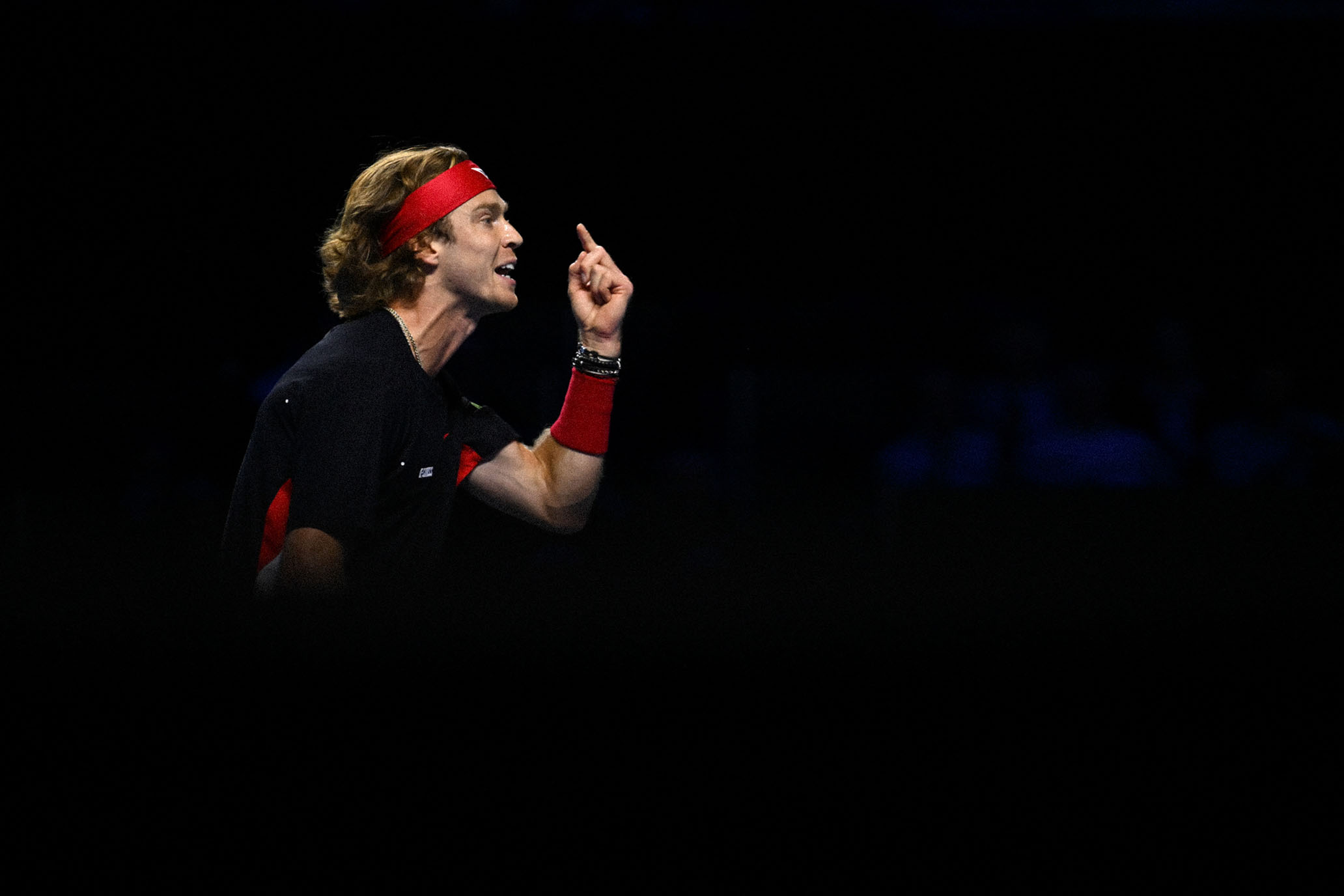
Andrey Rublev during darker times, at the Swiss Indoors Basel. // Getty
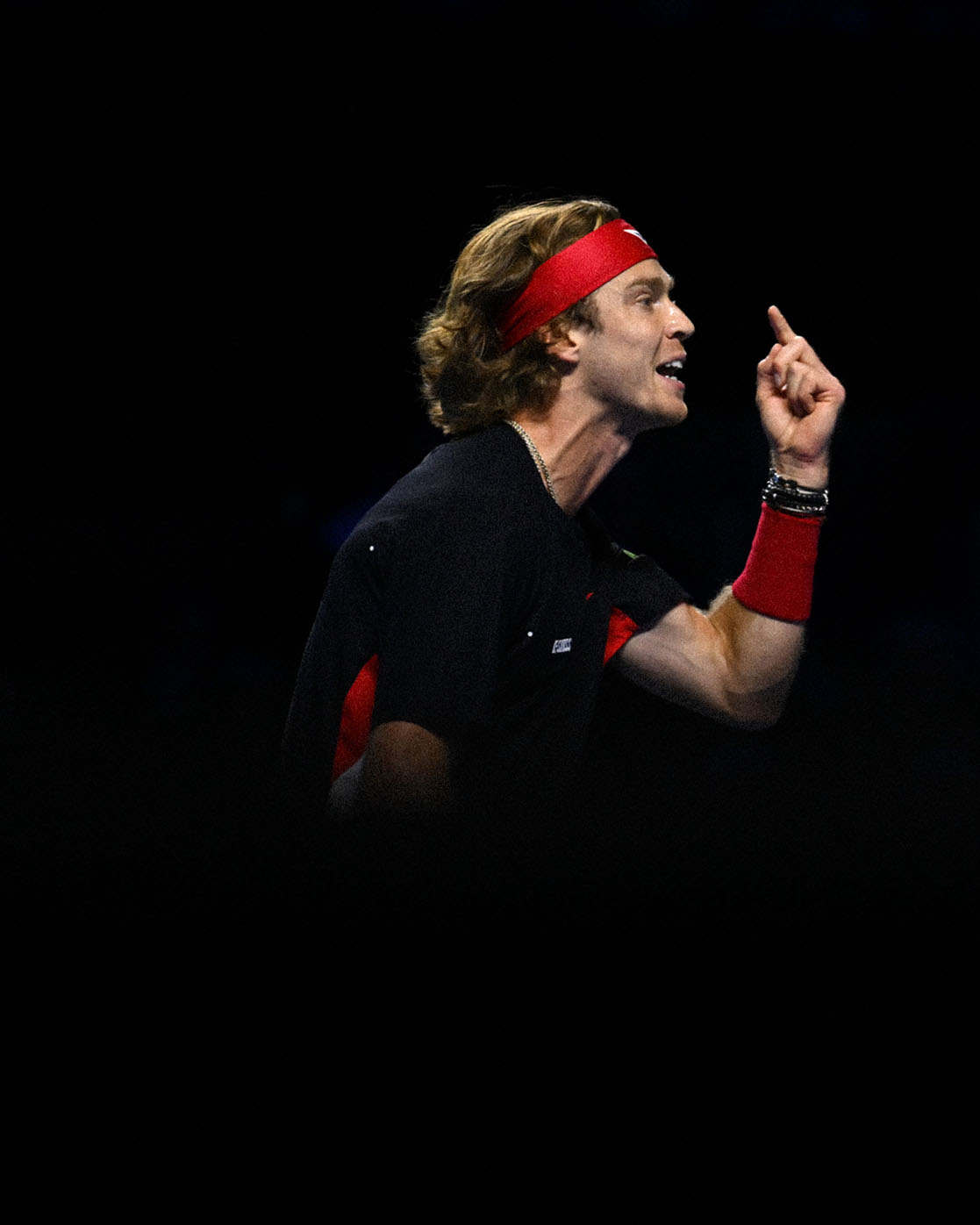
Andrey Rublev during darker times, at the Swiss Indoors Basel. // Getty
The first look at Andrey Rublev in his YouTube/ATP Tour documentary Breaking Back comes via his countryman Karen Khachanov. “It was an under-10 tournament in Russia, and I heard from a few courts behind me screams, crying,” Khachanov says. “One boy was laying over, throwing balls, racquets. They told me, ‘His name is Andrey Rublev.’ I say, ‘Very good. Nice to meet you.’ [Laughs]”
That Khachanov seemed unsurprised in his recollection is no coincidence—this sport has a way of desensitizing the shock of watching a player act out their self-hatred. At the 2008 Miami Open, Mikhail Youzhny raged so fiercely at his cowardice for a pitty-pat backhand into the net that he turned his racquet on his own brain, whacking his forehead with the strings until dark blood trickled down his scalp. Even this disturbing masochism earned only a blithe look from his coach, and a startled emoji in Tennis TV’s caption for the video when, in 2021, they released extended highlights of the match. Compare that reaction with the uproar over Aryna Sabalenka’s salty comments after losing the Roland-Garros final to Coco Gauff, and you’ll have a good idea of how much these tantrums move the emotional needle for most observers.
Rublev, though, took self-recrimination to such a visceral degree in his darkest years that many grew uncomfortable while watching him play. His fury was not only destructive but desperate. He’d howl after a miss, eyes practically pulsing out of his head. He drew blood from his knee via repeated racquet whacks. At the 2024 US Open, after a shoddy forehand error, Rublev clapped his left hand onto his racquet strings with such force that he cut it and needed medical attention. The miss came at 3–1 in the first set, so early on that it couldn’t possibly have proved costly all on its own. No tennis mistake is worth losing blood over; even if one could be, this wasn’t close to being it.
In Rublev’s on-court interview following his fifth-set tiebreak escape from a fourth-round match with Holger Rune at the 2023 Australian Open—Rublev had had so many leads he’d never be able to think about anything else if he’d lost—he likened crunch time to being held at gunpoint. He crosses himself when his matches end, suddenly seeming to gain a measure of peace, win or lose. In light of quotes like this, it made sense. After hours of feeling like life hung in the balance, I’d accept salvation or oblivion too.
“When you were watching him, you were saying, ‘Okay, he has a lot of potential,’” Galo Blanco, Rublev’s coach and agent, says in the documentary. “‘But he’s completely crazy.’” Breaking Back efficiently chronicles how Rublev ended up so tortured: He was raised with the mindset that tennis mattered above all else, so when his tennis began to fray, so did his world.
The stifling pressure to win a major title only worsened his anxiety (a word Rublev repeats dozens of times throughout the doc, and pronounces “ank-shitty”). Rublev takes the gun-to-the-head metaphor even further to the ATP’s cameras: “Every time I was going on court and things were not going my way, the feeling is like you’re dying. It’s like someone came to murder you.” When Rublev lost, he felt like that someone had succeeded.
In off-court moments on camera, Rublev is light and genial, poking fun at himself and others, eagerly hugging his friends. Compartmentalization can rip perception from reality, that I knew. I also wondered whether Rublev might have been happier in previous years if he’d quit tennis. The tragic thing, as an observer, is that his violent reactions after his errant shots seemed only to ruin his mental health rather than improve his tennis. He is sublimely skilled, better than you or me or everybody on the planet except a dozen or so people could ever get at tennis. But he is also limited. His big forehand is his best shot; it will never be as big as Jannik Sinner’s. He does everything well and nothing as well as Carlos Alcaraz. When Djokovic rips into himself, you get it; you’ve seen what he can do at his best and understand how anything short of that glorious, stifling peak is a disappointment. Rublev, who has made 10 major quarterfinals and lost them all, demanded a perfection from himself that he was incapable of producing.
In time and after a lot of pain, tennis-related and not, Rublev came to realize that expectations of winning a Slam were “bullshit,” that he’d die for real at the rate he was going. “I still love [tennis],” he says. “I still want to achieve as much as I can, but in a healthy way, not a struggle way.”
The realization is euphoric. To this viewer, the expectation that top players win a major is indeed hot crap. A player’s chances of doing so depend almost wholly on how many years in age separate them and various generational talents, who gatekeep the game’s shiniest prizes with a Cerberusian vigor. If Rublev were to win a major, he’d earn the privilege of brief catharsis and Big Three-pilled fans calling the crowning achievement of his career a “Mickey Mouse title” for the rest of time.
Rublev seems to be suggesting that the goal of a financially sustainable tennis career should be to escape with one’s mind intact. Players frequently find it unfulfilling to reach their lifelong objectives—think of Agassi writing in Open that he felt nothing once he reached the top spot in the rankings, or Dominic Thiem losing all his motivation after he finally won a major. The price for these cold prizes is high. Expectations spiral ever higher, unavoidable losses keep you up at night (Djokovic, tennis king of kings, has lost 13 major finals), you play even more matches. The real achievement, then, is not going crazy while navigating this demented maze, to reserve a bit of yourself from the game. Give everything to tennis, and what you get back will be inevitably less.
As top-ranked players have suffered upset after upset at this year’s Wimbledon, Rublev has progressed through the draw calmly, making the fourth round to live up to his 14th seed. Hiccups that once would have had him screaming his vocal cords raw—a missed match point and a fourth set in his opener against Laslo Djere, back-to-back double faults as he tried to serve out his third round against Adrian Mannarino—he now accepted with grace. Against Mannarino, Rublev hit a sick, sliced forehand pass on the defensive in the final game, a shot you’d have thought came from Carlos Alcaraz had the video stream blurred out the player who hit it. An ace on the next point sealed his win. Never did I worry that he was going to hurt himself.
Rublev sits on the beach at the end of the documentary, giving a voice-over that sounds driven more by philosophy than by the fiercely competitive instincts that power elite players. He is sleeping better and spending more time with himself. “It’s not easy because it’s super painful in the beginning,” he says of fixing himself. “But then it’s relief.” Watching him suffer the beginnings of a choke at moments during his Wimbledon run and react as if only a tennis match is at stake, not his own life, I see what he means.
PURE, ORIGINAL TENNIS — SIGN UP!
Andrey the Giant
Andrey the Giant
Andrey the Giant
Andrey Rublev might just be the last original “NexGen” star standing.
Andrey Rublev might just be the last original “NexGen” star standing.
By Giri Nathan
July 4, 2025
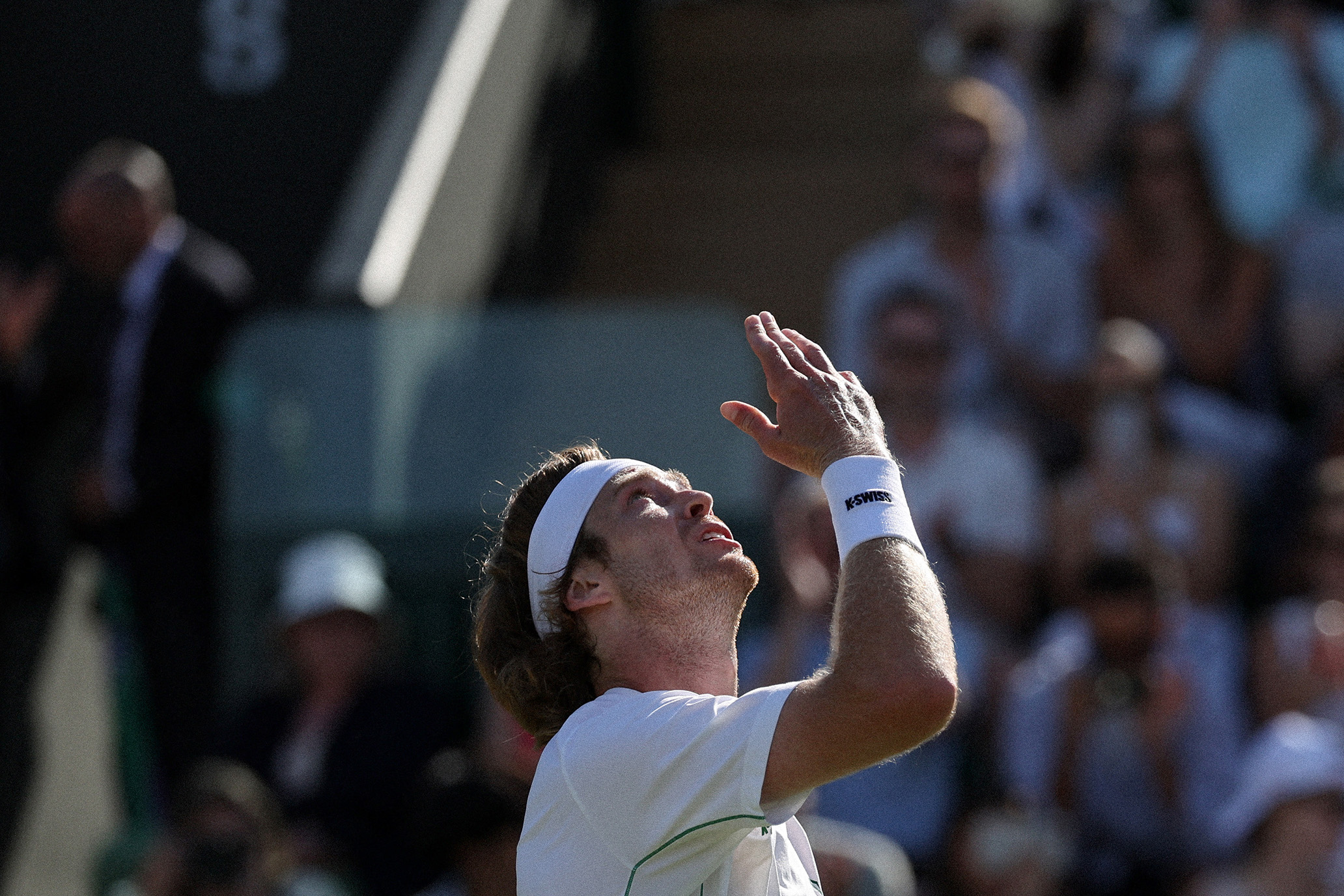
Andrey Rublev looks for inspiration during his second round match at Wimbledon against Lloyd Harris. // Getty
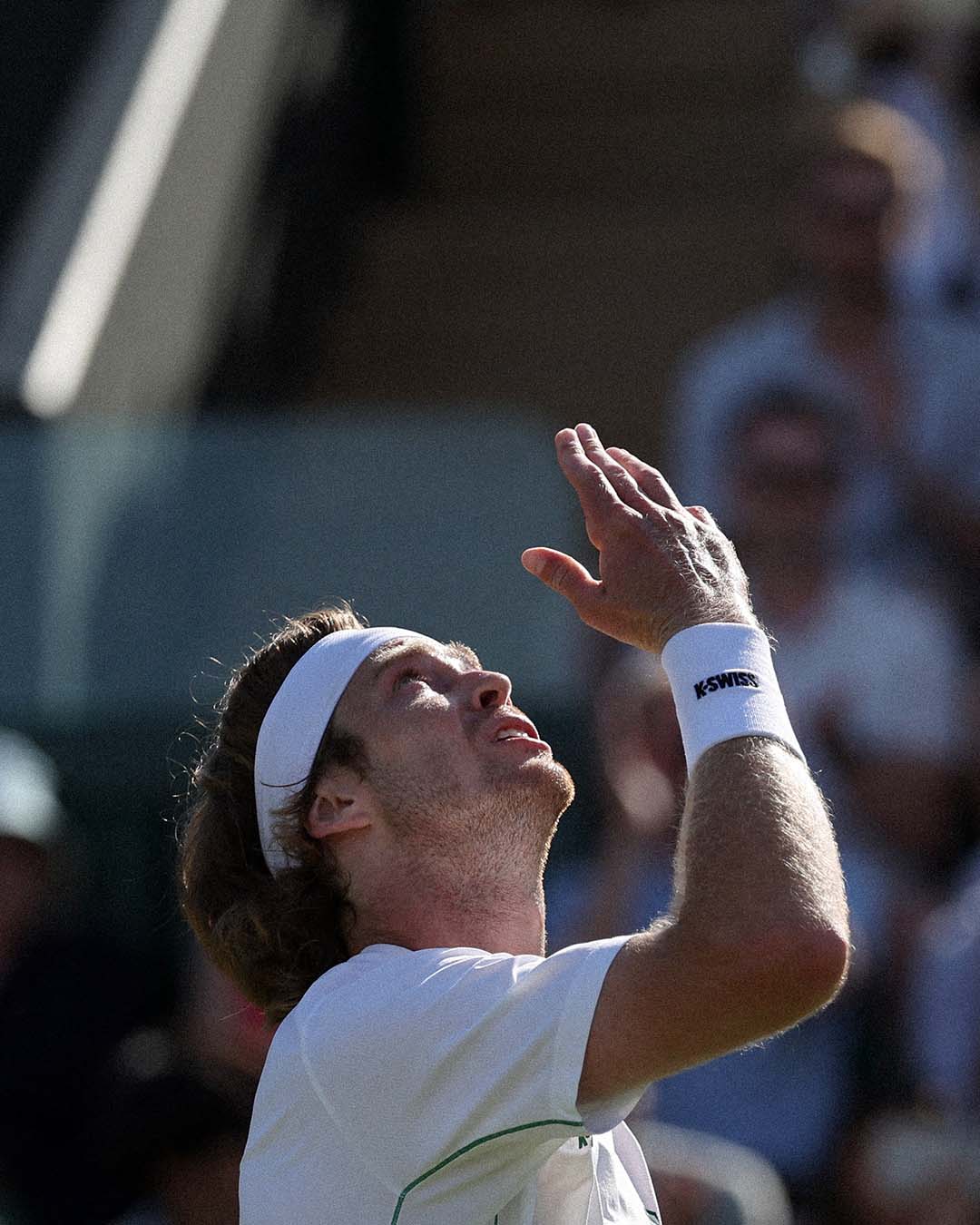
Andrey Rublev looks to the heavens during his second round victory over Lloyd Harris at Wimbledon. // Getty
I used to say to friends, offhand, that Andrey Rublev could win a Slam someday. The draw might open up just so, and the tempest in his mind might be subdued for just seven matches in a row, and that would be it. He had the weapons to pull it off. He just needed some luck, and he needed to stop beating himself up (both figuratively and literally).
I no longer say this.
In the years since, it has become clear that the Slams will be won by two even younger guys, with one old guy sticking around to make everyone work a little harder. And it appeared that Andrey Rublev himself had hit a clear ceiling. He was the first of his age cohort to reach a Slam quarterfinal, way back when he was a 19-year-old, and he’d reached nine more quarterfinals since. But not once had he advanced to the semifinal. He has been stopped by the usual names, plus the occasional surprise: Rafa Nadal, Daniil Medvedev, Stefanos Tsitsipas, Marin Cilic, Frances Tiafoe, Novak Djokovic, Jannik Sinner.
This Wimbledon, however, is looking a little sunnier for Rublev. It seems to me that both of those conditions for success—a decent draw and a sound mind—have been met. The draw was opened up by a first-round bloodbath that claimed 13 seeded players. Some of the victims were guys of Rublev’s generation, who now comprise tennis’ upper middle class, idling in their late 20s, having been leapfrogged by Carlos Alcaraz and Jannik Sinner. (Interestingly, Rublev was the only player on tour to beat both Alcaraz and Sinner in 2024.) Gone in round 1 were Rublev’s peers Daniil Medvedev, Sascha Zverev, and Stefanos Tsitsipas, who lamented a high-rolling opponent, a total lack of joy in life, and a bad back, respectively.
When asked about the mass exodus of seeds, Rublev said, “It make me feel I’m not the only one!” He knows the feeling; he spun out of Wimbledon in the first round last year. During that loss, he whacked his own knee with his racquet seven times in a row and drew blood. It was part of a larger pattern of outbursts that season, which grew concerning even by Rublev’s violent standards. “I was completely lost,” he recalled in an interview this week with Tennis Channel, looking back at last year’s mental struggles. “It was nothing to do with tennis…. I was getting help from every place possible, but in the end the one who helped me a lot was Marat Safin.” In one of the ATP’s most spiritually apt pairings of player and coach, this spring he began working on a trial basis with Safin, who, like him, is a Russian with fearsome baseline power who spent much of his time on court teetering on the cusp of self-destruction. They also share origins in the same tennis club in Moscow, and both moved on to Spain to continue their training.
Rublev explained that meeting Safin for a conversation by the pool in 2024 helped him exit his spirals of anxiety. “Because I was going in circles, all over and all over, and I didn’t know how to go out from this circle—he helped me to realize why everything was happening to me,” Rublev said in a recent documentary produced by the tour. “He showed me the door.”
We’re still in the early days, but it appears that Rublev has emerged from that door much happier. When I saw how giddy Rublev got at the mere mention of Safin’s name, in Monte Carlo, when they were at the start of their collaboration, it already felt like a triumph. Rublev has since resolved to “achieve as best as I can, but in a healthy way, not in a struggle way.” But being a well-adjusted person and being a successful tennis player are not necessarily correlated. Would Rublev’s results suffer, if he didn’t?
So far, so good. He’s had a decent season. This week at Wimbledon he has survived two high-stress, tiebreak-stuffed matches. In his second-round win over the big-serving Lloyd Harris, Rublev even demonstrated rare flair at the net, winning 23 of his 26 forays there. He said that he knew he should be going to the net more often to finish points, but he previously lacked the confidence. Again he credited Safin: “His confidence straightway gives you confidence as well.”
Rublev won a painless third round against Adrian Mannarino on Friday to earn a spot in the fourth round. His likely opponent there, and the only other seed remaining in their quarter, is Alcaraz. If he can somehow find a way through, this could be a reformed Rublev’s best chance yet to make that long-awaited semifinal. He might even enjoy himself.
PURE, ORIGINAL TENNIS — SIGN UP!
Tears of a Clown
Tears of a Clown
Tears of a Clown
For Sascha Bublik at Wimbledon, anything can happen.
For Sascha Bublik at Wimbledon, anything can happen.
By Giri Nathan
June 27, 2025
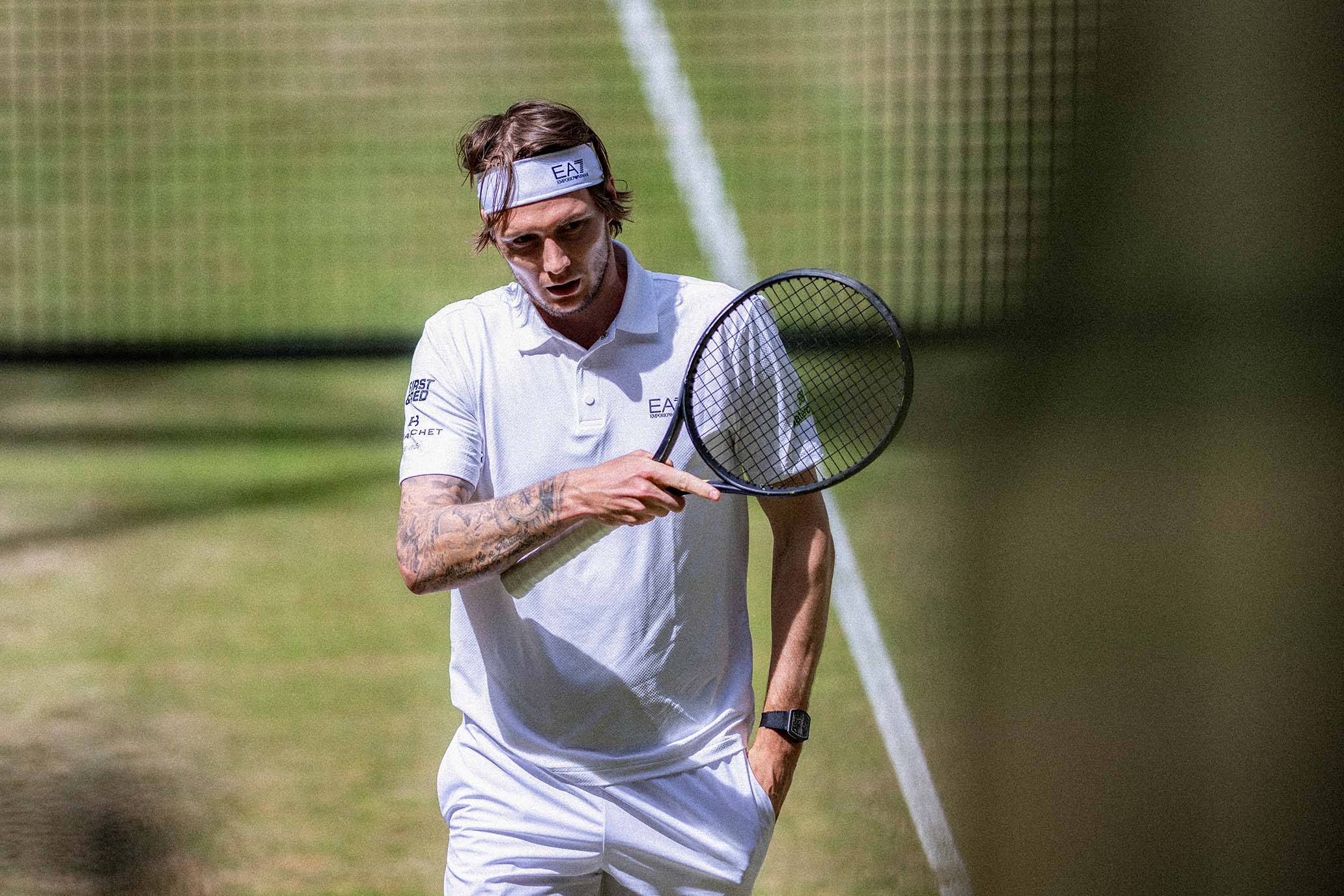
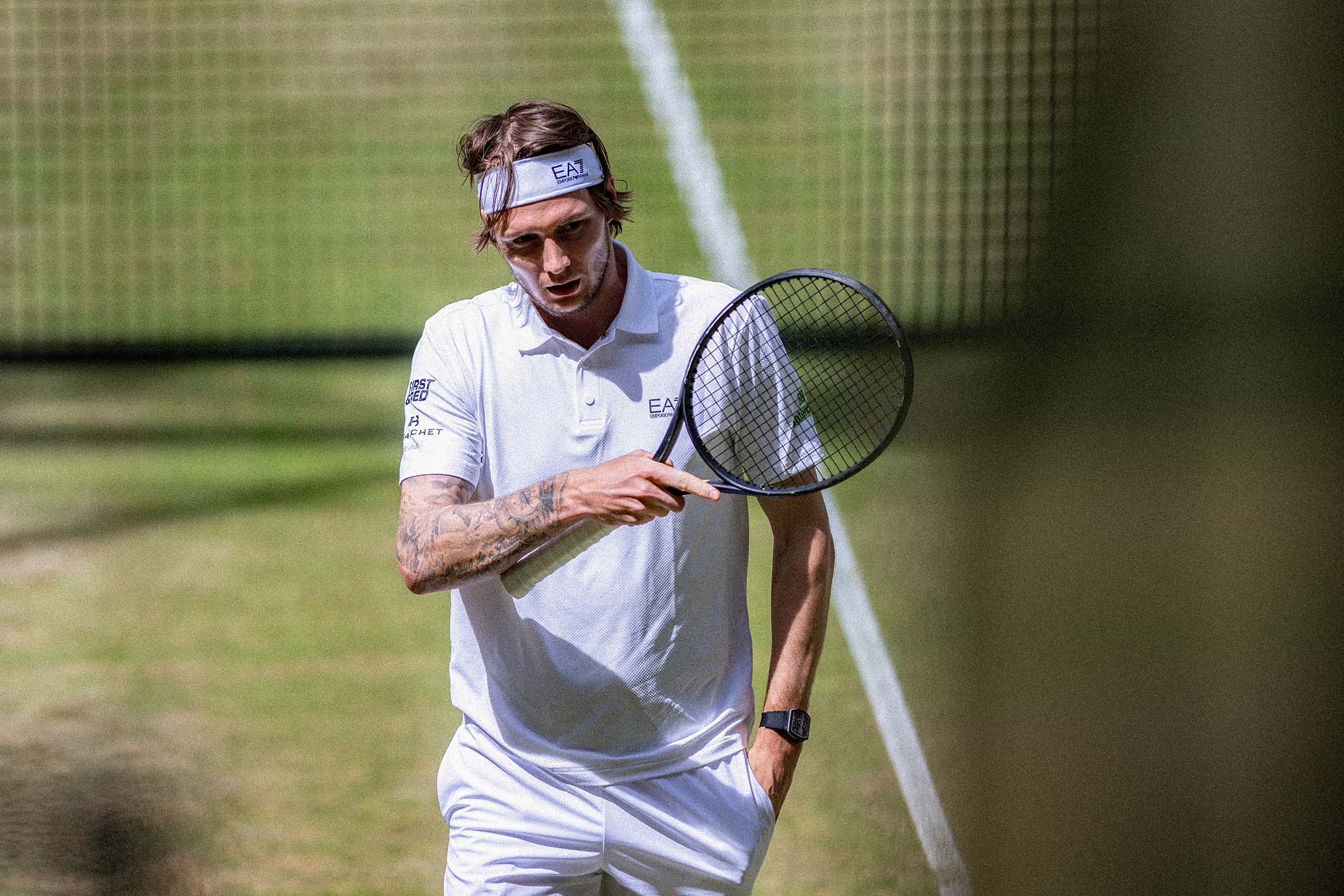
Sascha Bublik during his winning campaign at Halle. // Getty
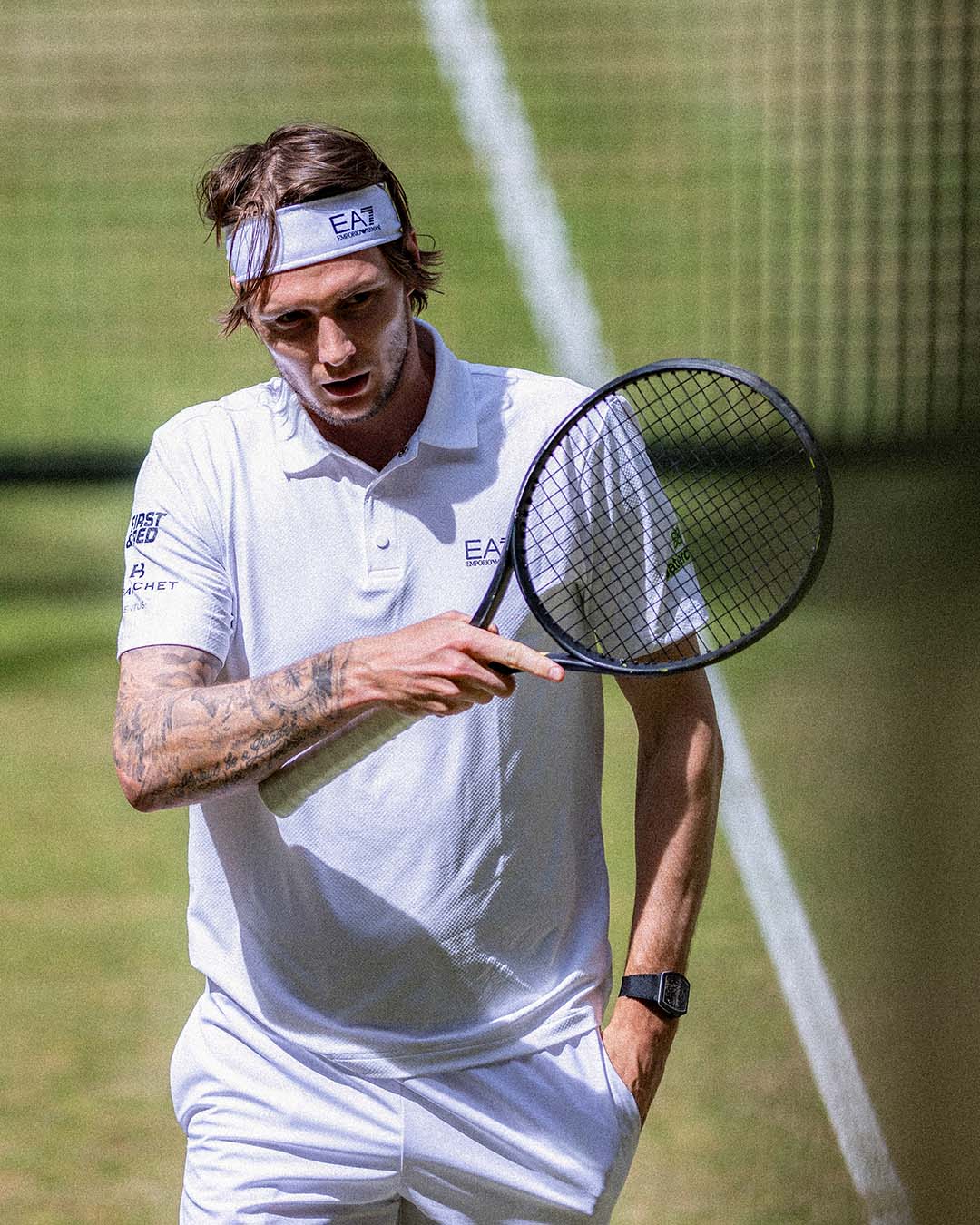
Sascha Bublik during his winning campaign at Halle. // Getty
On June 19, Jannik Sinner shocked the world, or at least me, a person who’d spent the past year thinking I had him mostly figured out. The No. 1 player in the world released a musical collaboration with the singer Andrea Boccelli. The world-famous tenor delivers his operatic swells in Italian, and Sinner offers wooden bits of spoken word in English. The tennis player opens the song with this invaluable wisdom: “In our lives there will always be many first times. All you have to do is, is [sic] to be yourself.”
Nobody on the ATP follows that maxim—be yourself—more faithfully than Sascha Bublik, the shaggy, smirking showman who represents Kazakhstan. His tennis is an unabashed reflection of his personality: expressive, trollish, darkly comic. He is a tall servebot that has been augmented with surprisingly soft touch. He has a taste for drop shots and trick shots, and a tendency to tank sets or even entire matches; he likes to talk about how much he values his life outside of tennis and doesn’t want to sacrifice too much at the altar of his career. He speaks with awe about the inhuman work ethic of the very top players, and clearly cherishes his own humanness. That archetype might sound a little familiar to you, and yes, he is basically a Nick Kyrgios without the baggage and with an active ATP career. On the same day that Sinner made his musical debut about being oneself, Bublik, always himself, managed to upset the top seed and defending champion at Halle in three sets.
Bublik can beat pretty much anyone if he’s having a good day and they’re having a bad day. But Jannik Sinner has effectively purged bad days from his tennis life. It was the first time since August 2023 that Sinner had lost to a player ranked outside the top 20. It was also the first time since August 2024 that a human being not named Carlos Alcaraz had managed to beat him. For Bublik, this was a career-best upset. He had a dozen top 10 wins but had never before beaten the tour’s No. 1 player. Barely a month earlier, Bublik had been routed by Sinner in straight sets and wrote sarcastically on Instagram: “I almost got him guys.”
After their match in Halle, he offered a pleasant update: “I got him guys.”
Bublik, rarely blessed with consistency, kept marching along after the upset, beating Tomas Machac, Karen Khachanov, and even Daniil Medvedev to reclaim the Halle title that he’d won in 2023. “From the mental point of view, that’s the toughest match I ever played in my life,” said Bublik after the final. In his six previous matches against Medvedev, he had won just one set. “I have never beaten Daniil. He’s a super tough player to play, especially with my game style, and today everything clicked in mentally and physically.”
It has been a season of renewal for the 28-year-old Bublik, who said he considered quitting tennis around this time last year. As recently as this March, he had lost 18 of his previous 22 matches. He fell to No. 82 in the world after Indian Wells. His reasonably secure top-40ish career was in peril. As with so many players, dropping down a rung of competition helped him rebuild some form. His fortunes began to turn at the Challenger in Phoenix, where he made the final. During the clay season, typically his most wretched stretch of the calendar, he picked up a Challenger title in Turin. Clay season concluded with perhaps the most miraculous moment of his career to date: At Roland-Garros, he made his first Slam quarterfinal, beating top 10 seeds Alex de Minaur and then Jack Draper, after which he wept and savored the applause of the crowd. This longtime jester was now taking part in disorientingly sincere interviews about seizing the moment. “You know, sometimes in life there is only one chance, and I had a feeling like that was mine,” Bublik said after the fourth-round Draper win at Roland-Garros. “I couldn’t let it slip. So, standing here, this is the best moment of my life. Period.” I received texts from friends who were enjoying their first-ever exposure to Bublik. And it must have been nice. But those tears were even richer, emotionally, if you’d witnessed the dozens of clownish episodes in the years leading up to that point. (I highly recommend his conversation with Casper Ruud and Benoit Paire, and in particular his phrase “Check the fact sheet,” if you want a better sense of Bublik’s life philosophy.)
That life-peak run at Roland-Garros was ended unceremoniously by Sinner; Bublik has already exacted his revenge on grass. Now he is about to enter Wimbledon as a No. 28 seed that no player wants to see in his draw. Bublik’s best surface is grass, where his big serves and skidding off-speed shots grow more lethal. In his runner-up speech at Halle, Medvedev openly asked his peer to eliminate Sinner or Alcaraz from the Wimbledon draw, opening things up for everyone else’s sake. On the lawns of southwest London, Bublik could sputter out in round 1, or he could defeat two top 10 players. Both outcomes feel equally possible to me at this moment. Therein lies the Bublik magic.
PURE, ORIGINAL TENNIS — SIGN UP!
Late to the Ball
Late To the Ball
Late To the Ball
Tatjana Maria, Amanda Anisimova, and the triumph of the never-too-late attitude.
Tatjana Maria, Amanda Anisimova, and the triumph of the never-too-late attitude.
By Carole Bouchard
June 19, 2025
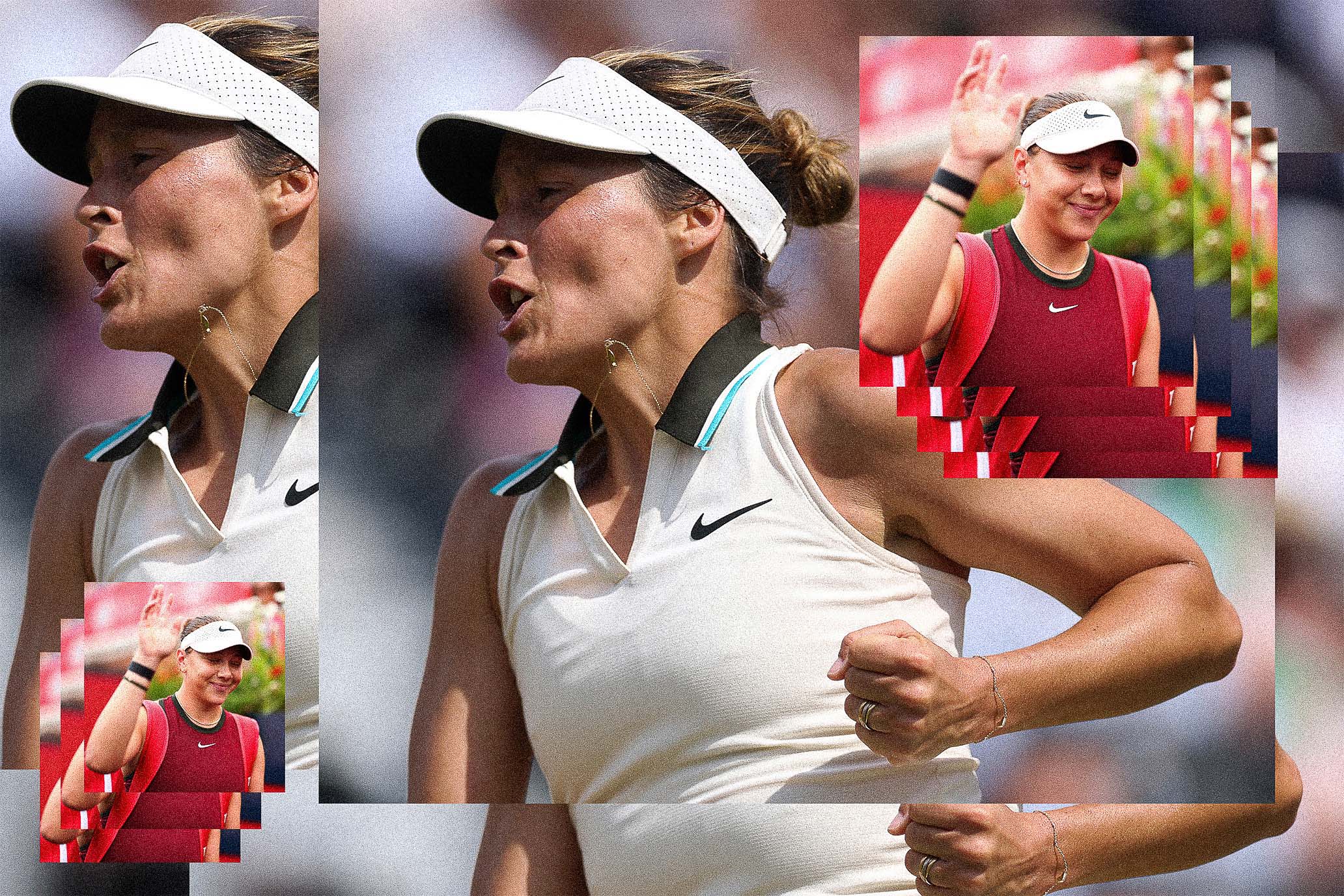
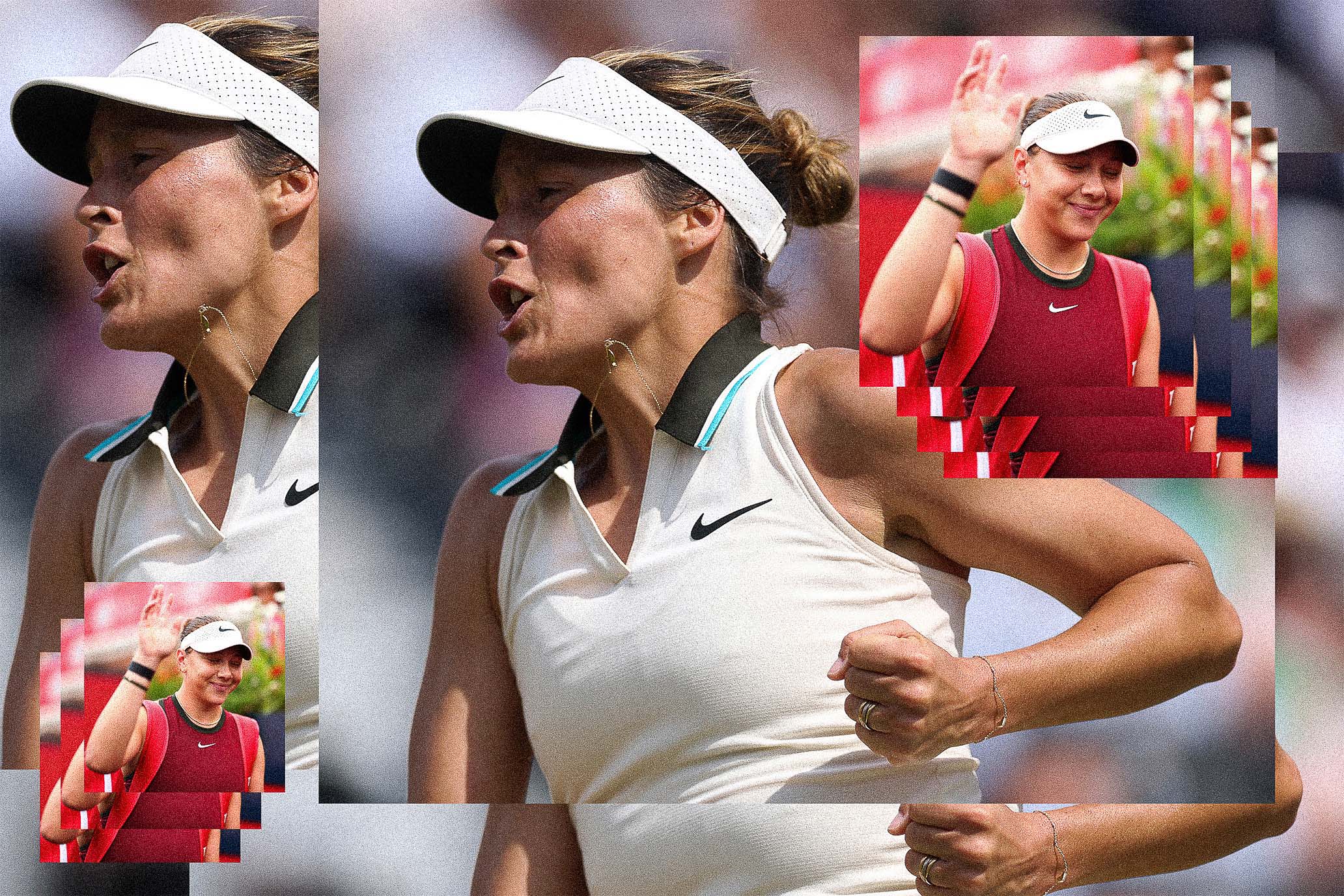
It was a big week at Queen's for Tat Maria and Amanda Anisimova. // Getty
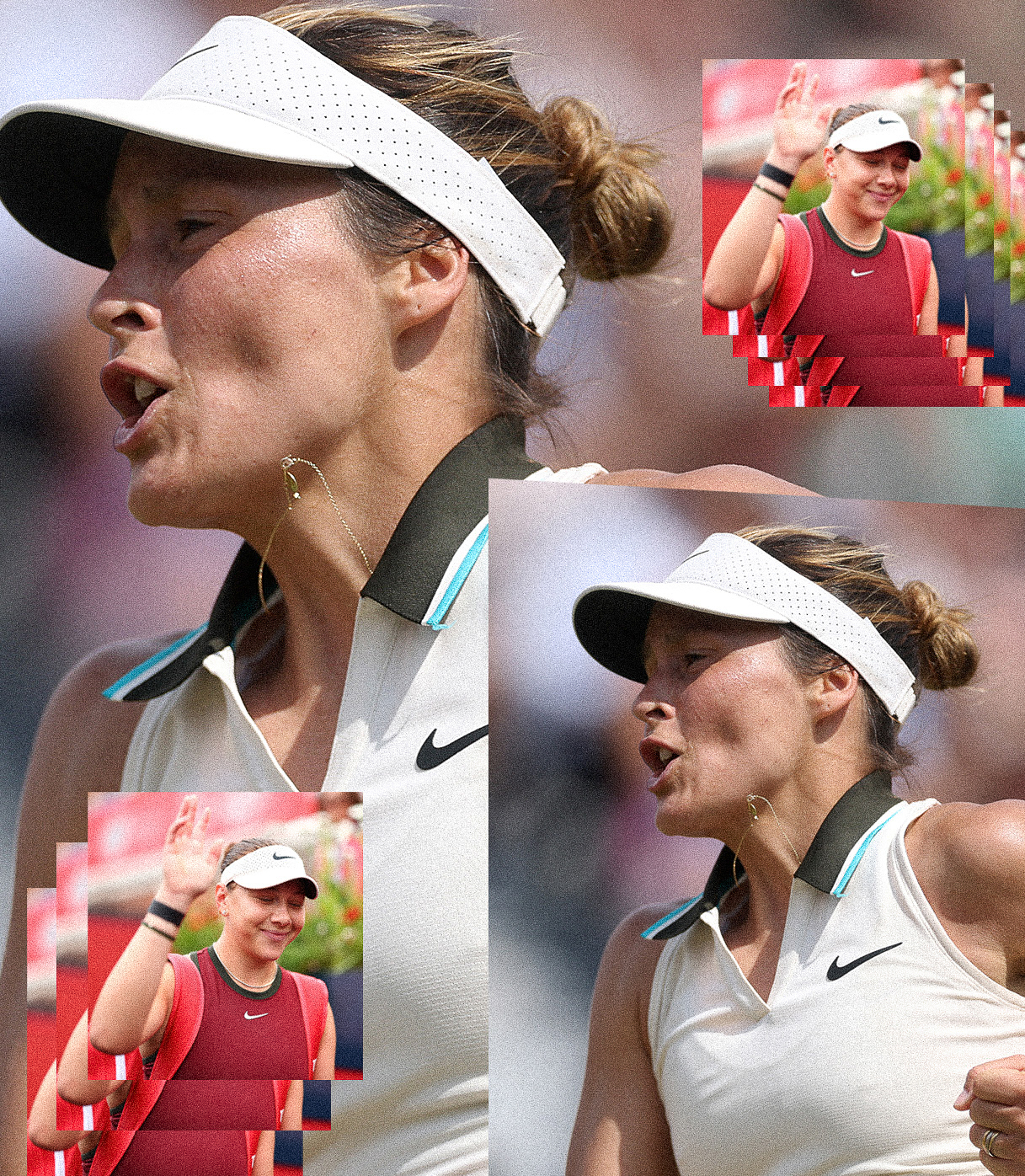
It was a big week at Queen's for Tat Maria and Amanda Anisimova. // Getty
Tatjana Maria and Amanda Anisimova launched their grass seasons at the Queen’s Club by showing again that it’s never too late to win big, and never too late to reset your career.
The grass may host a blink-and-you-miss-it season, but it always delivers on the drama and the storylines, and it lived up to its billing in its first week. Women’s tennis was back at Queen’s for the first time since 1974, and the players returned in style, giving tennis a fairy-tale ending. Disney is calling, wanting a word with Tatjana Maria.
Maria, 37 and ranked 86th in the world, hadn’t won a single first-round match in her previous nine tournaments when she entered qualifying at Queen’s. Sure, we knew her game was perfectly suited for grass, with her sharp backhand slice and her fondness for the net, but it seemed to many that her incredible run to the semifinals at Wimbledon in 2022 was a result plucked from a bygone era. Unbeknownst to the rest of the field at Queen’s, Maria was about to tear through the draw, clinching her fourth title and reminding everyone she was still an opponent’s nightmare on grass.
Maria’s win was an even more poignant story as it came against former wunderkind Amanda Anisimova. Two very different career paths, but the same story, where success only comes when the player is ready. Anisimova, now 23, reached the semifinals at Roland-Garros in 2019 when she was just 17. She had it all: the power, one of the sweetest backhands in the game, and loads of charisma. But life came for her the same year, with the death of her father. And then came her struggles. Anisimova lost her way, despite finding moments of occasional grace, such as her run to the second week at the Australian Open, in 2022, with coach Darren Cahill, and to the quarterfinals at Wimbledon the same year. Still, tennis lost Anisimova when, mentally drained, she decided to take a break in 2023.
Yet, the same way Tatjana Maria found her best game in her 30s, Anisimova, thanks to her run at Queen’s, has reached her highest ranking to date (13th), launching a kind of second career in the process.
While away from tennis, Anisimova went to college, enjoyed a normal life, learned to paint, and only then came back. Because she wanted to, not because she felt she had to. It has taken some time to pay off, and some more time for her body to adjust to the rigors of the tour, but this year she won her first WTA 1000 title in Doha and advanced again to the second week at Roland-Garros. She’s still not as consistent as we’d like, but she’s finally happy to be out there. Will getting to the final at the Queen’s after beating Zheng Qinwen for the first time be a trigger for a deep run at Wimbledon? Let’s see.
Will Queen’s winner Tatjana Maria be propelled to another epic? Maybe. She is nowadays talked about mostly for her longevity and taken as an example of how to have it all, having had two kids by the time she semifinaled at Wimbledon. Sure, before her there was Kim Clijsters, but if you looked for a player who was not a star to give guidance to the field, you always came back to Maria. The German can be seen all season long with her husband/coach and kids in tow, a smile on her face, fire in the racquet.
“It’s incredible to see what she’s doing, and her family is so cute, seeing her kids coming everywhere,” said Anisimova, who would be Maria’s last victim (6–3, 6–4). It’s not just that Maria became the oldest player to win a WTA event. It’s not just that she was on that dreadful nine-first-round loss streak before arriving in West London. And it’s not about what it says about her mental strength that she still wants to go through it all. It’s mostly about who she beat on the way to that title.
After winning three matches in qualies, Maria had to go through four top 20 players to get her hands on the trophy. The lowest-ranked player she faced in the main draw was Canadian Leylah Fernandez (no slouch at 30th in the world). Besides Leylah, Maria went through two more Grand Slam finalists (Karolina Muchova and Elena Rybakina), the reigning Australian Open champion (Madison Keys), and an on-the-rise-again, 14-years-her junior Amanda Anisimova. How many sets were lost in seven matches? One.
“I’m a good example that even at my age, you can still win big trophies,” Maria told the press after the final. “I’m super proud of myself that I could win this tournament because actually, I always believed in it, and my husband too. That’s why we kept going.” Maria winning at the Queen’s, 51 years after the last women’s match was played there, with a throwback game, is quite the wink from history. It’s also a great lesson for the next generations who, for some impossible-to-understand reason, have decided it wasn’t worth it to get a decent slice. (And it’s not even a shot of the past: Just ask Ash Barty!)
“Grass is perfect for my slice,” said Maria. “I am serving well, I can play a lot of slice, I can go to the net. I can play exactly how I would like to play, and the surface takes every single thing from it. It’s a perfect fit for my game. It actually helps me that nobody plays my style, and everybody has to get used to playing against me. Of course, my game on grass, nobody wants to play me, which is an advantage,” she said after cruising through the draw in London.
“Just not something you’re used to,” Anisimova said of Maria’s playing style. “I mean, in most of my matches, I’m not getting a slice after every single ball. It’s definitely different.” Why not try to take something from it? Imagine the power of Anisimova with a strong slice in her toolbox. The only top player of this next generation who has really worked to add other weapons to her big-hitting game is Aryna Sabalenka, and look what that’s done for her career.
Tatjana Maria winning in London is also a reminder that maybe more players should acquire a slice. And a drop shot. And a good volley. It’s never too late to win the biggest title in your career, to get that career back on track, to add more layers to your game, to shine. Tatjana Maria and Amanda Anisimova were two faces of the same tennis coin throughout the week at the Queen’s, proving, in their own ways, it’s never too late to find your form.