
A Vibe Shift for Meddy
Meddy's Vibe Shift
Meddy's Vibe Shift
Daniil Medvedev finds his form.
Daniil Medvedev finds his form.
By Giri Nathan
October 24, 2025
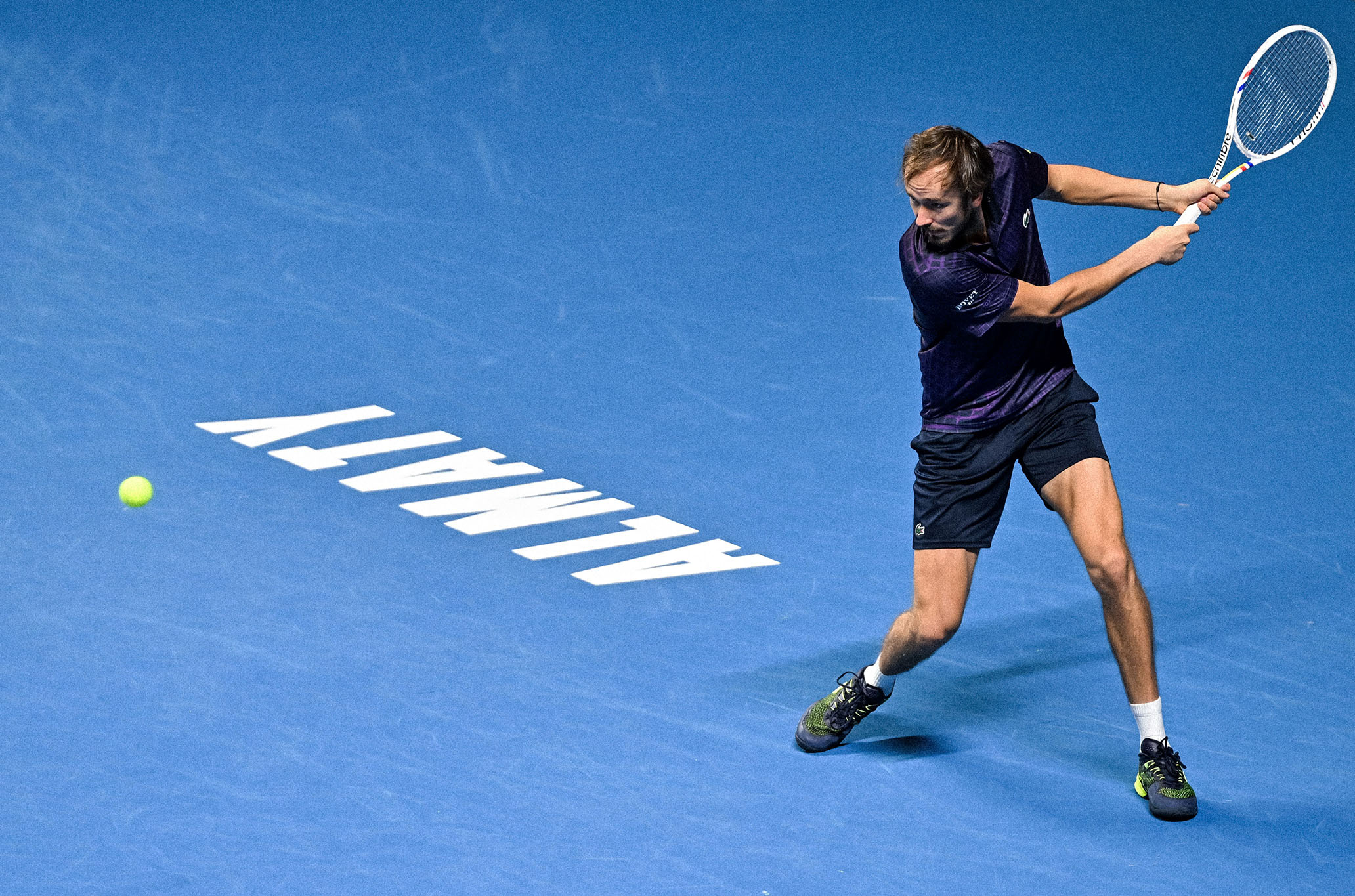
Vintage Meddy in Almaty. // Getty
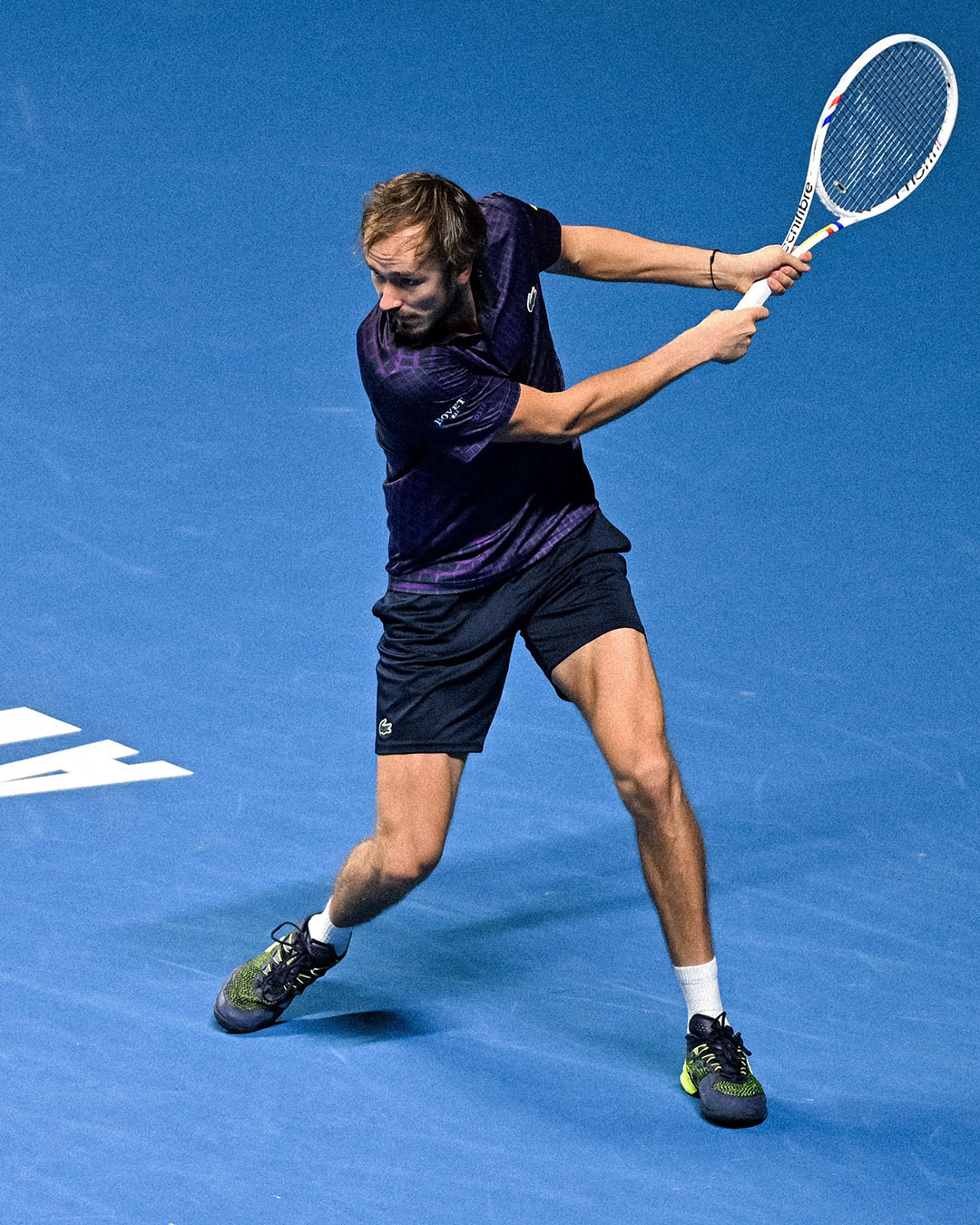
Perfect form. // Getty
I’ll take any excuse to write about Daniil Medvedev. I’ll even take a book nominally about Carlos Alcaraz and Jannik Sinner and squeeze in a whole chapter about Meddy. I find his chatter enlightening and I find the tour more compelling when he is imposing on it his cunning and visually janky style of play. But, as any Medhead is all too aware, he has provided few occasions to write about him—at least not in an appreciative light. Tantrums aplenty, some of them unseemly even by his standards. But not much winning, and very little hope.
He spent much of 2024 dealing with a shoulder injury and griping about how the lower quality tennis ball sapped his counterpunching game. Then his 2025 season managed to be even worse. He lost to lesser players. The big serving that fueled his early success was no longer so reliable. His title drought continued. He tinkered with his gear, even going as far as switching up his actual string setup mid-match—not just the tension, but switching from gut hybrid to full poly, an adjustment I have never seen before and that read as outright desperation. Most alarming of all, across the four Slams, Medvedev won only one match. One! This is a man who you could pencil into one Slam final per season, a guy who reached No. 1 in the world. It wasn’t so long ago that he beat Sinner at Wimbledon, and Alcaraz at the Open. Yet they had reached even higher levels of tennis and he seemed to be slouching into irrelevance. They had no exploitable weaknesses and boasted power he’ll never access. Meanwhile, Medvedev still struggled to end points from the baseline, attack short balls, or volley in basically any context.
The breaking point was this year’s U.S. Open. In his first-round match, after a photographer mishap, he orchestrated a minor riot, halting play for six minutes as the crowd booed, before crashing out against Benjamin Bonzi, a player ranked outside the top 50 who had also just beaten him at Wimbledon. Dire stuff. After the tournament, Medvedev’s ranking plummeted to No. 18 in the world. Most heartbreaking for his fanbase, he even split with his coach of eight seasons, Gilles Cervara, the one constant, beleaguered presence in Medvedev’s sparsely populated player box. Cervara was the ideal co-conspirator for a player of such “unconventional magic,” as the coach himself put it in his farewell message. He helped Medvedev take his strange weapons—flat, skidding groundstrokes in a world of heavy topspin—and fight all the way to the top of the tour. He also remained patient and steadfast through some of the most spectacular meltdowns tennis has ever seen. Could anyone else handle that job description?
“A team around a player is like an engine—a complex machine that drives forward,” Cervara said in an interview with Tennis Majors after the split. “When it runs at full power, you go fast. At some point the engine stops, but you don’t see it because the boat continues gliding. After a while, that energy is gone, and you’re stuck mid-sea, trying to restart that engine.” Medvedev was adrift at sea. He obviously needed a restart of some kind, but given the idiosyncrasy of his tennis and personality, perhaps it would take some time to find the right fit.
But instead the success was instantaneous. Medvedev started working with a new team: the 2002 Aussie Open champ Thomas Johansson, and Rohan Goetzke. They trained for a week in Monaco, and then they went off to China and found those elusive wins. Medvedev made consecutive semifinals in Beijing and Shanghai, beating a mix of old rivals and new challengers. (No matter how abysmal his form, he seems to always find a way to defeat Sascha Zverev.) It was the best run he’d had all year. More than any particular technical points, he said it was an emotional shift. “It’s more the energy that changed, I regained my confidence, that’s the most important thing. Because of that, some shots started coming back,” he said, ahead of the ATP 250 last week in Almaty. He went on to win that tournament, too, beating Corentin Moutet in an entertaining final, on the strength of his serve and his volleys, the two specific shots that he said returned with his confidence. Almaty was a modest title by the standards of his past accomplishments, won against a modest field, but it was also his first title since Rome 2023. He’s now won 21 titles in 21 different cities, no repeats, which is another wonderful oddity in his career. After a season of despair, the vision of Medvedev in traditional Kazakh garb, holding his first title in 882 days, was enough to make you believe again.

PURE, ORIGINAL TENNIS — SIGN UP!
The Sad Generation
The Saddest Generation
The Saddest Generation
The despair is palpable for the charter members of the "SadGen".
The despair is palpable for the charter members of the "SadGen".
By Owen Lewis
October 23, 2025
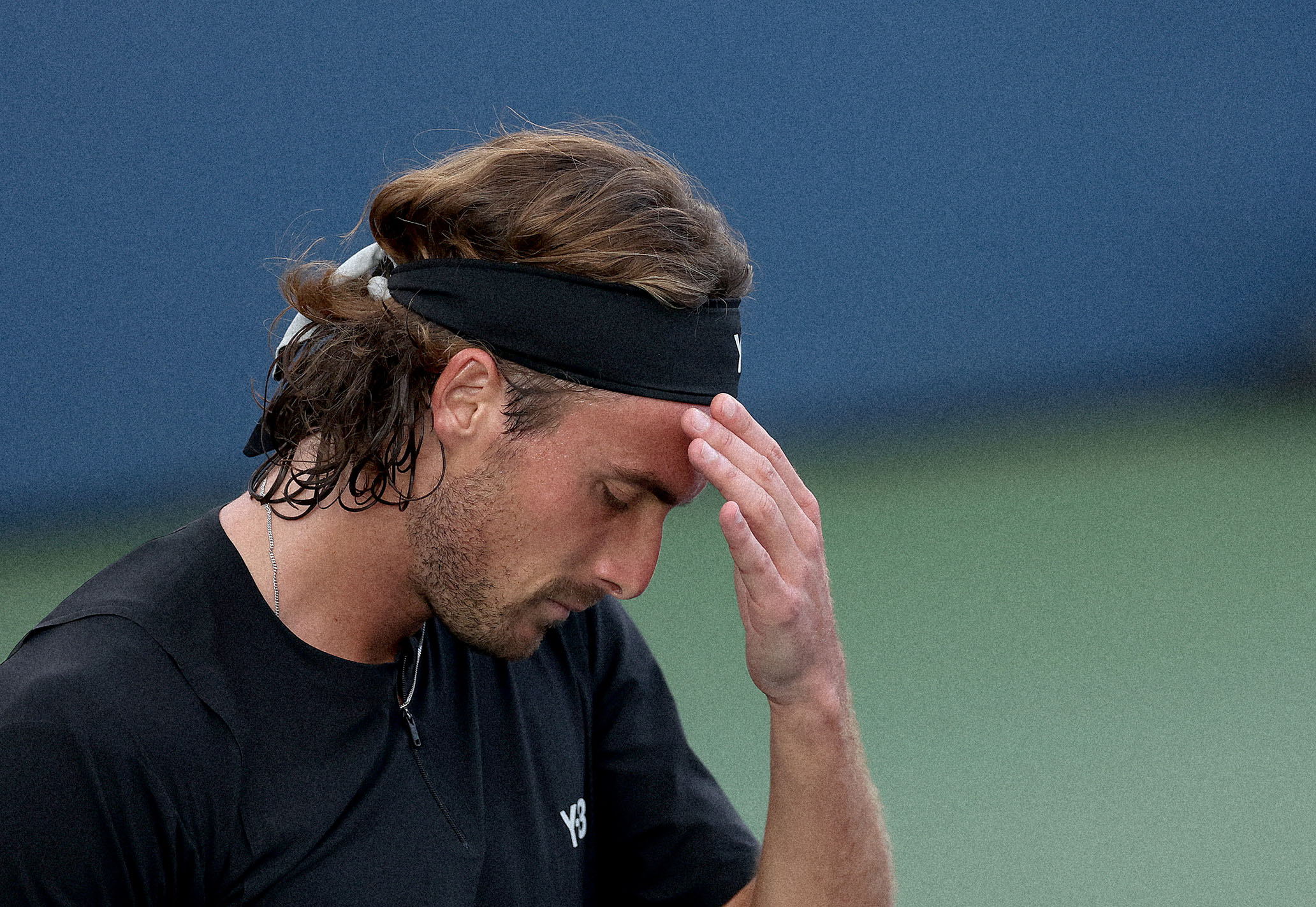
Oy Vey. "SadGen" stalwart, Stefanos Tsitsipas. // Getty
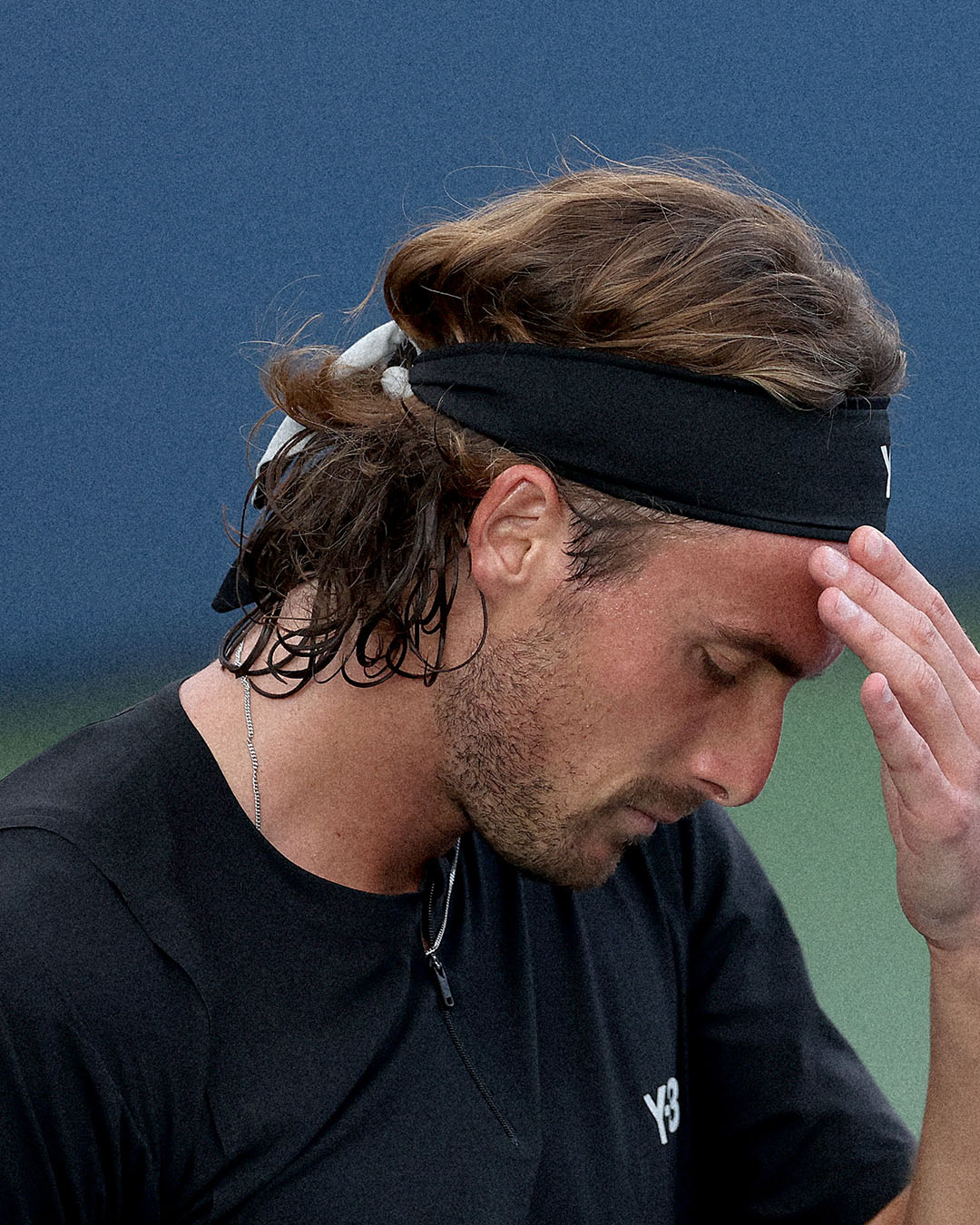
Oy vey. "SadGen" stalwart, Stefanos Tsitsipas. // Getty
In dark times, I turn to the past for comfort: When Daniil Medvedev was kicking Rafael Nadal’s ass through two and a half sets of the 2022 Australian Open final, fresh off winning the 2021 US Open, he looked like the future. A giant first serve and octopean court coverage seemed an ideal recipe to dominate the hard courts for the next half decade. Medvedev had disposed of Novak Djokovic in the previous major final without much trouble, and now the Serb was sitting out the AO thanks to a prolonged, surreal deportation saga. Who knew if he’d be able to recover? Another rival in Dominic Thiem destroyed his wrist hitting a forehand in 2021, and Nadal? Well, Medvedev was handling him just fine, up 6–2 7–6, 3–2 with three break points in hand. Medvedev would probably rack up six or seven of these majors, maybe more if he translated his prowess on cement to clay and grass. Stefanos Tsitsipas and Alexander Zverev could pounce on the crumbs he left behind.
Well, Nadal improbably came back to win that Australian Open final, then won Roland-Garros; Djokovic took over from there until 2024; Carlos Alcaraz won the two majors Djokovic didn’t and began sharing the Slams with Jannik Sinner instead once Novak began to fade. Polished, napalm-packed games shredded Medvedev’s peculiar, probing style. Djokovic employed the serve-and-volley against Medvedev to almost cruel effect, demonstrating the inherent weakness in Medvedev’s Mariana-Trench-deep return position for all to see in the process. These modern greats left no crumbs for Medvedev, much less anybody else. Daniil, still just 28 years old, is now the face of a doomed generation of ATP players.
To think that we once debated who among the NextGen would finish with the most majors, envisioning tallies deep in the single digits. Tsitsipas still has a bad backhand and now a bad back; his former coach Goran Ivanisevic was so critical of his charge that it seemed to torpedo the relationship. Zverev, the least sympathetic of the group, has long been reduced to lobbing excuses after early defeats and now conspiracy theories about court speed. Casper Ruud, three times a major finalist, doesn’t seem likely to make another and would rather play golf on grass than tennis. Frances Tiafoe pulled the plug on his season months early and is replacing his team.
The original LostGen of Grigor Dimitrov, Milos Raonic, and Kei Nishikori has already seen their window open and then slam shut; the group we once dubbed the NextGen is now SadGen.
Lately, the despair is visible in SadGen players’ demeanor. On his way out of his last several tournaments, Medvedev has raised hell upon the chair umpire. His seven-minute outburst during his first-round loss to Benjamin Bonzi at the US Open went instantly viral and was hilarious at times, but once the laughs faded you realized this was just a 28-year-old man throwing the most public tantrum possible. His cramp-induced retirement against Learner Tien in Beijing involved contentious discussions with both umpire and supervisor. And last week in Shanghai, as Arthur Rinderknech celebrated bouncing Medvedev out in the semifinals, Daniil was still griping with Mohamed Lahyani. Medvedev’s specific complaint was that Rinderknech had held up a hand, asking Medvedev to wait before the match point and (apparently) breaking his rhythm. But Medvedev had himself to blame more than anybody else—having saved one match point with a 128-mph second serve, he tried it again on the next one and missed badly. “Explain yourself,” Medvedev berated Lahyani after the match, as Rinderknech celebrated. Et tu, Daniil? A safe, spinny second serve was an option too. Medvedev just won the Almaty Open, a 250-level tournament, a much-needed victory but not one that seems likely to tame his temper the next time his game goes off the rails.
Tsitsipas, meanwhile, recently scheduled a series of tweets to send during his funereal loss to Sinner at the Six Kings Slam exhibition in Saudi Arabia. More alarmingly: His tweets are now accompanied by a distinctive note labeling them as “Ad.” Tsitsipas’ sometimes unattributed, sometimes bizarre philosophical musings have become monetized content. He and Medvedev, both major finalists inside the past three years, are having a good old existential crisis.
Though their grieving processes can prove cringeworthy, I sometimes think we hold SadGen players to too high a standard. The simple fact is that the all-time greats are just much better at tennis. Losing to them repeatedly over a decade-long span and then crashing out due to that fate strikes me as entirely natural, rather than a sign of crippling mental weakness. After the Cincinnati final, in which Sinner retired ill after five games against Alcaraz, a friend texted me that had Taylor Fritz done so instead, the tennis world would have jumped down his throat for being a disappointment. I agreed, then paused to ask myself why. Was it the manifestation of a desire for someone, anyone, to overcome their apparent limits and upset the status quo at the top of the game?
At Wimbledon, Fritz came closer than he ever had. Alcaraz beat him in a four-set semifinal but stared down two set points in the pivotal tiebreak that would have forced a decider if converted. A popular first instinct after Alcaraz reeled off four straight points to close the match, despite Fritz beginning each of them with either a precise first serve or a baseline-kissing return, was to criticize Fritz for not optimizing his aggressive forehands afforded to him by his good early work. In hindsight, I think this was silly. Taylor, as the underdog, hit wonderful shots on all four points, beneath stifling pressure to which his opponent was far more accustomed. To expect perfection from him after Alcaraz then returned those wonderful shots is simply not a realistic standard for Taylor Fritz—it’s a realistic standard for Carlos Alcaraz. (Alcaraz himself failed to meet that standard in the final, I suspect partly because Fritz made him use too much of his magic to survive here.)
Tennis results can feel frustratingly predetermined at the best of times. Even Djokovic, paragon of inevitability for most of his career, will surely never beat Sinner again. “It’s one of the best matchups we have,” Alcaraz claimed before Sinner predictably beat Djokovic in straight sets for the fourth straight time, at an exhibition in Saudi Arabia, facing all of one break point in the process. If true, that’s a dire landscape of rivalries. Few would blink an eye, though, if Djokovic retired right now. SadGen players will feasibly play for another decade, and all the way they’ll be hounded by the younger, more skilled New Two. I might cringe at Medvedev’s antics, but if the proposition in my own life were to work my butt off in the hopes of outdoing supertalented peers (unlikely) or capitalizing at a major in which both were injured (keep dreaming), I couldn’t vouch for my own sanity either.
None of this is especially conducive to an entertaining ATP Tour. Alcaraz-Sinner matches rarely miss, but if made to explain to a stranger why I dedicatedly follow a half of the sport that boasts all of one elite, competitive rivalry (and even here Alcaraz has won seven of the last eight), I worry I’d sound incoherent. Participating in this impossible game as a member of SadGen seems far worse than a dubious pastime, though: Einstein’s classic definition of insanity is also your job description. Perhaps there’s comfort in what you know, even if the familiar is something like misery.
PURE, ORIGINAL TENNIS — SIGN UP!
Turin or Bust
Turin or Bust
Turin or Bust
Lorenzo Musetti's complicated journey to the ATP Finals.
Lorenzo Musetti's complicated journey to the ATP Finals.
By Simon Cambers
October 16, 2025
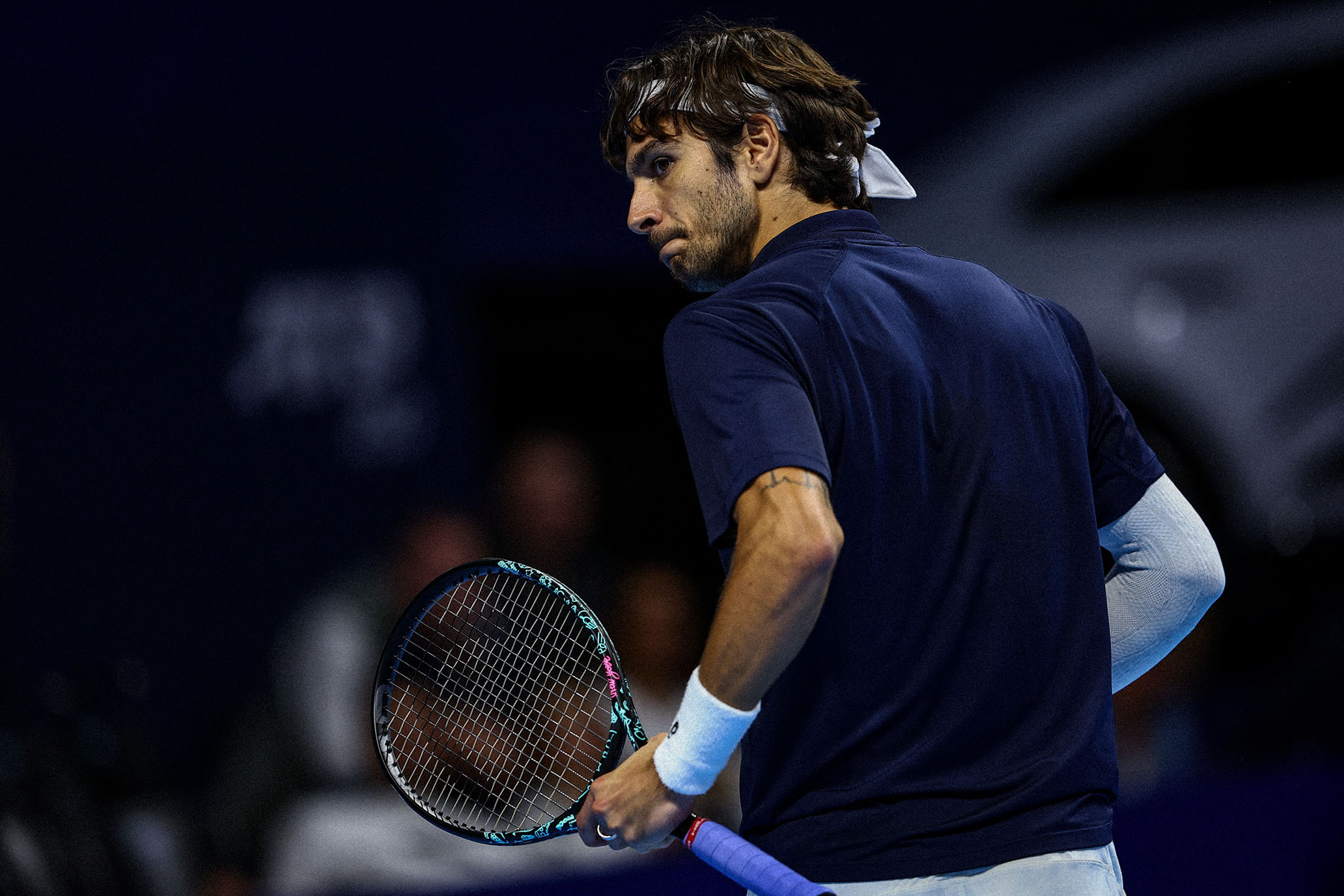
Lorenzo Musetti in Shanghai last week. // Getty
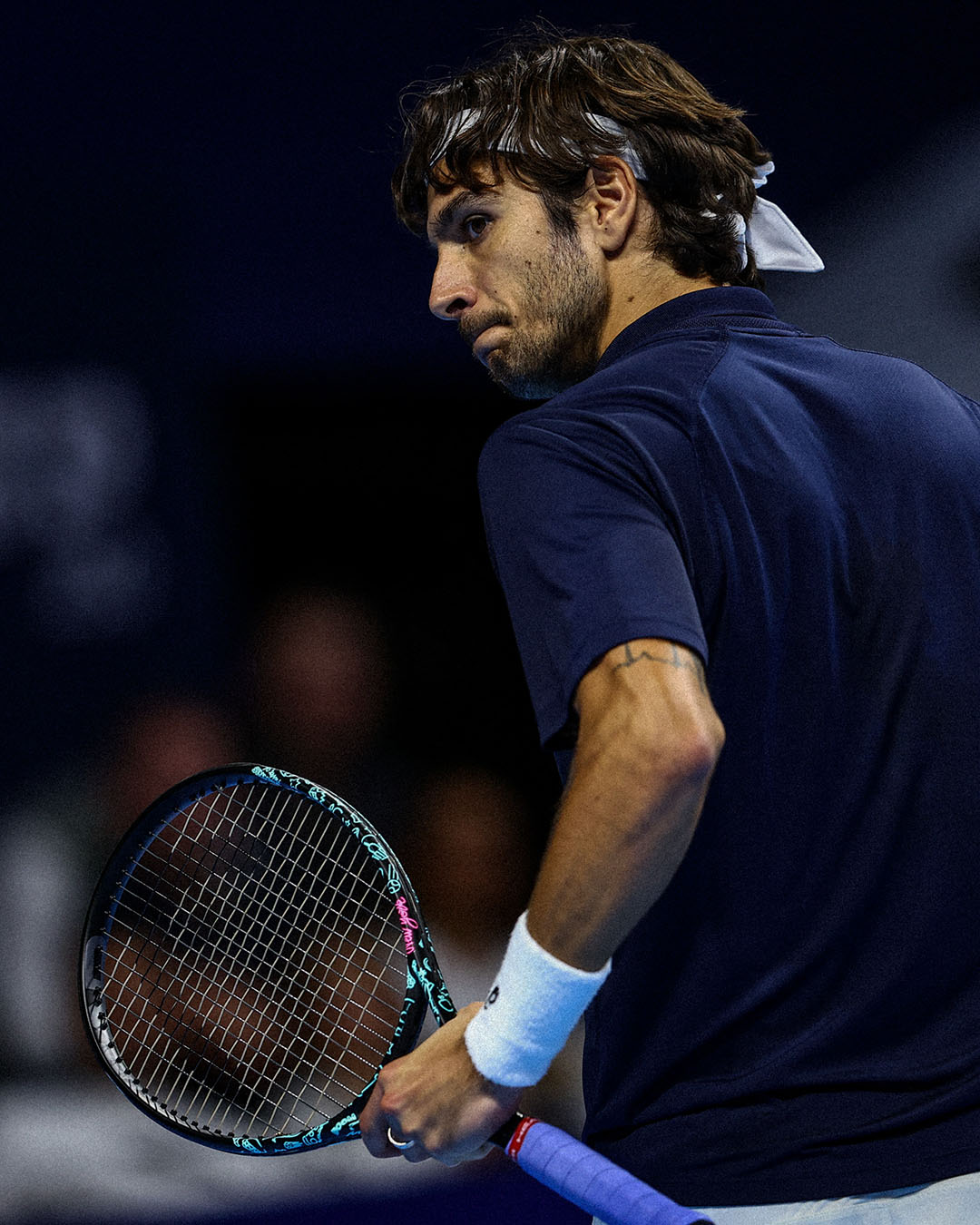
Lorenzo Musetti in Shanghai last week. // Getty
The fall season is a funny time for tennis players. Some find themselves hanging on for dear life, the efforts of the previous months catching up with them, their minds crying out for them to stop. Some, like Jack Draper, Elina Svitolina, Daria Kasatkina, and Emma Raducanu, have already called time on the year.
For others, the last few tournaments offer a golden opportunity, a chance to make it to the prestigious end-of-year ATP and WTA Finals. While the rolling 52-week rankings don’t always tell the story, especially early in the year, the ATP Race, which shows a player’s calendar-year ranking points, makes it clear.
As we hit the final few weeks of the season, on the men’s side there appears to be a two-horse battle for the eighth and last spot, with Lorenzo Musetti just over 500 points ahead of Felix Auger-Aliassime. Novak Djokovic, who sits third, is still mulling over whether he will play in Turin or not, so it’s entirely possible they might both get in. But the race for that eighth spot is keeping both men going, and what happens this weekend in Brussels, where both are in action, could yet be significant.
Halfway through the year, Musetti was sitting pretty. Having gone 19–4 in the clay-court season, including a run to the French Open semifinals, the Italian was in the top five of the ATP Race. An injury stopped him in his tracks, however, and it took a return to form at the US Open, where he made the last eight, to restore his belief that he can qualify for the Finals for the first time.
“The US Open was really, really important,” Musetti said in an interview with The Second Serve this week. “It was not [looking] that great. After the semifinal in [the] French Open, I got injured and spent one month at home. I didn’t play anything on grass, and I lost a lot of points at Wimbledon when I was not that healthy to play and to win matches there. Then the journey in America with Washington, Toronto, Cincinnati, was a little bit complicated. I had three huge matches with many chances in all three matches, but what was missing was a little bit of confidence. Luckily, I got back the confidence at the US Open, and that probably was the turnaround of the end of the season.”
Every top player wants to make the ATP Finals; of course they do. But Musetti has extra motivation, with a chance to make history alongside world No. 2 Jannik Sinner. “It would mean the world,” Musetti said. “It would mean the world for me, because, of course, it’s going to be a first for Italy, the first time with two players, two Italians in Turin. It will be awesome, really special for everyone who is involved. I always went there to do some sponsor [events] or stuff, but I never had the chance to really play there. The main goal of the season was Turin, and I’m pretty close, so I don’t want to stop now.”
Musetti’s backhand has been a thing of beauty from the moment he stepped onto the tour, but in the past couple of years, he’s added bulk, like Sinner, and consistency, to the point where, at the age of 23, he is becoming a regular fixture at the back end of tournaments. Making the finals would be further validation that he continues to move in the right direction.
“It’s something that we wanted,” he said, “and something that, of course, we didn’t [just] expect. Honestly, I was dreaming to have the chance to fight for this goal. It [would be] something for myself, for my team, for the people who are working with me, because we know how much work we put in, how much sacrifice we have done to try to go there, to reach these kinds of goals.
“There are also other goals in terms of ranking, try to achieve a higher ranking in the end of the season, and try to go for it. There’s still three, four tournaments, and then the Masters. The mentality is to give 110 percent.”
Musetti is a laid-back personality, occasionally fiery on the court but generally focused on getting better, honing his talent. Chasing a place in the ATP Finals means keeping an eye on the points, but he’s not someone who’s been agonizing over the numbers.
There is just one thing that might stop him. Musetti is due to become a father for the second time at some point in November. With both the ATP Finals and the Davis Cup Finals in the same month, it’s not ideal timing. It helps that they are both in Italy, but as a proud family man, Musetti may yet have a difficult choice to make. “It’s pretty, pretty close,” he admitted. “So we are going to see what happens there, and we will [make] a decision.”
PURE, ORIGINAL TENNIS — SIGN UP!
Family Affair
Family Affair
Family Affair
A career altering run in Shanghai for cousins Valentin Vacherot and Arthur Rinderknech.
A career altering run in Shanghai for cousins Valentin Vacherot and Arthur Rinderknech.
By Giri Nathan
October 13, 2025
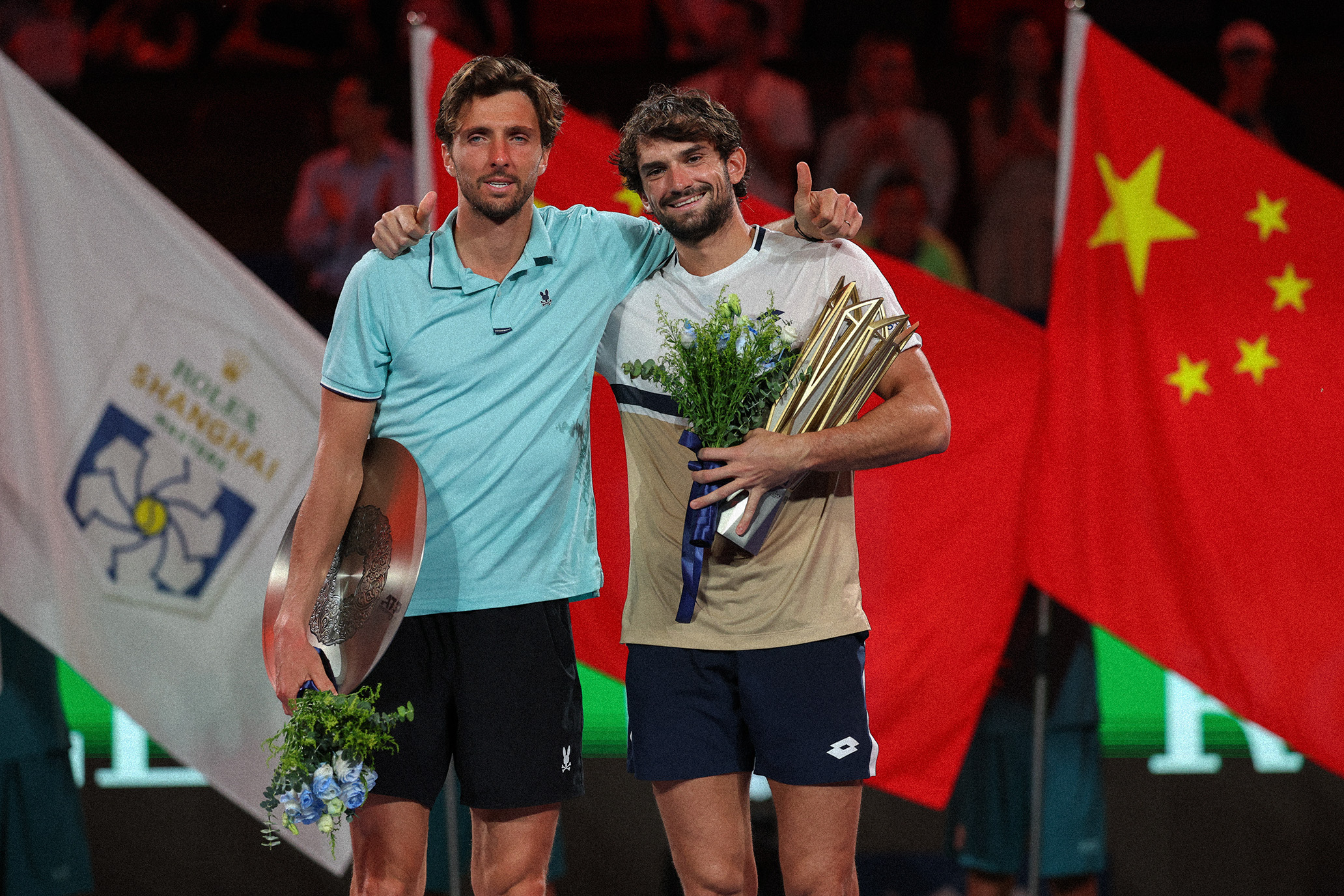
Don't ever take sides against the family: Cousins Rinderknech (left) and Vacheron in Shanghai. // Getty
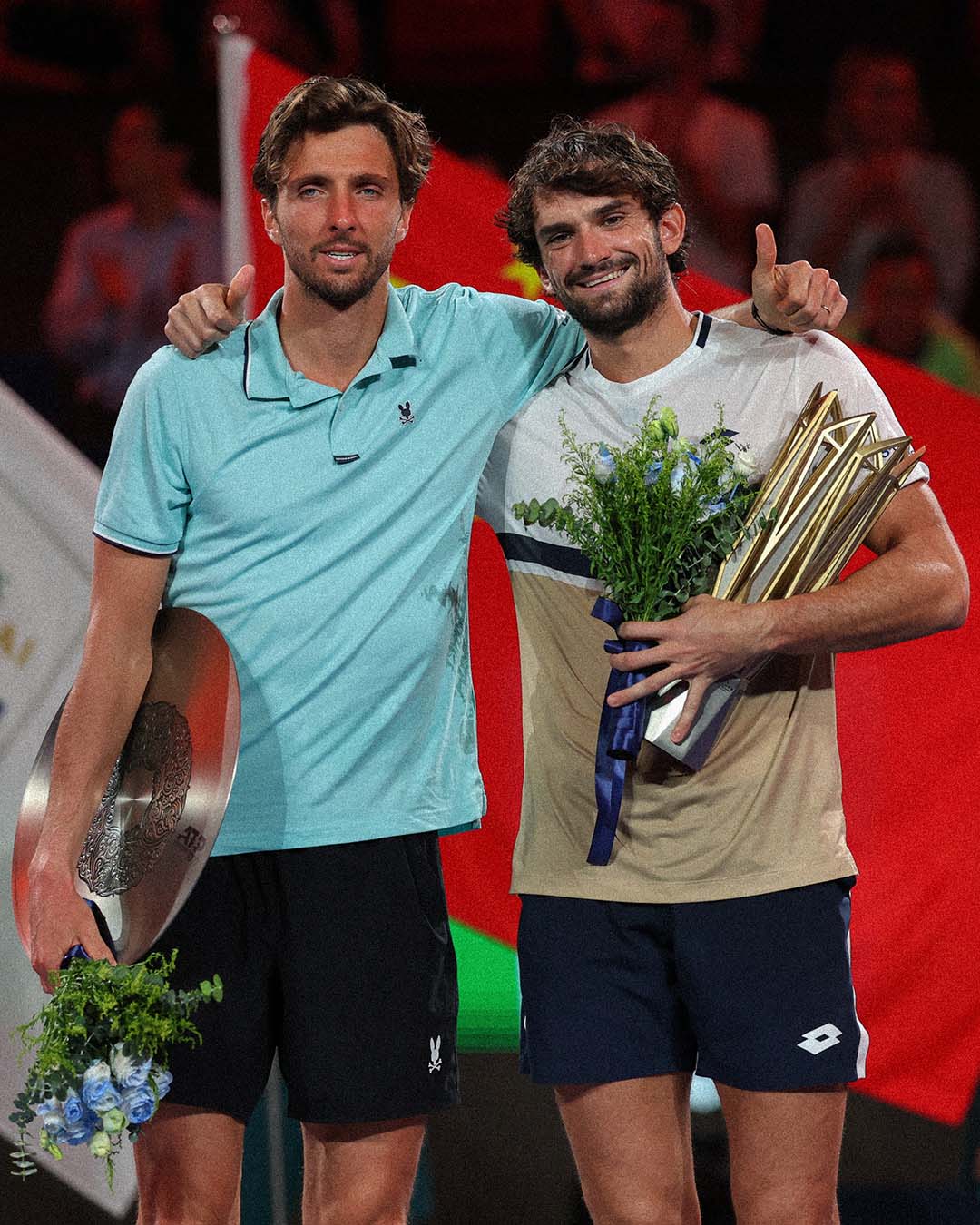
Don't ever take sides against the family: Cousins Rinderknech (left) and Vacheron in Shanghai. // Getty
Describe the conclusion of the Shanghai Masters, one of the most surreal happenings in modern tennis history, and it all sounds fabricated. Each successive detail makes it sound more and more like tennis Mad Libs. There are two finalists. One of them was ranked outside the top 50 and had never made it past the third round of a Masters event like this. The other one was ranked outside the top 200, had barely even made it into the qualifying draw in Shanghai, and had won only one previous match at a Masters tournament. Collectively they defeated Daniil Medvedev, Sascha Zverev, Felix Auger-Aliassime, Holger Rune, and Novak Djokovic en route to the final. Also, they’re cousins.
A double Cinderella run within the same family tree, in the same week of the tennis season. Preposterous stuff. The players in question, 30-year-old Arthur Rinderknech and 26-year-old Valentin Vacherot, said that their family group chats were blowing up during the tournament. Makes sense, since tennis is a family affair. Their mothers are siblings, and Rinderknech’s mother, Virginie Paquet, was a professional player too. The two men have been playing tennis together their entire lives. Vacherot followed Rinderknech to Texas A&M, where the cousins were college teammates and occasional doubles partners. Currently Vacherot is coached by his brother, Benjamin Balleret. And after the match, which Vacherot won, 4–6, 6–3, 6–3, he wrote on the camera, “Grandpa and grandma would be proud.”
Before this life-changing run, Vacherot’s name would have only been known to those who study the Challenger tour. In the spring of 2024, he was on the cusp of breaking into the top 100, but a shoulder injury took him out for the season, and he’d been slowly working his way back up. To measure the oddness of this result, just look at his most recent loss before Shanghai: At the Saint-Tropez Challenger, he lost to the world No. 311. That is not typically the mark of a player who is about to beat three top-20 players and lift a Masters title. But he snuck into the qualifying draw after several players ahead of him withdrew. And then he played the tournament of a lifetime. Shanghai was notorious for brutally hot and humid conditions, which caused a flurry of retirements. Vacherot had a bigger workload, playing those two extra matches of qualifying, and he still beat everyone in his path. In six of his matches, he bounced back after losing the first set. How did he know this was coming? Six weeks before the tournament, he’d sent a message to a friend: “I’m gonna go take my chance in Shanghai Q’s because a sick run can come any second.”
The other cousin, Rinderknech is a much more familiar name to tennis fans, having spent the past few seasons at the tour level and having gone 6–3 against top-20 opponents this year. (The most high-profile of those wins was his upset of Zverev at Wimbledon.) Having watched a lot of his tennis this year, I often felt like his ranking didn’t reflect his ceiling. As Medvedev put it before their semifinal matchup: “He’s the type of player that when his game is on he can beat anyone. His serve is amazing, he hits the ball great. So he’s not the type of player where, as I say, when his game is on you know that you’re still going to have some chances, rallies. He’s going to try to finish the point in two shots.” Rinderknech won that match in straight sets, and Vacherot came down from his courtside seat to hug him, now that they had secured their dream final. Rinderknech looked ahead with joy: “Tomorrow night there will be two winners anyway. There’s going to be a match, of course, but today we won everything. We couldn’t win any more, you know. We won everything.”
In the final, the two players did genuinely look like tennis cousins. At 6 foot 5 and 6 foot 4, respectively, Rinderknech and Vacherot are lean and rangy, both with imposing serves, both capable of athletic plays at the net. Despite their inexperience playing a match with these stakes—or anything remotely close—the quality of the match was extremely high. This was charismatic all-court tennis, and the ambiance was exactly as positive as you might expect between two players who found themselves in these strange, happy circumstances. For any fan who needed a palate cleanser in this era of unbroken Sincaraz dominance, it’d be hard to ask for a better match, or storyline, than this one.
Vacherot became the lowest-ranked player to ever win a Masters title in the 35-year history of the format. He became the first player from Monaco to win an ATP title. He won $1,124,380 in prize money from Shanghai; before this tournament began, he’d won $594,077 in his entire professional career. He leaped up from No. 204 in the world to No. 40. Meanwhile, with this runner-up finish, Rinderknech will move up from No. 54 to No. 28 in the world. I recommend watching the words that Rinderknech offered his cousin, in their native French. “Two cousins are stronger than one,” he said, as both of them cried. A few minutes later, in an apt final tribute to the conditions in Shanghai, Rinderknech began cramping and tumbled off the platform, while his cousin chuckled—a little comic relief from all the intense emotions of those career-altering two weeks.
PURE, ORIGINAL TENNIS — SIGN UP!
A Force of Nature
A Force of Nature
A Force of Nature
Amanda Anisimova steps into her comfort zone.
Amanda Anisimova steps into her comfort zone.
By Carole Bouchard
October 8, 2025
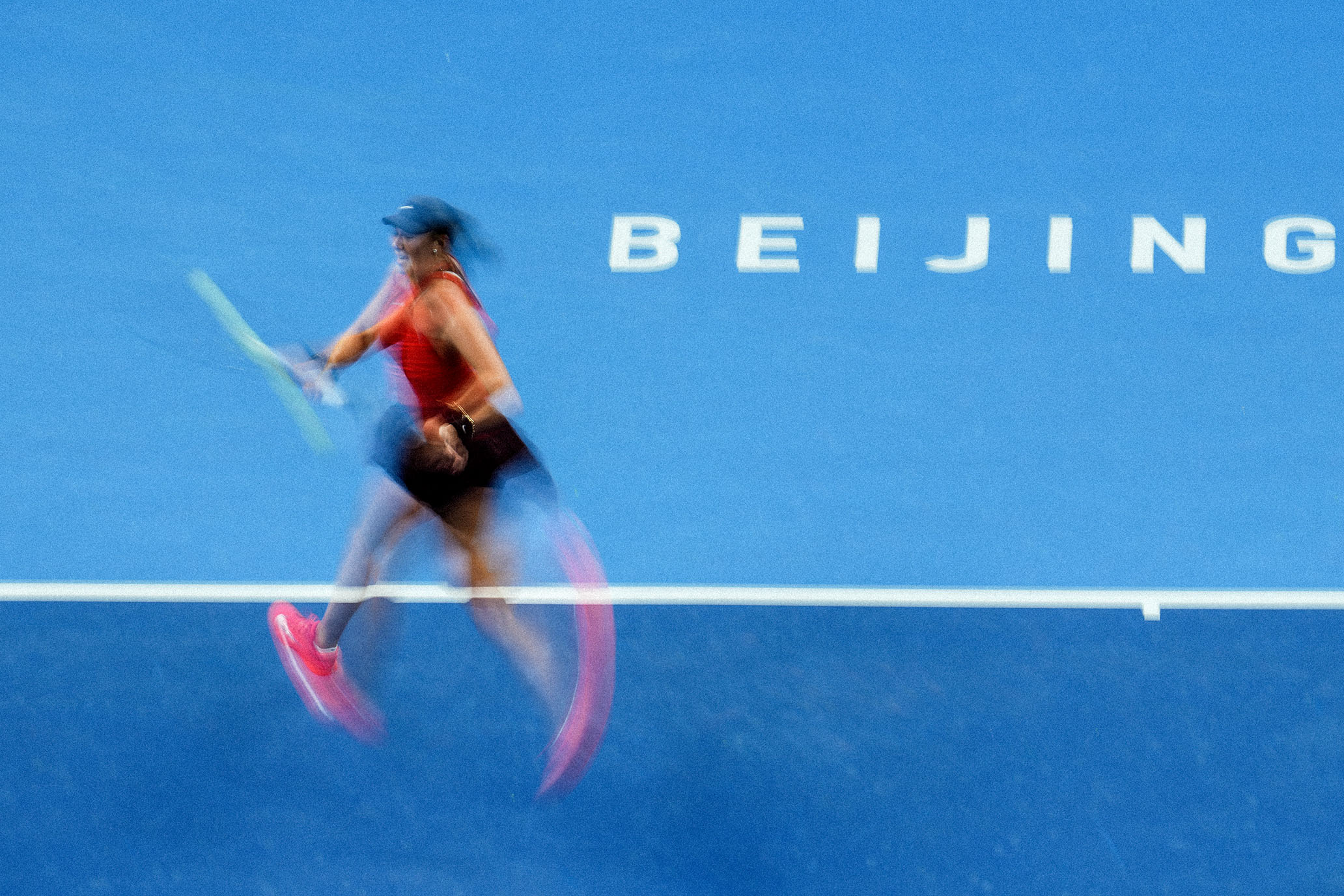
This season, Amanda Anisimova has taken the WTA Tour by storm. // Getty
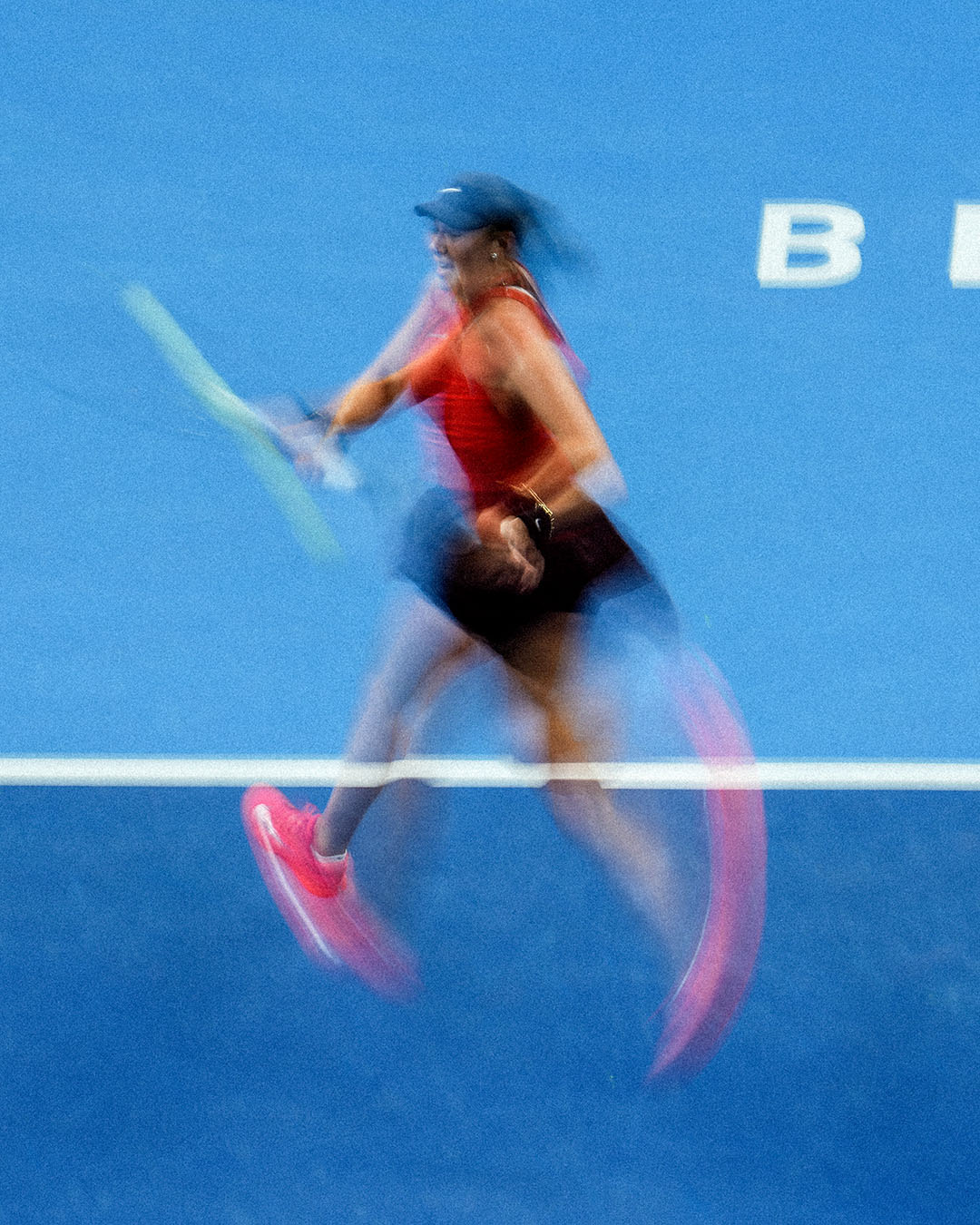
This season, Amanda Anisimova has taken the WTA Tour by storm. // Getty
Amanda Anisimova used to be like a storm that appeared on the horizon, only to disappear just as quickly, before doing any damage. In Beijing, though, after a year of ascendant results, she finally looks like she’s socked in for good.
Tennis blinked, and suddenly, Amanda Anisimova has become a force to be reckoned with. Once a tennis prodigy, then a question mark, she came back and found a way not only to start fulfilling her potential but also, in 2025, to become a champion for an entire season. Who would have thought that Anisimova would become one of the steadiest players on tour this year? I’m not sure many were ready to put their hands in the fire for that.
Yet here we are, talking about two Grand Slam finals and now two WTA 1000 titles, most recently the one in Beijing this past week. It’s not so much that she won the second WTA 1000 title of her career, but it’s also notable that the first one was way back in February, and her level hasn’t dipped all season long. Moreover, she showed resilience, reaching the US Open final after losing that Wimbledon final, and then winning the China Open after losing a second Grand Slam final this year. Getting crushed but bouncing back: That didn’t used to be an Amanda Anisimova tennis pattern. She’d play all lights-out for a while, then disappear in erratic losses with an erratic motivation. She had reasons, going through a lot off the court. But she also had a game demanding an amount of discipline and commitment she couldn’t find.
There’s an obvious comparison to make with Aryna Sabalenka in how Anisimova has found a way to control her immense power for long stretches of time, in the process turning her career around. She dismantled reigning champion Coco Gauff in the Beijing semi, proving unplayable. “She’s definitely one of the best out of those I’ve played,” said Gauff about players with a game style built around power. “For sure, she and Aryna are tough when they’re playing that level of tennis. No matter what I did, I just couldn’t get into the match. She completely took over.”
Anisimova didn’t only blast rivals off the court this week in a state of grace. No, she also fought hard to come back from one set down twice, against Karolina Muchova and Jasmine Paolini, channeling the same level of resilience she needed to beat Naomi Osaka in the US Open semifinals in three tight sets. These kinds of wins can transform a tennis career. “I’ve learned a lot about myself,” Anisimova said after her triumph. “Just figuring out ways to face certain challenges and push myself in moments when it feels like I can’t go any further. In that sense, I learned that I’m stronger than I think. That’s a huge win for me.” In Beijing, despite not being 100 percent (foot and calf issues), Anisimova refused to give up. She stayed and she fought.
In 2025, she might finally be convinced that everybody was right: She has golden hands, golden timing, and a crazy good eye, so she can be so much more than an “I can hit all the winners” type of player. Significantly improved conditioning has also helped her mind stay tough in the matches. What we saw in Beijing was all the work Anisimova had done to become the player everybody had been telling her she could be. There’s nothing more annoying than people talking about how you’re wasting your potential, but Anisimova didn’t need anybody to tell her, because she knew it. “I feel like I’m playing to my full potential,” she confirmed. “I’m doing all the right things and working really hard, as opposed to a few years ago when I felt like I wasn’t competing or performing to my full potential.” And so now, week in and week out, we’re done wondering which Anisimova will show up on court, the one who can win it all or the one who isn’t in the mood to win.
Everything started to click for Anisimova in February, but a year of consistently high-level play ensured that winning a second title in Beijing felt inevitable, rather than a surprise. “In Doha, I was just there with my tennis coach and not my full team. It was a bit different and very unexpected there. That was my first big win. This week, I was riding on a lot of confidence because I’ve had a great year so far. Overall, just really happy to have started the year off well, and now to be able to keep still going strong.”
Not a week of being in the zone, but an entire season of staying out there, fighting. A full schedule, very few injuries, very few moments where she looked like she’d prefer to be somewhere else.
Amanda Anisimova, enjoying the competition and the suffering, has to be one of the most surprising, in all the right ways, events of the year. She’s now the world No. 4 and could soon take Coco Gauff’s throne as top American before gunning for the only one that matters: the World No.1. If she gets there, nobody will be shocked.
PURE, ORIGINAL TENNIS — SIGN UP!
The Everyman
The Everyman
The Everyman
Alejandro Davidovich Fokina needs a hug.
Alejandro Davidovich Fokina needs a hug.
By Owen Lewis
October 6, 2025
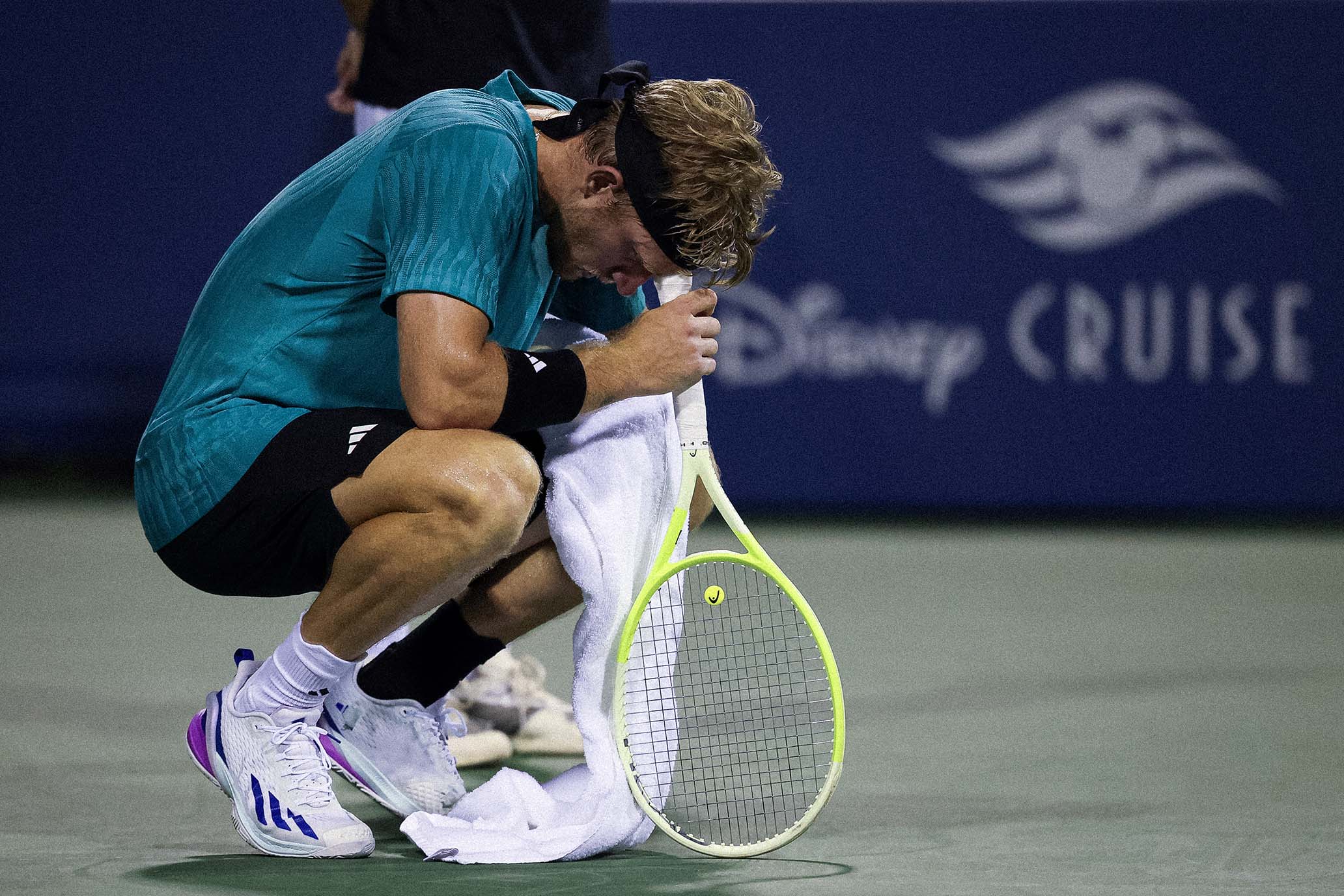
Foki readies himself for the inevitable in the DC final this summer. // Getty
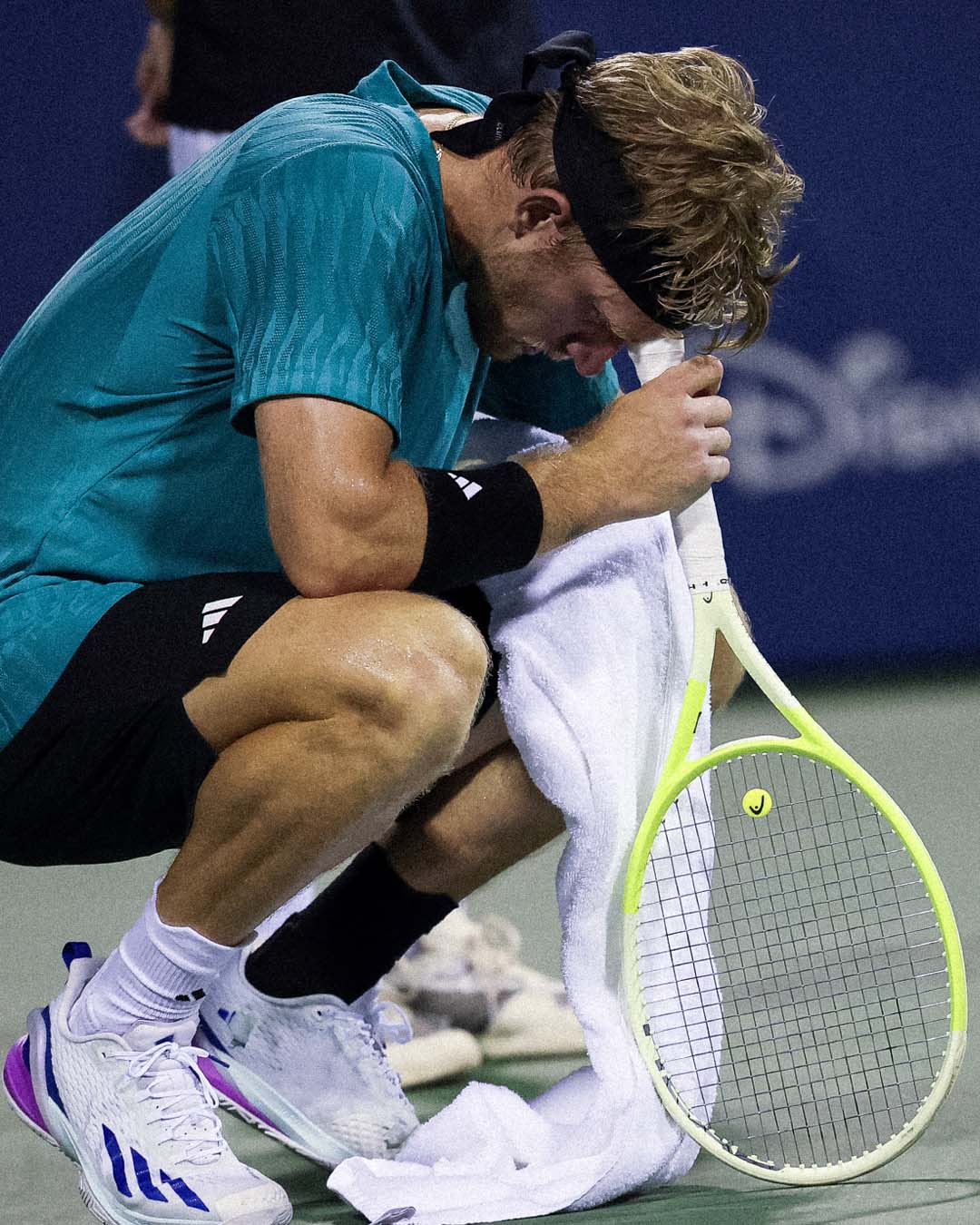
Foki readies himself for the inevitable in the DC final this summer. // Getty
Alejandro Davidovich Fokina must need a hug. Since Alex de Minaur saved three championship points to beat him in the final of the Citi Open, leaving Foki’s heart cracked and dripping over the Washington, D.C., hard court, the 26-year-old Spaniard hasn’t looked the same. How could he? He’s never won a title despite being more than good enough to do so; this was his golden opportunity to break the duck; and all this will hang over his head until he either corrects it or dies. His storyline wouldn’t be out of place if retconned into an episode of The Leftovers at this point—just substitute him in for Matt Jamison—or set to Max Richter’s most yearning track from the show. At Wimbledon one year, Foki hit a pathetic underarm serve at 8–all in a final-set tiebreak against Holger Rune, charging the net behind it to inevitably get passed. “I shit myself,” he said later, by iconic way of explanation. Foki gets good heft on both forehand and backhand, has soft hands, and his footwork covers the court like rainfall. But he is less than the sum of those parts. It’s like God designed a world-class tennis player and forgot to add the ability to stave off calamitous mental implosion, or adequate bowel control.
Foki surely rued God’s omission in Washington. Secondhand trauma incoming: Davidovich Fokina led de Minaur 5–2 in the third set and served for the title at 5–3, 30–love. He had three championship points at 5–4 and lost all those, too. Interspersed among these pivotal moments were deadly-serious stares at his box, hoarse shouts, windmilling arms, despairing whimpers. As if the hellish suite of missed opportunities weren’t enough, Davidovich Fokina did better and better on each match point, underscoring how close his failure was to tipping over into success. De Minaur saved the first with a backhand winner down the line. Foki landed a deep return on the second but played tentatively during the rally and eventually fell victim to another de Minaur backhand. On the third, Davidovich Fokina scorched a forehand down the line that stretched de Minaur to his limits. But the quick, willowy Australian managed to coax a lob onto the very outside of the sideline, then blitzed forward to pass Davidovich Fokina at net. Foki was learning and adapting on each match point, and had he gotten a fourth, maybe he would have done well enough to win it. He never did. Before de Minaur served an ace on a match point of his own, Davidovich Fokina sank back onto his haunches, butt of his racquet pressed into his forehead, getting a head start on grieving this catastrophe. I expected his blond hair to start turning white.
Since, Davidovich Fokina has won just five of 10 matches. At the China Open, he unraveled so easily that rage monster Daniil Medvedev looked as calm as a yogi en route to an easy victory. Foki was in disarray: He beckoned frantically for more towels and took a dislike to the angle at which a member of the tournament staff held an umbrella over his head on a changeover, adjusting it himself. He stared in mute betrayal at his racquet strings and the court. He hit so many standard crosscourt backhands into the same spot at the top of the net that I wondered if he was having an issue with his vision. Had he suddenly been raptured right through one of Lotus Arena’s folded diamond-shaped cutouts, I doubt he would have minded. Foki got another shot at Daniil in lethally humid conditions in Shanghai; he even shored up his backhand. (Perhaps at the cost of his forehand, which oozed 21 unforced errors.) He lost in straight sets again, at least this time making Medvedev beat him with brilliance in a second-set tiebreak. I doubt that was any consolation.
Foki’s struggles are refreshing to watch for their anguish. World No. 2 Jannik Sinner lost to Carlos Alcaraz in a Roland-Garros title match at least as torturous as the D.C. final, only to immediately exact revenge at Wimbledon. His coach, Darren Cahill, has said Sinner barely even discussed the Roland-Garros match with him before moving on. Imagine! The worst moment of your professional career, maybe your life, and for all intents and purposes, it never happened. Even the more mortal Taylor Fritz ate an 11th straight loss to Novak Djokovic at the U.S. Open in which he made plenty of mistakes sufficient to ruin a night’s sleep, then got right back to playing some of the best tennis of his career at the Laver Cup and Japan Open. The unfamiliar viewer could be tricked into thinking these losses didn’t hurt so much after all.
Foki knows better. His value is not as a glutton for punishment, but as the avatar for the common tennis fan and recreational player. (One who sometimes takes to Instagram to complain that 11 a.m. is too early a start time for his matches, but still.) Who among us hasn’t stared down a break point at 5–3 in the third set on the practice court, excruciatingly aware of the point-by-point process by which we could lose our lead and the match, and how much it would hurt? Like in D.C., you can see Foki sensing his collapses as they come, and sometimes he lets the woe envelop him like warm tar even as he continues to fight. He is a drama queen. Pressure makes him nervous, debilitatingly so at the worst times. Whether he will get over painful periods in his career is a question of if, not when. He does not always want to be at his job, and he lets you know. If he wins a title, it will be done via the oh-so-hard way of overcoming his persistent limits. That, or even a prolonged inability to get over the line, is unmistakably human.
PURE, ORIGINAL TENNIS — SIGN UP!

Good-Time Charlie
Good-Time Charlie
Good-Time Charlie
A review of Being Carlos Alcaraz: The Man Behind the Smile by Mark Hodgkinson.
A review of Being Carlos Alcaraz: The Man Behind the Smile by Mark Hodgkinson.
By Patrick J. Sauer
August 28, 2024
Carlitos mugs during his second round win at the US Open this week. // Getty
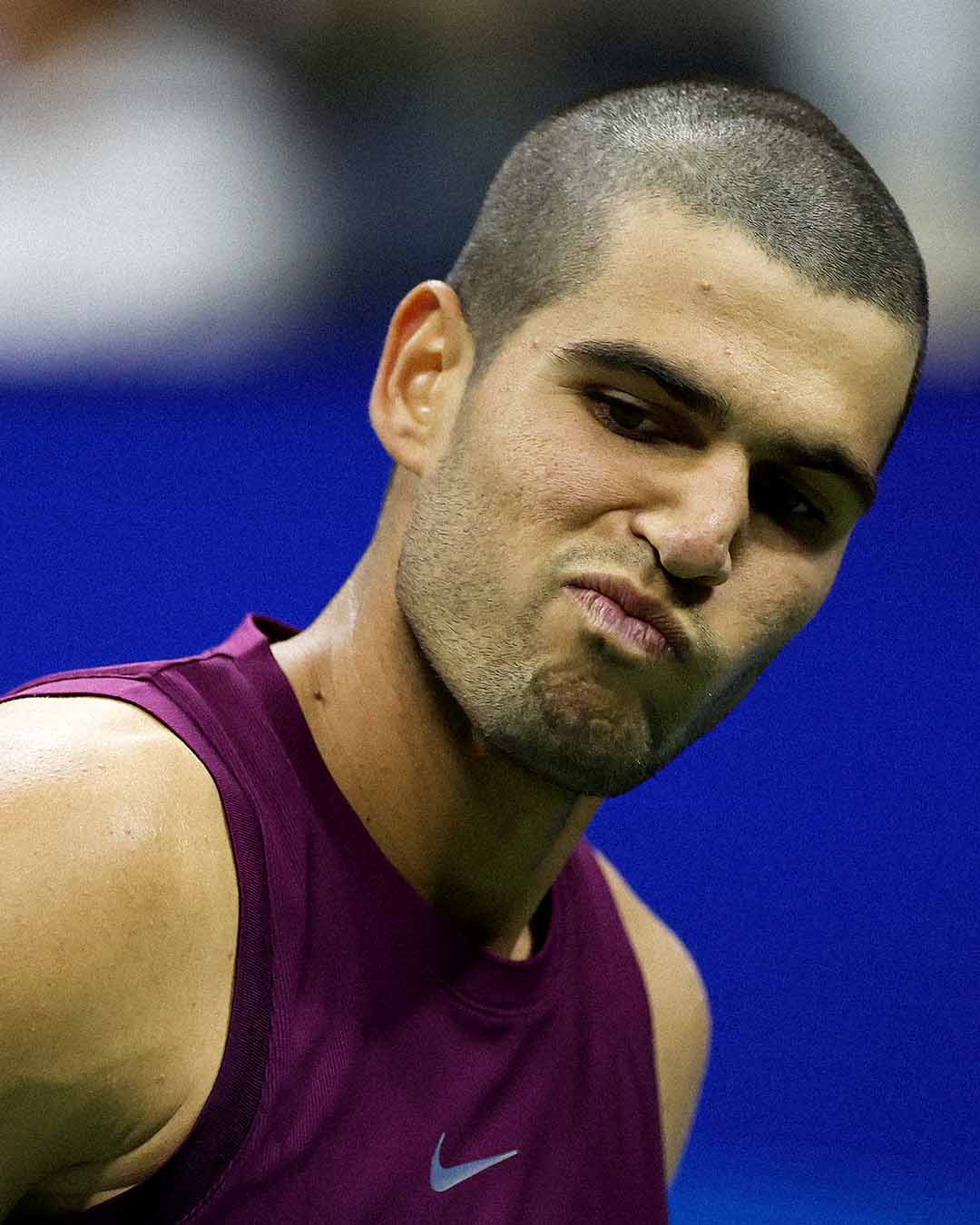
Carlitos mugs during his second round win at the US Open this week. // Getty
October 1 marks the 50th anniversary of the famed “Thrilla in Manila,” a brutal slugfest won by Muhammad Ali after Joe Frazier didn’t come out of his corner for the 15th round. It concluded the greatest trilogy in boxing history, still talked about with awe even though both the Greatest and Smokin’ Joe died during the Obama era and the sport itself has barely gotten up off the public consciousness mat since the previous century. There remains something particularly scintillating about an epic mano a mano best-of-three that goes the distance because the competitors, actual or metaphorical heavyweights, know each other’s styles and tendencies, strengths and weaknesses, equal beauty in the athletic ballet and the war of attrition.
Which is why everyone on tennis earth—even, I’m guessing, some of the actual men’s players currently in the US Open—wants to see Carlos Alcaraz and Jannik Sinner enter the ring on Sept. 7 for the “Clash at Ashe,” which would indeed crown the No. 1 ranking. If it happens, the hype machine will kick into overdrive, bringing along two new books with it. The first one you may know already, Changeover by The Second Serve’s own Giri Nathan, a fantastic, propulsive, deeply considered look at the Sincaraz phenomenon.
The second tome is Being Carlos Alcaraz: The Man Behind the Smile by British writer Mark Hodgkinson, an early career biography of the 22-year-old five-time Grand Slam champion. Hodgkinson works as quickly as Carlitos goes baseline-to-net. His last book, Searching for Novak, came out just over a year ago. I didn’t care for it at all, but I will concede it was probably doomed from the outset given the subject/writer pairing. Hodgkinson has ghostwritten columns for some of tennis’ biggest names, has coauthored workout books with English movie stars and their trainer, and consults for sports brands in the U.S., Europe, and Japan. It isn’t a knock to say he doesn’t approach book-writing with the same critical rigor as a dyed-in-the-wool reporter, which is his chosen bailiwick, and fair enough when it comes to the fun-loving human labradoodle Carlos Alcaraz. Uttering nary a negative world about Carlitos is nowhere near the credulity of taking Novak and his people’s self-serving rationales for his self-induced trials and tribulations. Sure, the descriptor “humble” grew tiresome in Being Carlos Alcaraz, but it isn’t the uncut unctuousness of Djokovic acolytes comparing him to the literal Lord and Savior. And I say that as a devout nonbeliever.
It’s important to understand that Hodgkinson’s book is as much a Carlitos brand extension as My Way, the streaming series the author uses as a primary source multiple times (e.g., Verbatim, page 41: “‘There’s no food in the world like my mother’s, let me tell you,’ he said in his Netflix documentary in 2025”). He doesn’t interview Alcaraz or seemingly anyone in the inner circle, but he does talk to people who are one step removed and have been around him at various times, so at least the effusiveness is spread around. Spain tennis luminaries like Antonio Martinez Cascales, founder of the Ferrero Tennis Academy, the rural once-bare-bones club where young Carlos learned the game, and Alex Corretja, a Roland-Garros finalist in 1998 and 2001, offer equal measure of insights and platitudes to make Being Carlos Alcaraz a pleasant-ish diversion. Although in the “Titanito” pecking order (“Little Titan” being excellent sobriqueting on Joker’s part), the Netflix romp offers firsthand on-camera interviews with the mega-joy and occasional furrowed brow from the young man himself and, of course, the accompanying highlights best seen to be believed.
There are a few key moments where Hodgkinson leans into the matches and the book jolts to life. He intimates—always a soft touch, Hodgkinson takes no strong authorial stances—that as a phone-addicted Zoomer, Alcaraz plays “TikTok Tennis,” intentionally pulling off moves for the reels. It’s a concept my old, atrophying brain has trouble trying to fathom, but then again, so was his still mind-bending “pause in midair and go behind the back” shot against Sinner in the 2022 US Open quarterfinals. It pops up algorithmically ad nauseam this hard-court time of year, so maybe IG ball-striking is a thing those crazy kids are up to these days. It’ll be fun to ponder over the next couple of weeks, at least.
Hodgkinson delivers enough decent anecdotes to keep things humming along. My US Open enjoyment has been raised, say, 2 percent knowing Carlitos sent Nick Kyrgios to his “CCC” (his grandfather’s credo: “cabeza, corazon, cojones”) tattoo artist Joaquin Ganga, who inked up a Pokemon mural on the entirety of the mercurial Aussie’s back.
I was tickled to learn Alcaraz was in a WhatsApp with Spaniards from a Murcia junior circuit called “Open Promesas,” and that the Alcaraz family donated 1,800 used tennis balls to his primary school to mute the metal-chairs-on-the-tile-floor screeches. It’s charming in a small-town, neighbors-helping-neighbors way, and amusing because in the book it’s treated as an incredibly magnanimous gesture and not just cleaning out the dog-ball baskets. The chapter devoted to “Happy Tennis” and Alcaraz’s beloved toothy grin is also sweet and includes this banger of a Andy Roddick podcast quote: In reference to Alcaraz smiling during three 2024 Wimbledon match points against Djokovic, the sardonic Husker said, “That’s very offensive to people like me, who played in kind of a miserable, stressed-out state most of the time.”
(One major Hodgkinson annoyance, for the second book in a row, is how he repeatedly postulates that the wealthy global megastar at the center of the book doesn’t care about the money. It’s silly on its face, but it becomes downright insulting when the author details how Alcaraz picked up a seven-figure Saudi exhibition appearance fee to play in the controversial Six Kings Slam exhibition.)
As the “other” Alcaraz book to be released just in time for the Gotham major, Being Carlos Alcaraz understands, and completes, its own assignment. Readers will get to know the hombre detrás de la sonrisa on a basic, overly fulsome level, but it’s a solid Carlitos starter kit for tennis neophytes and precocious middle schoolers alike. For those who are familiar with his story, Being Carlos Alcaraz is best enjoyed as a book to thumb through during boring US Open stretches as we all collectively hold out hope for the “Gushing in Flushing.”
Brushing? Mushing? Crushing?… All right, I hear you. Vamanos!
PURE, ORIGINAL TENNIS — SIGN UP!

Coco Gauff vs. Coco Gauff
Coco Gauff vs.
Coco Gauff
Coco Gauff vs. Coco Gauff
The American star is winning ugly at the US Open. But winning.
The American star is winning ugly at the US Open. But winning.
By Giri Nathan
Aug 29, 2025
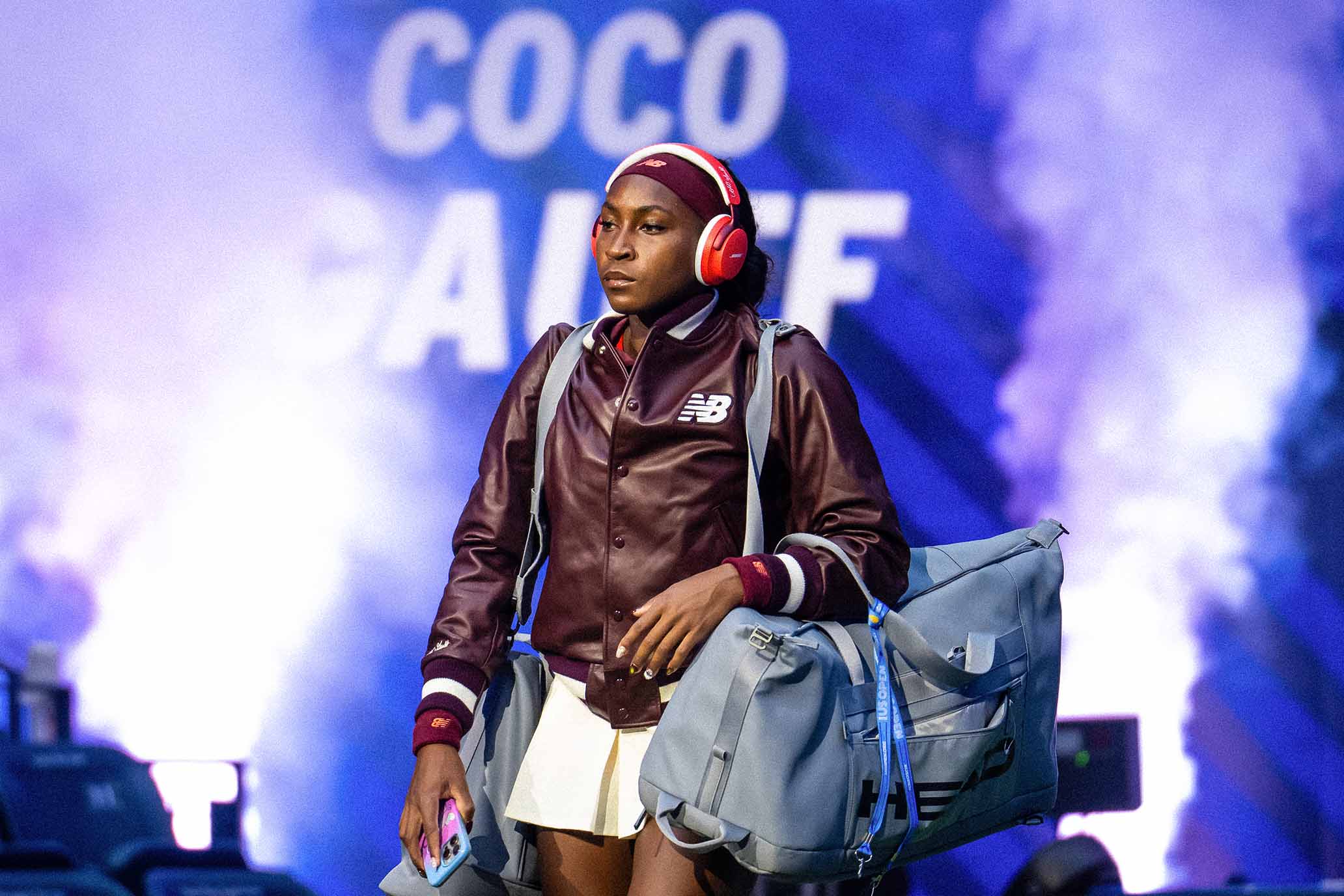
Coco Gauff walks on court for her second round matchup with Donna Vekic. // Getty
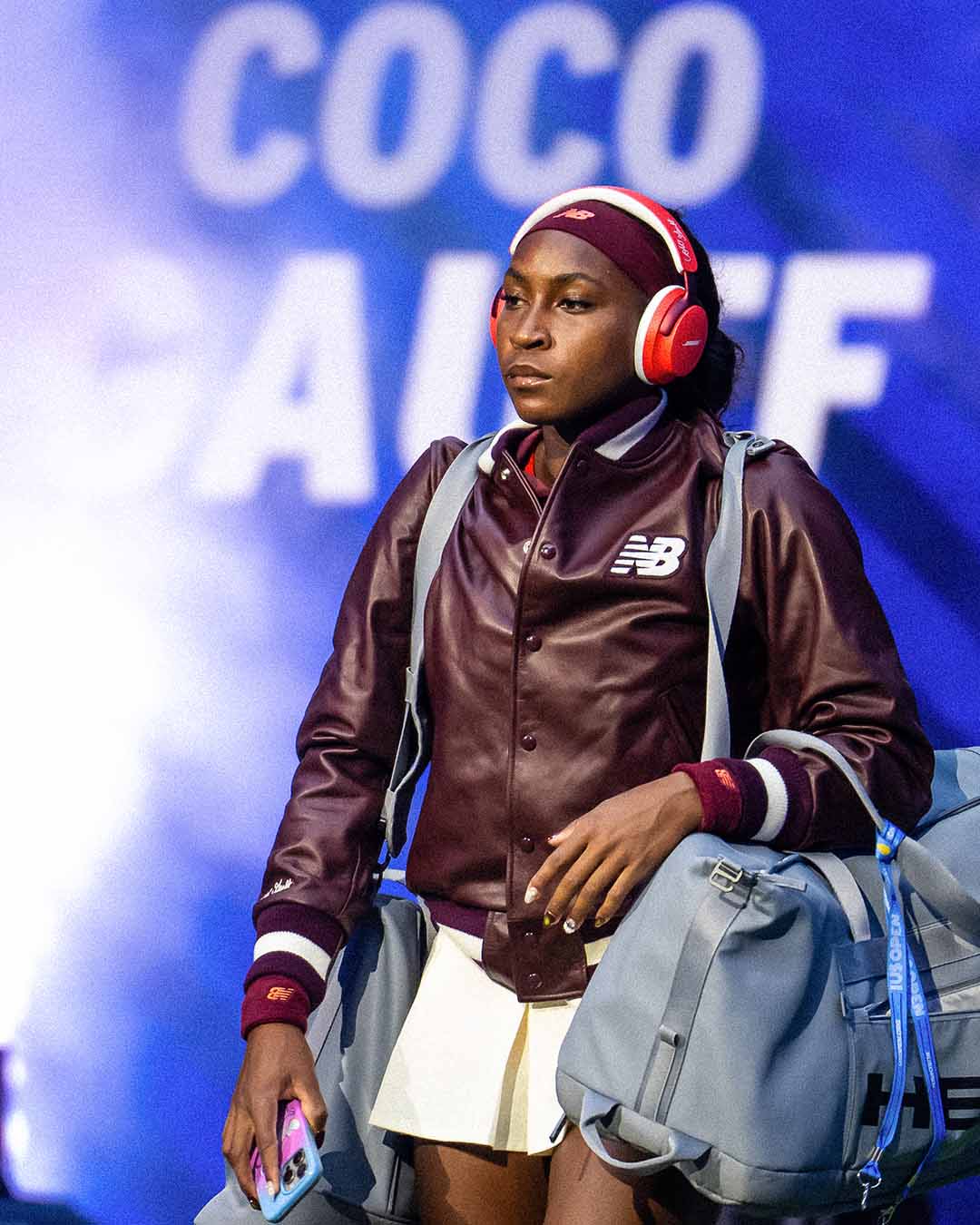
Coco Gauff walks on court for her second round matchup with Donna Vekic. // Getty
For me, the match of the US Open so far was Coco Gauff vs. Ajla Tomljanovic—which was also, to some extent, Coco Gauff vs. Coco Gauff. Which is why it was so compelling. Gauff is an all-world athlete and mental titan who holds two major titles at just age 21; she also happens to struggle with the two central shots of tennis, the serve and the forehand. And when those shots go awry, her matches can leave her fans white-knuckling. Sometimes a match is thrilling because of both the good tennis and the bad tennis it contains. It keeps you guessing which is coming next.
In that match on Tuesday evening, they played several of the longest and most spectacular rallies of the week, as Tomljanovic kept on the pressure with ingenious counterpunching. But lots of the pressure on Gauff was self-inflicted. You’d see her hitting an off-balance forehand off her back foot, and you’d know it’s going to land short in the court. You’d see that second serve ball toss go up, and you’d know that ball is fated for the net. In between those moments, you might also see some of the most fleet-footed defense you’ve ever seen on a tennis court. So it’s a little bit of everything.
Gauff returned to Ashe on Thursday to play her second-round match against Donna Vekic. Here her demon was, once again, the serve. She’s aware it’s an issue. In fact, just days before the US Open began, she hired the biomechanics specialist Gavin MacMillan, who had previously coached Aryna Sabalenka out of her crippling double-fault habit. Gauff was seen on practice courts receiving technical instructions, just ahead of the year’s last major. I imagine it’s a very tricky time to be in one’s head about technique. Whatever the cause, in her second-round match on Thursday, Gauff was broken four times in the first set, hitting seven double faults. She wept during the changeover after one of those breaks of serve. You might imagine that the atmosphere was tense and emotional.
I must clarify what it is actually like to sit in the lower bowl of Arthur Ashe Stadium during the night session, with beautiful, breezy late-summer weather, for a match starring the most beloved American player of the moment. All the elements are in place for an ideal tennis atmosphere. Instead the stadium is filled with an all-encompassing, dull murmur. Ten thousand lukewarm conversations taking place at the same time. The murmur continues during points, after points; it does not discriminate. It is totally indifferent to the tennis match happening below. It sounds like we are not in a stadium but rather in a large cafeteria, or hotel conference room. Sometimes the collective murmur is enough to drown out the sound of the ball. And what good is tennis without its tennis sounds?
It is the oddest atmosphere I’ve ever experienced on a show court at a tennis tournament. Even the fans seated just a few rows away from the hard court are prone to standing up, milling around, posing for photos during the rallies. I can’t remember when exactly it got this way, but it’s been like this for a while now. It feels like an unhappy medium. You get neither the pure silence of Centre Court nor the raucous environment of a normal non-tennis sporting event. You just get this purgatorial murmur. Sometimes I wonder if it’s an acoustics issue; sometimes I wonder if it’s a Honey Deuce issue. Probably a bit of both.
In any case, that’s the environment in which I watched Gauff will her way through a gutsy first set, before putting Vekic away more comfortably in the second set. And then, after the victory, and despite all my complaints I’ve just registered, Gauff started the on-court interview and…sincerely and effusively thanked the crowd. And even cried a bit! So what do I know? Maybe she’s detecting good vibes that I’ve been missing entirely. “I’ve had some tough moments on this court, and you guys pull me through each time,” she said. For the first time all night, with its teary champ on the mic, Arthur Ashe Stadium got loud.
PURE, ORIGINAL TENNIS — SIGN UP!
Peaks and Volleys
Mirra Andreeva’s Peaks and Volleys
Mirra Andreeva’s Peaks and Volleys
The teen will arrive at the US Open with neither momentum nor preparation. And that’s OK.
The teen will arrive at the US Open with neither momentum nor preparation. And that’s OK.
By Owen Lewis
Aug 22, 2025
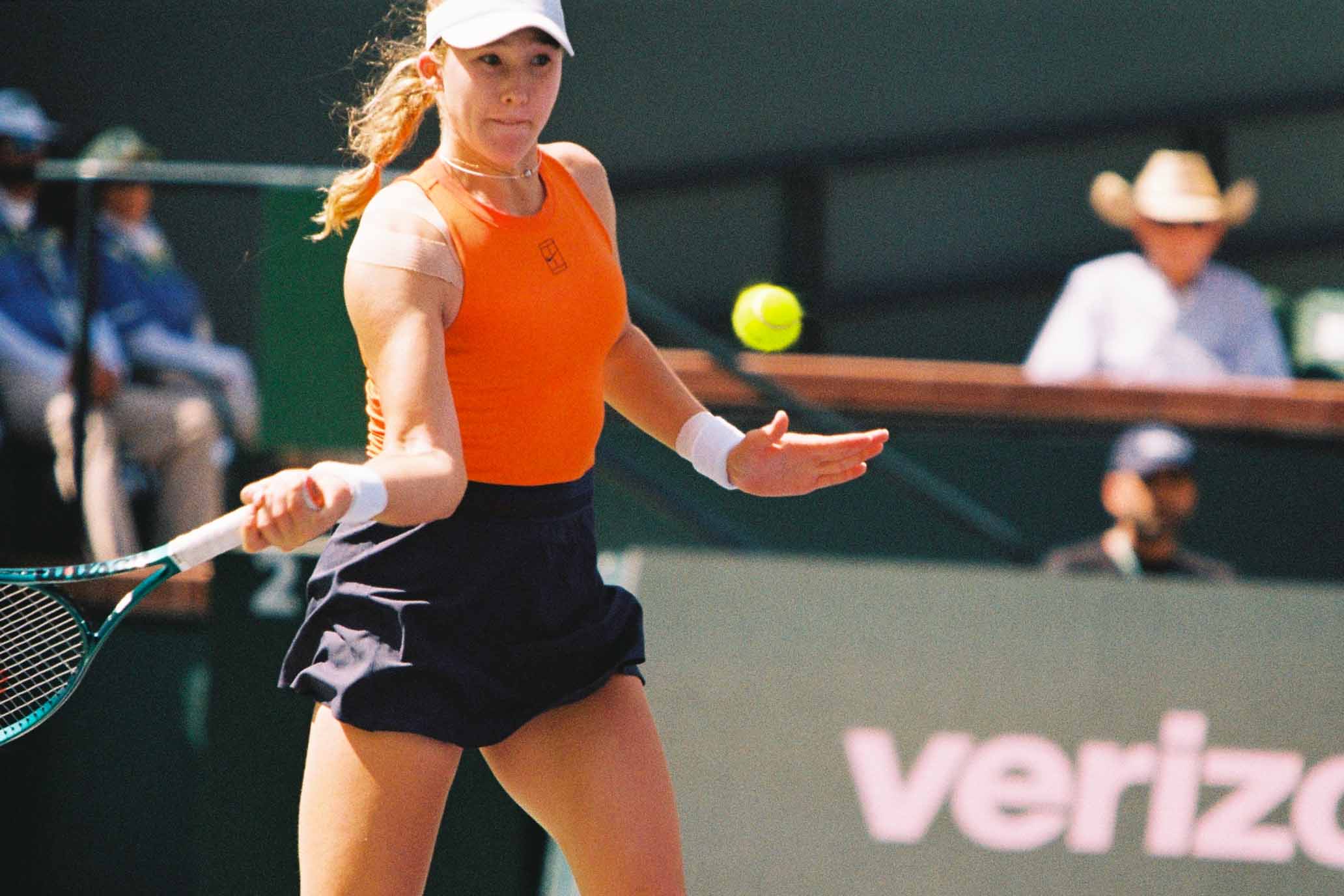
Mirra Andreeva. // David Bartholow
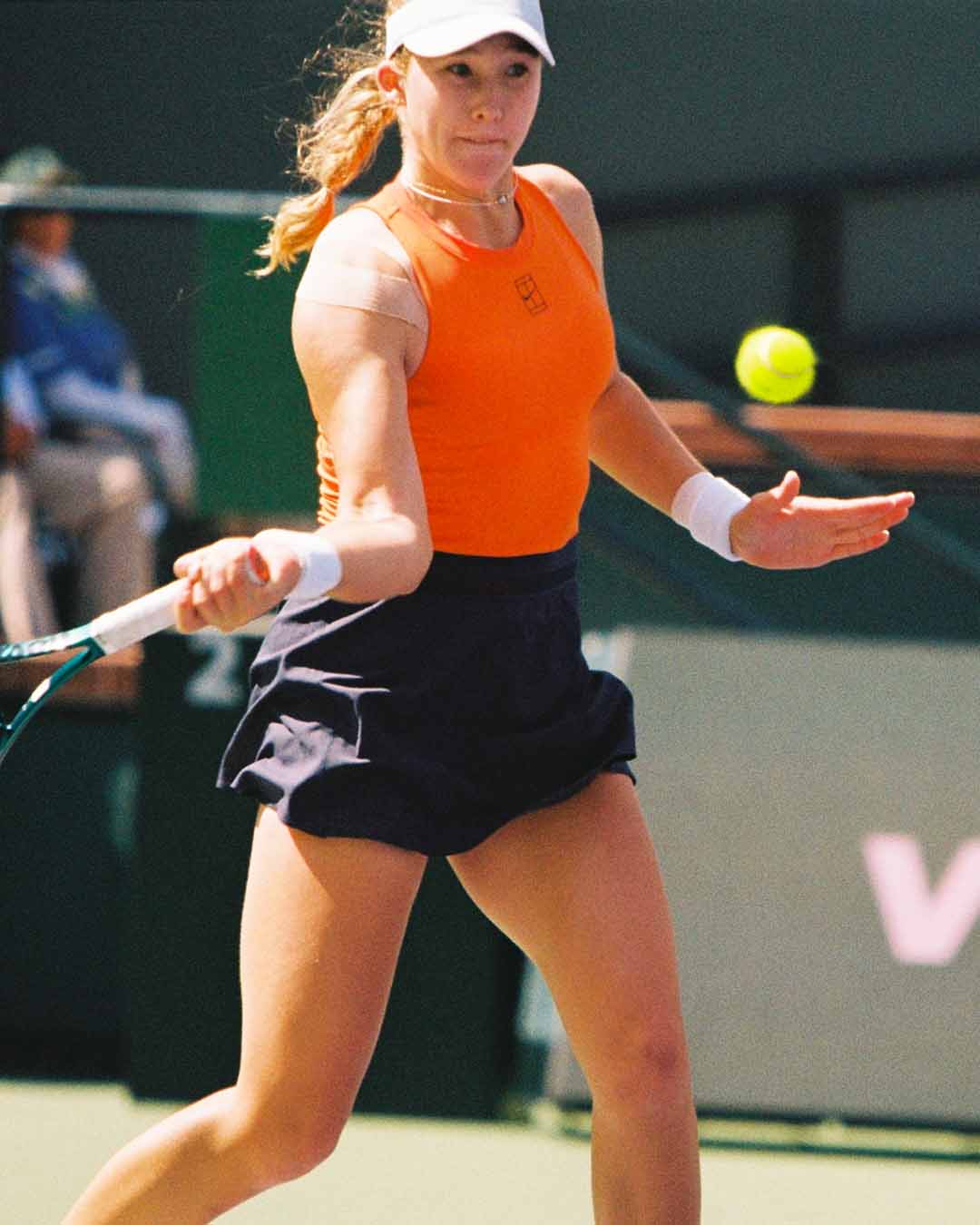
Mirra Andreeva. // David Bartholow
At 18 years old, Mirra Andreeva has already convinced me that when she strikes a lob, no matter how seemingly doomed the point of contact, it will always land in the most awkward imaginable location for the opponent. The first few times I saw her dive-bomb the baseline on the stretch at Indian Wells this year, I figured it was a purple patch. Nobody, not even Andy Murray, had the ability to hit those precarious parabolas with such precision and consistency. By the end of the tournament, I was already sold. Andreeva survived a second-set blowout to beat Iga Swiatek in the third. Her lobs tempted Aryna Sabalenka, the WTA’s most fearsome offensive machine, to smack forehands halfway up the net in the final rather than deal with another one. What couldn’t Andreeva do? I wasn’t sure if this devilish defensive work was calculated or instinctive, but the results were devastating.
After that obliterating triumph in the desert, her second straight WTA 1000 title of the still-young year, Andreeva looked ready to win a major. That defense could unravel the best offenses; Coco Gauff had won the 2023 US Open playing along similar lines. And at times, Andreeva would throw in blazing serves as fast as 126 mph—what?—suggesting that she hadn’t even scraped her ceiling yet.
Since, though, her results have stagnated. A spectacularly sloppy Miami loss to Amanda Anisimova was easy to look beyond; I’d petition to unilaterally ignore the result directly after a taxing tournament run. The BOSS Open, at which Ekaterina Alexandrova crushed Andreeva, didn’t seem sufficiently important to read into. A 7–5, 6–1 defeat to Gauff in Madrid raised an eyebrow: Andreeva had served for the first set, had set points, been broken, then won only one more game. Gauff beat her again in Rome. At Roland-Garros, Andreeva stormed to the quarterfinals without dropping a set. She met home favorite Lois Boisson, who was playing with unanimous crowd support but couldn’t match Andreeva’s complete game. Andreeva, though, buckled under the ferocity of the support for Boisson and lost in straight sets.
It was around then I started thinking that 18-year-olds should not necessarily be subjected to the intense atmospheric pressure at the top of the tour, prodigious talent or not. The forehands and backhands might be there, but what teenager could possibly be prepared for week-in, week-out travel, unrelentingly cumulative physical strain, grass courts, a French audience? In the first quarter of 2022, after Carlos Alcaraz became famous but before he consolidated his obvious talent into big titles, I had the gall to wonder why it was taking him so long. (He set various age-related records that year, won the US Open, and reached No. 1 in the world.) The game was so clearly ready. But teenage players have to worry about being a teenager as well as building a tennis empire.
My friend Vansh Vermani recently suggested to me that the challenge of improving at tennis is akin to ascending a skyscraper first via elevator, then stairs. Talent enables players to take the elevator at first, as far as the halfway point of the building for the most naturally gifted. But due to the structure’s architectural nature, that’s where the elevator tops out, forcing everyone onto the stairs beyond that point. The high stairs are where you’ll find players with perfect baseline games trying to refine their touch, former world No. 1s cooking up ways to get back at the rival who unseated them, hard-court experts translating their movement onto living grass and shifting clay. Even Novak Djokovic is there, now steadily sliding back down after topping out near the building’s apex at his best, stubbornly trying to ascend the steps labeled “reliably beating Rafael Nadal on clay” and “coherent overhead smash.”
Andreeva, to me, disembarked from the elevator after that remarkable Indian Wells run and has been adjusting to the stairs ever since. At the National Bank Open in Montreal, Andreeva failed to win the first set of her match against McCartney Kessler despite leading by a break four separate times. (Even more surprising than that, two of her lobs landed out during the tiebreak.) In a rare moment of imperfect coordination in the second set, she chased a Kessler backhand and couldn’t get there, then took a tumble and came up with an ankle injury and a good cry. She looked like a kid having an awful day. She fought through it to a straight-set loss, then pulled out of Cincinnati.
Andreeva may not be skipping steps yet or even climbing them, but I’d argue these experiences are still valuable. Sometimes it seems more advantageous to peak later in your career rather than as soon as possible. Get there early and you might not know the ropes yet—Roger Federer lost to Rafael Nadal most of the time despite being ranked higher, Jennifer Capriati burned out quickly, Carlos Alcaraz still had the attention span of an over-sugared toddler, Iga Swiatek faced magnified pressure. Jannik Sinner might have been flailing against top players while Alcaraz broke out, but Sinner’s current reign at No. 1 is smoother than Alcaraz’s ever was. Maybe what looks robotic now is just maturity.
What if it pays to eat all the shit before you reach your peak? Say Andreeva had won Roland-Garros on top of those WTA 1000 triumphs earlier in the season. It would have been remarkable, but the attendant rush of fame and obligation might also have sparked a deeper slump than what we’re seeing now. Emma Raducanu seems, finally, to be emerging out from underneath the deleterious effects of her teenage triumph at the 2021 US Open. Winning a major that young may not be worth it if the price is a three-year recovery period.
Andreeva will arrive at the US Open without momentum or preparation outside a brief mixed-doubles run with Daniil Medvedev (though the lack of expectation might prove helpful). She’ll have a distant chance to win it all and a golden opportunity to learn, to feel, to grow. Those things taking time doesn’t mean Andreeva can’t end up right where she wants to eventually, like her lobs.
PURE, ORIGINAL TENNIS — SIGN UP!
Changeover
Damage Control
Damage Control
Excerpt: Changeover: A Young Rivalry and a New Era of Men's Tennis.
Excerpt: Changeover: A Young Rivalry and a New Era of Men's Tennis.
By Giri Nathan
Aug 19, 2025
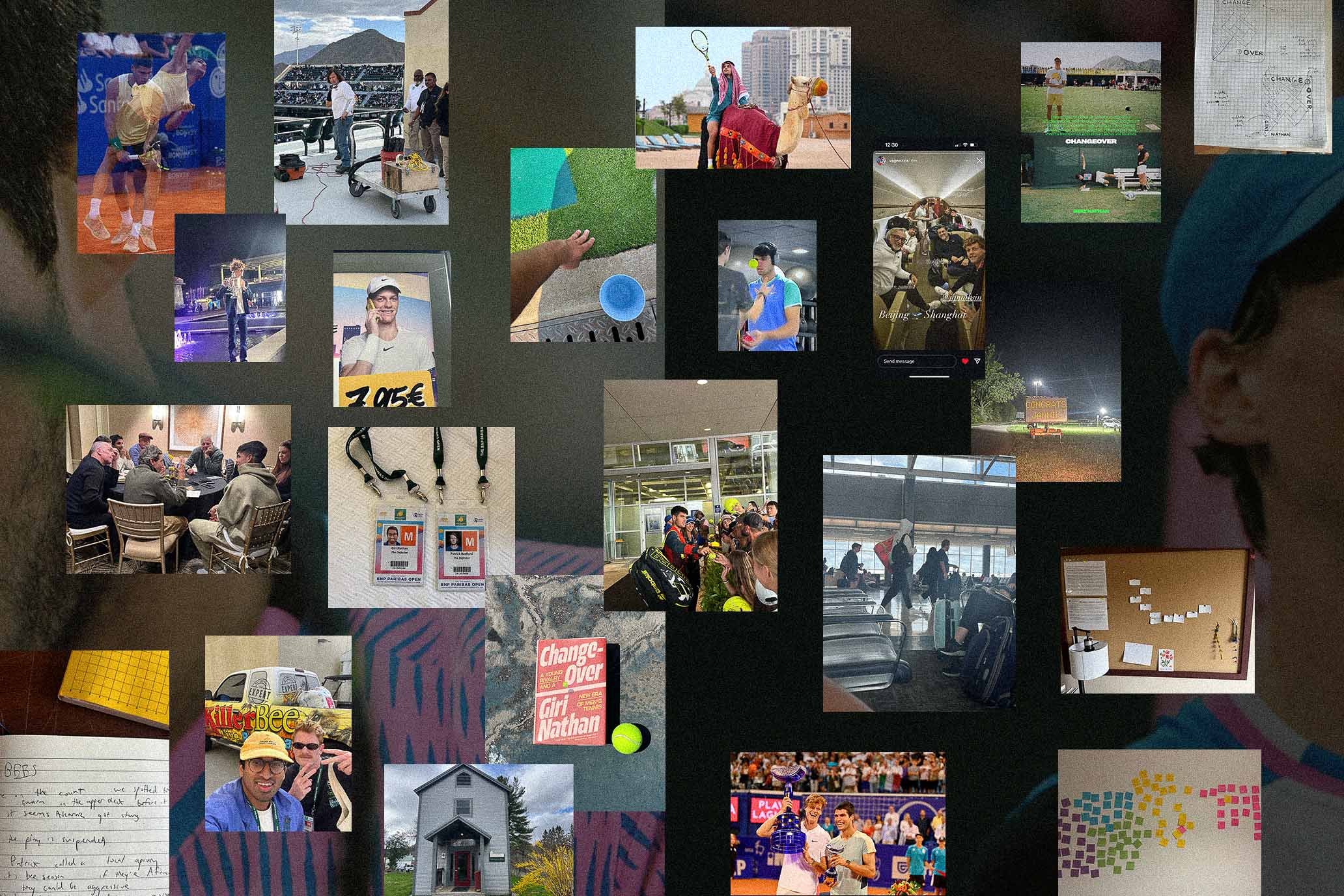
Giri Nathan's mood board for Changeover.

Giri Nathan's mood board for Changeover.
These days, to talk to a player in a truly relaxed state, you often have to catch them at the outset of a tournament, before the churn and toil begin. That hasn’t always been the case. The membrane between journalist and player was more permeable back in the day. The veteran tennis journalist Jon Wertheim told me that at the turn of the millennium, he could speak to Venus Williams privately for half an hour in the middle of a tournament; my eyeballs plopped out onto my keyboard. Curry Kirkpatrick, who wrote fizzy profiles of players for Sports Illustrated throughout the eighties and nineties, told me stories about ambling up to Andre Agassi at a swimming pool and bickering with John McEnroe on a walk after he’d written something not quite to the hothead American’s liking. The notion of a player today submitting themselves to the critical eye of a journalist, for meaningful conversation, was essentially unthinkable. Tournaments have whittled away the zones where players and writers could commingle. Storytelling is consolidated in the hands of the players.
Sports media is dead; most of what’s left is window dressing for online sports gambling firms.
Print journalists have become unnecessary middlemen for athletes who can instantaneously transmit their idle thoughts to fans on social media. To expand his popularity, a player relies not on a ferrety writer, but on a well-cut highlight reel or a high-end photo shoot. I understand the calculus: When your own time becomes so valuable, why give away access to your life story for free? There has to be something in it for them, too. A brief, canned sit-down interview might be an acceptable cost to promote a needy sponsor, or to secure a sumptuous cover shoot, which yields photos that can be tossed on Instagram to slake thirsty fans. The image has fully stomped out the written word in sporting culture, if not culture full stop. Players with enough clout can even partake in another current pastime: the hagiographical docuseries, where the player gets full editorial veto power. As noted, Netflix cameras trailed Alcaraz for chunks of the 2024 season. What we lose, in this new media ecosystem, are the thornier narratives that the players themselves don’t want to share.
Aside from this broader societal shift, there’s also been a tennis specific shift: The athletes have gotten a lot more sophisticated about whom they hire for their “team.” Top-ranked players have become business executives, constantly hiring and replacing personnel. Typically, the team consists of the following. There is the agent, to secure the endorsement deals, sponsorships, and appearance fees. The coach, to hone tactics and technique—sometimes two, with different emphases, as Sinner has in Darren Cahill for the bigger picture and Simone Vagnozzi for the fine details. The strength-and conditioning coach, to keep nudging the body toward its optimal state. The physiotherapist, to help a banged-up body recuperate after matches. There might also be a sports psychologist and a nutritionist. Much of this staff travels the world with the player, and unlike in team sports, where a franchise handles the overhead, players have to pay their employees out of their own earnings. In a 2021 interview with Sports.ru, Andrey Rublev estimated his annual expenses were about $600,000; even that was on a down year for travel, and more than a few players have an even larger full-time staff than his.
The rapid expansion of the player team is a consequence of rapidly increasing prize and sponsor money in the sport. The titles won them glory, and the agents leveraged that glory to win the player even bigger checks. Winning Roland-Garros in June, for example, earned Alcaraz €2.4 million from the tournament. But a few weeks earlier, he had signed a long-term contract with Nike that paid him roughly $15 to $20 million a year, according to the Spanish outlet Relevo. Sinner had signed a similarly structured Nike contract in 2022, about $150 million over 10 years, before he had won much of note. The apparel companies were already flinging around the sorts of sums they had paid to the Big Three. In a famous round of corporate bidding, Roger Federer had been lured away from Nike to Uniqlo with a 10-year, $300 million contract. Even apparel companies outside of sport wanted a piece of the new kids. Sinner became an ambassador for Gucci, and in 2023 the luxury brand had to persuade Wimbledon to permit a brownish duffel bag that broke the tournament’s militant all-white code. The Italian’s leggy frame and glassy expressions hold up surprisingly well in the context of a fashion shoot. Alcaraz’s brawnier build, meanwhile, had him modeling underwear for Calvin Klein.
Armed with these bankrolls, the Big Three could afford to reinvest in personnel to help prolong their careers and earning potential. This became a new template for the present stars to follow. But as the tennis journalist Ben Rothenberg told me, young players ensconced in these huge teams can also become “siloed and isolated,” spending most of their lives around people on their payroll, marinating in a tour culture that is increasingly sterile. The personalities are becoming a little less freewheeling and inquisitive, a little more coddled and calculating. We cherish someone like Daniil Medvedev because he is an outlier to these trends. He seems to be one of the last people speaking his truth at all hours, sometimes to his financial detriment, always to our delight.
There’s a lull before every tournament called “media day.” Players have arrived on the premises, and they’re practicing, but not yet playing official matches. They are thus ripe to be turned into Content. They spend a decent chunk of that day recording clips that will be circulated on social media to promote the tour. Part of the day is set aside for journalists. Select players of interest are trotted out for a casual roundtable discussion, which at the Cincinnati Open was taking place in the dining area of a little golf club across the street from the tournament venue. These discussions, which were each set to last around eight or nine minutes, were also susceptible to starting eight or nine minutes early, as Sinner’s did; the player’s schedule overrules all others’. He popped into the golf club looking tanner than I remembered, as if his skin were bronzing to match his hair, and wearing a white-and-black hoodie that seemed like overkill for the 84-degree afternoon. He talked us through his summer of ailments—hip pain in the clay season, an unnamed illness at Wimbledon that left him woozy, the tonsillitis that knocked him out of the Olympics—and ended with a bit of Zen. “You know, sometimes you have to accept this.” The hip in particular had looked sketchy in his most recent match in Montreal, a loss to Rublev, where Sinner had been clutching at it for the better part of an hour. When I asked if it was still bothering him, he said it wasn’t, and he was “not afraid.”
But he wrapped up on a muted note, as if he just wanted to get some match reps in Ohio to get in shape for the imminent U.S. Open, the year’s last major.
In Cincinnati, Sinner and Alcaraz were the first and second seeds respectively and could meet in the final. Djokovic was still recovering from his Olympic bliss and would not play the role of the chaperone at the teen dance making room for the Holy Spirit between the youthful duo. Alcaraz showed up on media day in the boxy white tee that had become his pre-tournament staple, speaking fondly about the “epic” final he’d lost to Djokovic at last year’s tournament. Asked whether the suburban environs relaxed him, he laughed; this was still a 1000-level tournament, and he was fighting to end the year as the No. 1 player in the world, a race that Sinner still led despite Alcaraz’s rare double at Roland-Garros and Wimbledon.
Alcaraz was asked once again about playing alongside Nadal at the Olympics, and I was vaguely depressed to hear him recycle almost verbatim an answer I’d heard before. I felt for him, and for those trying to coax a tasty quote out of him. Every journalist seemed to want the Nadalcaraz doubles to have been a transformative experience for the junior Spaniard, and while I’m sure it was on some level, it might not have been the Yoda-like transmission of wisdom we hoped to depict it as. Again I was reminded that sports writing isn’t so much tracing the truth as telling a story with a satisfying shape. I could almost mouth the words as Alcaraz repeated what he’d learned from Nadal on court: “Sometimes when we were down, he was there in a positive way, talking to me like, ‘Well, right now they are gonna feel the pressure. We have to just stay there, putting some balls in, trying to get them in trouble.’ Some situations, some things that you probably don’t see—or is difficult to see—he sees very clear.” Alcaraz was always cooperative with reporters, and he didn’t switch on autopilot the way Sinner sometimes did. It was hard to blame a 21-year-old for reusing an old line. Maybe today’s players had reason to prefer recording breezy video clips about who the funniest or most handsome player on tour was, when the alternative was talking to us obsolete scribes with our little recorders.
Click here to order Changeover.
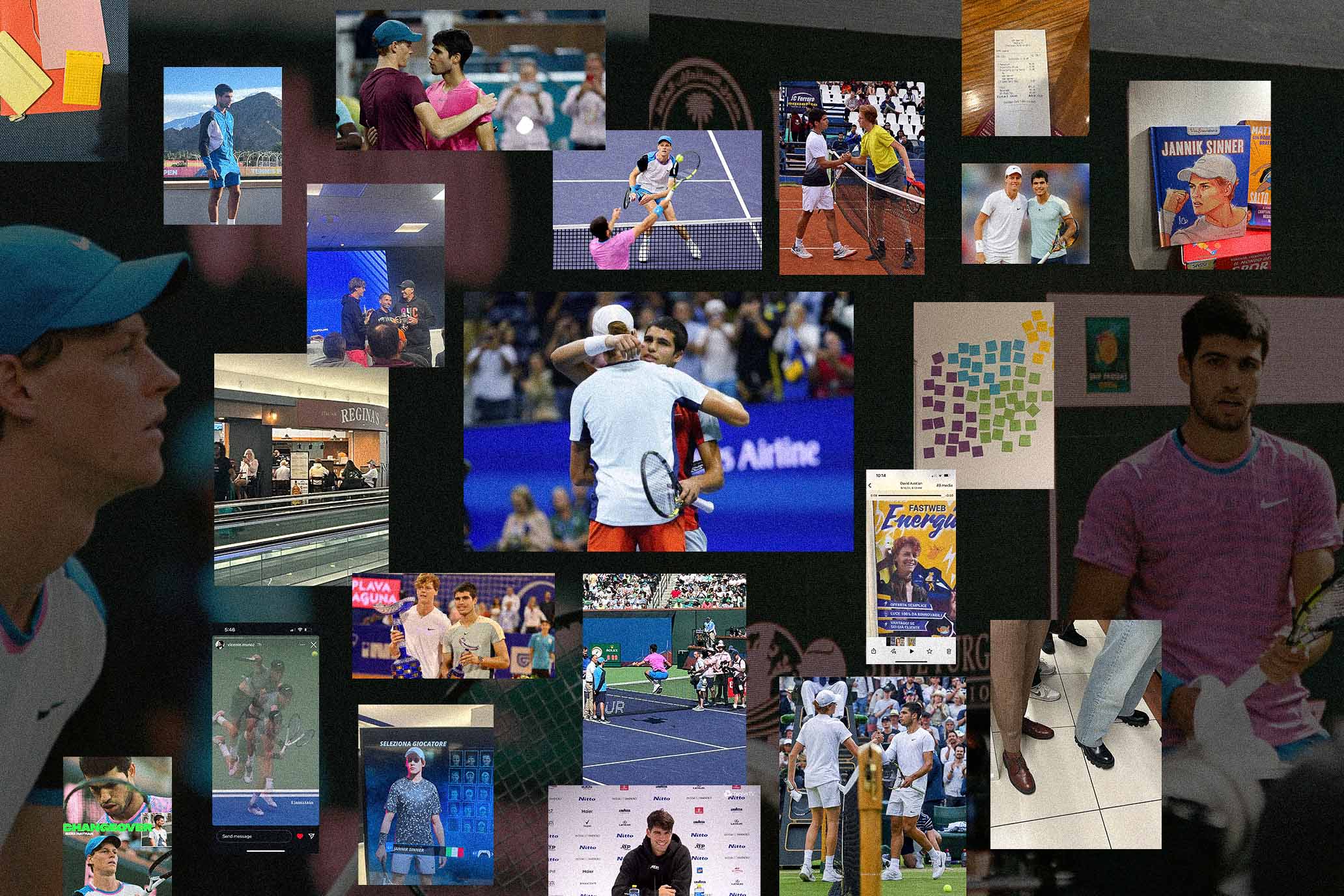
Giri Nathan's mood board for Changeover.
Giri Nathan's mood board for Changeover.