
The Kid Stays in the Picture
The Kid Stays in the Picture
Review: "Novak Djokovic: The Wolf in Winter"
Review: "Novak Djokovic: The Wolf in Winter"
By Owen LewisAugust 20, 2026
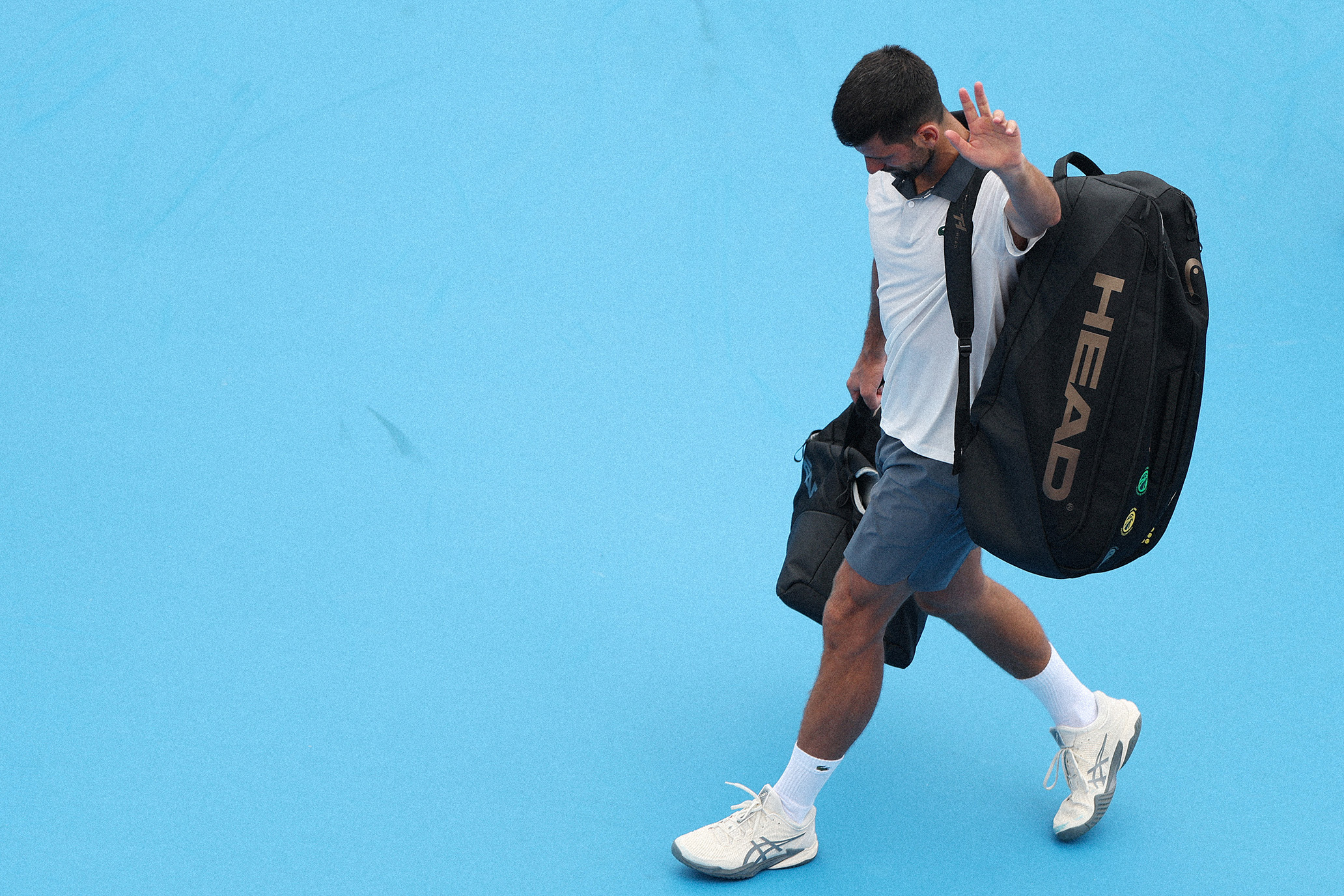
Novak Djokovic after his opening round loss to Thiago Agustín Tirante in Cincy. // Getty
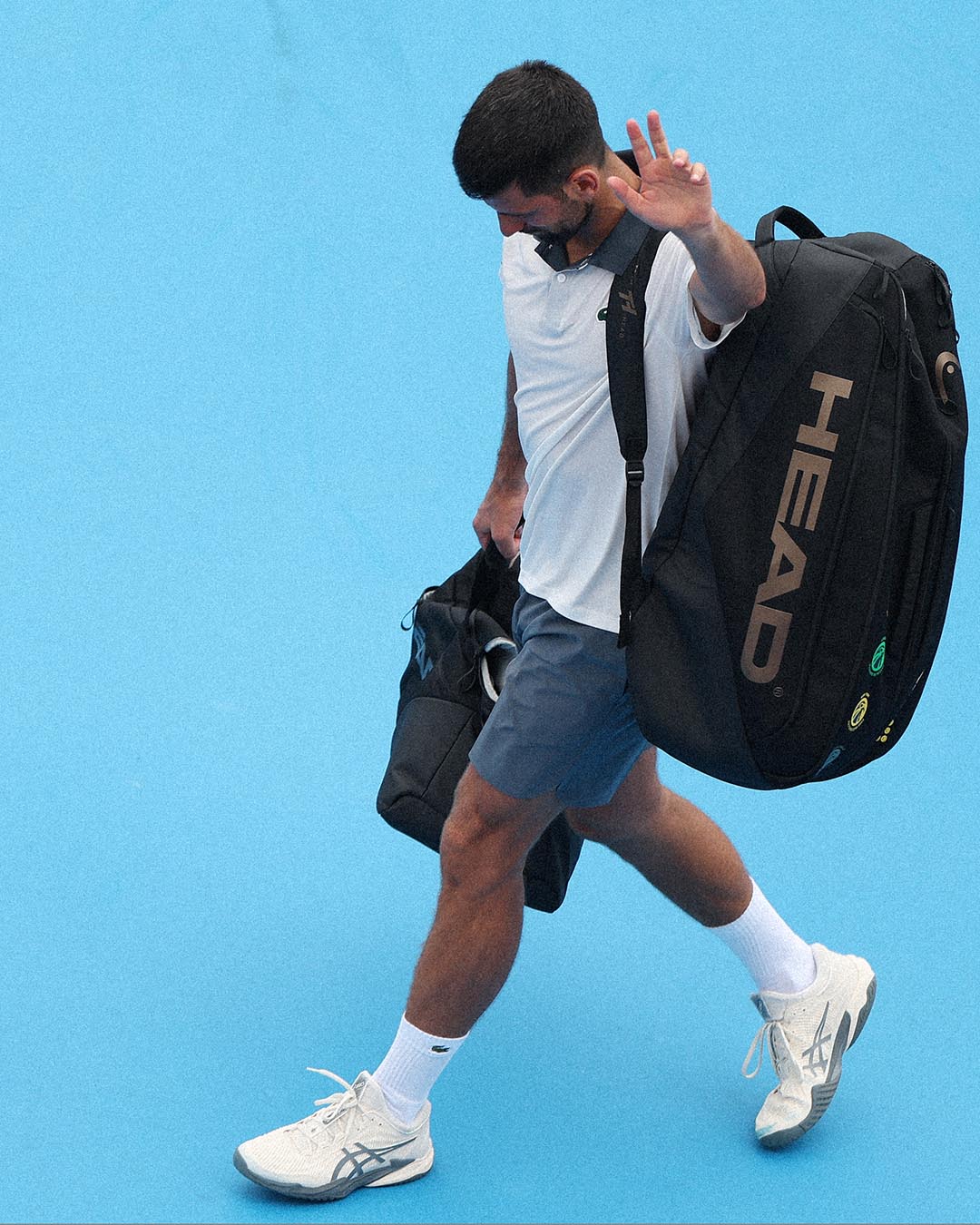
Novak Djokovic after his opening round loss to Thiago Agustín Tirante in Cincy. // Getty
It’s hard to write an ending to a good story. The plot twists, letdowns, happy surprises, and tear-jerking moments bear extra weight on the final act. All you can really ask for is a landing representative of the quality of what came before, which is a higher standard than it sounds like—the better and more complex the story, the more elusive the exit. I just finished reading the Attack on Titan manga, a breathtakingly intricate and violent story that left me completely floored at dozens of points over the 34-book series. The ending kind of sucked, and I’m not even sure if there was a way for it not to suck. I’m just grateful it didn’t ruin my perception of the whole work; my partner still gets venom in her voice whenever we talk about Lost.
So, Novak Djokovic. It’s pretty obvious he doesn’t know how or when to wrap up his legendary career. I speculated about his retirement more than a year ago, and it doesn’t feel like he’s any closer to calling it quits. He spent Saturday puking and ailing in a first-round loss in Cincinnati’s putrid heat. Seems like a pretty miserable way for a 39-year-old with a lovely family and hundreds of millions in the bank to spend his time, but call it the price of GOAThood. Asked whether he’d make it back to the tournament, Djokovic said, “I certainly hope so, but it looks more likely not, unfortunately.” Scalding my esophagus with the contents of my stomach often makes me want to return to the site of my torture, too.
All this is to say that the filmmakers behind the upcoming documentary Novak Djokovic: The Wolf in Winter were dealt a tough hand. I had a Zoom call with director Jason Hehir—of the renowned The Last Dance—on the 13th, and asked him if there was any topic that Djokovic didn’t want to touch.
“He was very reluctant to even discuss the notion of retirement,” Hehir told me. “The word itself, he bristles at it…. To the point where he said, ‘Why don’t you just take the word retire or retirement and replace it with the word longevity throughout the doc, and that’ll be fine.’ Which is obviously grammatically and logistically impossible.” Given the complexity of the story and the initial reluctance of the subject to hit on the theme of the documentary, the resonance in this film is hard-won.
We begin with Djokovic’s childhood. The beats are familiar to longtime tennis followers, but no less arresting in a visual medium. Djokovic, wielding a pink racquet as a child, looking like a young Kevin Arnold. Djokovic, answering questions with the seriousness of a judge at kindergarten age, understanding his role already. NATO’s bombs falling on Serbia. The old story of his father placing the equivalent of 10 dollars on the table and announcing it was all they had; his father asking Novak for total dedication. Djokovic telling a story of falling as his family ran from the bombs, his yells going unheard, looking around and seeing the bombs falling on a hospital. When we get to Djokovic gate-crashing the favored rivalry of the masses, Jelena, his wife, suggests that tennis mandated elegance. “Novak was not the chosen one,” she says. The subtext is legible: Djokovic going pro and making enough money to provide for his family is a success story on its own. In a sport with less of a Fedal fetish, that’s what might have defined his legacy to the masses.
The storytelling of Djokovic’s career is sure to ruffle some feathers. There’s nothing on the 2012 Australian Open final here, or the 2018 Wimbledon semifinal, or the 2019 Wimbledon final, or Djokovic’s disqualification from the 2020 US Open. Nadal appears as a talking head to attest that playing Djokovic is “very difficult” and that “you have to be at your 100 percent, and even then it might not be enough,” and says little else. There’s no insight from Nadal on the animalistic particularity of their battles, or any specific moments in their rivalry. There’s nothing from Federer, period. A passage on Novak’s prime is mostly narrated by journalists rather than Novak himself. His defense is heralded through generalities from Pete Sampras and Andre Agassi, overlaid onto his 2007 Miami win over Nadal—four years before Djokovic hit his defensive peak.
Hehir told me that his goal was to explore this precise moment in Djokovic’s career—no longer at his peak, but too good to retire—not to tell the story of the career as a whole. He didn’t reach out to Federer, and planned to include the 2012 AO final in a previous version of the doc. (“This doc went through so many iterations,” he told me. “Every time we thought we were done, he was threatening to win another major.”) So know these omissions were not made lightly, or out of ignorance. That doesn’t mean they were all necessarily the right move. The doc does dwell on Djokovic’s iconic match-point-saving return at the 2011 US Open, the one that reduced Federer to salty bafflement in press. Bringing back Roger—who, in Nadal’s doc, retains plenty of his faux-humble arrogance in retirement—and asking him about that moment, and Novak’s tennis, 15 years later, would have been fascinating. A Last Dance-esque format, extrapolating the story out over multiple episodes instead of a movie-length monolith, might have let Hehir explore both Novak’s career and his retirement predicament.
There are some revelations here. We learn that the line in Djokovic’s 2022 social media post that kicked off the deportation saga, drawing millions of eyes to Djokovic’s unvaccinated status—heading to Australia on an “exemption permission”—remained in the post because Djokovic insisted it was vital, despite his wife advising him to leave it out.
We linger on the deportation saga. Hehir gets a chance to ask what so many have wondered from the couch: “Why didn’t you get vaccinated?”
“I didn’t feel like I needed it,” Djokovic says, as if it’s perfectly obvious. “Why? Why should I get the vaccine? I’m healthy, I’m an athlete.” He goes on to say, “That fundamental right that you have as a human being on this planet, freedom to choose, was taken away from a lot of people on this planet.” He seems not to consider the infectious disease of it all, that it’s not just about him here, or the trypanophobic. He says the anti-vax movement made him an unwitting hero, but then he had to know how gleefully that group deals in bad faith, and the implications of him treating walking disease factory RFK Jr. like a buddy. (Also unexplored here is Djokovic’s role in the disastrous Adria Tour.) Look, it’s clear Djokovic was deported for political reasons rather than rule-breaking. But what’s most striking about this passage is how Djokovic lays out his vaccine philosophy with more conviction than anything else he says during the film. In fitting with the man’s many contradictions, he’s simultaneously at his least convincing.
There’s a fascinating bit after Djokovic’s heroic win over Carlos Alcaraz at the 2025 Australian Open, executed from a set down and through a hamstring tear. As he’s recovering, it’s clear the match shook something loose. The quotes come thick and fast: “Mentally, I’m at the stage where I’m almost losing my mind.” “The brain, it’s like it has had enough.” “I cannot enjoy.” “I cannot be 100 percent dedicated to tennis. It’s not my life anymore.” It’s at once an insight into Djokovic’s mortality and superpower. Throughout the documentary, Novak deems himself his harshest critic. His mind seems like an unpleasant place to be sometimes—all those emotions during often uncomplicated matches! But he’s uniquely capable of either rendering his performance unaffected by those emotions, or spinning them into a boon at just the right time. “He will find his way out,” his wife, Jelena, says of his retirement. “I don’t want to be the one telling him how.” At one point Djokovic muses on the topic himself: perhaps one more major, perhaps 15. He’s not smiling when he says 15. Maybe what’ll mark the exit for Novak is that ability to compartmentalize diminishing at some point.
This doc won’t blow up like The Last Dance, for all kinds of reasons. I’m not even sure it’ll convert many Djoko-haters into fans—the vaccine bits will go a long way toward sinking that ship. But it’s hard to imagine anybody watching it and not respecting Djokovic’s body of work, or, for that matter, the difficulty of navigating this last act. He has written a good enough story that the merits of its ending are as close to irrelevant as possible. Unfortunately, the one person with sufficiently high standards to disagree is the author.

PURE, ORIGINAL TENNIS — SIGN UP!
RECOMMENDED
Review: Coco Gauff’s “The Zina Effect”
FILM REVIEWS
Postcard from the Japan Open
JAPAN OPEN