Beyond Belief
Beyond Belief
What happens when elite players start to recognize their limitations?
What happens when elite players start to recognize their limitations?
By Carole BouchardJul 17, 2026
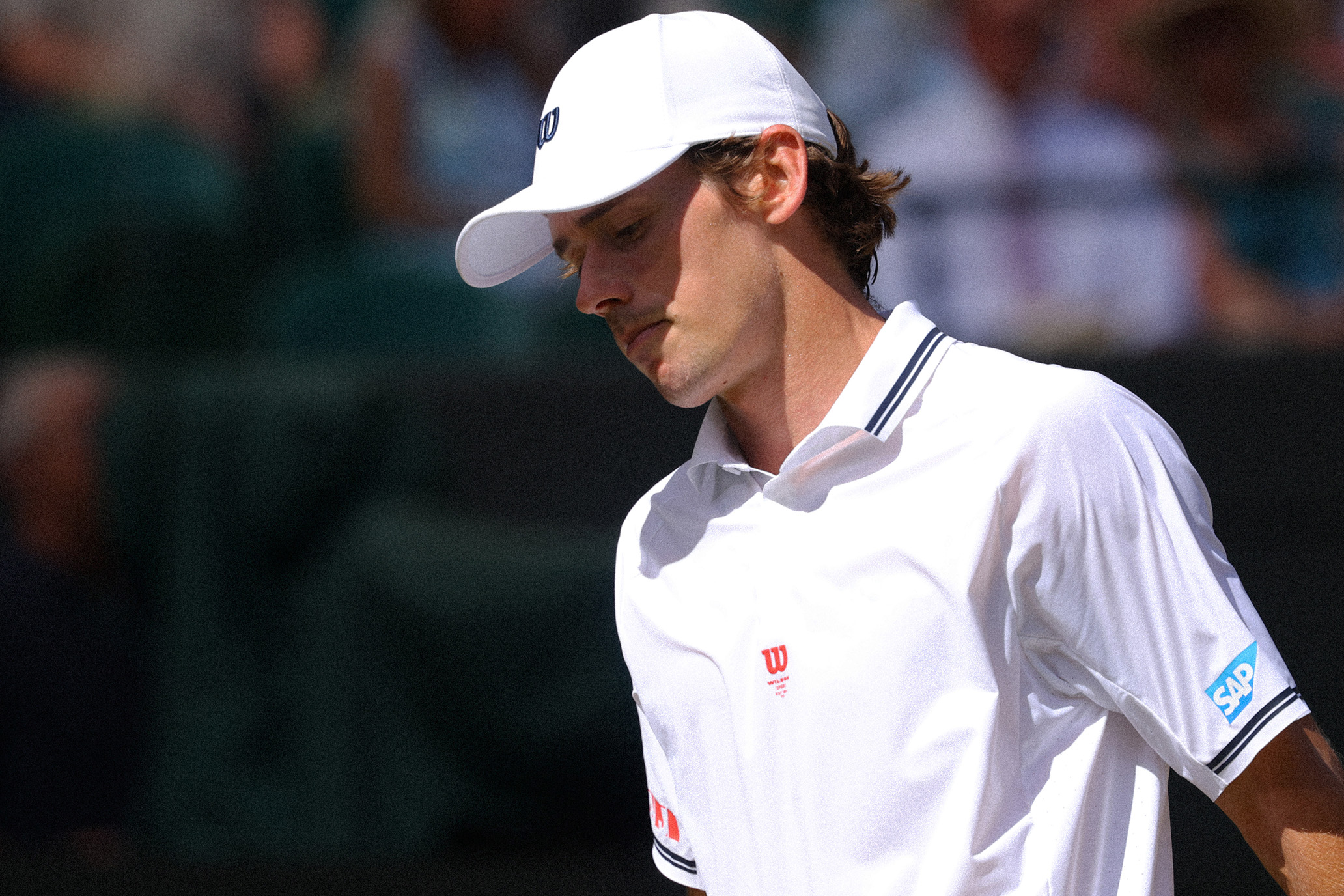
The Demon during his round of 16 loss to Flavio Cobolli at Wimbledon. // Getty
The Demon during his round of 16 loss to Flavio Cobolli at Wimbledon. // Getty
Alex de Minaur’s distress in London echoed Felix Auger-Aliassime’s broken heart in Paris, as the two top players wondered aloud about their ceilings.
One of the most significant events of Wimbledon 2026 didn’t happen on the court; it happened in Interview Room 2, when Alex de Minaur met the press after losing in the fourth round to Flavio Cobolli. Shattered, he gave the stage to the little voice in the back of his mind that every top player tries so hard to silence. The Australian couldn’t take it anymore, so he uttered the words that had clearly been haunting him.
“You feel there are opportunities to be taken to make it to the next level, to become an even better version of yourself. And to fall short constantly, you start doubting yourself. You start doubting whether you’re going to be able to break through. As much as I’m in a great position, the fact that I want more and I’m not able to achieve more is a battle that I deal with every day. The goals, the beliefs, the dreams that you have, they start fading away, or feel a little bit further away than when they once were.”
It is an extraordinary statement, as you never hear a top-five player like de Minaur publicly say he’s scared he might have gone as far as he is capable of going, wondering if he has what it takes to achieve every top player’s dreams: winning Grand Slam titles and becoming world No. 1. I’m not even sure many allow themselves this kind of epiphany even privately. And yet it felt like he needed to get it off his chest. It, of course, matters to listen to the Sinners of this tennis world talking about how they achieve their dreams, but it also matters to see how those who don’t get there cope with it.
De Minaur’s statements were even more notable because they echoed what Canadian Felix Auger-Aliassime said in Paris after losing in the quarterfinals against, yet again, Flavio Cobolli. “I’m in a place right now with my tennis career that it’s tough. I’m a little bit destroyed. My whole career, I was going back to training with optimism and positivity. Now I feel like I’m not the player I want to be. I’m growing more and more impatient. I’m 26 this year, and I’m not improving the way that I wish.”
Every other week, a player talks about wanting to or needing to get better every day to become the best version of themselves. It has gone from desire to injunction. The only way is up. You should always strive for more. Treat winning and losing the same way. And repeat. Everybody is chasing the version of themselves that will propel them to the top of the game. After a certain point it becomes less about doing the best you can within the frame of your abilities, but about somehow becoming more Superman than Clark Kent. Perhaps their generation is paying the price of taking inspiration from the Big Four instead of recognizing that era as the magnificent anomaly that it was. Yes, they kept improving and made the impossible possible, but treating their genius like common law is a road to disappointment for mere mortals.
For de Minaur and Auger-Aliassime, this is the friction point right now. Nobody dares say it. We’re in the manifesting era, so it would be a faux pas to table those kinds of sentiments. But what if the player they are now is the best version of themselves? What if they already got better every day until today, and that’s it? What if that’s as far as they’re going to go? What if they’ve met their ceiling and need to reframe the expectations and how they view their career?
Should they pack their things and go home? Surely not. Some players make peace with that and just keep doing their (very lucrative) job. By relaxing a bit, sometimes they end up achieving something huge right when it didn’t seem in the cards anymore. Others, like the Australian and the Canadian, will try to prove these odds wrong until they’ve used every drop left in their body and mind, because another voice keeps telling them they still have a shot at these dreams. And because they’ve reached a place so close to the sun that they can nearly feel the metal of that major under their hands. Tennis without these dreams is not what they’ve signed up for.
They’re also so good that there’s no way anyone can tell them they won’t make it. They’re the ones who, if stars align, could at least once touch their dreams. It’s the toughest spot to be in. The very wise Coco Gauff is known for often saying that at this level of the sport, to keep going and believing, one needs to be delusional. It’s either this or accepting to downgrade the expectations. The latter seems such a logical choice, right? But what about the players who cannot envision their careers without these expectations? If it’s the only thing that makes them pick up the racquet or go shed sweat and blood in the gym, then there’s gonna be no downgrading option.
“I was the young player very much awaited. I was also, at times, the player a little forgotten, in a few more difficult years. And then I’m a little more awaited again,” said Auger-Aliassime in London. “Now, with hindsight, it’s true that I know that every time, no matter the result, I’m going to have to keep being better than I am today. Even if I win this Wimbledon, I’m going back to training. At some point, I’m going to go back and try to be an even better player. That’s all I know. That’s really all I’m controlling. I’m someone who, deep down, is very emotional, and losing like that in the quarterfinals [in Paris] was very difficult, but two days later, I was really in solution mode and really focused on the future. So it’s true that today, again, I’m an eternal optimist.” FAA reached the quarterfinals at Wimbledon and played this epic match against Novak Djokovic. He left crushed and empty, but more hopeful than after Paris, and revealed he had ended his decade-long collaboration with coach Frédéric Fontang.
The limit is the moment these sky-high expectations turn into an obsession or the scale by which players measure their value as a person. “It hurts like hell now. But I’ll get back up,” swore de Minaur. “I’m a competitor through and through. I’ll give myself another chance. I just want it to happen to keep giving me that hope. If not, this is a tough, tough sport to play with no hope.” And so they look at the ceiling they’ve acknowledged for the first time and search for another path to the sky.