
Czech Mate
Czech Mate
For Czech players, whatever is needed, that’s what’s available.
For Czech players, whatever is needed, that’s what’s available.
By Joel DruckerPhoto collages by Dakarai AkilOriginally Featured Volume 3 of OPEN Tennis — BUY
Czech Mate
For Czech players, whatever is needed, that’s what’s available.
By Joel DruckerPhoto collages by Dakarai AkilOriginally Featured Volume 3 of OPEN Tennis — BUY
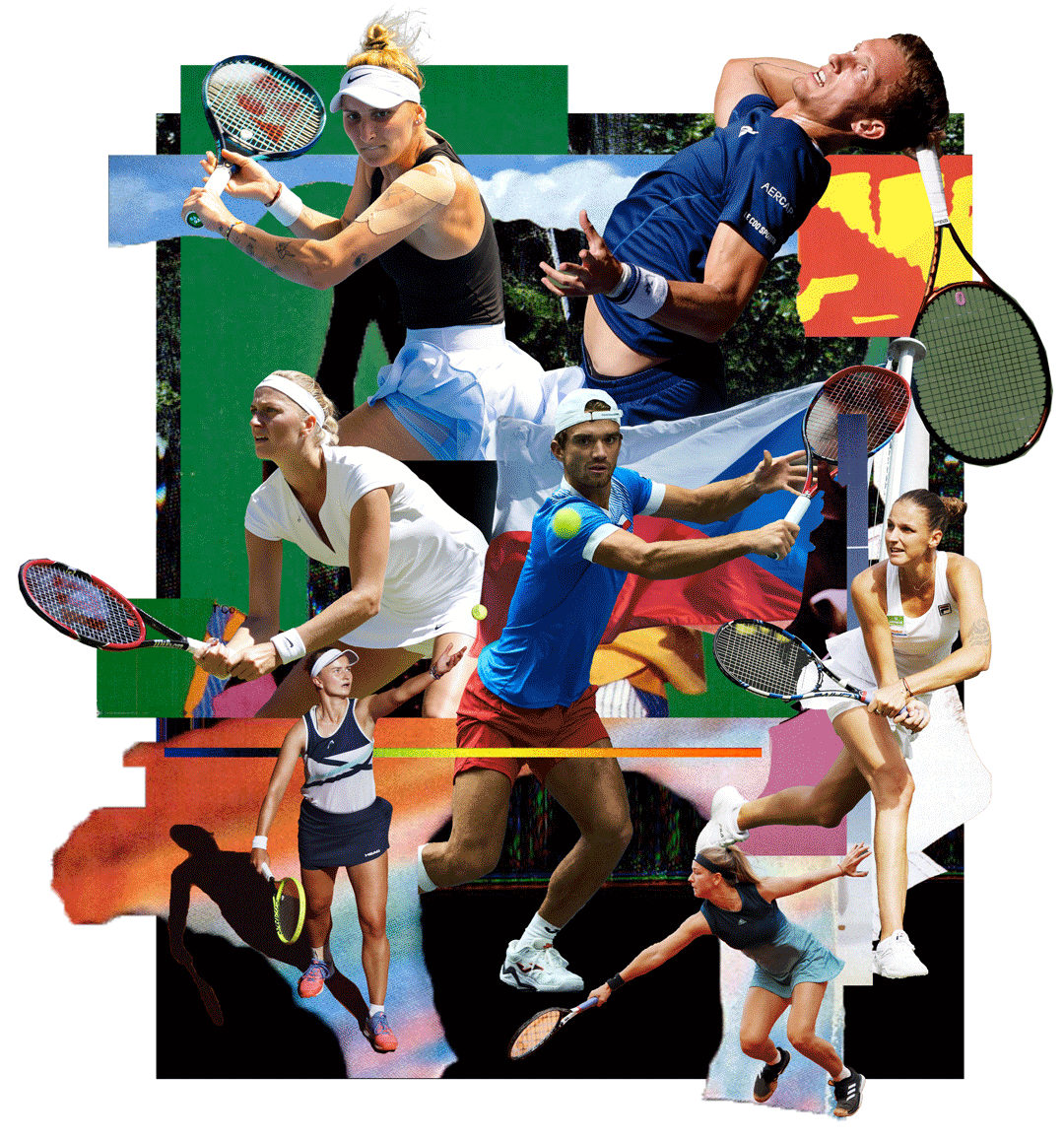
Czech legends, then and now. // Photo collages by Dakarai Akil.
Czech legends, then and now. // Photo collages by Dakarai Akil.
A common occurrence at pro tennis practice sessions is the sight of a coach, hitting a serve, again and again, to the same spot. Across the net, the pro blisters one return after another, also repeatedly to the same spot. As many a tennis coach will tell you, repetition is a vital attribute on the path toward competing effectively.
But on this Sunday morning at the Indian Wells Tennis Garden, a few hours before she plays a match at the BNP Paribas Open, Karolina Muchova has approached the return drill quite differently. A serve comes to her backhand in the deuce court. Muchova lines one hard and deep down the line. The next is driven inside out. Then, an inside-out drop shot, followed by a down-the-line drop shot, another ripped with tons of pace, finally a deep slice.
Muchova’s wide range makes her an outlier in contemporary tennis, that rare case of a player adept at deploying various spins and paces, as well as exhibiting a hearty appetite for volleying. “I’ve always played this way,” Muchova told me later that day. “No one was trying to push me to play something that is not natural for me.”
There are many ways to assess Muchova’s playing style. Some might cite the word “variety,” implying that her breadth constitutes a deviation from the forceful ground strokes that a contemporary aspiring pro should gain mastery of before venturing into such realms as various spins, volleys, and more. But might we also simply call this palette what one of Muchova’s compatriots has called “tennis, the way it’s meant to be played”?

A telling factor is that Muchova comes from Czechia, a nation filled with an exceptionally wide range of successful tennis stylists who light up the court with many shots. And, like many from that country, Muchova’s face reveals a distinct kind of detachment, a distance that’s quite relaxed, as if she were witnessing something other than herself in the act of a labor-intensive physical endeavor.
For one prior example of state-of-the-art detachment, consider the languid demeanor of the accomplished Slovak who represented Czechoslovakia, two-time Grand Slam singles finalist Miloslav Mecir. Graced with balance, footwork, and preparation so stealth-like that he could repeatedly direct balls either behind or away from his flummoxed opponents seemingly at will, Mecir looked so subdued you’d think he was standing at a street corner, calmly awaiting the arrival of a bus. Hall of Famer Mats Wilander, whose career record versus Mecir was 4–7 (including a loss in the 1988 Wimbledon quarterfinals that was Wilander’s only defeat at a major that year), has called him the greatest player to never win a Slam.
The slang term in tennis for what players like Mecir do is “hold the ball.” But what’s really meant by this is that the swing is delayed. The hectic, loud, and cluttered patter and volume often seen and heard during clinics and lessons is not part of the makeup of the Czech tennis culture. “For them, the racquet is like a sacred wand,” said Steve Stefanki, a former U.S. junior Davis Cup team coach. “It’s not about ‘go beat the guy’ with them. It’s about being relaxed, learning how to be surgical and have a relationship with both your body and the ball.”
It’s an approach similar to the one taken by the iconic martial artist Bruce Lee. As Lee once said, “When I attack, I always try to pause—stop action—to study my opponent and his reactions before going into action again. I include pause and silence along with activity, thus allowing myself time to sense my own internal processes as well as my opponent’s.” “It was hell,” Wilander once told a Reuters reporter about playing Mecir. “For me, it was hell because I couldn’t make him look stressed or rushed.”
Perhaps that pause is the trigger point for the balanced body work and eclectic styles of so many Czech players. As a start, consider the three who’ve won Wimbledon over the past 15 years. There’s 2024 champ Barbora Krejcikova, the early-career doubles wizard whose comfort in all parts of the court eventually helped her earn singles majors at Roland-Garros and Wimbledon. In 2023, Marketa Vondrousova, a rangy lefthander with an eclectic mix of spins and shapes, became Wimbledon’s first unseeded champion. And the 2025 US Open marked the retirement of another lefty, the more linear and powerful two-time Wimbledon champion Petra Kvitova.
Through the first few rounds, though, the ’25 US Open was a showcase of Czech breadth and depth. Vondrousova, Krejcikova, and Muchova all reached the quarterfinals. Vondrousova was superb in earning a rough-and-tumble three-set win over ’22 Wimbledon champion Elena Rybakina. Krejcikova won the best match of the tournament, fighting off eight match points to beat Taylor Townsend in the round of 16. Muchova’s four wins included many of her trademark array of shots.
Many other Czech women have generated strong results in recent years. Flat-hitting Karolina Pliskova advanced to two Slam finals and was ranked No. 1 in the world in 2017. In the ’90s, Krejcikova’s mentor, Hall of Famer Jana Novotna, played excellent serve-and-volley tennis, winning Wimbledon in ’98.
Always eager to strike the ball all kinds of ways in all directions, Hall of Famer Hana Mandlikova earned four singles majors—two at the Australian Open, one apiece at Roland-Garros and the US Open. Another Hall of Famer, imposing volleyer Helena Sukova, reached four Slam singles finals and won 14 in doubles and mixed. Her mother, Vera, a crafty counterpuncher, was a Wimbledon finalist. Daniela Hantuchova, another smooth Slovak striker akin to Mecir, won mixed doubles titles at all four majors with four different partners. Nimble lefthander Lucie Safarova won five Grand Slam doubles titles. Disruptive righty Barbora Strycova took two, as did the Czech duo of Andrea Hlavackova and Lucie Hradecka (Hradecka also won one in mixed). An active doubles wizard, Katerina Siniakova, has to date earned 10 majors. “We saw all those great players,” said Siniakova, “and we wanted to be good as well.”
Czech men’s Hall of Famers span the decades, from Karel Kozeluh in the ’20s and ’30s, to lefty Jaroslav Drobny in the ’40s and ’50s, Jan Kodes in the ’60s and ’70s, on to Lendl—who won eight majors and in large part created the power baseline game that dominates contemporary tennis—in the ’80s and ’90s.
Lefthander Petr Korda, father of that smooth American contender Sebastian Korda, won the Australian Open in ’98 with ample amounts of power and angles. Other tough Czechs who’ve made a mark over the past 40 years have included Tomas Smid, Jiri Novak, Karol Kucera, Radek Stepanek, and Tomas Berdych. Their styles range from Smid’s awkward but effective penchant for disruption to Novak and Kucera’s Mecir-like deception to the old-school net-rushing attack of Stepanek to the raw baseline firepower of Berdych.
More recently, in the past year, three Czech men, all under the age of 25, have made their way into the top 30—Jiri Lehecka, Tomas Machac, and Jakub Mensik. Of this trio, the 19-year-old Mensik thus far has made the biggest splash. In March 2025, Mensik won his first ATP Tour singles title. It was a big one, Mensik winning a Tennis Masters 1000 event, the Miami Open. Along the way he beat three top 10 players—Jack Draper, Taylor Fritz, and, in the finals, his idol and even quasi-mentor, Novak Djokovic. Amazingly, in those three matches, all six of the sets Mensik won were decided in tiebreakers.
Said Djokovic following the Miami final: “I have seen him play when he was 15 or 16 and invited him, we had some training blocks together. He was training at my club in Belgrade, and, you know, to see his development and evolution is really great, amazing. I could see back then already that three, four years ago that he’s going to be, you know, one of the top players of the world. I’m super glad that he’s using the potential that he has, because he’s got the complete game. Obviously his serve is incredible, powerful, precise, wins a lot of free points with the first serve. Backhand, as well, you know. Czech school, they always have a great backhand. But forehand, he’s improved a lot. And movement for a tall, big guy like that, he slides and moves well.”
Brad Stine has been an ATP Tour coach for more than 30 years, most recently working with Tommy Paul. Speaking about Czech players, Stine said, “They all prepare well and have great footwork. Every single one of them seems to get the spacing from the bounce of the ball to where they can hold the ball a little more and change direction.”
But when it comes to a body of work, looming over all these accomplished Czechs is yet another lefthander, the legendary Navratilova. Navratilova’s staggering tally of an Open-era record 59 major titles—18 singles, 31 doubles, 10 mixed—makes a strong case for her as the most complete and versatile player in tennis history. As skilled a serve-and-volleyer as tennis has ever seen, winner of a record nine Wimbledon singles titles, Navratilova over time improved her ground game well enough to reach six Roland-Garros singles finals, taking the title there twice. Disclosure: Navratilova was the one who called it “tennis, the way it’s meant to be played.”
A major key to Navratilova’s success was her mid-career decision to embark on a rigorous new fitness regimen that included cross-training (running, basketball, gym work, and more) as well as careful attention to everything from diet to stretching to equipment and sleep. Lendl swiftly followed suit. In time, what these two Czechs commenced became standard operating procedure for all pros.
Though the oppressive nature of Communist rule compelled her to defect at the age of 18 in 1975, Navratilova has told me that one benefit of Communism was the regime’s desire to gain global status through sports—and that those desires and opportunities were extended equally to young girls. “We were encouraged to be jocks,” she said.
If what was imposed from the very top helped in one way, on a more grassroots basis, there are repeated tales of Czech players beginning to play the game at small, accessible facilities. A typical story comes from Mensik. “I was 4 years old, and in front of my house there are two tennis courts outdoors,” he said in an ATP Tour website piece. “And I asked my mom and dad if I can try to play tennis also. This was the start of my career.”
“It’s cozy and low-key at these places,” said Kevin O’Neill, a longstanding WTA Tour coach who has visited Czechia. “The atmosphere is tremendous. The young players and the adults all mix and play together. You feel that they’re allowed to play, that tennis is something to enjoy, not a job.”
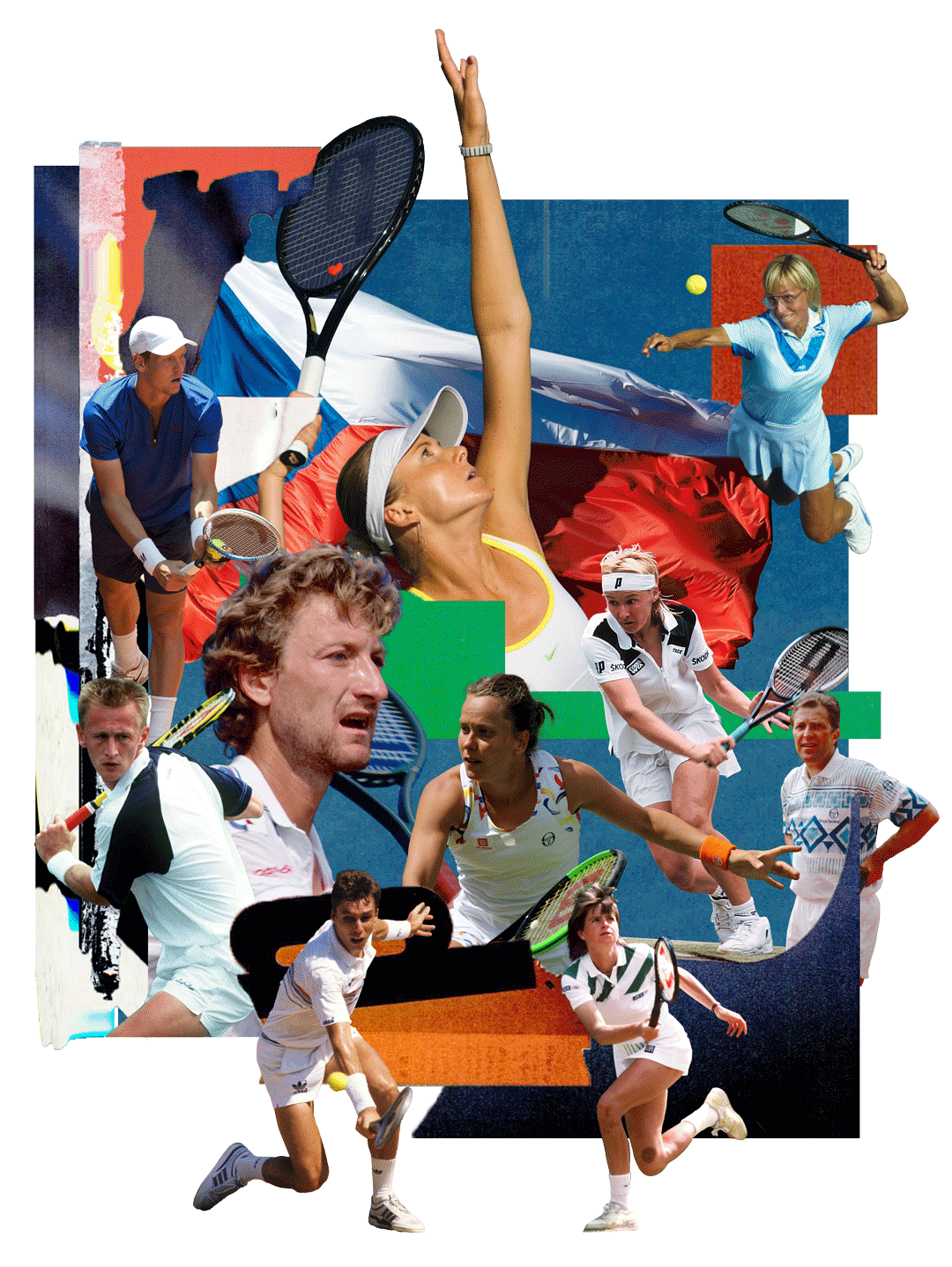
Photo collage by Dakarai Akil.
Photo collage by Dakarai Akil.
It’s often asserted that the presence of excellent players can boost a particular nation’s tennis economy. This was the case in such countries as Sweden when Bjorn Borg became a superstar and Germany during the glory years of Boris Becker and Stefanie Graf. But what about the ways greatness can also inspire study and, subsequently, rigorous instruction? At least this has long been the case in Czechia. Kodes, taught to play in the ’50s, underwent the tennis equivalent of a classical education.
One of Kodes’ early teachers, Karol Semerad, began to stress the importance of footwork soon after a student had started to hit against that most consistent of practice partners, the backboard. As Kodes wrote in his book, A Journey to Glory From Behind the Iron Curtain, “[Footwork] means going over the balls of the feet down to the heels in a slightly forward-leaning position and with tiny steps…. The coach taught us to shorten the steps through sort of a little dance and then he said: ‘It is always better to take one more step than be short of a step. You must fondle each ball a little rather than just get rid of it.’”
Dance. Step. Fondle. These are words that convey delicacy, natural siblings of balance, posture, and subtlety. “Their legs are firm behind the ball and very balanced so they can hit through the ball,” said Craig Kardon, Navratilova’s coach for the last six years of her singles career. From that deliberate, grounded base, the player is encouraged less to be metronomic and repetitive, but instead to cultivate his or her own particular playing style. “All my instruction growing up was on technique,” said Navratilova. “So I just figured it out. I knew I really liked coming to net.” Aiding the development process was that Czech players in recent decades have often played indoors in the winter on faster surfaces and outdoors in the summers on slower courts. “They’re able to find their own creativity and what helps them put points together,” said O’Neill.
There is also another layer behind this that might well explain much about the Czech tennis culture. In recent years, amid the epic results generated by Rafael Nadal and the ascent of clay-court, baseline-based tennis as the prevailing playing style, attention has turned to Spain. What’s made Spanish tennis players so successful? One concept constantly surfaces: the need to suffer. “Suffering to the Spanish means mental toughness, perseverance, and a fighting spirit,” writes Chris Lewit, author of the book Secrets of Spanish Tennis. “It is part of the tennis culture and every young Spanish player is expected to learn to fight and suffer on the red clay—to never give up.”
No one can deny the value of those attributes. But why suffer? What does that really mean when one is playing a game? Certainly, one suffers the pain of having lost a match one hoped to win. And there is the literal physical pain that is the result of the demands of competition, be it even in one match, much less a tournament, a year, or a career. But in all those cases, suffering is an outcome; an ends, not a means.
Per the Spanish model, must suffering be part of a tennis player’s operating system? For generations of Czech tennis players, the harsh and austere Eastern European setting might have plausibly warranted such a view. “Kodes and Lendl were supremely disciplined,” said Gene Mayer, a top 10 player during Lendl’s career. “They clearly showed the work ethic and focus of people raised in a setting where life was hard.”
No question, from the way it was carved up by European leaders prior to World War II, to the presence of an oppressive Communist regime, Czechoslovakia has had its share of suffering. From the late ’40s and well into the ’80s, the travel movements of its star tennis players were monitored closely, a police-state-style manner that led Drobny, Navratilova, and Lendl to base themselves elsewhere. While researching his book Ivan Lendl: The Man Who Made Murray, Mark Hodgkinson found a five-page letter authored by Lendl sent to Minister of the Interior Vratislav Vajnar in the fittingly Orwellian year of 1984. As Hodgkinson wrote, “Lendl knew that just one caustic memo could have seen his passport destroyed, which would have meant the end of his international tennis career…. [There] was always the fear of being silenced or purged from public life, of seeing the state’s tank turrets swivel in his direction.” There have indeed been tales of East European-based tennis players and other athletes being barred from travel. Now, that’s suffering.
Though Kodes never defected, he emphatically let Czech tennis’ leaders know how aware he was of their machinations. As Kodes wrote about the time he was confronted prior to flying to Tokyo to compete in the 1970 season-ending Grand Prix Masters, “I said: ‘Dear comrades, do you know what? I recognize why you do not desire that my wife travels along with me. You think that if we both travel out of the country at the same time we might decide to stay there! You are afraid that we would do that! But I’ll tell you something! My wife was with me twice on the Caribbean Circuit. Twelve weeks this year and last year. We have criss-crossed parts of the Americas—Curacao, Caracas, Columbia, and the United States. Thus, we could have defected a long time ago. I do not need to go to some damn Tokyo to do so! If this is your only reason for prohibiting my wife from traveling with me then it is totally pitiful.’” Having been in many meetings with the passionate and thoughtful Kodes, I can assure you that the exclamation points are as emphatic and authentic as his crisp ground strokes.
“Your tanks can’t beat me,” Navratilova once told a Russian opponent she’d just beaten. To study the history of one Czech stylist after another is to see how limited the concept of suffering is when it comes to a sport. “Suffering in tennis?” Navratilova asked. “Please, it’s a game.”

TENNIS. ART. CULTURE. FASHION. TRAVEL. IDEAS. — SIGN UP
RECOMMENDED
Review: Coco Gauff’s “The Zina Effect”
FILM REVIEWS
Postcard from the Japan Open
JAPAN OPEN