5.
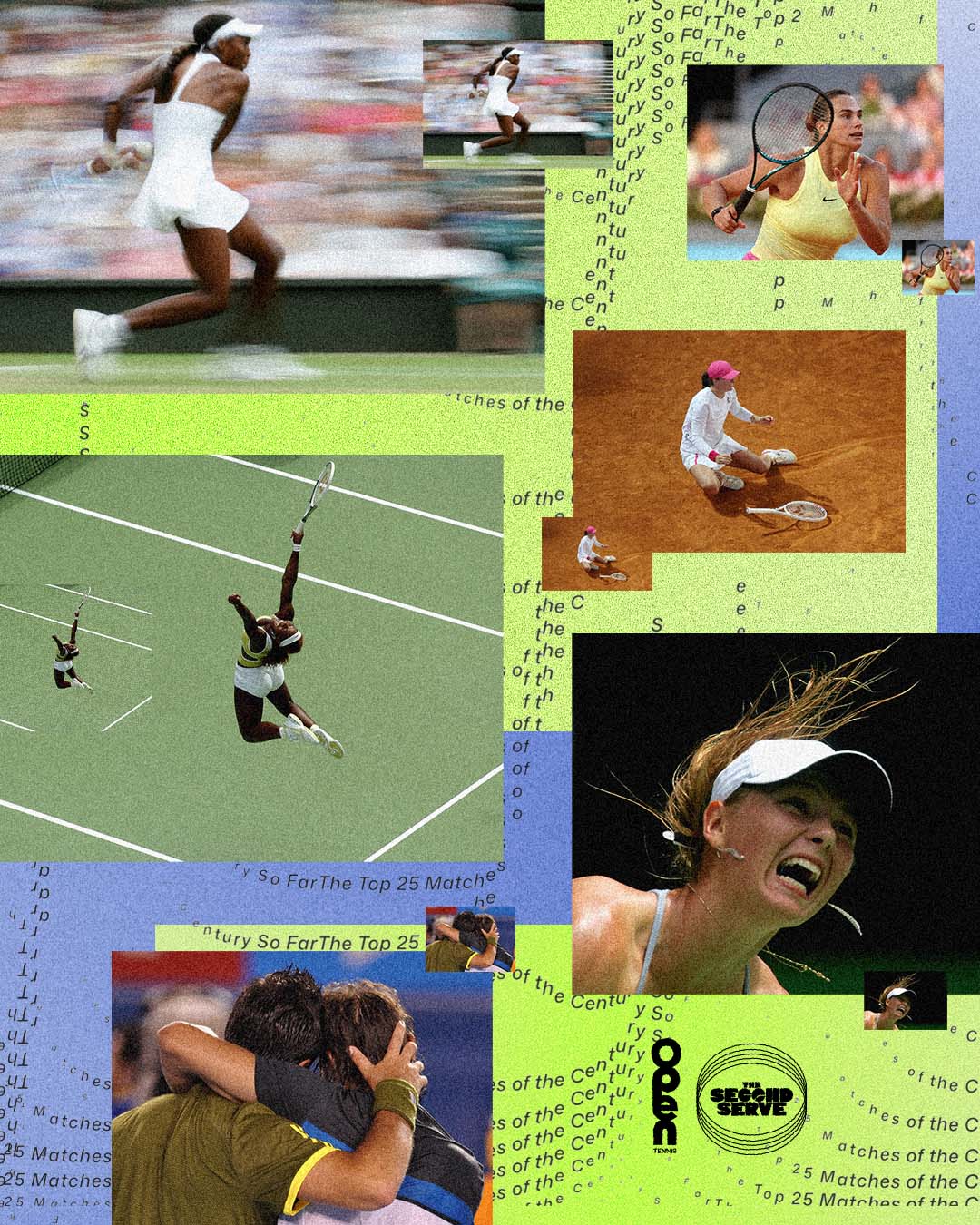
2005 Australian Open Semifinal, S. Williams d. Sharapova, 2–6, 7–5, 8–6
As 17-year-old Maria Sharapova stepped to the baseline to serve for the match in the second set, up 5–4 and having yet to be broken, it seemed for all the world like an inflection point. She’d used the depth and angles of her ground strokes to dominate Serena Williams in the first set (6–2), as she had in the previous year’s Wimbledon final and WTA Championships. Williams had undergone knee surgery at the end of 2003, and through 2004 was not the player—the crushingly dominant player—she’d been from late in the winter of 2002 through the spring of 2003, a stretch during which she, at one point, held all four Grand Slam titles. Was she, at 25, now on the way to…done? She was not.
A revivified Williams forehand and a ghastly double fault at 15–40 evened the set, which Williams went on to win 7–5 after breaking Sharapova again. Set 3 was 66 minutes of breathless tension and fight in the cauldron created by the Australian summer heat. Maria’s yelps grew louder. Serena’s glares grew longer. The baseline rallies left both of them gasping for air. Once again, Sharapova secured a late break and was serving for the match at 5–4. Once again, she failed to get it done, despite holding three match points, an epic almost—overwhelmed or wrong-footed by some of the most daring forehands Williams would ever strike. Williams eventually prevailed 8–6, went on to win the final—and went on (inflection point!) to become Serena. Along the way, she never lost to Sharapova again. —Gerald Marzorati
4.
2009 Australian Open Semifinal, Nadal d. Verdasco, 6-7(4), 6-4, 7-6(2), 6-7(1), 6-4
If you are a true tennis fanatic, there’s something about waking up in the middle of the night to watch a big match. It just means more when you have to set your alarm for 3:30 a.m. to watch a spectacle unfold.
In the case of the 2009 Australian Open semifinal between Rafael Nadal and Fernando Verdasco, sacrificing a little bit of sleep was no price at all. What unfolded was an instant classic—a five-hour and 14-minute marathon of the utmost quality that ended at 1:07 in the morning (9:07 EST!). What I remember most about the match was the absurdity of the baseline rallies. Even Alcaraz vs. Sinner matches would be jealous of what Nadal and Verdasco produced from the back of the court.
No statistic can do justice to what we saw with our own eyes. But if you somehow missed it, there is proof in the numbers. Just how good was this tennis match? Verdasco blasted a ridiculous 95 winners…and lost! Nadal made only 25 unforced errors. That’s right, of 385 total points played, a mere 25 ended with a Nadal mistake.
Seventeen years later, I still can’t decide how I feel about the match ending on a Verdasco double fault. On the one hand, that’s not how any legendary contest should ever end. On the other hand, it sort of augments Verdasco’s career-long role as a tragic hero.
Although a loss to Federer in the championship two days later would have done nothing to diminish Nadal’s semifinal feat, the fact that he went on to lift the trophy—after yet another five-set thriller against Federer—allows the Nadal-Verdasco match to live in even higher echelons of tennis lore. —Ricky Dimon
3.
2024 Madrid Open Final, Swiatek d. Sabalenka, 7–5, 4–6, 7–6
The crown jewel in one of the tour’s best rivalries. Swiatek won the first set of this final surgically enough, as you might expect given her ridiculous résumé on the dirt. But from early in set 2, Sabalenka found whichever area of the court she liked with her titanic ground strokes, forcing the modern Queen of Clay to play the rest of the match on the back foot. Swiatek did whatever she could to jam up the gears of the hostile ball machine on the other side of the net: anticipating putaways to her forehand and sliding them past Sabalenka for crosscourt passing shots; counterpunching deep backhands on the run; attacking early and with venom in the rare peaceful moments in a rally that Sabalenka did not dominate. Each woman executed her strategy to near-perfection, whittling the margin for error down to nothing.
Sabalenka thwacked her way to two championship points at 6–5 in the third set, then another in the deciding-set tiebreak. Swiatek erased one with a purposeful forehand winner—off a Sabalenka return that wasn’t too shabby either—and the other two fell away thanks to Aryna’s suddenly nervous, uncertain swings. Though Sabalenka had beaten Swiatek in the 2023 Madrid final, beating the Pole on clay remained a very real mental block. (Naomi Osaka would learn the same thing when up match point against Swiatek at Roland-Garros the next month.) Sabalenka saved a championship point herself with a pinpoint ace, but Swiatek’s greater reliability down the stretch proved the difference. At Roland-Garros in 2025, with Iga’s aura of invincibility somewhat dented after an uncommonly flawed clay season, Sabalenka got her revenge in a semifinal played at a similar standard for the first two sets before wilting in the third. The Madrid final remaining spectacular until the end makes it a tough act to follow, even for these two. —Owen Lewis
2.
2005 Wimbledon Final, V. Williams d. Davenport, 4–6, 7–6, 9–7
True to its status as tennis’ most important tournament, Wimbledon’s press seats are unsurpassed—close enough to the court that you can hear each player’s shoes squeak. And so, on Saturday, July 2, 2005, I occupied a seat on the north end of Centre Court, watching Venus Williams and Lindsay Davenport play one another in the final.
It was fascinating to see these two champions, raised within a 30-minute car ride of each other in Southern California. Both were hungry for a big result. Williams had last won a major in 2001, Davenport in 2000. While some rivalries revolve around contrasts, this one tilted on similarities: powerful ground-strokers, each able to repeatedly drive the ball deep and hard. Each had played excellent tennis in the semis, Williams beating defending champion Maria Sharapova, Davenport fighting hard to get past versatile Amelie Mauresmo.
Having won the first set, Davenport served for the title at 6–5. But Williams countered sharply and took the set in a tiebreaker. In the third, the quality of play picked up nicely, with power, precision, and movement rising to the occasion.
Then there came a moment neither will ever forget.
Williams served at 4–5, 30–30, and double-faulted. Facing championship point, Williams quickly gained control of the rally and laced an untouchable down-the-line backhand. Per the Wimbledon tradition of those years, there would be no tiebreaker. At 7–all, Williams broke Davenport and then held serve at 15—becoming the first woman since 1935 to win the Wimbledon singles title after facing championship point.
The day before the final, Williams had made the case for equal prize money to Wimbledon officials. By playing one of the greatest finals in the tournament’s history, she’d emphatically proved her point. Two years later, equal prize money became a reality at SW19—and this time, too, Williams won the title. All told, Williams and Davenport would play each other 27 times, Davenport winning 14. Of course, no one knew that this would also be the last time they’d meet—and, poetically, their final encounter proved a masterpiece. —Joel Drucker