
The Top 25 Matches of the Century So Far
The Top 25 Matches of the Century So Far
Our favorites for performance, lifestyle, and everything in between.
Our favorites for performance, lifestyle, and everything in between.
By The Second ServeDecember 26, 2025
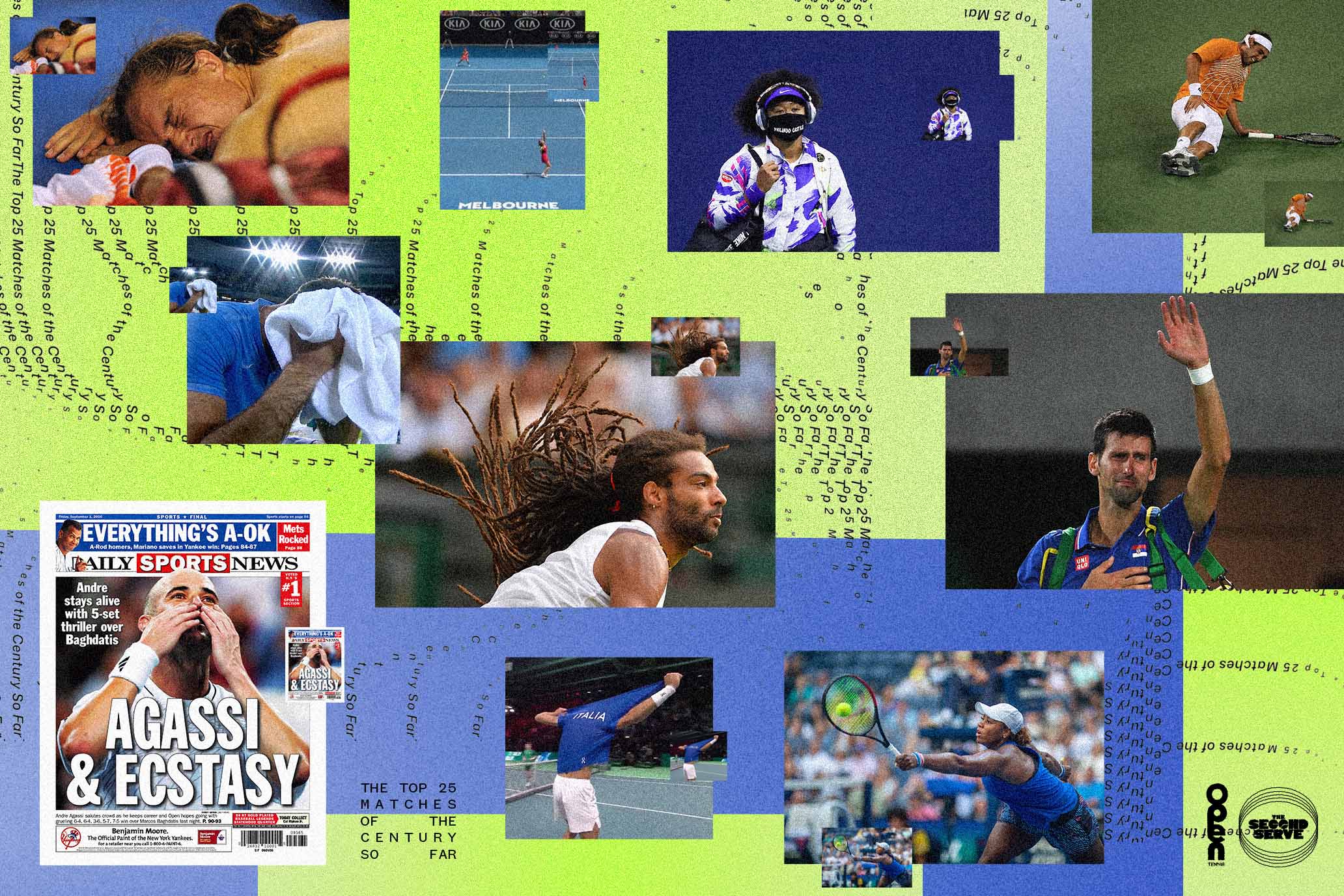
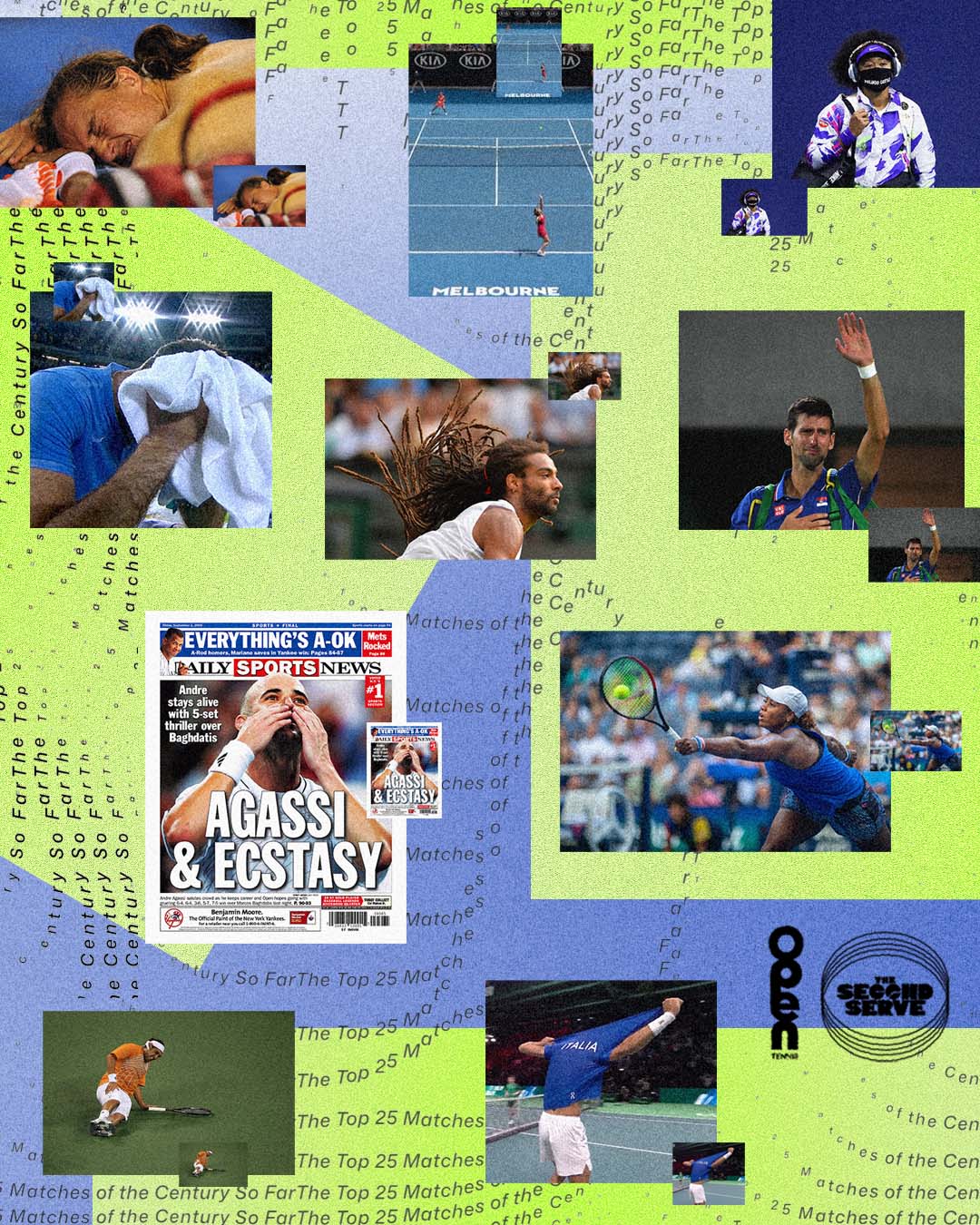
Since we’re a quarter of the way through the century, we thought it a good time to take a look back at all the great tennis that has transpired since the turn of the millennium. We’ve asked some of the best tennis writers working today to choose what they thought were the best matches of the past quarter century, and to help us rank them based on some combination of the level of play, the moment, the stage, and the historical implications. The results were often surprising, always fun—we’re sure you won’t find anything controversial herein.
25.
2025 Davis Cup, Cobolli d. Bergs, 6–3, 6–7, 7–6
Davis Cup—in many ways a vestige of the pre–Open Era that never successfully adapted to the commercialization of tennis—has had a rough go in the 21st century so far, losing the reliable participation of top players and other elements of its magic formula. But for one night in November 2025, even the stripped mine bore a gold rush of a match, with 43rd-ranked Zizou Bergs of Belgium and 22nd-ranked Flavio Cobolli each playing their breathless best as the match went beyond any conceivable last gasp.
Yanking momentum back and forth, the pair combined to save a baker’s dozen match points between them before Cobolli bombed a serve up the T that Bergs could not wrangle back into the court on the 14th, the culmination of an epic third-set tiebreak. The crowd in Bologna roared for Cobolli—only the third-best Italian man but the top Italian who showed up for the occasion—and a couple days later he’d win Italy its third straight Davis Cup title.
Bergs, a player initially known more for a coquettish TikTok presence than his tennis, may never get closer to glory than that, but just being part of such a moment also might be enough. “You gave everything, and that is the greatest victory of all,” his father, Koen Bergs, wrote to Zizou later. “No matter the score, you have already won in my eyes. You are a champion of spirit, a warrior of heart, and a son who makes his father endlessly proud.” —Ben Rothenberg
24.
2012 Australian Open, 2nd Round, Tomic d. Dolgopolov, 6–4, 3–6, 6–3, 6–7, 6–3
By the 2010s, men’s tennis had steadily grown more and more monotonously metronomic. Two dudes, planted behind the baseline, lashing topspin ground strokes at each other until one of them blinked. The 2012 Australian Open ended with the farcical peak of this when Rafael Nadal and Novak Djokovic needed nearly six hours of baseline grinding to finally determine a winner. But a week prior, in that same Rod Laver Arena in Melbourne, two oddballs had shown what was possible. Alexandr Dolgopolov and Bernard Tomic put on as outré an exhibition as men’s tennis has ever seen this century, matching each other’s freak with exchanges of exaggerated slices.
Their creative carving sculpted something beautiful that would never again get such a stage in men’s tennis this century. That this match went five sets was entirely incidental to its greatness; viewers were hooked early in the first set. Forget metronomic—did you ever see those pictures of the sorts of webs spiders weave after being given LSD? That was this match.
Tomic, who was then a genuine hope for his country as a 19-year-old fresh off a Cinderella quarterfinal run at Wimbledon, won to reach the fourth round; he would top out there and never made it to another major quarterfinal in his career. A couple of years later Tomic would play almost certainly the worst match of the century when he lost to Jarkko Nieminen in just 28 minutes. But on that one night, with a continental grip, Tomic brushed up against the truly sublime. —Ben Rothenberg
23.
2019 US Open, 2nd Round, Townsend d. Halep, 2–6, 6–3, 7–6
Taylor Townsend had never beaten a top 10 player, progressed past the second round of the US Open, or taken a set off of former No.1 Simona Halep when she lined up against the reigning Wimbledon champion at Arthur Ashe Stadium in 2019. Then ranked No. 116, Townsend barely scraped through qualifying to earn her spot in the main draw. To earn the biggest win of her career, Townsend engineered the century’s most audacious display of net-rushing tennis, a style that had all but disappeared after the 1990s. “I think it was really great confirmation that this style of play works,” Townsend said afterward, “that I can continue to do it.”
To disrupt Halep’s baseline rhythm and keep the counterpunching Romanian on her heels, Townsend crashed the net an astounding 106 times. Her intentions were laid bare in the opening game, as she held serve off four successful forays into the net. Halep ran off five straight games to take the first set, but Townsend never backed off. She continued to chip and charge and serve and volley to finally take her first set in eight tries against Halep, setting up a dramatic final set. Townsend crashed the net 64 times in the third set, forcing Halep to respond in kind with her own baseline magic.
By the time Halep had saved two match points and Townsend saved one, the only mystery left was the result. The entire stadium, which included Kobe Bryant and Nadia Comaneci, knew what was coming in the final tiebreak: Taylor would rush the net, and Simona would either find the pass or not. It was edge-of-the-seat viewing, and as the old cliché goes, fortune favored the brave. —Courtney Nguyen
22.
2016 Olympics, 1st Round, Del Potro d. Djokovic, 7–6, 7–6
Going into the match, Novak Djokovic was at the height of his powers; the only accolade that had eluded him thus far was an Olympic gold, and thus joining Rafa and Andre as the only men to complete the career “Golden Slam” (though Steffi Graf had done it in a calendar year). He’d leave the Olympic stadium bereft, though. So far Novak had been in uncharacteristically lackluster form at the Olympics, but this year was supposed to be different, with Novak seemingly able to do anything on a tennis court. What we didn’t know at the time was that Novak was at the beginning of his yearlong lost weekend, where he’d miss time due to injury and see his ranking drop to the un-Novakian number of 12 and his love life written about in the tabloids. There was no evidence of any of that in Rio, though.
Juan Martin del Potro, on the other hand, showed up greatly diminished from the heady days of 2009 when he upset Federer in the US Open final. The atmosphere in Rio was electric from the start, practically a home court for the Argentine del Potro, and what ensued was a deeply emotional match that would see both players—and seemingly the whole stadium—in tears. While del Potro’s backhand was barely effective due to the wrist injuries that would end his career early, his forehand was a problem. Novak tried to stay away from it, but when del Potro got a look, he seemed to demolish the ball. He used that shot to pummel most of his 41 clean winners over just two tight sets. That, along with an 86 percent first-serve percentage, was too much for Novak, whose heart was broken again. Novak would get his Golden Slam eight years later in Paris, and del Potro would win silver at the games and eventually lift the trophy two years later in Miami, but Rio was the signature late-career triumph for del Potro, and he knew it. “I wanted to win, but I also wanted the match to go on because everything was wonderful,” he said afterward. It was an unexpectedly epic and moving run for del Potro, who had the Brazilian crowd in the palm of his hand. —David Bartholow
21.
2020 US Open Semifinal, Osaka d. Brady, 7–6, 3–6, 6–3
Many elements of the 2020 US Open, played behind closed doors as the pandemic roiled onward outside, felt understandably depressing. Arthur Ashe Stadium, known for its buzz and roars that reach the rafters, had become an empty cavern whose size only amplified the echoing emptiness.
Though there were fewer than 150 people in attendance in a stadium built for more than 22,000, the women’s semifinals of that tournament turned the void into infinite possibility. Under the roof, Naomi Osaka and Jennifer Brady distilled something that felt lab-perfect in the pristine conditions: pure power tennis in a vacuum.
The two women combined for 19 aces and just three double faults, belting baseline winners on command in a dazzling barrage of reverberating power tennis. No one had shaken off the pandemic dust as quickly as Brady, who had won in a stacked field in Lexington before coming to New York ready to take on the world. She played the match of her life, but Osaka was just better—as she so often proves to be across her absurd 13–1 record in the quarterfinals, semifinals, and finals of majors.
Osaka, who had won the loudest and most chaotic US Open final a couple years earlier, thrived in the opposite extreme and won her third major a couple days later. But the real victory, she said, was making the final: By playing seven matches, Osaka ensured she would get to wear all seven of the masks bearing names of victims of racialized violence that she had made for the tournament, which she said had been “a very big motivating factor” for her.
Osaka won a rematch over Brady a few months later in the final of the 2021 Australian Open. That one didn’t live up to the high-proof potency of this match; it’s hard to imagine the conditions will ever exist again for the recipe they brewed the first time. —Ben Rothenberg
20.
2018 Australian Open, 3rd Round, Halep d. Davis, 4–6, 6–4, 15–13
After twin towers John Isner and Kevin Anderson needed more than six and a half hours to end their deadlocked 2018 Wimbledon semifinals with a 24–22 fifth set, the rules of tennis were rewritten. Soon, no match, anywhere in professional tennis, would be allowed to continue on past 7–6 in the final set. The rule was made to stop mundane marathons between men who can’t return serve, but tennis has never been one-size-fits-all, and a lot of classics were surely prevented in the process.
Thankfully, though, Simona Halep and Lauren Davis had already played one last classic a few months earlier. In a lightweight throwdown for the ages, the generously listed 5-foot-6 Halep and 5-foot-2 Davis tussled back and forth for hours. With neither possessing a serve that could win her many free points, every game was a complete toss-up. Even in the tightest moments, the two stayed attacking throughout, trading winners and breaks as the third-set score pendulated into double digits.
Davis had three match points on return at 10–11 but couldn’t convert, for a good reason: One of her toenails was falling off. Though ranked No. 1, Halep had a lot to prove: She was playing in Melbourne without an apparel sponsor, wearing a red dress she’d ordered from China and an Australian Open-branded visor.
Halep would make it all the way to the finals of that Australian Open, winning another marathon in the semifinals against Angelique Kerber before finally hitting the wall in the final against Caroline Wozniacki. Halep, who had to be hospitalized for dehydration after losing that final, would finally win an elusive first major title a few months later in Paris. But the best match of her year—and the grittiest of her career—was against Davis. —Ben Rothenberg

19.
2015 Wimbledon, 2nd Round, Brown d. Nadal 7–5, 3–6, 6–4, 6–4
What if low-percentage suddenly became high-percentage tennis? For the answer, look no further than Dustin Brown’s epic upset of Rafael Nadal at Wimbledon. Rafa came into the tournament somewhat diminished as a 10 seed after an appendectomy in late 2014, but the match was less about Nadal than Brown, whose brand of tennis was at one point described by commentator Andrew Castle as “hilarious.”
Brown, 30, came into the match ranked 102 in the world, having come through qualifying. Though a prototypical journeyman, Brown was a grass-court specialist and thrilling shotmaker who’d beaten Lleyton Hewitt at the Championships two years prior and had smoked Rafa on the grass of Halle the previous year—and he put on a hell of a show. Rafa lost this match after the very first game, won by Brown in four quick points: a serve + drop shot, a serve + swinging backhand volley winner, a 123 mph second-serve ace, and a drop volley. The ensuing four sets were characterized by more of the same. Every time Rafa held serve, it felt like a dodged bullet, whereas Brown held easily. By the sixth game the broadcast team, who had given Brown so little of a chance they didn’t bother to familiarize themselves with his bio, was wondering if Nadal was washed-up (He wasn’t). On set point in the third, in an attempt to return a Brown serve up the T, Nadal instead hit his own shin with his racquet, sending a bloodcurdling crack throughout Centre Court. Never has Nadal looked so out of sorts.
The match calls to mind the infamous “No Mas” fight, during which the more powerful Roberto Duran was so fatally flummoxed by Ray Leonard’s audacious style, he basically shut down. It’s nearly as notorious. In the recent history of Jamaican sports, there are only the achievements of Jamaican sprinters (Usain Bolt chief among them) and Brown’s takedown of Nadal. Here was a guy whom the elites in the Jamaican tennis establishment didn’t want—he represented Germany at the time but had the full support of the Jamaican street—a former ball boy at a Montego Bay resort, deploying a flashy, risky, and joyous brand of tennis to prevail on his sport’s biggest stage, against one of its most august opponents. —David Shaftel
18.
2006 US Open, 2nd Round, Agassi d. Baghdatis, 6–4, 6–4, 3–6, 5–7, 7–5
Take two of the best pure ball-strikers alive, one at the end of his career and the other at the start. Beat them to such a pulp that they can barely walk, and have them play a fifth set. This is your recipe for an unforgettable tennis match—or at least it was in the second round of the 2006 US Open, where a 36-year-old Andre Agassi met a 21-year-old Marcos Baghdatis. Maybe it was the contrarian in me, but despite Agassi’s legend, I recall rooting for the Cypriot, who had just broken into the top 10 that season. A paunchy shotmaker in board shorts and a headband, he seemed to possess the gift of perfect timing that defined Agassi’s own game. My friends and I liked to imitate the Baghdatis running forehand, badly.
That night, Agassi took the first two sets, then Baghdatis the next two. By the time they arrived in the final frame, pain had emerged as the third character in the match. Baghdatis was hopping around, rolling on the ground in cramp agony. Agassi, pumped full of cortisone injections to grit through his final tournament, saw his naturally stiff pigeon-toed walk get even creakier still. Between points it looked like neither man could walk 10 paces in a straight line. But during the points they hurtled around Ashe in crisp and hypnotic baseline rallies, their contact as clean as their faces were ragged. Agassi notched the last victory of his career; Baghdatis would never again touch the heights of that season. From them I learned how tennis could ravage a body, both over the course of an epic career, and over the course of a single evening. In his memoir Agassi wrote that the two players, flat on their backs and receiving treatment after the match, held hands—happy to have shown the world all that, and to have survived. —Giri Nathan
17.
2019 Indian Wells Final, Andreescu d. Kerber, 6–4, 3–6, 6–4
I remember the rage that propelled Bianca Andreescu to winning that Indian Wells 2019 final against Angelique Kerber, whose lefty paw had already won three majors. Ranked 152 to start 2019, 60 ahead of Indian Wells and 24 after, the 18-year-old became the fourth-youngest player to win a WTA 1000 at the time (Hingis, Seles, S. Williams), the youngest here since Serena (1999), and the first wild card in the event’s history.
I was on-site when she blasted through like a joyful hurricane, and what got her the title against Kerber, who tried everything to escape that kid, was her unique recipe of power and variety, added to an exceptional tennis IQ, a forehand hitting like a whip, and will power as X factor: She’d yell her “Come on!!!” and the ground would shake.
Yet, down a break in the third, Andreescu was about to lose her fairy-tale ending, her right shoulder in pain. But then it happened. She called coach Sylvain Bruneau and sat there repeating how badly she wanted to win, tears in her eyes, with an intensity that went through the stadium like a wildfire. And so Bibi went back and took over, missed three match points at 5–3 but hit a monster forehand at 5–4, 30A. “She’s gonna do it. It’s insane,” was my only thought. A great return later, and she was yelling out of rage and pride on the ground, everybody pinching themselves.
The rest is history: a 10-win streak until retirement in Miami; just two matches played before winning the WTA 1000 in Toronto and the US Open, beating Serena Williams. She was top five, and the world was her oyster when her left knee gave up at the WTA Finals, starting a streak of injury issues. We’re still here, waiting for Bibi, just because we know how unreal her peak is. —Carole Bouchard
16.
2001 Wimbledon Final, Ivanisevic d. Rafter, 6–3, 3–6, 6–3, 2–6, 9–7
Glorious chaos, in tennis form. One of the all-time great Wimbledon finals, even if the quality of the tennis itself was at times, as Pat Rafter admits, “pretty scratchy.” But this was about more than just tennis. Scarred by losing three finals and bruised by a shoulder injury, Goran Ivanisevic was ranked 125 and needed a wild card just to get in the event. Somehow his game came together, his serve began to fire, and the unthinkable became possible. Rafter, a serve and volleyer in the true Aussie tradition, had lost in the final the previous year, but after beating Andre Agassi in the semis, he was the favorite.
The final was pushed back to Monday due to rain, and tickets were sold on the gate for £40, a bargain that created an atmosphere more like a football match, with the Australians in green and gold mingling with Croatians in red and white checks, alongside Jack Nicholson, shades and all.
The match itself was chaos. Twice, Ivanisevic led by a set, but Rafter sped through the fourth to level. The fifth was nip and tuck until Ivanisevic fired a forehand return across Rafter to get the break for 8–7. Ivanisevic was so nervous he could hardly stand up, and that final game, wow. Three double faults, two on match point, and a third match point lost to perhaps the best backhand topspin lob of all time from Rafter before the Aussie returned into the net to finally give Ivanisevic his dream victory. —Simon Cambers