
A Calm Contender
A Calm Contender
A fourth round loss at the Australian Open doesn’t make Iva Jovic any less of a sensation.
A fourth round loss at the Australian Open doesn’t make Iva Jovic any less of a sensation.
By Owen LewisJanuary 27, 2026
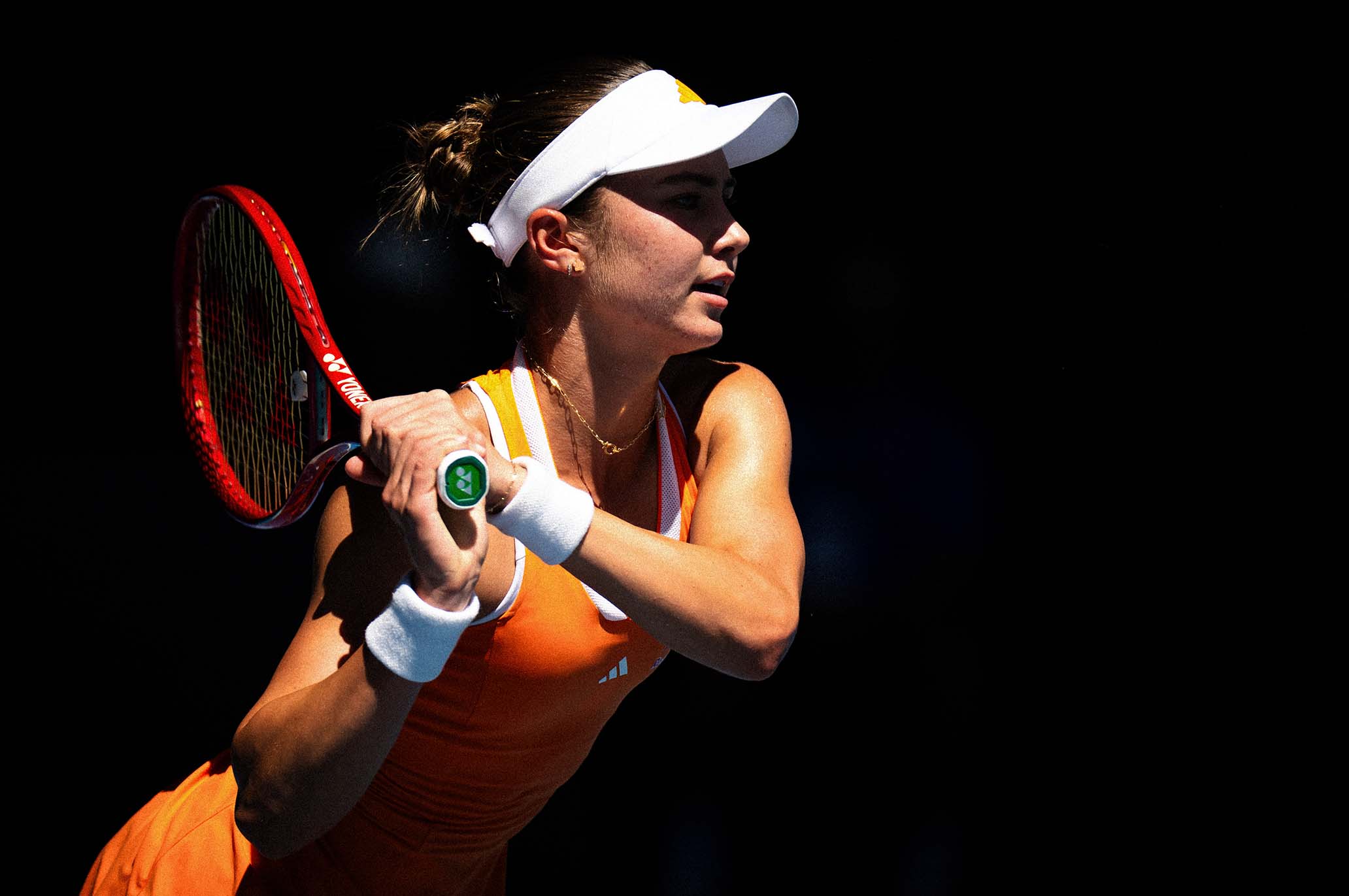
Peak Iva Jovic is already fearsome. // Getty
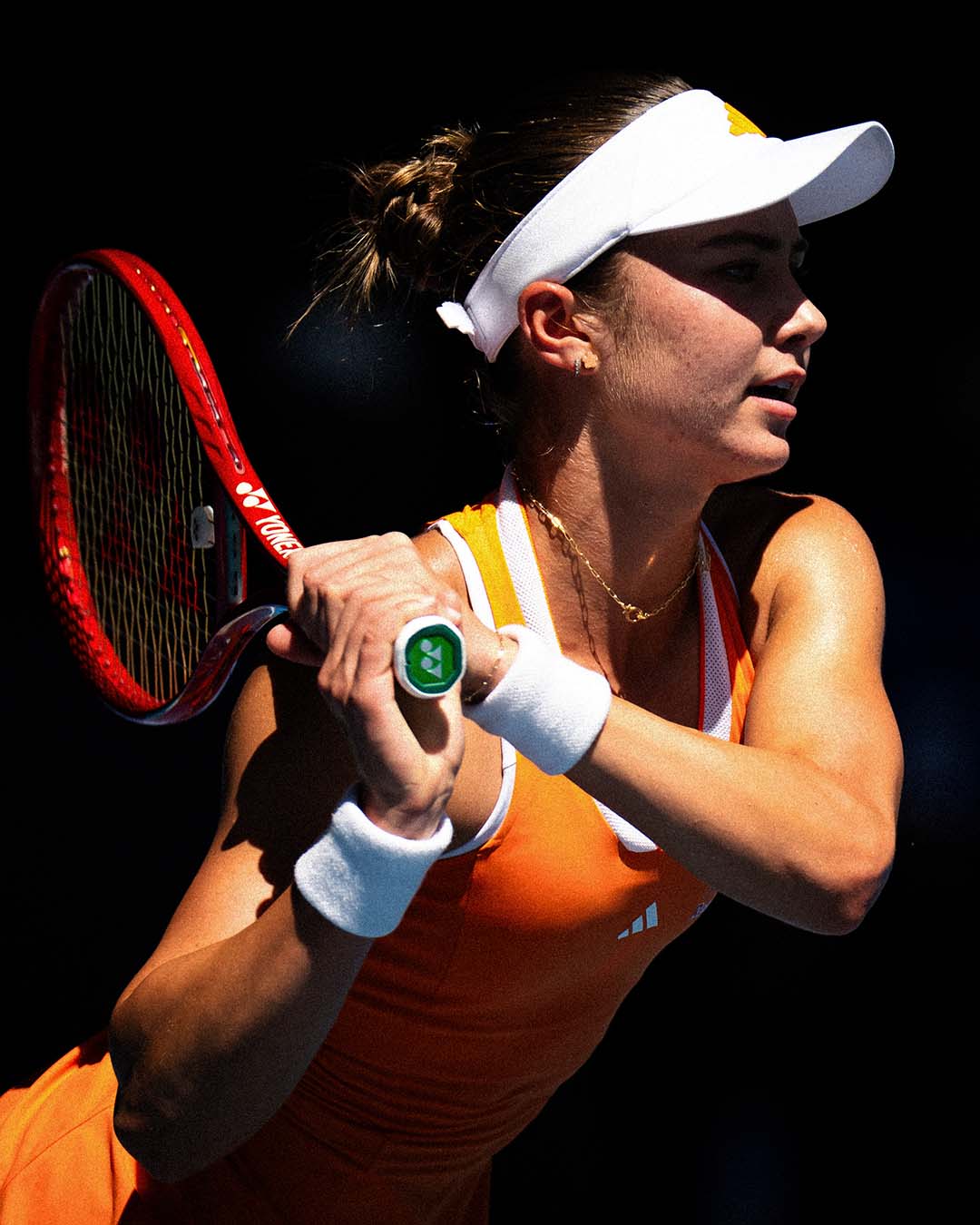
Peak Iva Jovic is already fearsome. // Getty
You have to be a special player for your opponent to praise you wholeheartedly after she has just beaten you 6–3, 6–0. The player in question is 18-year-old Iva Jovic, whose breakout run at the Australian Open ended at the hands of Aryna Sabalenka in the quarterfinals. Jovic didn’t drop a set in her first four matches but came up against a version of Sabalenka hell-bent on destruction. Points ended immediately after Sabalenka struck a forehand the way she wanted to, which was all of them. She threw in a low backhand slice that forced an error from a charging Jovic. A spookily good drop volley drooped over the net for a winner. Jovic did not quit, or grow visibly demoralized, or even, I thought, drop her level dramatically. None of it mattered.
This was peak Aryna, no doubt about it, the kind of performance that could make someone pull the trigger on the premature, irresponsible prediction that she’ll hold the No. 1 ranking for the whole of 2026, as she did in 2025, in a group text. (Whether someone actually did make this call, I’ll leave to your imagination.) But Sabalenka was telling the truth when she said in her on-court interview that the score is a poor indication of how hard she had to work. She added in press that she couldn’t recall playing better in too many matches. (The list, for me, pretty much begins and ends with the third set of her 2025 Roland-Garros semifinal with Iga Swiatek.) “The second set I felt like I have to step in and put even more pressure on her, because I can see that she’s young, she’s hungry, and I could tell during the match that no matter what’s the score, she’s still going to be there trying and trying to figure her way,” Sabalenka said when I asked her about that spotless second set. “Yeah, that was definitely amazing performance in the second set.”
Sabalenka had reason to feel she needed to step on the gas after the first set. She came out of the gates sharp, and after taking a 3–0 lead, she looked destined for a bagel in the opener.
Only Jovic didn’t play along. She saved a break point to hold for 1–3, then two more to hold for 2–4. When she held from deuce to get to 3–5, the match 50 minutes old by that point, it suddenly felt close. Jovic poured on the pressure in the next return game, dragging Sabalenka into a protracted deuce battle that required her to hit multiple aces to prolong it. On her third break point, Jovic hit a second-serve return into the top of the net. Immediately, she doubled over, practically twisting herself into a pretzel in her horror. It was the preternaturally calm teenager’s only demonstrative reaction of the match.
Yet it was her first time at Rod Laver Arena. Jovic had an excuse to totally wilt, particularly in 95-degree temperatures (it’ll be 114 later, whee) under such a pale blue sky I can’t imagine it ever being any other color. Seagull feathers regularly spiraled down from above, as if portending the skin that would later flake off sunburned spectators. Jovic had enough meaningful crowd support, too—more than Sabalenka—to add the pressure of satisfying her fans. Though she gets no credit on the scoreboard for it, Jovic played well enough that Sabalenka saw no option other than to pay her the painful compliment of annihilation.
This loss doesn’t make Jovic, a Californian born to Serbian and Croatian parents, any less of a sensation. At its outset, if asked which 18-year-old would go furthest in this tournament, all of tennis’ fans and media would have answered as one: “Mirra Andreeva, and I would put a month’s rent on it.” But the Russian phenom is developing a tad slower than her two WTA 1000 titles early last year forecasted, and she lost in straight sets to an imperious Elina Svitolina on Sunday night. In Melbourne, it was Jovic who found the steadier level of tennis, and her equilibrium more easily when under duress.
Jovic came into the tournament as the 27th seed thanks to a 35–13 run since Roland-Garros in 2025. (She’s now 20th in the live rankings.) The maturity of her game belies her age. She is comfortable playing several feet behind the baseline, making her hard to hit through, but doesn’t push. Her forehand is one of the more interesting shots I’ve seen recently. It lacks the power of Sabalenka’s or Elena Rybakina’s but has a ton of weight on it, so the opponent (except Sabalenka, apparently) always seems to be playing catch-up with it, whether they’re trying to run the ball down or merely change direction with it. Jovic is also armed with a tip from Novak Djokovic himself to open up the court with angles as well as depth. She can rip the aerial backhand return with a violent two-handed swing; it’s almost as though she’s flying when she strikes that shot.
Peak Jovic is already fearsome. Her demolitions of Hon and Putintseva, in particular, were clean and ruthless, artworks typical of the seasoned veteran who has smoothed out all the flaws in their game. Down 6–0, 3–0, and break point to Jovic, Puntintseva fatalistically threw her racquet at an unreachable forehand pass. If Jovic is breaking opponents’ resistance at 18 years old, we may need to allow her opponents a free courtside psychologist when she hits her prime.
Maybe the most alarming attribute Jovic has, though, is that temperament. Before this tournament, she’d never been past the second round of a major. As she has won the matches that have propelled her to the quarterfinals, her reactions have been…happy? Satisfied? A show of emotion, after she beat Jasmine Paolini, lasted approximately a quarter of a second. She has rarely seemed exuberant. She may have exceeded her expectations by making the quarterfinals, but the way she did so has felt routine. “I don’t really feel like there is a lot of house money or underdog mentality that I’m feeling, because I don’t feel like I have been playing anything outside of my comfort zone or outside of my normal level,” Jovic said, after dropping one game to Putintseva. Terrifying stuff.
Jovic was calm in press after losing to Sabalenka, aware of the fact that this match wouldn’t have defined her career even if she’d won. When asked what she tried to emulate from Djokovic’s game, she identified “the way he is able to almost suffocate opponents.” (Again: terrifying.) She said Sabalenka’s power forced her to operate at an extreme, which she struggled to adjust to given that she’d hoped to “drift a little bit in the middle.”
“There’s always next time,” she added with a smile, “which is nice.”

PURE, ORIGINAL TENNIS — SIGN UP!
RECOMMENDED
Zac Farro: Life Preserver
CULTURE & ARTS
Coco Gauff: Prophecy in Progress
ATP & WTA

Ben Shelton & Frances Tiafoe: Top Dawgs
FILM REVIEWS