
Oh, Joy.
Oh, Joy.
From OPEN Tennis Vol. 2: Is Tennis Fun?
From OPEN Tennis Vol. 2: Is Tennis Fun?
By Brittani Sonnenberg
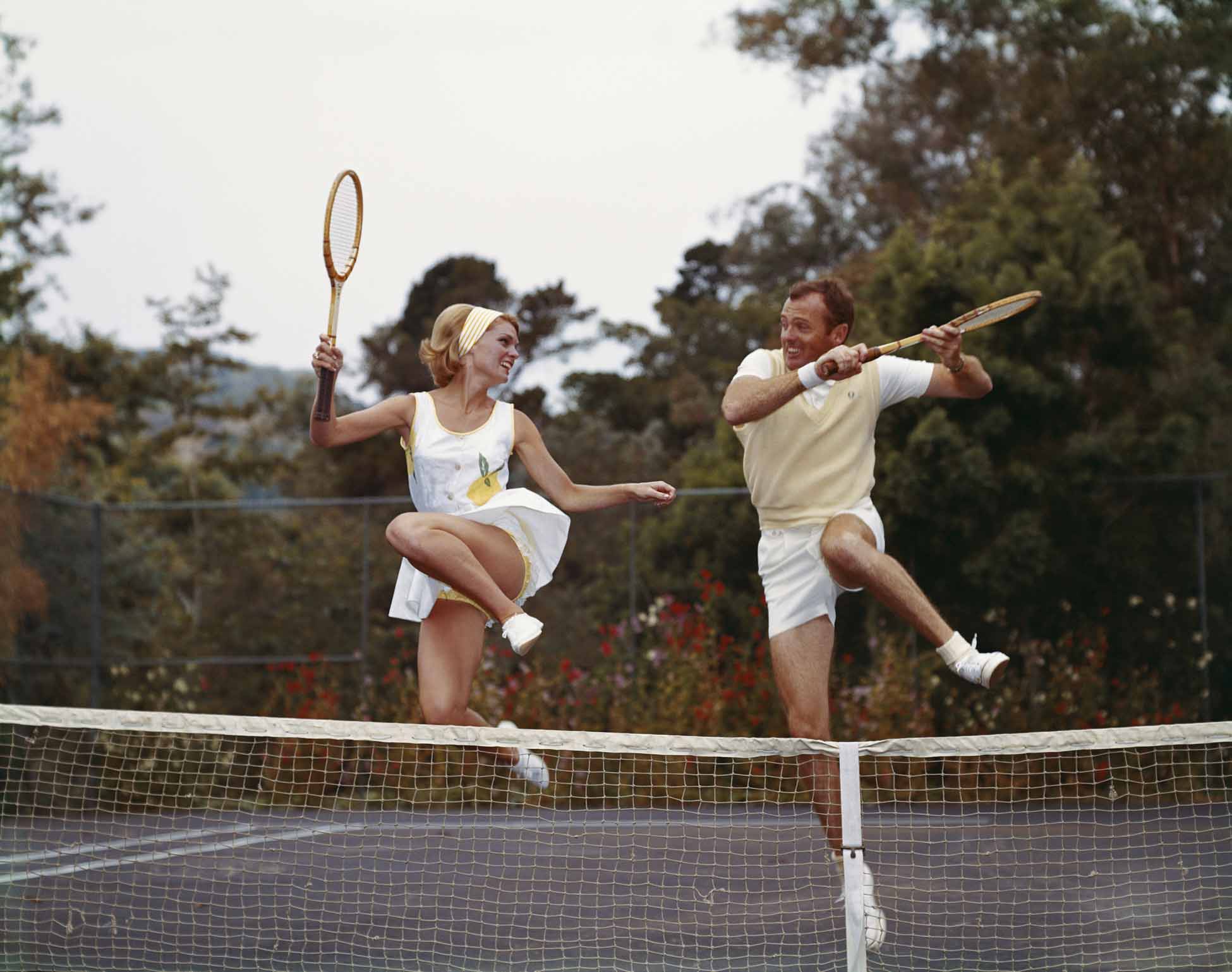
Not pictured: the author of this piece. // Getty
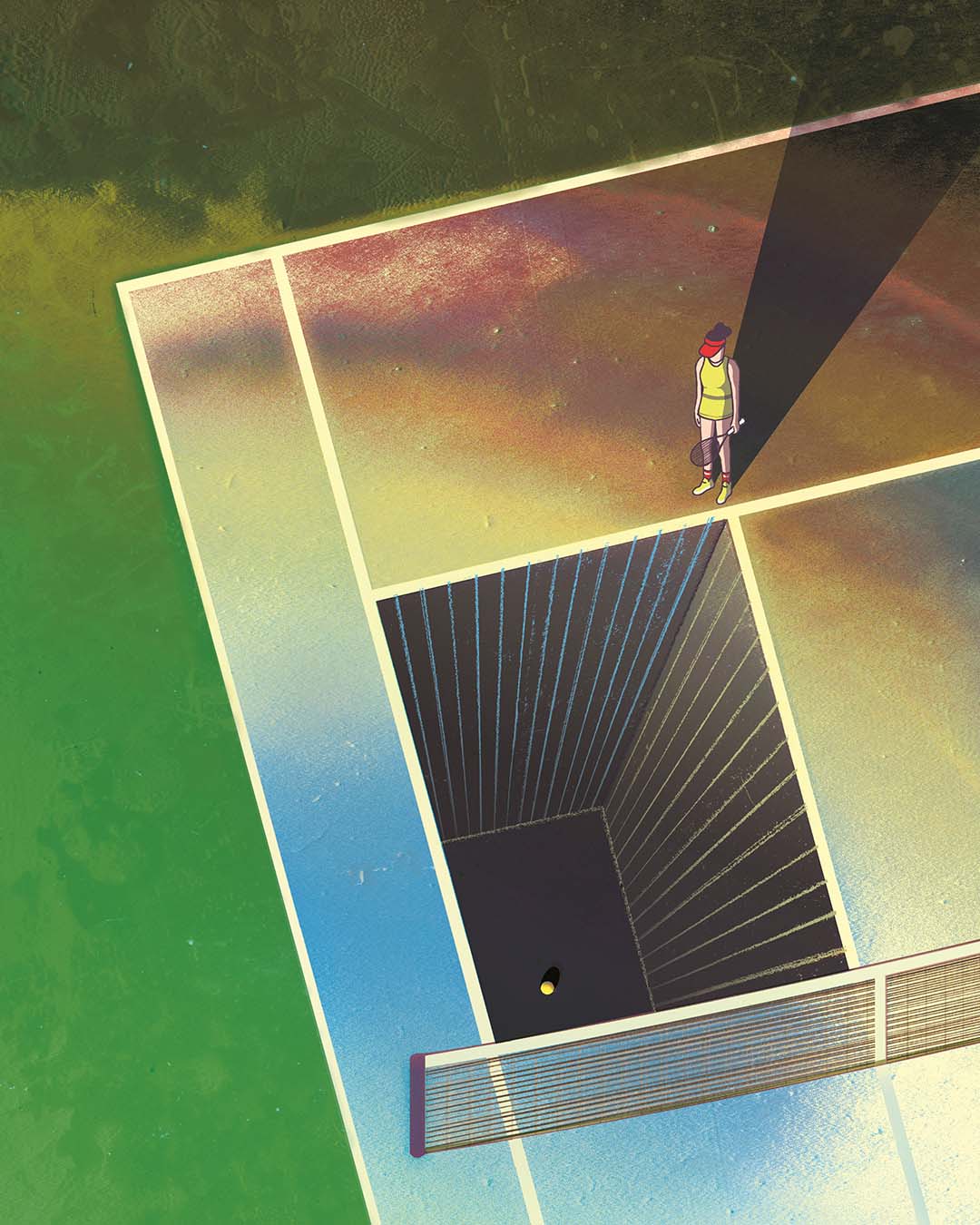
Illustration by Dalbert B Vilarino.
I kept my cool walking past courts 4, 5, and 6; then the infuriating water fountain, whose measly burble is like a woman talking to herself; then the KEEP OFF GRASS sign, which Alejandro and I ignored, like everyone else, taking the well-trod shortcut to our car. Doors closed, I fixed a stony gaze out the front window. At the stoplight, the tears began to leak out, and by the time we got on I-35, I was messy-crying.
It wasn’t that my husband had beaten me, again, in our Tuesday singles match, although the 0–6 first set rankled. I usually get at least one game off of him, four on my best days. There had been a close baseline call, and then a blatant ace theft, after which I summoned my inner Ostapenko and glared at him while slamming winners right and left. Or, more truthfully, straight into the net.
My odds were not good going into the match. I was about 1–350 in our four-year head-to-head. As I told tennis friends, who raised their eyebrows and said they would never play against their spouse, playing against a 4.0 dude made me better in my 3.5 women’s matches. But as Ale squeezed my knee in the car, an admittedly kind gesture that just felt really fucking condescending, I thought: I hate this.
*****
Is tennis fun? If you play tennis regularly, your answer is probably yes. The Oxford Dictionary defines fun as “enjoyment, amusement, or lighthearted pleasure.” Would you call your matches a “lighthearted pleasure”? Doesn’t that sound more like pickleball players, and isn’t that why we make fun of them? When is the last time you left a court thinking: That was delightful! Admit it, if you won, your satisfaction was bloodier than mere “enjoyment.” If you lost, you were probably attacking yourself, as I was on the car ride home, for taking it too seriously. For not having fun. For being so infantile.
*****
Speaking of babies, my 15-month-old, who just learned how to walk, looks a lot like me on the court. She’s elated, and then she’s furious. Ona looks astonished when she falls, even though this is what happens every time she takes a few steps. Everyone praises the toddler can-do attitude for getting up again and not letting it affect their sense of self-worth. But if her vocabulary extended beyond “banana,” “woof,” and “uh-oh,” I think she’d tell you that she loves the forward-flying miracle of walking but hates how quickly it abandons her, the same way I feel about my forehand approaches. The difference, I guess, is that she doesn’t retreat into a corner of the playroom to think about how she can walk more “loosely” next time. Walking is thrilling, and walking is the worst, like most things in Ona’s life, except for mashed potatoes, which are perfect.
*****
David Foster Wallace famously called luxury cruises a “supposedly fun thing” he would never do again. I know this because I remembered the title and the essay’s subject, but in truth, I have never read the actual essay because it didn’t seem fun enough. I’ve read his tennis essays, of which I recall that the wind didn’t bother him because he grew up in North Dakota, and that he was kind of hard on Tracy Austin. I’m not going to go back and reread them now to glean where he lands on fun in tennis, because that would not be fun. But the reason that essay title stuck in my head is that it’s so damn good; so much of what we do as adults is “supposedly fun” but ultimately too draining to repeat.
Tennis, however, is a supposedly fun thing that we do again and again and again, which brings it into the realm of addiction. (Get ready for another fun definition!) “Addiction: a compulsive, chronic, physiological, or psychological need for a habit-forming substance, behavior, or activity having harmful physical, psychological, or social effects.” Am I grumpier when I play tennis or when I abstain? This week, I am limiting my tennis to three days to heal a wrist injury (see: addiction’s “harmful physical effects”), but I know I’ll be moodier on the days that I don’t play. Like David Foster Wallace, I have a depressive streak, and I imagine this is true for a lot of athletes who choose tennis, especially singles players. It’s the lonely overthinker’s sport. But in the moments when the physical and mental challenges are eclipsed, you are freed from your Eeyore, and part of the joy comes from how hard it was to shed yourself.
That said, I most consistently enjoy tennis in my other weekly meeting with a better male player: my coach Tom. But in these lessons, of course, I am literally set up for success. His encouragement replaces the sarcastic, cutting voice in my head. But do private lessons count as real tennis? Aren’t they just pre-tennis, like clinics or choosing cool shoes? There’s a Velveteen Rabbit dilemma to “club-player tennis”: You aspire to veracity, but as Conor Casey’s satirical Instagram videos so gleefully skewer such wannabes (us), the gap between our own seriousness and the actual stakes is laughable.
*****
I spent half of my childhood in Shanghai and Singapore in the late ’90s and loved watching martial arts, ballroom dancing, and calligraphy painting in the parks. (Alongside more esoteric activities like tree slapping, which turned out to be a martial-arts drill.) Practitioners, largely retirees, were often more enthusiastic than notably skilled, although you could always spot a few whose liquid movements revealed mastery. Recently, researching traditional Chinese medicine for a novel, I came across the Taoist concept of “yangsheng” (养生), whose literal translation means “life nurturing,” but which serves as an umbrella term for all kinds of amateur pursuits (from disco dancing to kite flying to walking backwards) and health practices (regimens around eating, drinking, sleeping, etc.). “Yangsheng should lead to greater vigor and alertness; it should prevent common diseases such as colds and rheumatism; it should above all make you happy,” write Judith Farquhar and Qicheng Zhang in Ten Thousand Things: Nurturing Life in Contemporary Beijing. In their ethnography, Farquhar and Zhang report that an important aspect of yangsheng groups is that “participation is optional and…has nothing to do with a sense of duty.”
Is tennis 养生? My first tennis coach often told me I needed to “take it down to 70 percent” in order to play my best. If there is a sweet spot on the racquet’s strings, is there a sweet spot in our brains, where we are deliciously driven but not depressed?
Alejandro and I are scheduled to play in six hours. Irrationally, I am looking forward to it, although I know that losing to him will make me livid. Still, there is the belief that one day I’ll win. And before then, the little moments of triumph—passing him down the line, acing him up the T—are victory enough. That juicy compulsion to beat a tough opponent might be fun’s weird cousin; they’re related, but you can only see the resemblance if you squint. The biggest challenge when facing your biggest challenges is not figuring out how to win, but how to keep fun around, instead of assuming you can’t afford to enjoy yourself in the big moments. Inviting that lightness and trusting it. Tennis is fun until it isn’t, but luckily, like a tennis fan who made a bad decision about when to grab food at a Grand Slam, fun always wants to be let back in.
PURE, ORIGINAL TENNIS — SIGN UP!
RECOMMENDED
Elena Rybakina Summons the Ghosts
AUSTRALIAN OPEN
The Happy Slam Is in a Funk
AUSTRALIAN OPEN
Iva Jovic: A Calm Contender
ATP + WTA