
If You're Feeling Sinister
If You're Feeling Sinister
How lefties create chaos.
How lefties create chaos.
By Saikeerthi RachavelepulaIllustration by Rodrigo CorralOriginally Featured Volume 2 of OPEN Tennis — BUY
If You're Feeling Sinister
How Lefties Create Chaos.
By Saikeerthi RachavelpulaIllustration by Rodrigo CorralOriginally Featured Volume 2 of OPEN Tennis — BUY
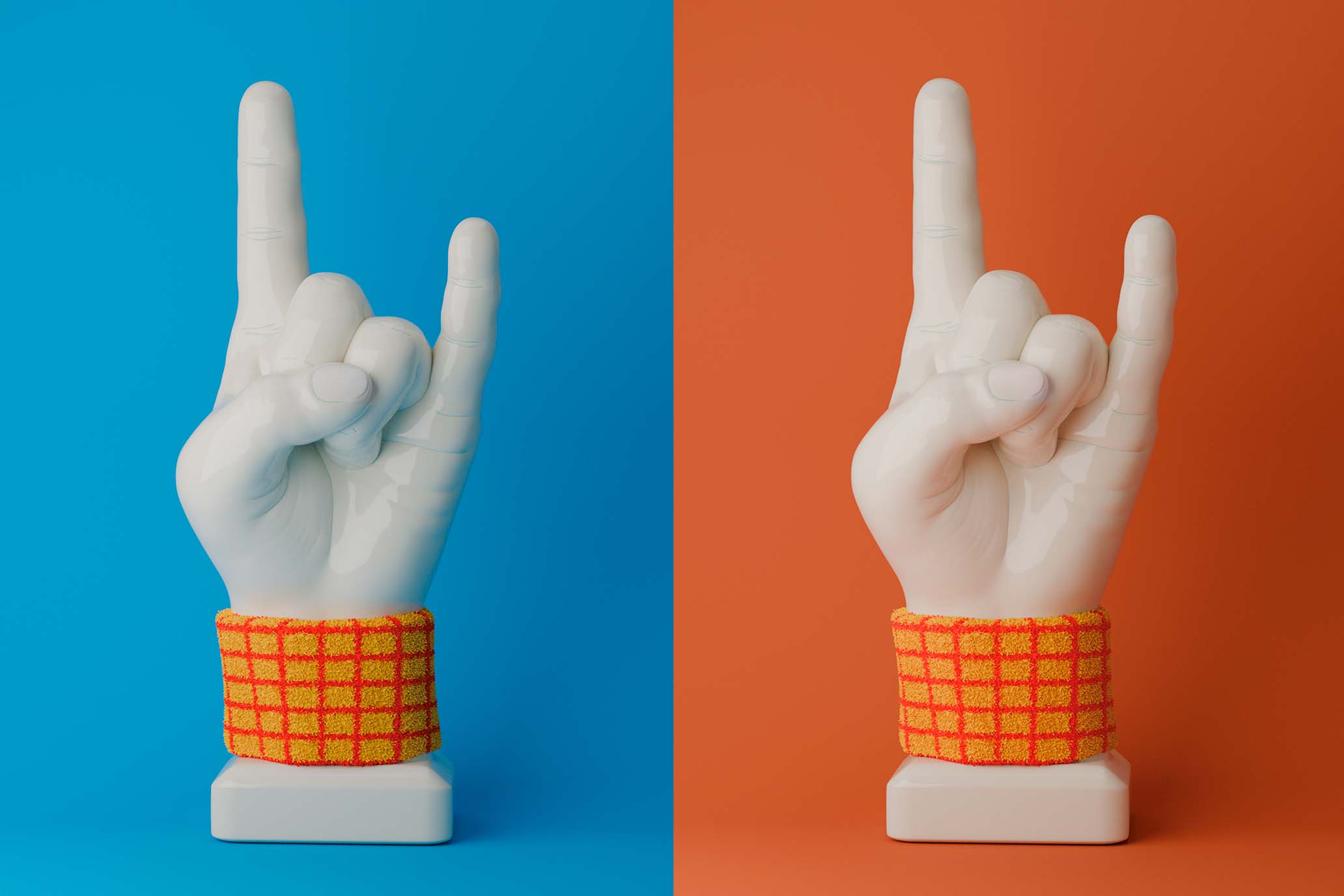
Illustration by Rodrigo Corral
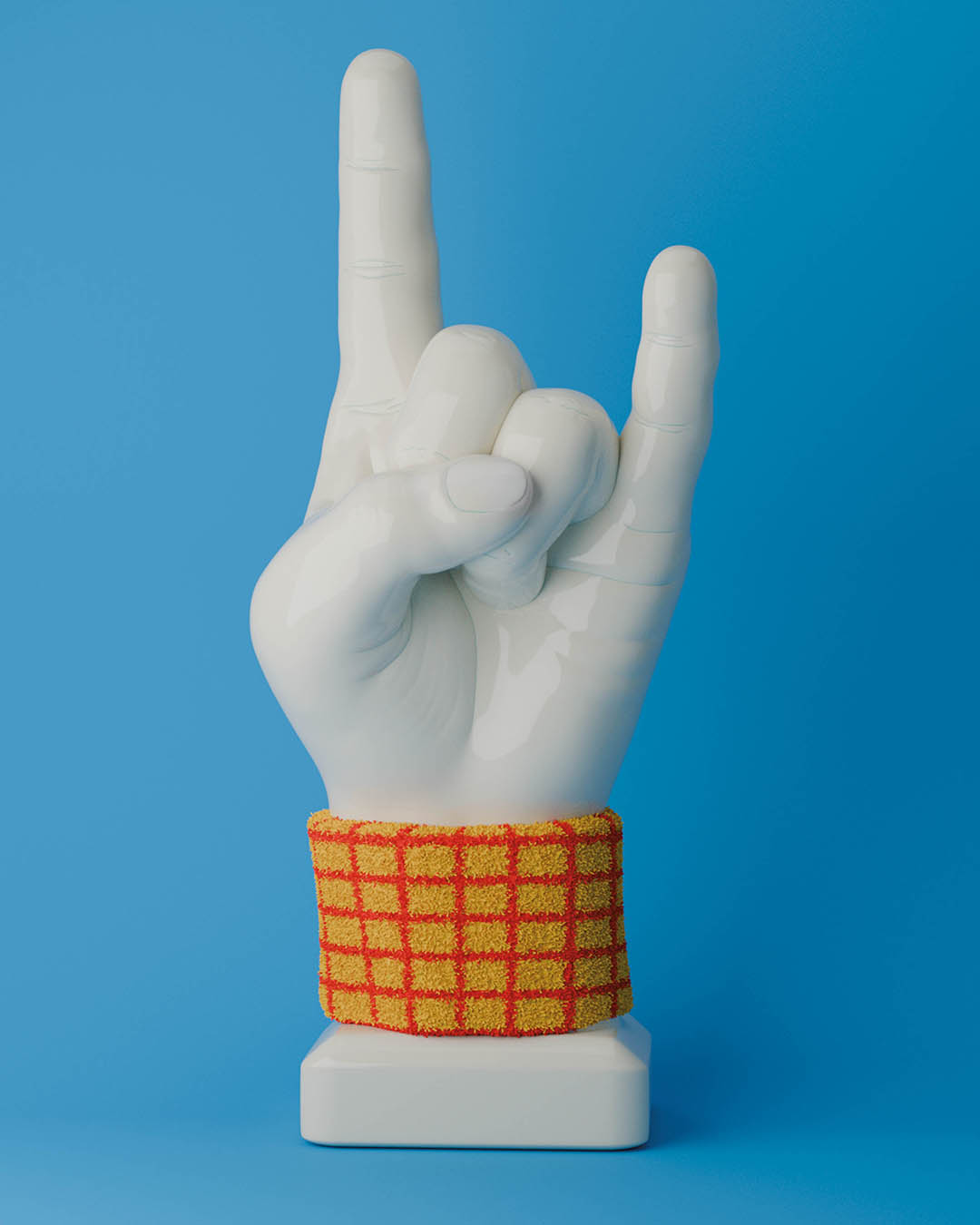
Illustration by Rodrigo Corral
Armed with rulers and an aversion to all things sinister, Catholic nuns are known to go around slapping the wrists of children holding pencils in their left hands. In Latin, “sinister” means both left-handed and inauspicious, generating an institutional bias that extended even to King George VI, who, despite being naturally left-handed, was forced to write with his right hand. The trauma of the involuntary conversion is thought to have produced his stutter, the subject of the film The King’s Speech and a classic case of what psychologists call “misplaced sinister.”
Given his thick Spanish accent, it is difficult for me to say if Rafael Nadal developed a similar impediment when his coach and uncle Toni forced him to change hands. As the apocryphal story goes, he told a 12-year-old Nadal—who eats, writes, and golfs with his right hand—to play tennis with his left in order to gain a tactical advantage. That unconventional decision proved pivotal. Nadal, who retired at the 2024 David Cup, forged one of the most successful careers in tennis history, with 22 Grand Slam titles over a 23-year-long career.
Despite his retirement, a quick glance at his countryman Carlos Alcaraz’s biceps affirms that tennis will never be a perfectly symmetrical sport. This is because, in tennis, the significance of left-handedness goes beyond any individual player’s musculature or tactical advantage. It reflects a larger asymmetry at the heart of a sport that is ultimately about clashing styles and shifting power dynamics. As it turns out, the Taoist belief that the interaction between opposites creates life applies to good tennis, too.

Conventional wisdom tells us that being left-handed is an advantage in tennis. Junior players love to repeat this in the face of defeat. But even professional players admit that this familiar fact gets under their skin. Before the 2021 French Open, Italian Matteo Berrettini told a reporter that playing a lefty is “really annoying.” Around the same time, two-time Wimbledon champion and top lefty Petra Kvitova smugly admitted, “Everybody doesn’t like to play lefties because it takes more thinking.”
Comments like these have given rise to scientific research programs dedicated to identifying the extent to which left-handedness is an advantage in professional sports. When the subject was first studied in the ’80s, researchers believed it was because left-handers were biologically better suited for athletics. According to one theory, this is because they possess larger right hemispheric brain regions associated with visual and spatial functions. According to another, it is because they exhibit more dominant and aggressive personality traits. (The latter theory was also used to argue that left-handers are more likely to be criminals.)
Research has since progressed past this essentialist view and toward the more commonsensical one: Because left-handers are the statistical minority, most players are less familiar facing them. Thus, lefties can upset the rhythm of an opponent accustomed to the typical set of patterns and spins.
The tactical advantage is not exclusive to tennis. Boxing, baseball, fencing, table tennis, and cricket have all been shown to exhibit a greater degree of lefty advantage than tennis. This is partly because the advantage increases with added time pressure. Less time to react means a greater reliance on prediction and instinct. Added time pressure, therefore, increases a lefty’s chances of catching their opponents off guard.
In addition to time pressure, there are other factors correlated to lefty advantage, such as the coordination problems arising from team dynamics. But this does not help us grasp the significance of left-handedness in tennis. If some player has a biological advantage, so what? As servebots remind us, that doesn’t necessarily make things more exciting. It doesn’t explain the thrill of a good lefty-righty battle, why it’s able to scratch our brains and divide our houses.
David Foster Wallace’s 7,000-word love letter to Federer in The New York Times tries to explain this with the claim that the stark character contrast—“Apollo and Dionysian, scalpel and cleaver, righty and southpaw”—provides the conditions for good (Federer) to triumph over evil (Nadal). The logic of his eloquent fangirling, however, is erroneous, for even Djokovic fans can admit the kinetic beauty displayed in the Federer-Nadal rivalry. No matter what DFW says, tennis matches do not thrust us into a mythic realm of angels and demons.
No—it’s more like a return to the mirror stage, a chance to bask in the visual splendor of a matrix of reflections. A kind of infinity room, the grinding juxtaposition of styles is able to create something greater than the sum of its parts. Athens versus Sparta, yin versus yang, Team Edward versus Team Jacob. To witness opposites interact is to be reminded that there is always more than one mode of being, and there is always more than one object of desire.
While the aesthetics of handedness explain our primordial fascination, they do not explain what it is about the interaction of opposites that’s able to create something larger. After all, why can’t some other mash-up of styles achieve the same effect?
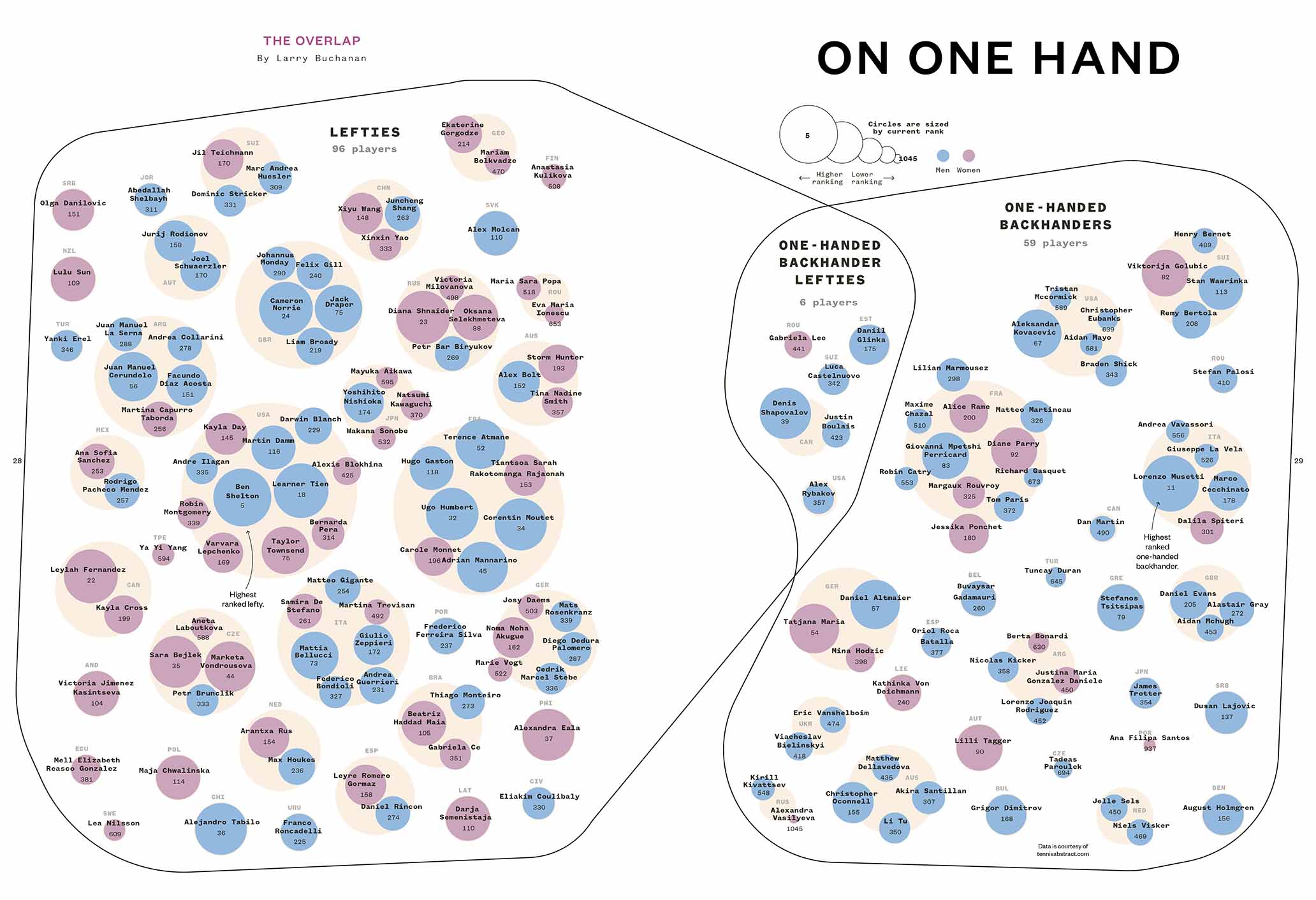
If you thought the one-handed backhand was a dying breed, consider the lefty one-hander. // Infographic by Larry Buchanan, featured in OPEN Tennis Vol. 4.
If you thought the one-handed backhand was a dying breed, consider the lefty one-hander. // Infographic by Larry Buchanan, featured in OPEN Tennis Vol. 4.
To understand the impact of left-handedness, we need to look beyond the typical ways of approaching unpredictability in tennis. When analyzing matches, we talk too much about luck. By now, we all understand that players are not machines. They are susceptible to good days and bad days. Sometimes Fortuna is on their side. Other times, she is not. Blah blah blah…
The issue with luck talk isn’t that it’s misplaced or that it discounts hard work and talent. The issue is how luck is used as a conversational roadblock. Saying that a player had a “bad day” or a “lucky break” is an easy way for a commentator to fulfill their job description. Similarly, players know that they shouldn’t reveal their game plans and deepest inner thoughts, so they blame the intangibles, the ineffable, the weather… Almost always, these are strategies to oversimplify the complexity of a match they paid professionals to analyze. Almost always, there is more going on behind the scenes. To cite luck is a performative way of throwing one’s hands up and saying, “Next question.”
But even the weather is not a system governed by chance. It is a system governed by chaos. Framing things in terms of chance is not only overdone, but it obscures the role of chaos in a tennis match, its ability to shift momentum and instate disorder.
In physics, a dynamical system is called chaotic if a small change in initial conditions produces a large change in outcome. Until recently, it was thought that small changes in inputs could only produce small changes in output. In the ’60s, however, physicist Edward Lorenz showed that a difference in the thousandth decimal place (the difference between .506 and .5061) in ocean-surface temperature could have a profound impact on future weather patterns. The difference between a devastating storm and low tide.
What’s unique about chaos is that it generates unpredictability without the involvement of chance. Unlike flipping a coin or rolling a die—simple systems that offer few surprises—the unpredictability of chaos stems from its complexity. In a chaotic system, there are many physical laws at work, and, crucially, these laws push in conflicting directions. In chaotic systems like weather patterns or fluid dynamics, forces such as momentum, pressure, and temperature can simultaneously amplify and counteract one another. The tug-of-war of opposing forces makes it difficult, sometimes impossible, to predict the system’s behavior over time. (Famously, the three-body problem, in which three celestial bodies orbit one another, has been shown to describe a chaotic system that has no general solution.) In such cases, even if we understand the causes, the effects elude us.
Chaos also tells us that the relationship between input and output is not always linear. Contrary to popular belief, there are many cases where it is possible to get out more than you put in. Flipping one’s forehand onto the ad side is one such case.
A lefty-righty matchup continuously subjects the ball to maximal changes in trajectory. Each player produces an opposing set of forces in an arduous attempt to make sure their particular set of spins, angles, and curvatures wins out in the end. A lefty-righty matchup expands the possibility space of physical states that the ball can occupy. The possibilities only increase as we advance in the match. As we move from shots to points to games to sets, the complexity and therefore unpredictability compound. Even if we think we know what’s coming, we can’t help but get aced out wide.
What lefties do for tennis, therefore, is not just create awkward angles. They create chaos. As agents of chaos, they do not just alter the physical elements of a tennis match, but also the psychological. A missed backhand return, a shanked overhead, a seemingly unremarkable bunt that falls a little too short and out of reach—each of these can introduce psychological disorder. A lefty’s ability to constantly redirect the ball along all physical dimensions makes each of these disruptions more likely. If you are in doubt, just watch one of Adrian Mannarino’s matches. Standing atop the baseline and cutting off angles like he’s making it up as he goes, the left-handed Frenchman became 17th in the world in part by drawing errors from frustrated opponents.
Ultimately, tennis is not about luck, nor is it about control. It is about the small, errant shifts that go unnoticed until they’ve already changed everything. A lefty-righty matchup, in this sense, is a demonstration of chaos. It’s not God or chance that dictates the outcome, but a system teetering on the edge of instability, where the downstream consequences of every decision, every misstep, travel further than we could ever expect. We like to think we understand what’s coming, but we never do. And in that uncertainty, in that entropy, lies the beauty and the annoyance.
Among other things, the rapture of the lefty-righty dynamic is in the physics. Newton’s third law tells us that for every force, there is an equal and opposite one. When rival forces come together on the tennis court, the angles bend unnervingly, the ball doesn’t know which way to spin, and we’re left with no option but to wait and watch what happens next.
Though chaos by definition resists long-term prediction, a 12-year-old Nadal seemed to know which hand to hold his racquet in to create disruptions years down the line with his hooking forehand on the run and slice out wide. No one embodies the ethos of chaos more than Nadal, with his belief that the position of his water bottle, the tightness of his Bermuda shorts, and the number of sprints he runs in the locker room have the power to change the outcome of the match.
With Nadal’s retirement, there is an even greater need to push for more chaos in the sport. While those like Nick Kyrgios think this should come in the form of tattoos, trash talk, and smashed racquets, this solution misunderstands the nature of what has been lost. To break the rules is one thing, but to expand what is possible within them is another. Chaos does not mean noise. Chaos, as Nadal practiced it, is an insistence on expanding the physically possible, on doing what the game itself had not yet imagined. The answer is not louder. The answer is deeper, a return to the fundamental principles that make tennis’ particular kind of destruction inevitable—rhythmic, even.

TENNIS. ART. CULTURE. FASHION. TRAVEL. IDEAS. — SIGN UP
RECOMMENDED
Pete Sampras: Wanna Bet?
FILM REVIEWS
Zac Farro: Life Preserver
CULTURE & ARTS