In Praise of Magic
In Praise of Magic
Carlos Alcaraz raises the bar in Paris.
Carlos Alcaraz raises the bar in Paris.
By Owen LewisNovember 9, 2026
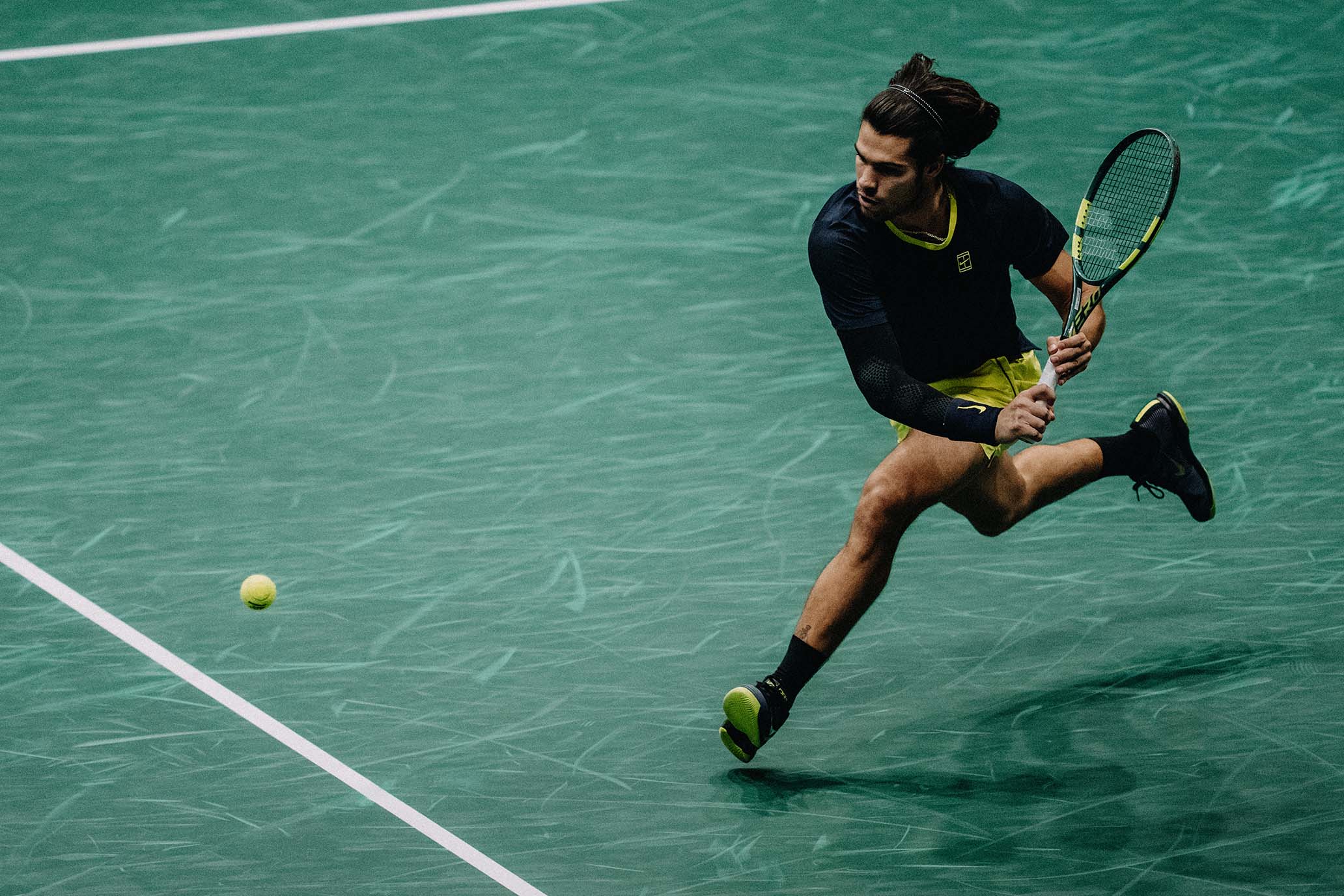
Carlitos in full flight in Paris. // GETTY
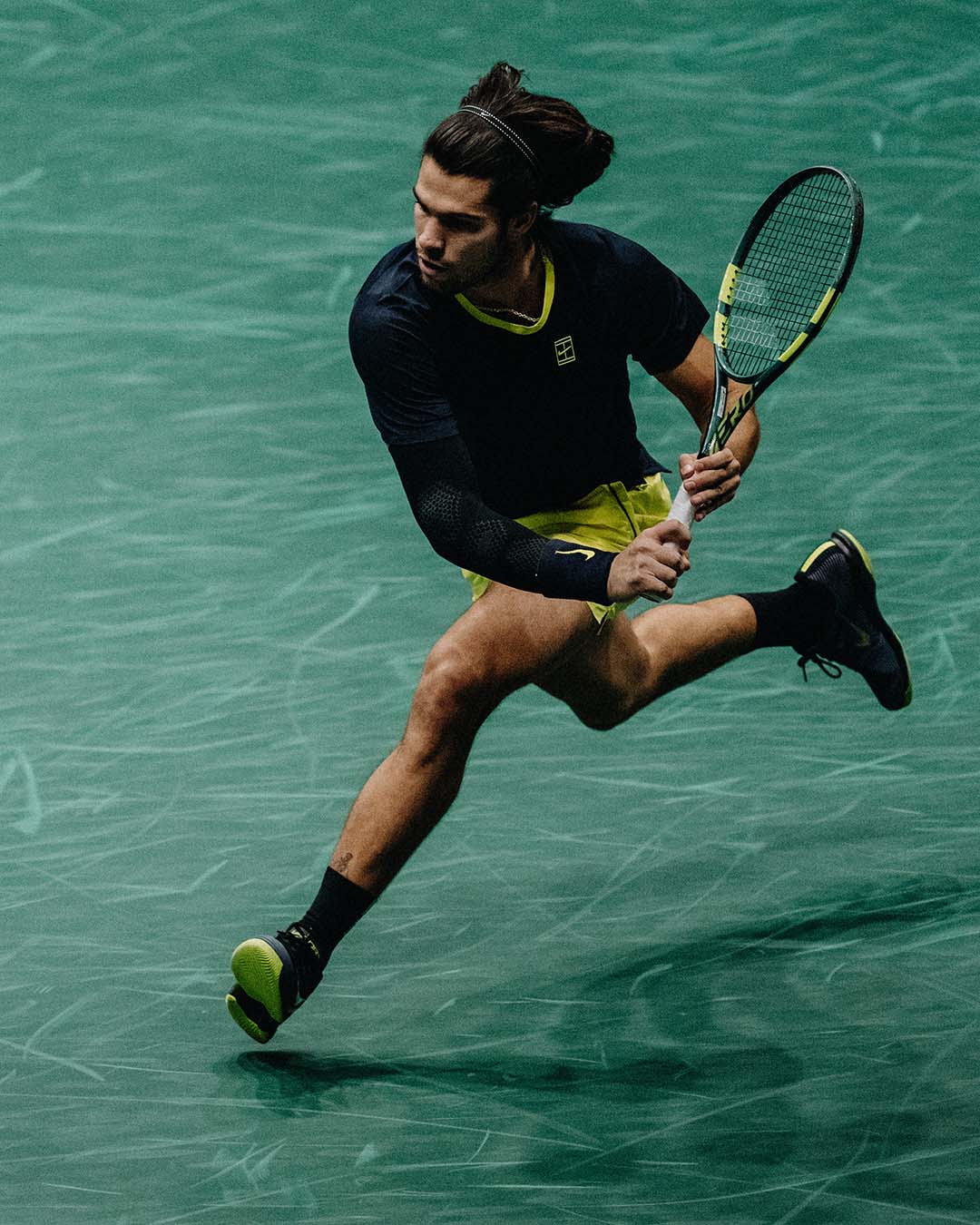
Carlitos in full flight in Paris. // GETTY
During the Paris Masters final between Carlos Alcaraz and Ben Shelton on Sunday morning, Alcaraz began his 1–2 service game in the first set with three consecutive forehand plus-one errors. That set ended in a tiebreak, in which Alcaraz went up 3–1 and then lost three more points in a row, the last thanks to a horrendous swing volley error. At 2–2 in the second set, Alcaraz lost serve for the only time all match thanks to these four points: forehand plus-one unforced error, double fault, double fault, forehand plus-one unforced error. As an Alcaraz fan, this last sequence was nearly enough for me to turn off the match. It’s a testament to Carlos’ ability to exceed the magnitude of some very low lows with his peak, and at the right times, that he wound up beating Shelton in two sets.
I once wrote that Alcaraz’s best tennis emerges naturally from necessity. His title run this week reminded me of the virtues and limits of that quality. Anything more than zero breathing room might not trigger the clutch gene. It might even trigger errors bad enough to challenge your opinion of Alcaraz as a player. The first-set tiebreak Alcaraz played against Taylor Fritz in the quarterfinals could act as a long research paper in support of that idea. Carlos whittled his margin for error down to nothing, blew plus-one shots on set points both for and against him, and lost the breaker 12–10. Fritz did not celebrate one of the biggest set wins of his career, perhaps too confused by his all-time-great opponent momentarily forgetting the concept of net clearance. But if you follow tennis at all, you know what wound up happening: Fritz had two match points, Alcaraz hit winners on both and authored a scorching comeback to echo his Roland-Garros comeback against Jannik Sinner in the best-of-three format.
I watched that comeback in a coffee shop. I’d originally gone there with the intent of transcribing some interviews for a long project and called up the match to monitor it between fevered bouts of typing. In the end, I forgot about the project (almost immediately), that the coffee shop was way too hot, and that I had to pee badly enough that kidney damage seemed like a slight risk. At 5–3, Fritz socked a backhand return that Alcaraz could only flap at pathetically, and then a crosscourt forehand return that zipped by him cleanly to bring up match point. When Alcaraz missed his first serve, the match felt over both logically and narratively.
A minute later, Alcaraz was racing outside the tramlines in pursuit of Fritz’s crosscourt backhand overhead, which crossed the net at such a violent angle it seemed like the only possible response was a short lob at the very end of Alcaraz’s range. Instead, Carlos got there comfortably and sent the ball back along the same vector via a drop shot, an idea no player would have, that no coach would teach. He slid into the shot and right out of the camera frame, his movement exceeding the bounds of the obnoxiously boxy court presentation in Paris. Fritz couldn’t come close to returning it and pulled up with a wide grin that remained on his face until midway through the changeover.
From that point until Alcaraz won the second set 7–5, I felt like my chest was on fire. I saw Fritz land what felt like another knockout blow, a cramped backhand pass after Alcaraz had sprawled out fully to hit a sharp volley on the stretch (after which he winced and rolled his head around, like he’d pulled something in his neck). I saw Fritz making every first serve on the fastest court so far this season while trying to serve out the match, and Alcaraz get them all back besides one that caught the very edge of the sideline. I saw Fritz line up another match point, earn a short backhand at net, and watch as Alcaraz reached it and flicked a forehand by him. Alcaraz debuted a choppier version of the motion players usually use to pump up the crowd, matadorlike, turning the match into a war of pride.
This match has produced an online debate about Fritz’s decision-making on the second match point. He clubbed an inside-out forehand and came in behind it, only for Alcaraz to unfurl a low sliced backhand that Fritz decided to hit on the bounce instead of volleying. A vocal contingent thinks Fritz should have taken it out of the air, and, though I hope not to offend the intelligence of this party too much, this is one of the more ridiculous things I’ve ever heard. For one thing, are these people familiar with Fritz’s net game? Volleying this ball had a better chance of producing an outright miss or setting up an easier pass for Alcaraz than winning Fritz the point.
But what feels even more relevant is that we’re nitpicking Fritz’s decisions on a match point against a player much better than him. Since when do we expect players on the cusp of a monumental upset to execute letter-perfect shot placement and selection on match point? That it’s required doesn’t make it easy, that Fritz was close to beating Alcaraz is not a reason to hold Fritz to Alcarazian standards. Though he still had to break to stay in the match, Alcaraz entered the 5–4 game with a tidal wave of momentum on his side thanks to hitting (inventing) one of the shots of the year. Sinner, a player who is both significantly better than Fritz and more clutch than him, also crumbled in this situation in last year’s Roland-Garros final. Unlike Sinner, Fritz at least got to match point while trying to serve the match out (and had a break point at 5–5). Fritz also made Alcaraz do more than Roger Federer made Novak Djokovic do on one of the match points in the 2019 Wimbledon final.
What decided this match is that Alcaraz was playing without magic until he ran entirely out of breathing room, and then played with magic thereafter. I have only ever seen one player survive Alcaraz in the terrifying extent of his death-defying mode before (Djokovic in the 2023 Cincinnati final, when Alcaraz was 20). The tennis Fritz had to compete with was not endurable. I’m not sure it really matters that he still hasn’t beaten Alcaraz outside the Laver Cup, aside from any wounded pride he might feel personally, because the idea that anybody could watch this and hold that record against him is impossible. He made screamingly obvious in this match that he’s good enough to get a win. If it’s just about him not converting match point and formalizing what’s already known, maybe we have the wrong standards.
If you couldn’t already tell by the long digression, Alcaraz’s ability to create absurd and unexpected yet accurate shots under the highest pressure is taking up significantly more space in my head than his title win. Which is a big achievement! This Paris title is Alcaraz’s biggest title in conditions that do not favor him. He took revenge on Shelton for beating him in the US Open quarterfinals. He brought his post-wrist-injury record to 19–2 and won a third title in five events. He erased any existing doubt that he is the best player on tour in Sinner’s absence.
And yet all I can think about is Alcaraz’s coexisting qualities as a fighter and a magician. I have often wondered why Alcaraz doesn’t play his best more frequently. His shotmaking is utterly unique—it’s brawnier and even more audacious than Federer’s, who brought to mind an artist with a paintbrush; Alcaraz would be authoring deafening rock concerts if he had the voice—and his consistency is so spotty that it’s often unclear if he’s bored or unfocused or truly confused. It’s as if he has a switch he can flick at will to summon his most devastating play when he most has to, so it should be easier when he’s under less pressure, right?
This has been true since his maiden major victory: He turned into a servebot in the fourth set of the final, when he needed to spare his legs from a moment’s more work. Channeling the spirit of Pete Sampras at 19 years old implied that a wonderful server lay close in the future. And yet, four years later, Alcaraz still plays matches in which it looks like he has no idea how to serve. (Though we saw flickers of his serving peak again in Paris, particularly in his semifinal against Casper Ruud.)
This tournament left me with an answer to why Alcaraz’s level constantly fluctuates only to find divine equilibrium in defining moments. I don’t know if this ability is natural or learned, if he knows the answer or not. But it suddenly feels obvious nonetheless: It’s so that he can play matches like the one against Fritz.