The Graduate
The Graduate
More than 60 years after leaving college to pursue tennis, Billie Jean King is finally a graduate.
More than 60 years after leaving college for tennis, Billie Jean King is finally a graduate.
By Joel DruckerMay 22, 2026
She's come a long way, baby.
Champions finish.
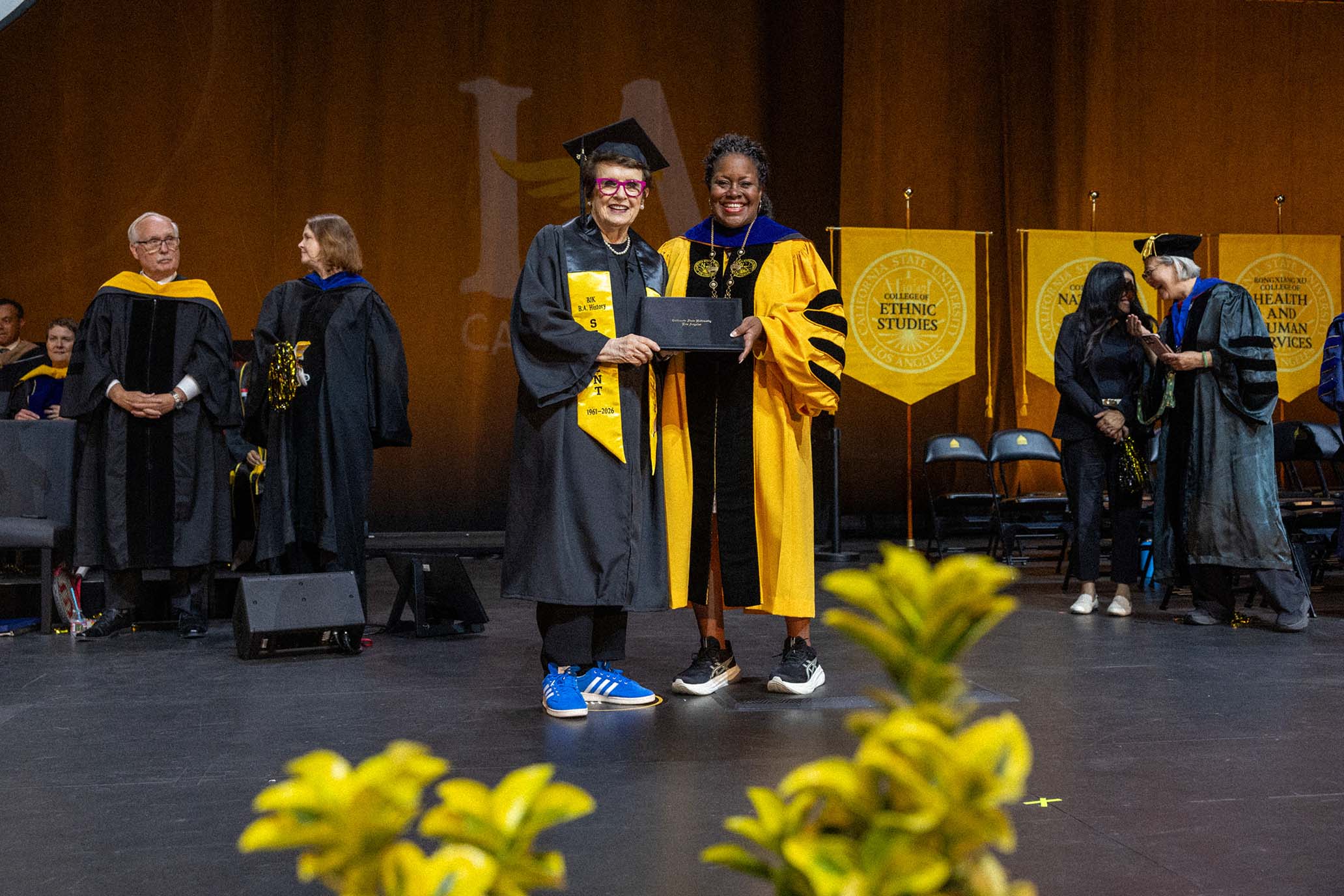
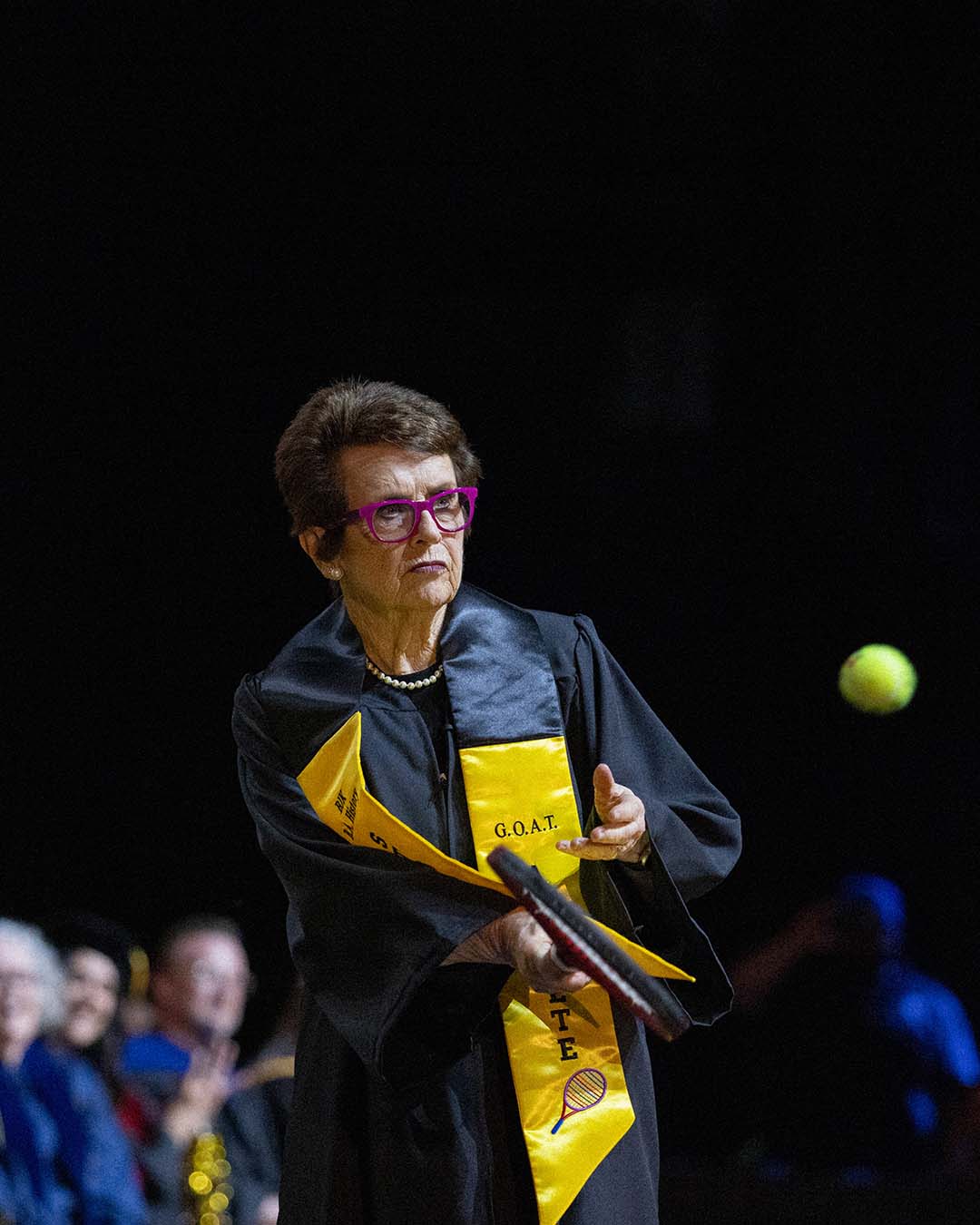
“Champions finish,” goes one of Billie Jean King’s trademark sayings. So it came to be that on Monday, May 18, more than 60 years after leaving college to pursue her tennis dreams, the 82-year-old King at last earned a degree, graduating from Cal State LA, the same Southern California-based school she’d entered in the fall of 1961 and left four autumns later.
King’s major was history, a personal passion and mission since childhood that for decades has propelled her relentless curiosity and ambition. Determined to make tons of history, in July 1966, less than 12 months after exiting college, King won her first of six Wimbledon singles titles.
The next 15 years were a whirlwind. There was envisioned success inside the lines, grand triumphs at all of tennis’ major venues. There was also what’s arguably the greatest crusade in sports history, a simultaneously desired and surprising series of twists and turns that continually kept King at the forefront of transforming the landscape of sports. During that lively period, King helped create and promote pro circuits, testified before the U.S. Senate on behalf of equality, met with oodles of sponsors, conducted thousands of interviews, launched a foundation and a magazine, and cofounded league and team competitions.
These days, she remains deeply involved and invested in several sports properties, including the Billie Jean King Cup—the all-women’s international team tennis event that King can joyfully trace all the way back to an early-20th-century tennis champion she knew well, Hazel Hotchkiss Wightman. The epic history made by King has been extensively documented in articles, books, documentaries, and feature films.
More than 25 years prior to Monday’s graduation, during the years when she worked as a commentator for HBO’s coverage of Wimbledon, King strolled across a hillside at the All England Club with a colleague, glanced over rows of grass courts, and explained her deep engagement with history. “The best way to change the world is to understand what came before you,” King said that day in London. “You study and appreciate the traditions, and from there you can make the innovations.” Has anyone ever more vividly lived that statement? Of King’s 39 Grand Slam titles, 20 had come at tradition-bound Wimbledon. But King had concurrently tilted at windmills and fought for change, so successfully that the USTA in 2006 renamed its national center after her.
The education of Billie Jean had begun in her hometown of Long Beach, Calif. Long before such terms as “visualization” entered the public lexicon, she did precisely that by conjuring the sport’s icons and citadels. “I studied all the players, past and present,” King told me last month as she reflected on having not just read about but also spoken with 100 years of tennis champions. “I was able to be a leader because I knew about the history of the sport…. I wish every tennis player would read the history of our sport.”
Another fortuitous aspect was that King’s tennis education took place in a region teeming with its own rich history. At places like the Los Angeles Tennis Club during the annual Pacific Southwest Championships (then the second-most important tournament in the country), King witnessed such visiting greats as Althea Gibson and Rod Laver. Year-round, other giants were front and center whom a young Billie Jean learned from, including major champions Alice Marble, Louise Brough, Darlene Hard, Pancho Gonzalez, Pancho Segura, and many more. “I’m seeing the cream of the crop,” said King. “I was watching living history.” Call it a tennis version of growing up in Florence during the Renaissance and dreaming of becoming a painter.
But as much as King absorbed through her own studies and experiences, unfinished business remained. Though she’d already earned honorary degrees from the likes of Northwestern and Oxford and been offered the chance to study at other colleges, there was no question in King’s mind that what she’d started at Cal State LA must surely finish there. “Talk about delayed gratification,” she said. “I came back with a purpose.”
Having accumulated three years of credits during the first stage of her Cal State LA journey, the New York City-based King went about taking a final year’s set of classes online. Coursework covered a variety of subjects, including classes on the LGBTQ Political History of the United States, Latin American Women, Digital & Public History, Historical Research & Writing, Kinesiology, Communications, and Historical Interpretation. There were live interviews with professors, as well as oral and written reports. “One thing that will always jump out at me with a student is a degree of curiosity,” said one of King’s professors, kinesiologist Anne Larson. “Billie Jean King possesses an extremely high degree of curiosity. She wants to know, and then she wants to dig in.”
King’s prominence also created other opportunities, such as when she spoke to a group of incarcerated men and women as part of a program run by Cal State LA. “Seeing their world through their eyes was life-changing for me,” said King. “I was reminded that wherever we are in life, we can connect.”
But most of all, as King stressed when we spoke, there was reading, reading, and reading, volume after volume of stories, interpretations, analysis, detail. “You have to be careful when you read history,” said King, “and remember that’s the interpretation of the person writing it.” As an example, during a course that addressed Title IX, the 1972 piece of legislation that helped create significantly more opportunities for female athletes, King politely corrected a professor’s explanation of an occurrence from that time; in this rare case, the student’s credibility was greatly enhanced by having been present when it happened.
“The only way you can figure out the bigger picture is to actually do a little bit of studying of the history of the nation that we live in,” said Lynn Hunt, a history professor at UCLA, “the countries that we relate to, the world that we are part of, and also how this has developed over time…. How amazing that someone who made so much history herself would set about studying it.”
“Like so many of today’s graduates,” King said as she gave a commencement speech Monday evening, “I am the very first member of my immediate family to graduate from college.” As King spoke, it was easy to conjure history as kaleidoscope. It had been 72 years since the 10-year-old Billie Jean had taken her first tennis lesson at Houghton Park in Long Beach and later that evening informed her mother, Betty, that she intended to become the best tennis player in the world. It had been 52 years since that sleep-deprived 1973 when she’d formed the WTA, beaten Bobby Riggs in the iconic “Battle of the Sexes,” and, yes, won the singles, doubles, and mixed at Wimbledon. It had been 65 years since she’d commenced life on the Cal State LA campus, a few weeks after winning her first Wimbledon doubles title.
While such King peers as Arthur Ashe at UCLA and Dennis Ralston at USC attended college as scholarship student-athletes, no such opportunities existed for women then. One way King supported herself was by working as a playground director at an elementary school, a job she greatly enjoyed. Talk with King long enough, and you will see all these occurrences—just and unjust alike—splash across a sparkling and present now; history as pinball machine, a rich jumble of tennis balls, people, and places bouncing off one another in volley-like ecstasy as King continues her quest to, in her words, “learn how to learn.”
And then, as always with King, there are the possibilities held by the future. Sept. 22–27 marks the next round of the 2026 Billie Jean King Cup, this year to be held in Shenzhen, China. Back when that event was known as the Fed Cup, King had played the inaugural version in June 1963 and contributed greatly to a victory over Australia in the final. She was 19 then, a teenager having completed her second year at Cal State LA. Now she’ll return as a graduate. “Have fun, be fearless, and make history,” King told her fellow graduates Monday night. From Long Beach to London to Cal State LA and back again, China and beyond, history for Billie Jean King is no distant island. It’s a dynamic entity, one she breathes fire into ceaselessly.

PURE, ORIGINAL TENNIS — SIGN UP!
RECOMMENDED

The Long Rally
The Hobby