Almost Heaven
Almost Heaven
Grigor Dimitrov is Wimbledon's lovable underdog.
Grigor Dimitrov is Wimbledon's lovable underdog.
By Owen LewisJuly 3, 2026
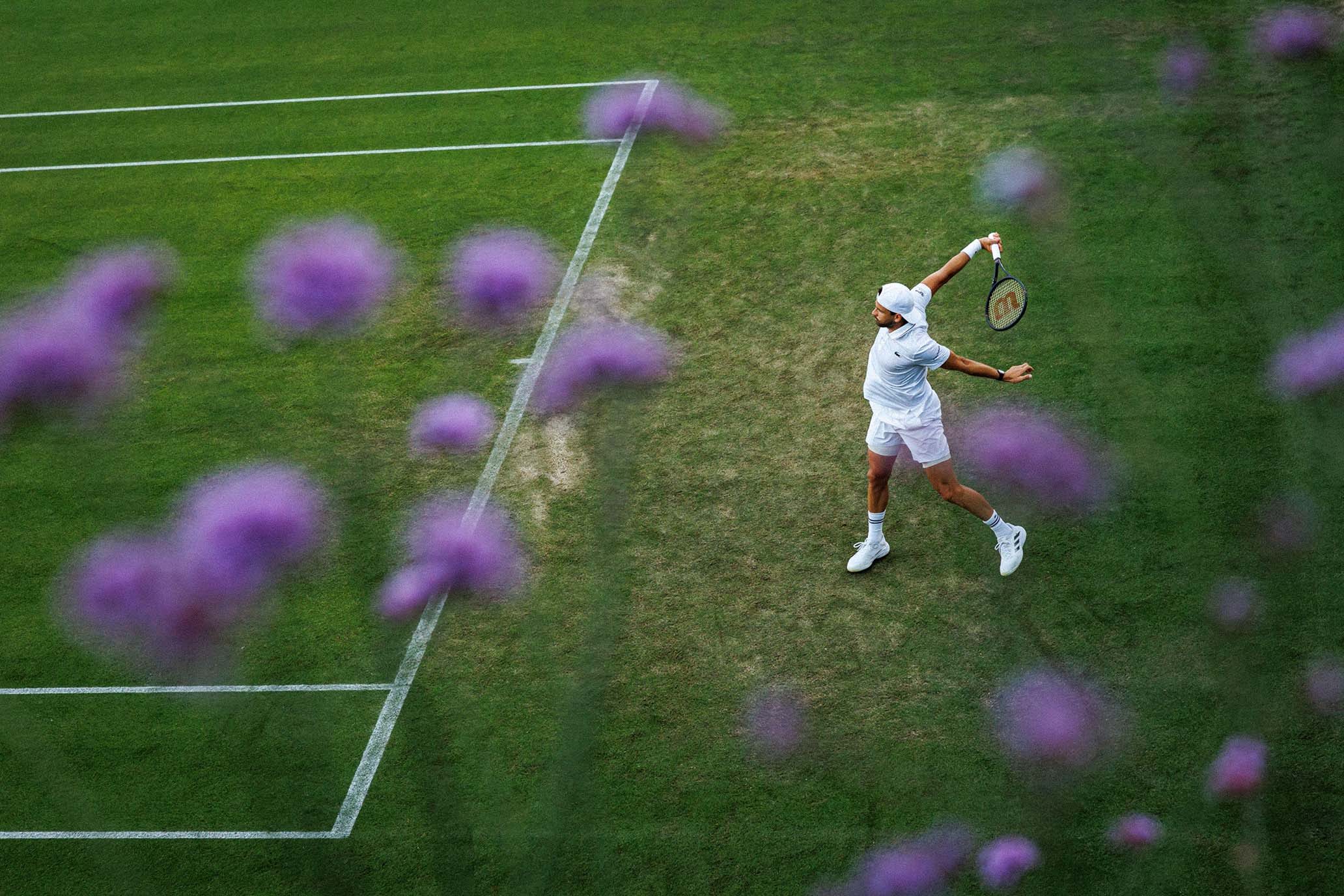
Perfect form. // Getty
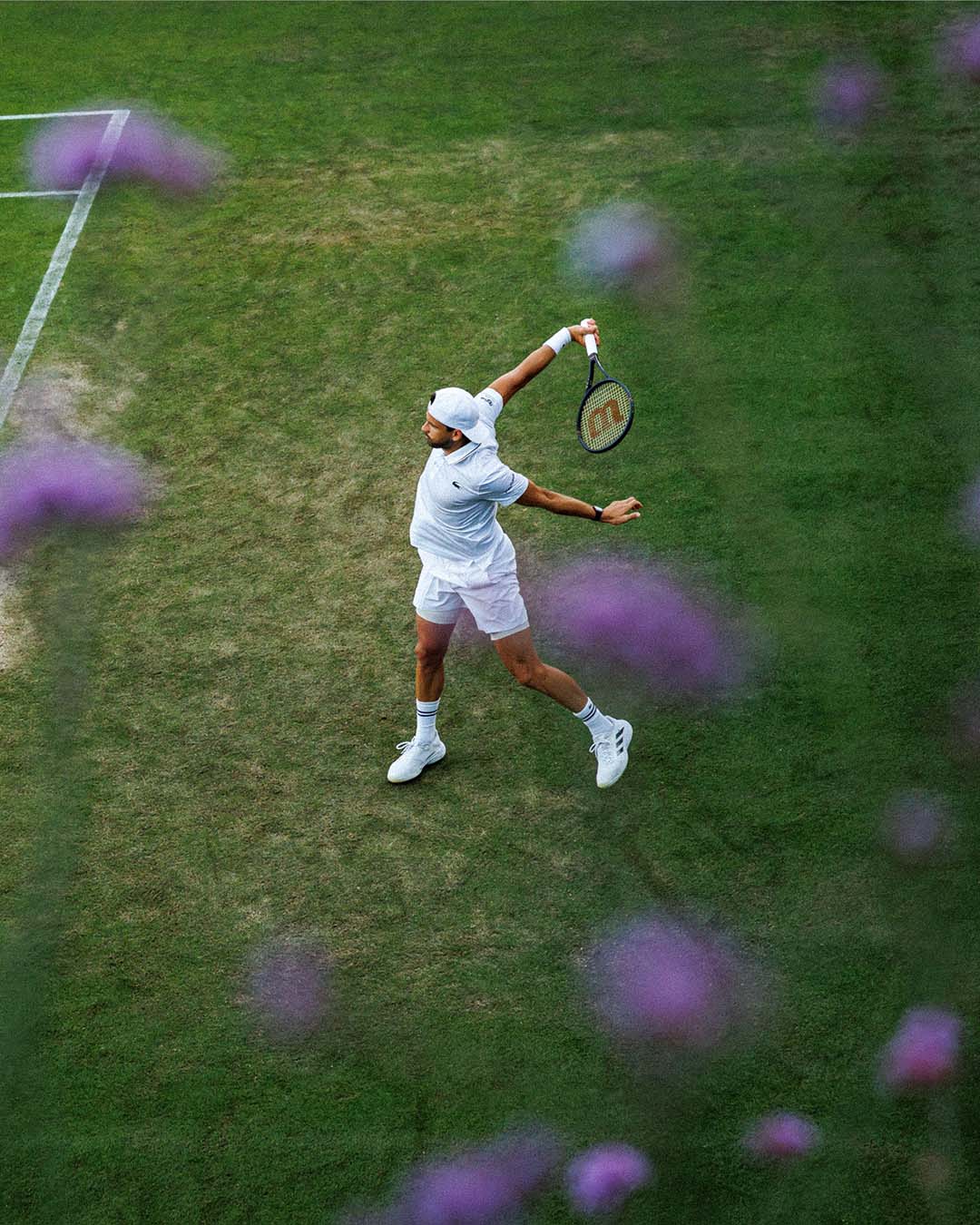
Perfect form. // Getty.
It felt too good to be true, and indeed it was. Grigor Dimitrov was up two sets on Jannik Sinner in the fourth round of Wimbledon, yet to lose serve in the third set. Sinner had fallen on his wrist early in the match, robbing his rally ball of the requisite sting to unravel Dimitrov’s one-handed backhand. Faced with a glitchy world number one, Grigor feasted. He ripped off the first set easily. He served for the second and Sinner broke him, showing more emotion in his celebratory roar than he displayed after winning at least three of his four major titles. Many an upset has died at this juncture: 5–4 to 5–7, 1–6, 1–6, good night. Instead: Dimitrov broke back immediately, his break-point chip return diving off the line and away from Sinner’s racquet. A tough service game later, and he was two sets to the good.
That Dimitrov blew out his pec while hitting an ace to hold for 2–2 in the third set was darkly fitting. Maybe the roof closing after the second set had a bit to do with it—Sinner getting a 15-minute break at just the right time smelled a bit of A-side favoritism—stiffening Dimitrov’s muscles before he had to keep firing serves at upwards of 130 mph. But it felt most likely that he just overextended himself. He’d been reaching back for a bit of extra zip on that serve all day to keep Sinner’s bruising returns at bay. The price of two sets and change of pristine serving might be a little extra give in the muscles, or a lot, at the worst possible time. Dimitrov needed to lift his right arm with his left to shake hands with Sinner; hitting another ball was out of the question.
It was Dimitrov’s fifth straight exit from a major via injury. As if the notion that his near career-best form was irrelevant because his body couldn’t sustain the force of playing it wasn’t dispiriting enough, his momentum cratered as well. He didn’t come back until the Paris Masters, won one match, then pulled out of that tournament, too. He lost nine of his next 11 matches, including one from a set up in the first round of Roland-Garros qualifying. Under a year on from having the best player in the world on the ropes deep in a major, Dimitrov couldn’t even crack a main draw.
Wimbledon simultaneously stood as the site of his trauma and a sorely needed opportunity. With his ranking already having tumbled out of the top 100, his fourth-round points from SW19 in 2025 peeling off as well would feel like a fatal blow to his career. Grigor finally strung together a couple wins in Mallorca before losing to Alejandro Davidovich Fokina—who went on to win the title!—but there was little reason to expect much from him on the London lawns.
A well-spent wild card vaulted Dimitrov into the main draw, where he dismissed Dave Sweeny in his opening match. But his fortunes figured to end against Jakub Mensik. Arguably the most dangerous server in the draw, Mensik’s delivery would scorch frightening shapes in the grass, hell for a one-handed backhand to return. He’d be even more dangerous here than at Roland-Garros, where he made the semifinals.
Somehow, Dimitrov found his 2025 form when he needed it most. It must have taken so much will—he admitted to some trauma after the pec injury this week, haunted by uncertainty over whether the first hard swat of a ball would send the muscle hurtling back into distress. His scything backhand slice exposed Mensik’s forehand as the horrid, limp shot it can be at its worst. He filled the highlight reel with crafty passing shots and inspired volleys. (If only tennis reinvented itself into the short-court game, where you can hit only touch shots, Dimitrov would be number one—or two, behind Carlos Alcaraz.) He even outserved Mensik: He made first serves at a lower rate and produced 10 aces to his opponent’s 31, but won 74.8 percent of his first-serve points to Mensik’s 72.8 percent. It wasn’t even close on the second serve.
I’ve watched the match point five times already. It’s an even rally, both guys trying harder to avoid being attacked than attack themselves. Then Dimitrov directs his backhand slice crosscourt. Grigor’s chop is one of the best few of all time, and Mensik couldn’t match it. He sliced low and short, the ball landing around the T. It would have been easy to just chip back under the tension of match point, to accept the gift and return it. But it was also, to the willing, attackable. Dimitrov pounced on it, clubbing a deep, cutting forehand to the right corner that gave Mensik no chance to reach the ball. The winner required courage from Dimitrov, but also permission to feel the joy he’d been denied for a full sweep of the calendar. I’m not in the business of insulting my readers, but if any of you watched him leap with pride and pump his arms and didn’t crack a smile on instinct, there’s no chisel incisive enough to deice your heart.
From the bird’s-eye view, Grigor’s career is one of almosts. He almost won the 2017 Australian Open semifinal over Rafael Nadal, his blistering performance carrying him to two break points at 4–3 in the fifth set before Nadal lit up even more brightly. He almost took Novak Djokovic to five in the 2014 Wimbledon semifinal; he had three straight in the tiebreak there before Djokovic beckoned reality back in. He almost won the Miami Open in 2024 but had to play Jannik Sinner right after he annihilated Carlos Alcaraz. Look back at his 2019 US Open quarterfinal against Roger Federer, and it’s surprising Fed was the one who came down with a back injury and lost 6–2 in the fifth. He’s almost a great tennis player, one tick of easy power and serve precision away, but has to work a bit too hard for his successes.
It’s thanks to these deficiencies that—despite his perfectly impressive career, his dating history and conventionally good looks, the fact that everybody on both tours seems to not only like him but love him (Mensik smiled as widely as Dimitrov did at the net after losing to him!)—Grigor Dimitrov is among the most lovable underdogs in tennis. After ruining his pec against Sinner, in the immediate aftermath as he writhed on the ground, Dimitrov actually grinned. It might have been a smile of shock—man, this hurts—but I wonder if he was marveling at his own bad luck. His late career has had its share of tragedies, more than. Yet his win over Mensik made me reconsider these past few years, and that won’t change even if he reinjures himself against Matteo Berrettini next round. Almost may not be what you want, but if you can find enough joy and brilliance on your way to the word as Dimitrov has, it can’t be such a sad thing after all.

PURE, ORIGINAL TENNIS — SIGN UP!
RECOMMENDED
The Long Rally
The Hobby