
A Lot to Lose
A Lot to Lose
Last year’s Wimbledon finalists will be tested early.
Last year's Wimbledon finalists will be tested early.
By Giri NathanJuly 3, 2026
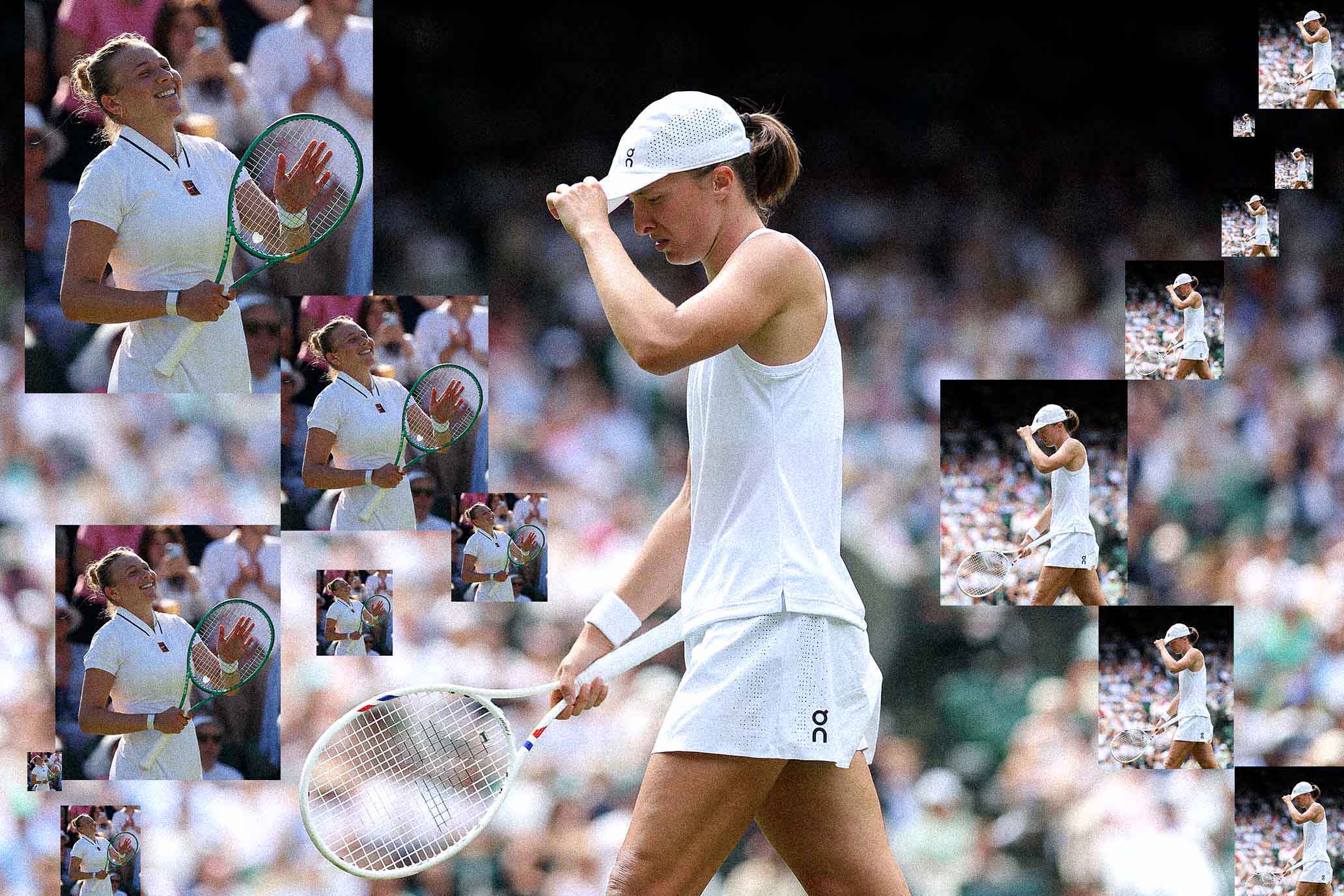
How you doin'? // Getty
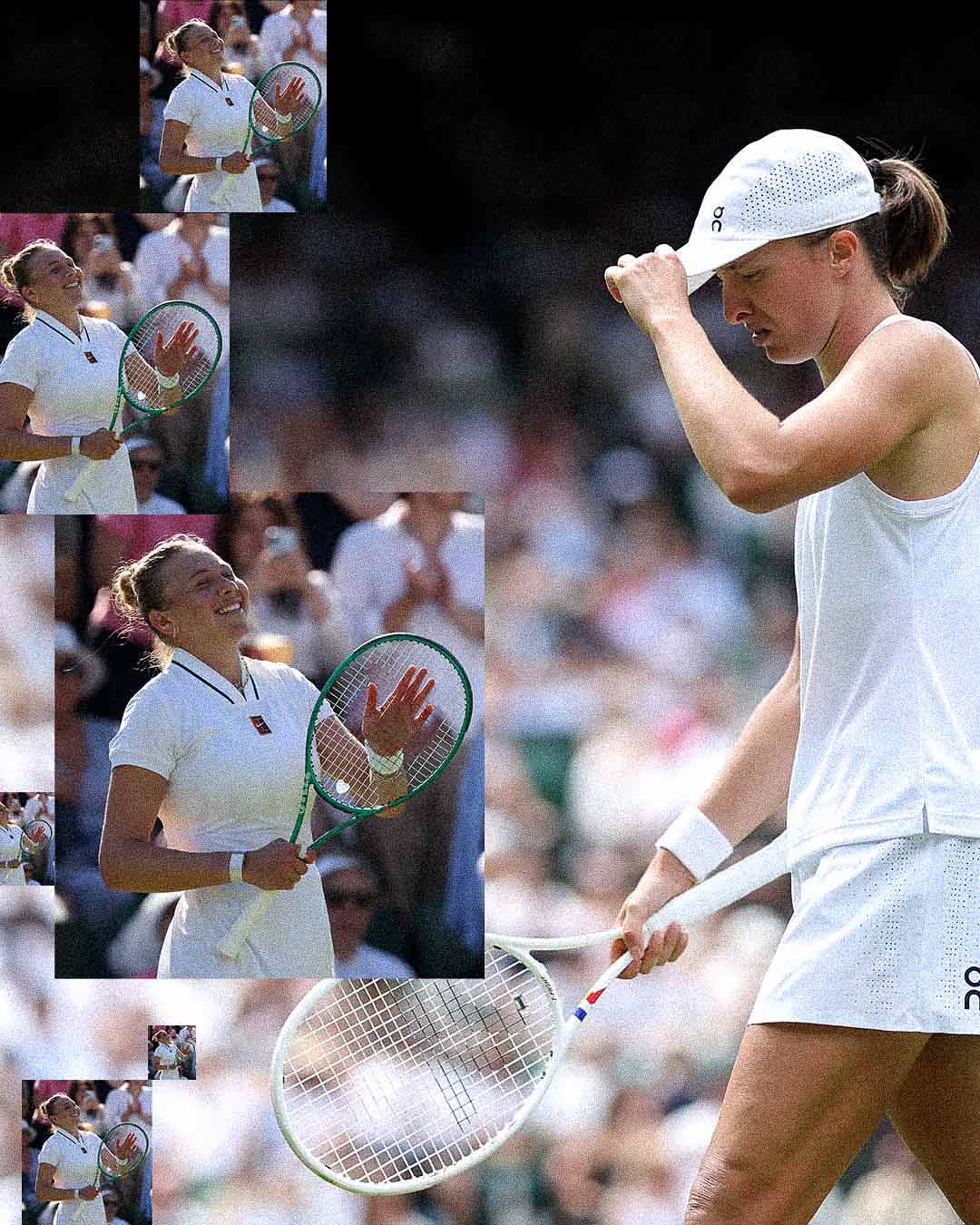
How you doin'? // Getty
Grass is fickle. Wimbledon is a revolving door. One frequently cited fun fact: There have been eight different women’s singles champions over the past eight iterations of the tournament. It’s hard to repeat, but it seems even harder at SW19 than anywhere else. Compared with the other Slams, which have seen plenty of holdovers from year to year, Wimbledon barely sees repeat finalists. Looking at those past eight championship matches, there have been only two names to recur: Serena Williams, presumed retired until her stealth return this year, and Ons Jabeur, on hiatus from the tour after childbirth but already off her top level due to injuries. It feels reasonable to assume that neither of them will ever appear in a Wimbledon final again. Other than them, the remaining finalists are a mix of players now retired (Garbine Muguruza, Angelique Kerber, Simona Halep, Ash Barty), closing in on retirement (Venus Williams, Karolina Pliskova), dealing with a potentially career-ending suspension (Marketa Vondrousova), or otherwise declining in form (Barbora Krejickova, Jasmine Paolini). There’s only one name in that mix that I fully expect to see back in a Wimbledon final someday, and that’s Elena Rybakina
Though I didn’t sort them into those categories, my skepticism extends to both of last year’s finalists, too, as good as they are. In 2025 Iga Swiatek and Amanda Anisimova met in an unforgettable—in terms of shock value, if not the actual rallies—final, which Swiatek won 6–0, 6–0 in just 59 minutes. On its surface, the match was a multi-Slam champ annihilating a player who had never been there before. But there was more narrative depth to it than that. For Swiatek, one of the defining players of her generation, this tournament was a surge out of a long slump, on a court surface that had frustrated her in the past. For Anisimova, a former prodigy, the runner-up finish was proof of her latent, blazing talent. Swiatek seemed like she’d gotten out of a bad funk and found chemistry with coach-of-the-stars Wim Fisette; Anisimova seemed like one of the best ball-strikers alive who would solidify a place on top of the tour, and indeed she went on to collect another runner-up trophy at the US Open two months later.
Flash forward to the 2026 season and instead of rocking up to Wimbledon as favorites, they both appear to be finding their footing all over again, swapping out coaches and working through uninspired seasons, Swiatek most of all. Fresh off losing in Miami to countrywoman Magda Linette, which broke a 73-match win streak in first-round matches, she split with Fisette as coach. She then sought to absorb some Rafa Nadal magic by hiring his former coach Francisco Roig, and there were indeed some delightful videos of Rafa modeling forehands next to Swiatek on court, but this did not bear fruit during her clay season. Once again, she seems to be stumped on the same old puzzle of how to be as good as she used to be—and in particular, as mentally unshakable as she used to be. At Wimbledon, after winning a first-round match over Taylor Townsend, a testy three-setter that saw a long passage of dubious quality from Swiatek, she wept. “I think the whole process of opening the court and playing as a defending champion is for sure really emotional,” Swiatek said. As surprising as it is to say about a defending champion, after studying her rather tame path to the title last year, it’s still unclear if she can beat the very best opponents on grass.
Meanwhile, Anisimova started 2026 with a solid stretch on hard court, but in the spring she swapped coaches and suffered a wrist injury that took her out of most of the clay swing. Her grass-season lead-in has been unusual too. After losing to Iva Jovic at Queens Club, Anisimova felt burned-out after her months in Europe and took a flight back home to spend five days in the U.S., only to fly right back to London for Wimbledon. Her first-round win was straightforward. But in the second round, I was reminded that she rivals current Swiatek in a key tennis metric: her ability to terrorize her own fan base by making winnable matches more complicated and emotionally rich than they should be. In her second match she took on Sofia Kenin, who is currently ranked No. 105, and as Anisimova sprayed error after error, she looked to be having a plainly awful time on court. She said as much, too: “Some moments were really awful. I’m just happy to be through to the next round,” she reported after a match that involved significant yelling. She was helped by playing Kenin, a returner so famously lax that Anisimova, whose serve is a weak point of her game, was able to reel off 20 aces, including two in the deciding tiebreak, which this match should not have reached. “I never thought I’d say this, but thank you to my serve. I’m not a good server at all, but after today, I can say that I am,” she said.
For both these players with lots of ranking points at stake and lots of uncertainty, the challenge begins in earnest in the third round. Swiatek gets Alex Eala, who is having an excellent grass season, and Anisimova gets Madison Keys, in what will surprisingly be just their second-ever meeting. No better way for last year’s finalists to answer the lingering questions than by beating these serious opponents.
PURE, ORIGINAL TENNIS — SIGN UP!
RECOMMENDED
Review: Coco Gauff’s “The Zina Effect”
FILM REVIEWS
Postcard from the Japan Open
JAPAN OPEN