
Outside the Box
Outside the Box
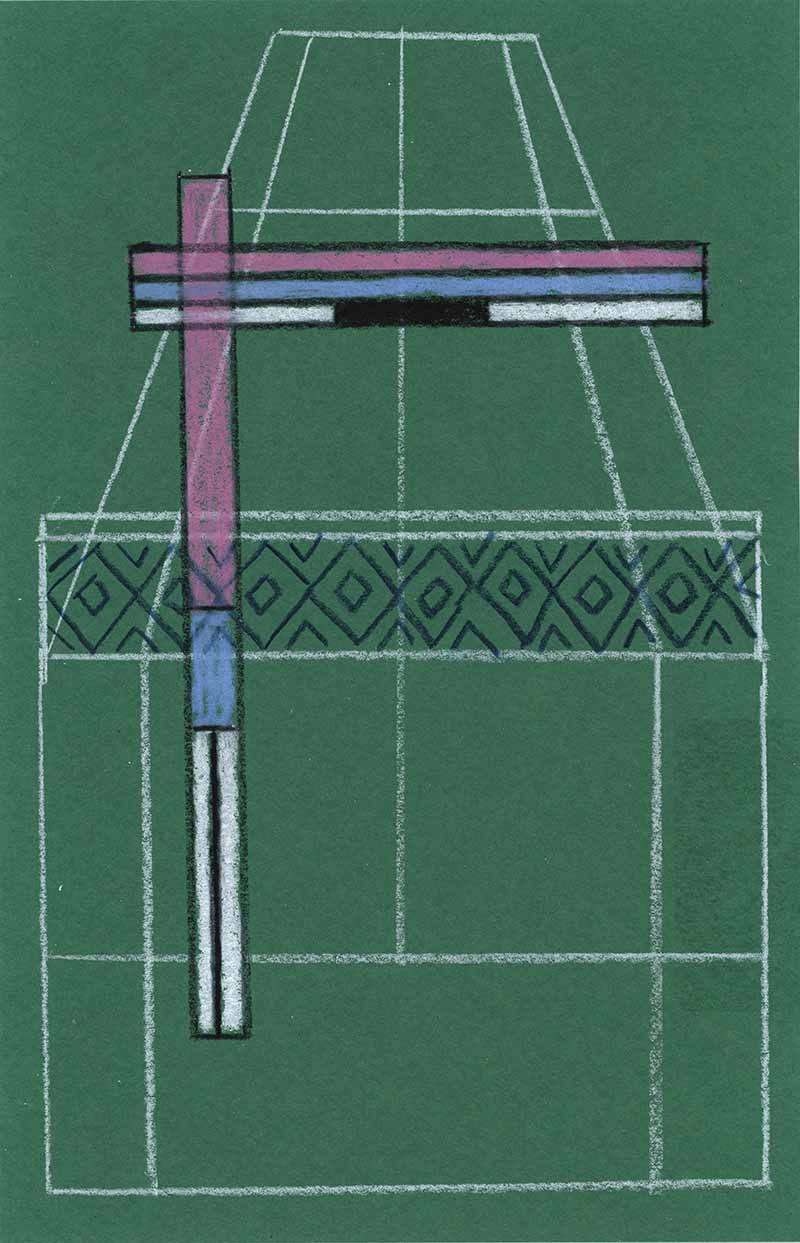
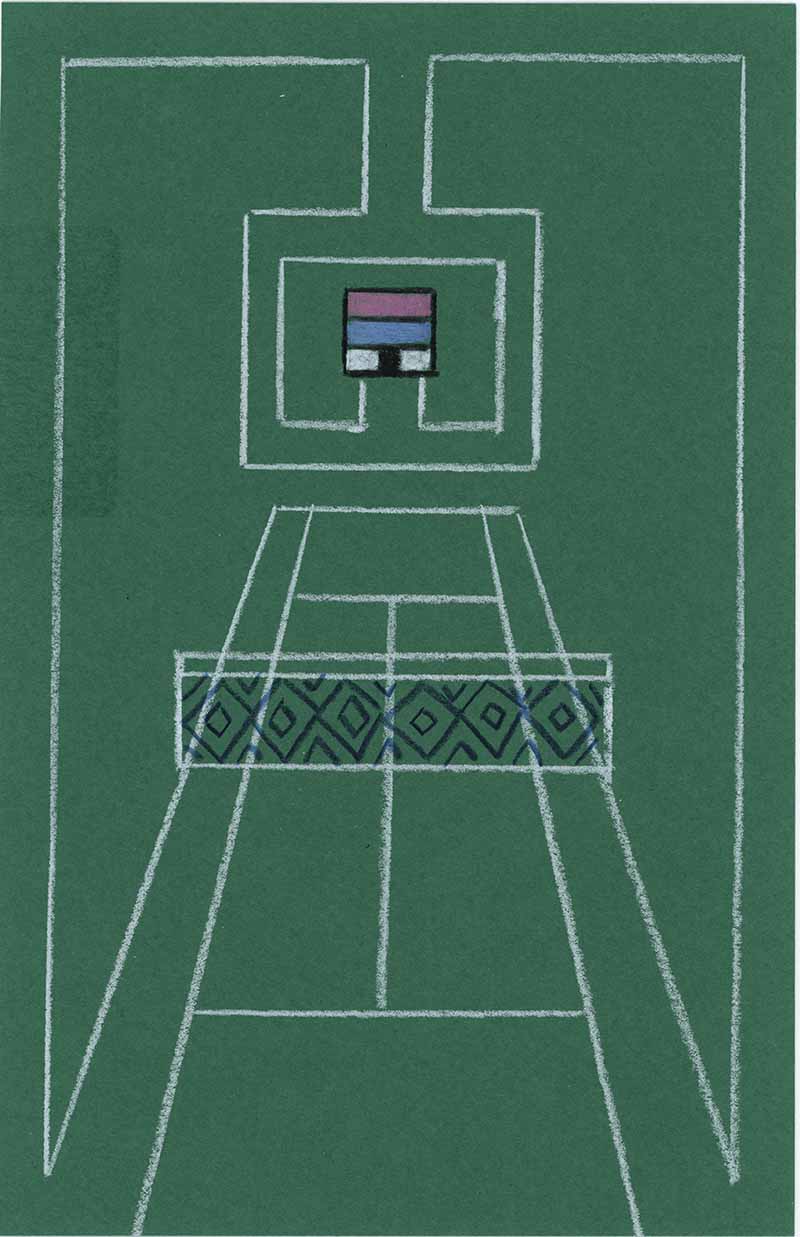
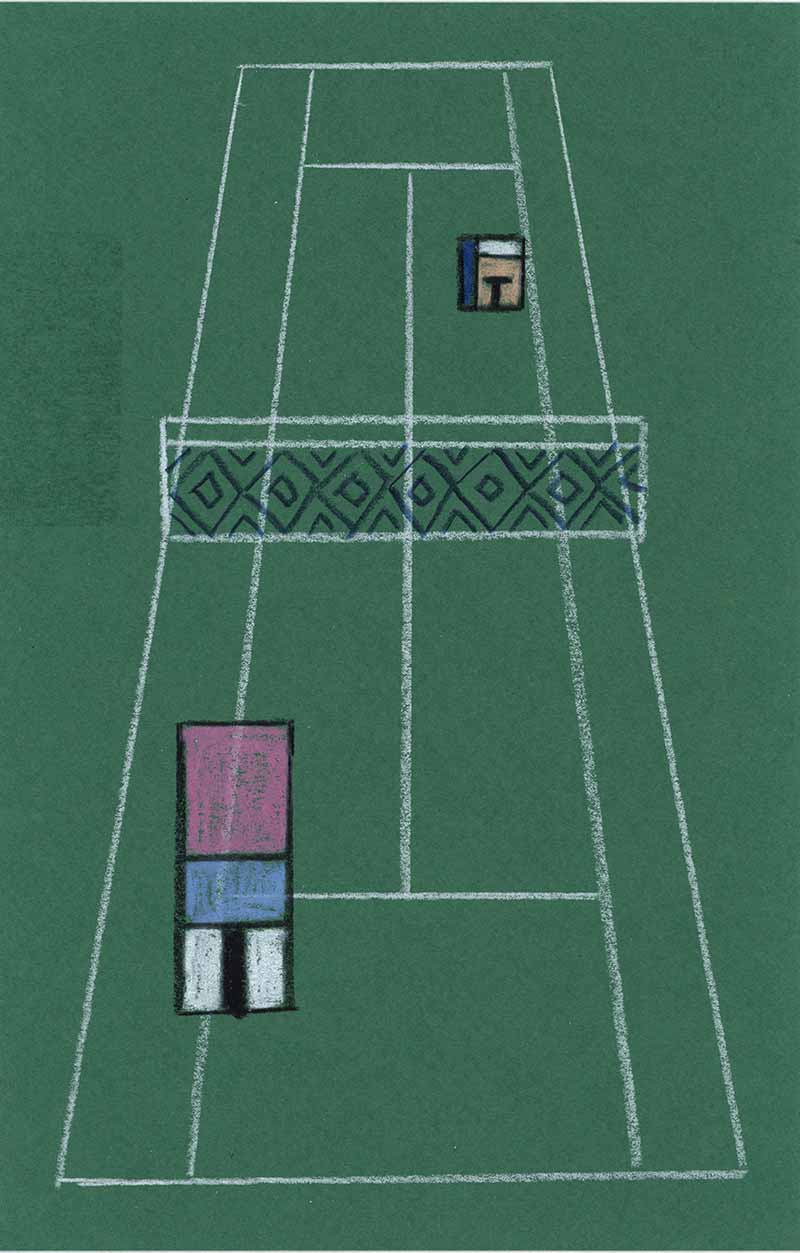
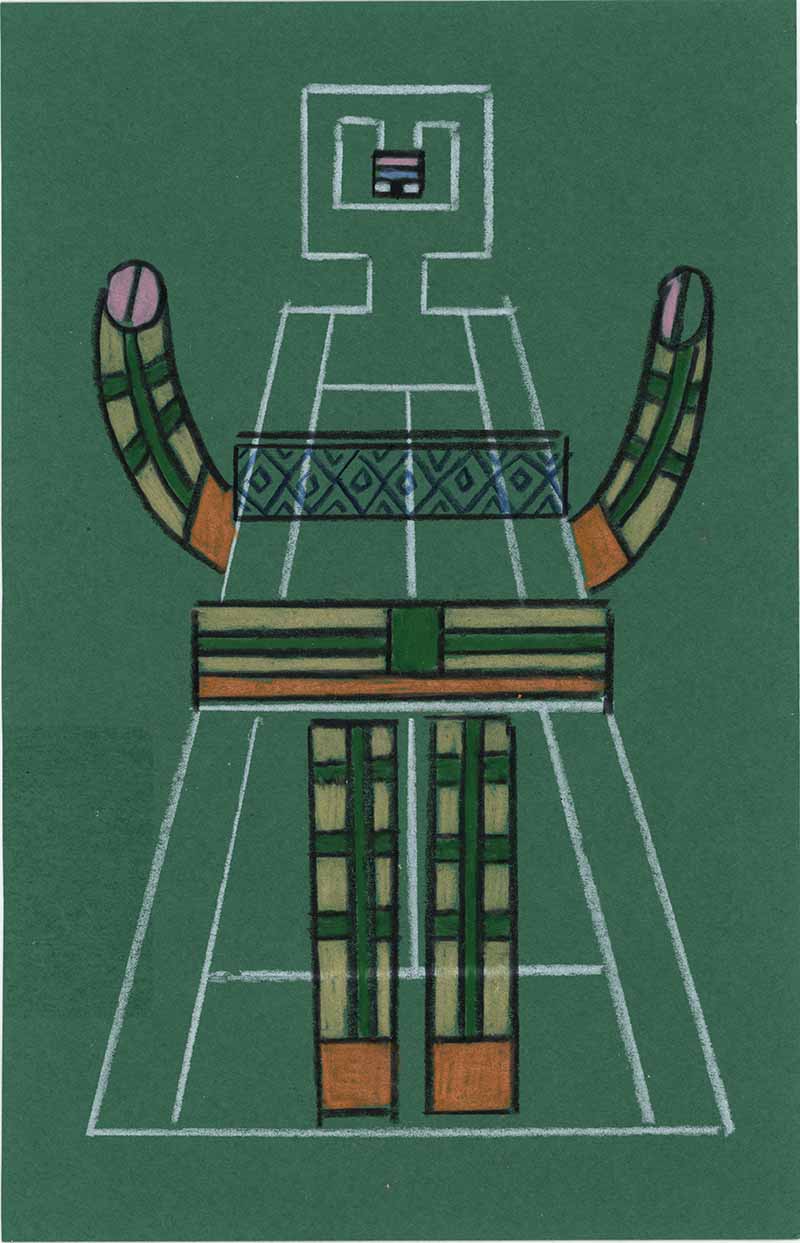
Anti-folk hero Adam Green’s reimagined tennis courts complement an adventurous Q&A with Gabriel Allen, author of Tennis Tensions: Class, Race and Gender in the Evolution of the Sport.
Anti-folk hero Adam Green’s reimagined tennis courts complement an adventurous Q&A with Gabriel Allen, author of Tennis Tensions: Class, Race and Gender in the Evolution of the Sport.
By Patrick J. SauerArtwork by Adam Green Featured in Volume 3 of OPEN Tennis — BUY
In the back-to-back seasons of 1904 and 1905, the violence at the heart of football was so extreme, the future Great American Pastime was on the brink of existence. A whopping 37 prep and college players died of football-related injuries, causing universities like Stanford and Duke to drop their programs. Saving the pigskin found noted gridiron and mustache enthusiast Teddy Roosevelt using his presidential bully pulpit to call for a football safety quorum. The rulebook was never the same. Among the suggestions was the “forward pass,” an alteration so shocking to the game’s brutish nature The New York Times reported that “many predict the ruination of the game through the drastic reformation.”
In October 2024, Evangel Christian Academy quarterback Peyton Houston completed 53 of 68 passes for 817 yards and eight touchdowns…
In a 77–76 overtime loss, sure, but the point is, sports are evolving all the time in ways big and small. A pitch clock was added to baseball three years ago, and the game now moves at a much quicker pace, a universally loved adjustment that didn’t alter the sport one iota. Various basketball entities like the G League and the Canadian Elite League have adopted the “Elam Ending,” which turns off the game clock late in the fourth quarter and teams play to a target score set by adding eight points to the leading squad’s current point total. The Elam doesn’t guarantee a buzzer beater, but it sure beats the excessive clock-stoppage fouling that squeezes the life out of what should be the climactic final moments.
Author and tennis lifer Gabriel Allen wholeheartedly believes it’s high time his beloved sport rids itself of its colonizer roots by ditching the love-deuce-ad scoring system that separates it from every other sport on earth. His advocacy for a “tiebreaker match” is just one of the thought-provoking ideas permeating Tennis Tensions: Class, Race and Gender in the Evolution of the Sport, a book that delivers a blistering overhead smash to any number of conventional wisdoms in its tight 185 pages. Allen is a didact, but never off-putting or smug. At various points, I found myself feverishly nodding along with him that a lot of what we “know” about the history of tennis is wrong, and yes, there is a basic universal unfairness at its core. Other times, I vociferously shook my head in defense of tradition, because honestly, who gives a shit if a casual fan feels the need to post about how they can’t understand 15–30–40? Try harder, dummy.
Tennis Tensions is never dull. And while Allen may be a contrarian, it’s from his head and his heart and not a hot take. He spoke to OPEN Tennis about the sport’s “white tennis unconscious” undergirding, his dad’s bespoke grip, DIY book hustling, and how, fingers crossed, it may be the beginning of the end of tennis as we know it.
How did your life in tennis begin and evolve?
I usually say my tennis background began right around the time I first got consciousness. My dad was huge into the sport, played at the University of Kentucky and coached throughout his life. The story goes I was rallying from the baseline at age 4, but then it was 3…. The legend is growing every year, but it was a big part of my youth. I played juniors, went to the Super Nationals and various other tournaments, but by high school I’d drifted away from the USTA stuff and wasn’t playing as much. I enjoyed playing on the high school team itself, but I was burned out. During my first couple of years in college at Temple, I didn’t play at all.
What got you back into it?
When my dad retired from his professor position, I was no longer going to get free tuition at Temple, so I jumped back across the river for in-state fees. I landed at the College of New Jersey in Trenton and decided to pick up my racquet again. I made the varsity tennis team and have been playing ever since. I graduated with a journalism degree some 10-plus years ago, looked around, and realized it was going to be a lot easier to make a living coaching and teaching tennis than as a writer.
Brilliant decision on your part.
Yeah, it’s really worked out. I teach private lessons year-round, coach boys’ and girls’ tennis at Moorestown High School, and write in my spare time. Strangely enough, I think I’m playing the best tennis of my life, better than my collegiate years. Last summer I had a successful grass-court run in the 35-and-up Nationals at the Philadelphia Cricket Club, and my 73-year-old dad and I won our first gold ball in the senior doubles tourney at Piping Rock out on Long Island.
What kind of game do you play?
Well, I’m 5’6″ and a half on a good day. A big serve is not really my thing. I’m left-handed, so growing up, my game was centered around athleticism to move around the court while playing a typical lefty style. Dad taught me an unusual grip I would call “extreme continental,” which I’ve used more as an adult. As I got older, I needed to put more pressure on opponents beyond just keeping the ball in play. I gravitated to more of a serve-and-volley game.
I ask this out of curiosity, not condescension—why did you go the self-publishing route for Tennis Tensions?
Around a decade ago, I had a couple of pieces in Sports Illustrated about my problems and frustrations with the tennis scoring system, a topic I had first written about in college. In 2017, I had an article in The Washington Post comparing it to the unfair, ridiculous Electoral College. I thought I was done with the topic, but then I read Ball Don’t Lie!: Myth, Genealogy, and Invention in the Cultures of Basketball by Yago Colás, a book about my other favorite sport. It introduced me to the notion of “white basketball unconscious,” the racial blind spots and inequities in how the sport’s origins are presented as opposed to how it actually evolved. The book stirred up a lot of ideas in me about how it applies to tennis. I began researching the sport from its earliest days and found a myriad of topics and issues beyond the archaic scoring system. It took off from there.
I knew I wanted to take my time and not be beholden to a deadline, so I never wrote up a Tennis Tensions book proposal. After five years, when I knew the book was close to being done, I showed it to a literary agent who felt it was more academic than commercial. Well, I’m not in the academic world and didn’t see the book that way. Rather than pitch it to an academic publisher and have them in turn say it was too commercial, I decided to do it myself. The financial setup also made a difference. I get $8.50 per Amazon sale, as opposed to a buck or two from a traditional publisher.
Can you please explain what the “white tennis unconscious” is and how it’s defined the sport for most of its existence?
It’s the privileged upper-class perspective that’s shaped the narrative, rules, and etiquette since lawn tennis was introduced in 1874 by Major Walter Clopton Wingfield. Yes, he invented lawn tennis, but not out of whole cloth. He took bits and pieces of other games that already existed, so the actual lineage of tennis gets lost to time. The origin story becomes one of well-mannered pastoral English aristocracy. It sets the course of the sport being for the country-club set and not for everyone else.
How did the games of badminton and racquets influence tennis, and why were they written out of the story?
Badminton was originally called poona after the city in India, Pune, where it was invented. British soldiers took to the game; there’s evidence they brought it to the U.K. as far back as the 1860s. The poona version of badminton was, and still is, played with a yellow woollen ball–later, hollow rubber balls were introduced for windy conditions–the nets were around five feet high, and players only served once. Originally, lawn tennis had basically the same rules and regulations; the one change in deference was Wingfield allowing for a single bounce. In those days, there was also a game played primarily in prisons and grimy English pubs called racquets. A ball was hit against a wall so there was no net, but it was definitely around long before lawn tennis. Both sports had a simple scoring system, first to 15 points, the same one Wingfield used.
So what changed?
Wingfield, and later even more so Wimbledon, wanted to be associated with what became known as “real” tennis—the indoor version we know as “court” tennis—which gradually lowered the nets, added a second serve, and utilized the scoring system that became the standard. Wingfield wanted lawn tennis to have the real tennis connection to royalty going back to medieval days, but that history is inaccurate. Real tennis started in 12th-century French streets and cloistered monasteries. There had been a time in 16th-century England when it was played by kings and students at Oxford and Cambridge, but by the time Wingfield invented lawn tennis, real tennis wasn’t popular at all. As played, lawn tennis principally evolved from badminton and racquets, but its origin story mythology evolved out of Wingfield not wanting his sport to be linked to an Indian game played by both men and women, or to the rowdy, gambling-heavy lower-class English version. He wanted to be associated with upper-crust British royalty, so at the first Wimbledon Championship, the convoluted scoring of the male-dominated real tennis was adopted.
Here we are, 150 years later, still beholden to an inequitable scoring system, a remnant of classicism, racism, and sexism. It’s the only sport where someone can score more points and win more games than their opponent and still lose. A five-hour match becomes much more a game of chance. The white tennis unconscious prefers aesthetics to arithmetic. Tennis is unique in that it’s uniquely inequitable. Just because both players are playing by the same rules doesn’t make those rules fair.
Setting aside how it started and how it’s going, I still find myself on the side of digging tennis because of its insane scoring. Do you find anything valuable in its singularity as a sport?
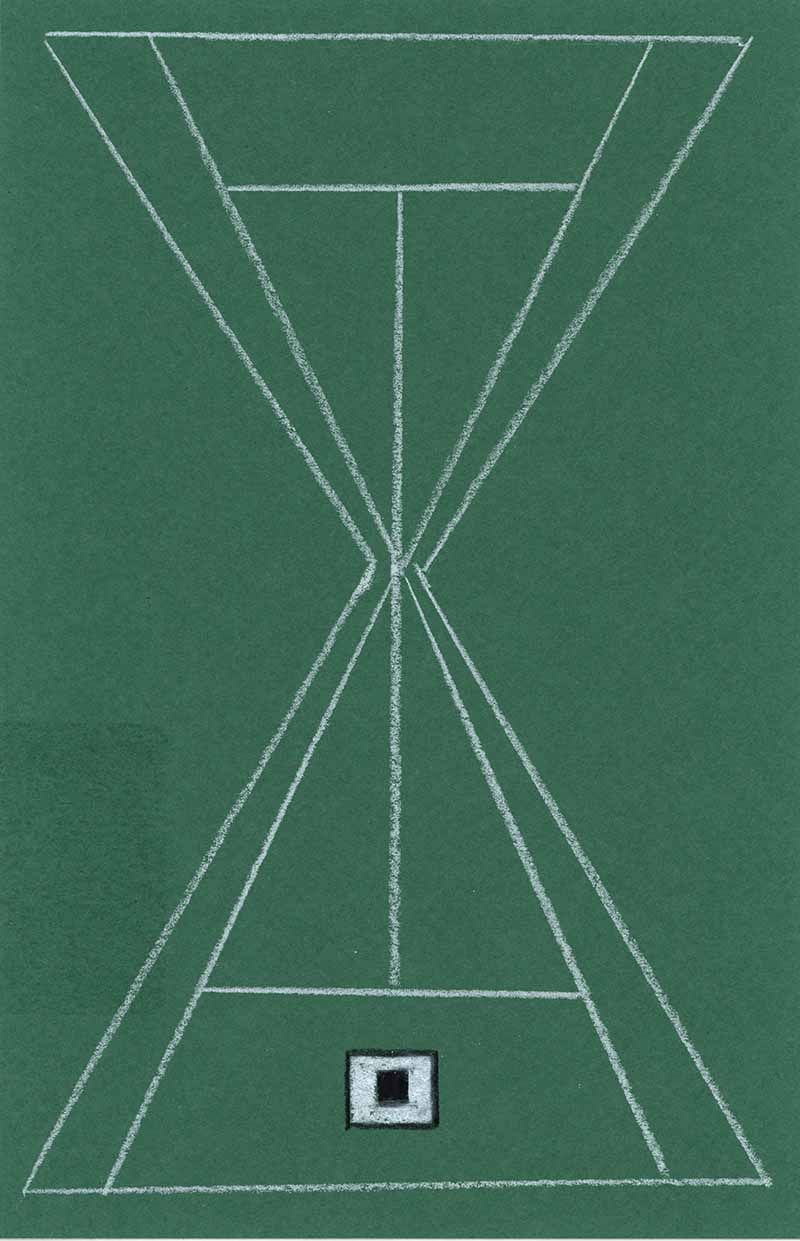
No. I’ve heard all the objections to my argument over the years, and none feel logical to me. Tradition is often mentioned, but Wimbledon didn’t keep Wingfield’s hourglass-shaped court, so the point is already moot. People tell me all the time they couldn’t imagine tennis any other way, but I don’t think anyone has ever tuned in to a match because they love the scoring system. We all watch tennis for the great points, incredible shots, different styles, and amazing matchups. Any notion of a more sophisticated, elevated sport because of the scoring system comes out of the white tennis unconscious. It’s not great.
You have a solution, which is?
I call it a tiebreaker match, the inverse of a match tiebreaker. The competitors play to a certain number of predetermined points—say, 50 for argument’s sake—serving alternates the same as in a tiebreaker. If you and I are playing, you serve first, then I serve two, and then you serve two, etc., until one of us hits 50 and wins. One tweak I would make is changing sides of the net after the first five points, then every 10, not six, so switching is less frequent and not between someone’s service turn. You still have to win by two, of course, so “deuce” in this example would be 48–48.
One intriguing scenario is a tournament where winning point totals rise as the rounds go on, like 40–50–60–80–100 or whatever, which could build a lot of drama…
Think of the spectacle of a major final with both participants entering knowing they have to win 100 points, not three sets. I don’t know exactly what the magic number should be; how many points must a man chase down before we can call it a match? I also think fans watching the US Open at home would love it. Only the biggest of die-hard fans watch a match from start to finish anyway, because you have no idea how long it’ll take. If it’s three hours to 100 points, you can lock in. Nothing would be lost.
And you advocate limiting serves to one, right?
Two serves came out of real tennis. I don’t know why we allow for a mulligan. From a competitive standpoint, players know they have a serve to waste. It allows for a certain degree of conditioned carelessness. People argue that it takes away some degree of strategy, but I don’t see why. It makes decision-making that much more crucial. A big server like Ben Shelton is still going to deploy it as a weapon. Others would be more judicious. Consistency and focus become more important. It would be fascinating to watch big-time players managing how to deliver every serve.
Are you able to enjoy watching tennis?
As long as the TV is on mute. After years of researching the actual history of tennis, I find the same tired commentary about big points and all that every match nauseating. To me, it’s about watching each point as it plays out and ignoring everything else around it. Even if we are ever lucky enough to watch a tiebreaker match, the scoring would still be secondary to the point at hand.
Have you converted anyone to your way of thinking about single serves and a complete overhaul of tennis scoring? Is there a Tennis Tensions movement afoot?
Enough people have been open to the ideas, especially those who have read the book. I don’t force it on anyone, but some of my frequent playing partners will play a one-serve tiebreaker match with me just to see if they like it. I strongly believe the more players who are exposed, the more it will grow. Obviously, at sanctioned tournaments I play by the established rules, but as more reviews of the book come in and more people become aware of it, the next natural step is to stage a full tournament. I’ve been in touch with a couple of people at Forest Hills trying to convince them to be the first tourney venue under a tiebreaker-match scoring system. Not everyone is opposed to change. The new professional Intennse league is experimenting with its rules and regulations, so I just need to find a tournament willing to give it a shot. When I do, you’ll be the first to know.
Your enthusiasm has moved me from dubious to intrigued.
I love tennis. It just needs to be changed from the ground up.
(Ed Note: This article originally appeared in OPEN #3, but a few minor inaccuracies were discovered after publication. This is a corrected version. The author regrets his error.)

PURE, ORIGINAL TENNIS — SIGN UP!
RECOMMENDED
Pete Sampras: Wanna Bet?
GAMBLING
Zac Farro: Life Preserver
CULTURE & ARTS