Alcaraz and Sabalenka Summon the Tornado
Alcaraz and Sabalenka Summon the Tornado
Painful losses at Slams were the catalyst for the US Open champions.
Painful losses at Slams were the catalyst for the US Open champions.
By Carole BouchardSeptember 12, 2025

Aryna Sabalenka and Carlos Alcaraz are going to need bigger trophy cases. // Getty
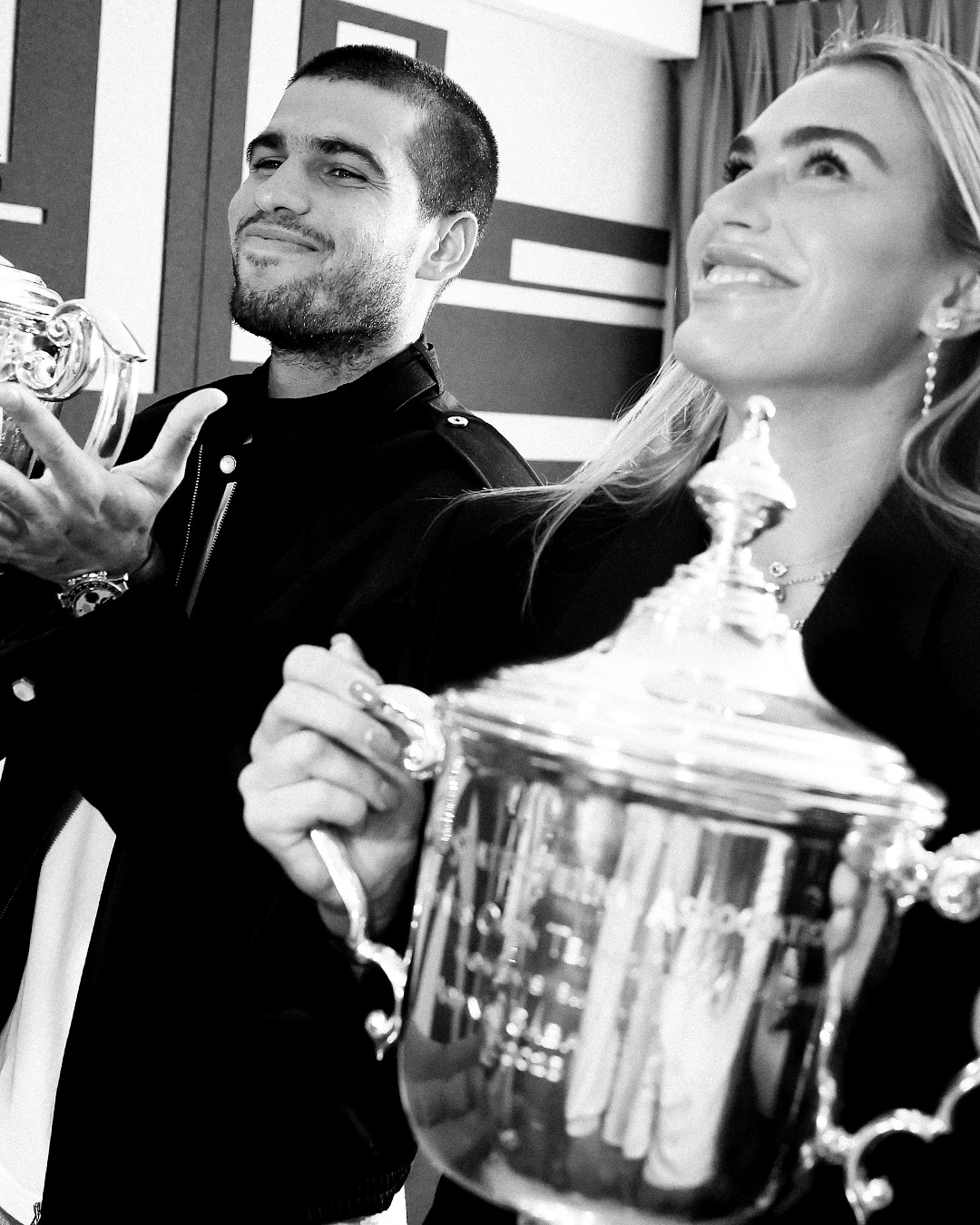
Aryna Sabalenka and Carlos Alcaraz are going to need bigger trophy cases. // Getty
Sometimes the best thing that can happen to a winner is losing. Carlos Alcaraz and Aryna Sabalenka showed us this by clinching titles in New York, having both bounced back from crushing losses at Wimbledon in June (not unlike Jannik Sinner, who prevailed in London after losing an epic five-setter in Paris to Alcaraz, despite three match points in the fourth set). When you’re already the best, you need a much stronger trigger to reach the next stage. And what better motivation than losing in the last stretch of a Grand Slam when your sole tennis ambition is to win them all?
To Sabalenka’s credit, she’s undoubtedly the player who has evolved the most and in the most radical ways to become the champion she is now. She had to control her temper, control her power, clean up her technique (that serve has come so far!), and find a way to bring variety to a game that seemed immune to it. Despite all that progress, she had yet to win a Slam in 2025 and seemed to need a double dose of defeat to get over the last hurdle. The World No.1 didn’t get there after losing to Coco Gauff in a messy Roland-Garros final. No, she needed a loss in the Wimbledon semis to an ascendant Amanda Anisimova for her to buckle down.
Carlos Alcaraz was already in control of most of what he needed, but his problem was Jannik Sinner, who continues to level up. The Spaniard, who won his sixth Grand Slam title in New York and returned to the rankings throne for the first time in two years, was on the verge of losing ground to the Italian, and he knew it. More to the point, his coach, Juan Carlos Ferrero, knew it. The margin on clay was thinner than thin, and the Wimbledon title was gone, but that loss birthed Carlitos Version 2.0 in New York, just as those tough losses triggered Aryna’s change of mindset. No champion can afford to remain in denial or delusion. And so, both asked the mirror on the wall and didn’t like the answer that came back.
Going into Wimbledon this year, Sabalenka said that “it felt like, if I made it to the final, it means that I’m going to win it. And I didn’t expect players to come out there and to fight. I thought that everything was going to go my way easily, which was completely the wrong mindset.” It is extraordinary that Sabalenka, who has gone through heartbreaks in Grand Slams before putting the puzzle together, and who faces an era where Iga Swiatek has been as dominant—if not more—than her, felt she would be an invincible force the moment she set foot in the final of a major.
Champions of that caliber need a healthy dose of confidence and delusion in equal measure, but the key word here is “healthy.” Being denied again at Wimbledon was the perfect shock to the system for Sabalenka. And the US Open ended up being the perfect exorcist for all her ghosts, as she won that fourth Grand Slam title against Anisimova, her SW19 nemesis, by remembering she wasn’t owed a Grand Slam title but had to fight tooth and nail for it.
“I really wanted to give myself another final, to prove to myself that I have learned those tough lessons and that I can do better in the final,” she said ahead of the US Open final. “I have learned the lesson, and I will never behave like that again. I let my emotions take over, and I am not like that anymore. It will never happen again. I have to trust myself and give it my all. At Wimbledon, I doubted myself a lot, and that is the main reason for my unforced errors.” And so at Wimbledon, she finally made that promise to herself that it wouldn’t happen again. And, at least in New York, it didn’t.
Alcaraz, who suffered for five and a half hours in Paris to keep his crown, already knew all of this, of course, when he landed in New York. But what he didn’t know anymore after Wimbledon was how to keep Sinner at bay. And so Ferrero found him the answer: a two-week “let’s take him down” retreat. Here Wimbledon didn’t trigger an overhaul but an epiphany. By starting to plan for Sinner more originally, Ferrero pushed Alcaraz to get back to himself. And so, to return to a genius kind of chaos. All the angles, all the effects, all the variations. Everything everywhere all at once. Summoning a tennis tornado like only he can.
“The consistency of my level during the whole tournament has been really high, which I’m really proud of, because it’s something I’ve been working on. Here I saw that I can play really consistent,” Alcaraz said after the final. Wimbledon had shown him that to stay ahead of Sinner, he had to reach the Italian’s level of steadiness. Now, finding steadiness in that tennis storm he’s been delivering is quite the feat!
Sinner had already used his trigger power from Paris to win Wimbledon, so a newly improved and steady Alcaraz must have come as quite a shock. The challenge now for both winners is to continue to train with a sense of urgency, despite being at the top of the rankings. Now the question is: What’s next? Can they keep their noses out in front of opponents that are just as likely to come back stronger?

PURE, ORIGINAL TENNIS — SIGN UP!
RECOMMENDED
The Long Rally
The Hobby